


Looking to launch your startup in a thriving environment? Cities across the U.S. are stepping up with government-backed programs to help founders succeed. From tax breaks and grants to state-funded incubators and streamlined regulations, these ecosystems provide the tools startups need to grow.
Here’s what you need to know:
- Top Hubs: San Francisco leads in AI and fintech, while Austin, Miami, North Carolina’s Research Triangle, and Denver–Boulder are emerging as key players in tech, biotech, and clean energy.
- Government Support: Cities offer tax credits, grants, and innovation districts to lower costs and provide infrastructure.
- Remote Access: Platforms like BusinessAnywhere let you register and manage a U.S.-based business online, so you can tap into these ecosystems without relocating.
Whether you’re a digital nomad or an international entrepreneur, these ecosystems combine public resources, private investment, and modern tools to support startups in diverse industries.
How Local Governments Support Startup Ecosystems
Across the U.S., local governments are stepping up to support startup ecosystems by providing financial assistance, infrastructure, and simplified regulations. This approach to economic growth focuses on creating environments where entrepreneurs can successfully launch and scale their businesses. From funding initiatives to regulatory reforms, these efforts aim to make starting and running a business more accessible and sustainable.
Here’s a closer look at some of the ways local governments are helping startups thrive.
Tax Incentives and Grants
To ease the financial burden on startups, many state and local governments offer various tax incentives. These include R&D tax credits, payroll tax relief, and property tax abatements – all designed to reduce operating costs. However, these benefits usually come with conditions, such as meeting specific job creation, wage, or capital investment benchmarks. Once startups meet these requirements, they can access benefits like tax credits, refunds, or abatements over several years.
In addition to tax breaks, public funds are often allocated to venture capital programs and innovation grants. For example, Pennsylvania’s Ben Franklin Technology Partners has backed over 2,000 companies, contributing more than $5 billion in economic impact and creating over 32,000 jobs in the Philadelphia area alone. Programs like these provide non-dilutive capital – funding that doesn’t require giving up equity – which helps startups extend their runway and attract private investors.
State-Backed Incubators and Innovation Districts
Many cities are investing in innovation districts – urban hubs that bring together research institutions, startups, and support organizations. These areas encourage collaboration between entrepreneurs, researchers, and companies. Notable examples include North Carolina’s Research Triangle and Boston’s innovation corridor, both of which combine university research with state support to nurture industries like biotech, healthcare IT, and advanced manufacturing.
Governments also fund or partner with incubators and accelerators, offering startups affordable office or lab space, mentorship opportunities, and direct investor connections. These programs bundle critical resources – like workspace, expert guidance, and funding introductions – into a single, accessible package. By integrating these efforts into broader economic strategies, cities aim to create thriving innovation ecosystems.
Streamlined regulations further enhance these initiatives by cutting down on bureaucratic delays, making it easier for startups to focus on growth.
Simplified Regulations and Public Procurement
Streamlining the regulatory process is another way local governments are making life easier for startups. Many states now allow businesses to register remotely, sometimes completing the process in as little as two business days. Additionally, cities often provide one-stop shops to guide entrepreneurs through licensing and regulatory requirements.
Regulatory sandboxes are another game-changer. These controlled environments let startups in sectors like fintech, healthtech, and mobility test their products under relaxed rules while collaborating with regulators. This approach allows startups to validate their ideas in real-world settings while managing risks to consumers and systems.
Governments also act as early customers through innovation challenges and pilot programs. These initiatives give startups the chance to secure paid pilot projects and build valuable case studies, which can open doors to new markets. By positioning themselves as partners, public agencies help startups gain the traction they need to grow.
Top U.S. Startup Ecosystems Backed by Local Governments
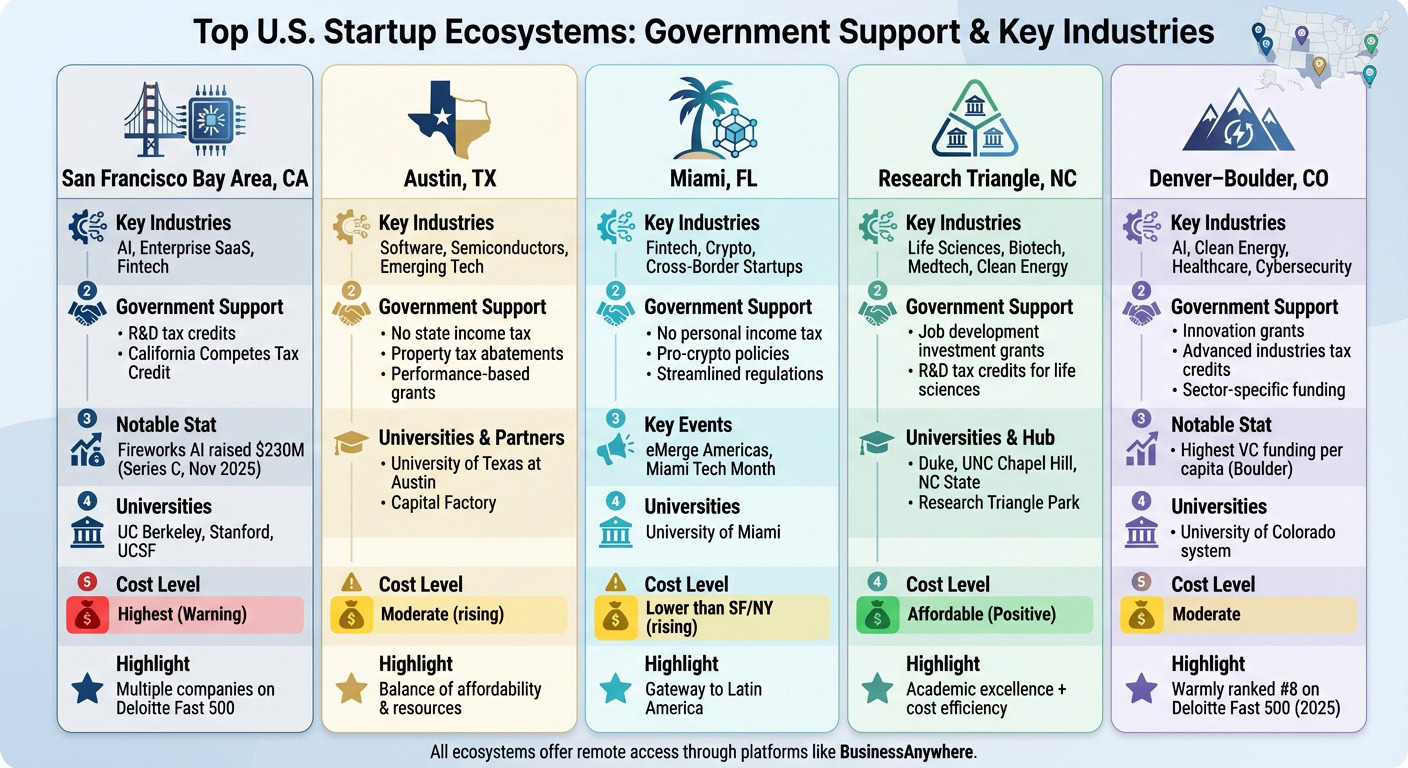
Across the United States, several cities have become thriving hubs for startups, thanks to proactive government initiatives and strategic investments. These regions offer a mix of financial incentives, partnerships with universities, and industry-focused programs, creating fertile ground for startups to grow. From AI and fintech to biotech and clean energy, each area has carved out its niche, offering unique opportunities for entrepreneurs.
Let’s take a closer look at some standout ecosystems where government policies have played a key role in reshaping the startup landscape.
San Francisco Bay Area, California
The Bay Area continues to lead the pack, fueled by its robust venture capital network. A prime example is Fireworks AI, which raised $230 million in its Series C round in November 2025, showcasing the region’s dominance in AI, enterprise SaaS, and fintech. Startups here benefit from California’s R&D tax credits and the California Competes Tax Credit program, which provide financial backing for high-growth companies and technology commercialization. Collaboration with top-tier institutions like UC Berkeley, Stanford, and UCSF ensures a steady pipeline of innovation through research spinouts and lab partnerships.
The region’s dense network of investors creates unparalleled funding opportunities, with multiple Bay Area companies, such as Horizon3.ai and Parafin, ranking high on the 2025 Deloitte Technology Fast 500. However, founders must navigate the highest business costs in the country, including steep rents, salaries, and housing expenses. California’s strict regulatory environment – covering labor, environmental, and data privacy laws – adds another layer of complexity. Despite these hurdles, the combination of talent, capital, and research infrastructure solidifies the Bay Area as a top destination for ambitious startups.
Austin, Texas
Austin has become a magnet for startups, thanks in part to Texas’ lack of state income tax, which lowers financial burdens for both founders and employees. Additional incentives like property tax abatements and performance-based grants tied to job creation further enhance its appeal. The city also partners with the University of Texas at Austin and organizations like Capital Factory, leveraging state and city economic development funds to nurture its startup ecosystem.
Known for its strengths in software, semiconductors, and emerging technologies, Austin has established itself as a leading tech hub. The University of Texas supplies a steady stream of skilled graduates, while state-backed R&D expansions bolster the talent pool and attract investors. Though Austin remains more affordable than San Francisco or New York, rapid growth has driven up housing and office costs in recent years. With its vibrant startup community and cost advantages, Austin is an appealing choice for founders seeking a balance between affordability and access to resources.
Miami, Florida
Miami has risen to prominence as a hub for fintech, crypto, and cross-border startups. Florida’s lack of personal income tax, combined with local and state incentives, creates a business-friendly environment. The city actively markets itself as a tech destination through initiatives like eMerge Americas and Miami Tech Month, with a particular focus on Web3 and blockchain companies.
Miami’s strategic advantage lies in its proximity to Latin American markets, making it a natural choice for founders targeting cross-border opportunities. The city has seen a surge in venture activity in the fintech and crypto sectors, driven by entrepreneurs relocating from higher-cost cities like New York and San Francisco. Pro-crypto policies and streamlined regulations have earned Miami a reputation as a blockchain-friendly city. Partnerships with institutions like the University of Miami further strengthen the talent pipeline. While costs remain lower than in other major tech hubs, the influx of tech workers has led to rising housing and office prices. For startups in fintech or cryptocurrency, Miami offers a compelling mix of resources and market access.
Research Triangle, North Carolina
The Research Triangle – comprising Raleigh, Durham, and Chapel Hill – has become a hotspot for life sciences, biotech, medtech, sustainable energy, and advanced manufacturing. Anchored by Research Triangle Park, this ecosystem benefits from strong state and local government support, including job development investment grants and R&D tax credits tailored for life sciences and clean energy startups.
Top universities like Duke, UNC Chapel Hill, and NC State produce a steady stream of highly skilled graduates in life sciences, engineering, and data science. State-backed research parks and lab facilities attract venture capital and strategic investors to fund deep-tech and biotech startups emerging from these institutions. The region’s affordable cost of living and lower business expenses make it particularly appealing for research-heavy startups needing lab space and infrastructure. For founders in life sciences or sustainable energy, the Research Triangle offers a rare combination of academic excellence, government support, and cost efficiency.
Denver–Boulder, Colorado
Denver–Boulder has built a strong reputation for AI, clean energy, healthcare, and cybersecurity startups. Colorado supports early-stage tech companies with innovation grants, advanced industries tax credits, and sector-specific funding programs. The University of Colorado system and local accelerators work closely with city and state governments to administer these initiatives.
Boulder, in particular, boasts one of the highest levels of venture funding per capita in the U.S., despite its smaller size. The region combines a thriving tech scene with an appealing outdoor lifestyle, attracting startups in software, clean energy, and outdoor industries. University partnerships and state programs help de-risk early-stage innovation, drawing both local and coastal investors. For instance, Warmly’s #8 spot on the Deloitte 2025 Technology Fast 500 highlights the ecosystem’s growing influence.
Denver–Boulder’s costs fall between those of coastal cities and more affordable inland metros. While talent competition and moderate regulatory challenges exist, state innovation policies help offset costs through grants and credits. For early-stage companies, particularly in software or clean tech, Denver–Boulder offers a supportive environment to bridge the gap from concept to market-ready product.
sbb-itb-ba0a4be
How to Access Startup Ecosystems Without Relocating
You don’t need to pack your bags to tap into thriving startup ecosystems. Thanks to modern remote business tools and digital infrastructure, it’s entirely possible to establish a legal presence in any U.S. state while running your business from anywhere in the world. This lets you enjoy the perks of being part of a local ecosystem without the costs and hassle of moving.
The secret lies in creating a legitimate presence in your chosen ecosystem through three essentials: legal business formation, a local address, and staying on top of compliance requirements. Many accelerators and government programs that once demanded in-person participation now offer virtual options like online mentorship, pitch events, and digital networking. Cities like Denver, Raleigh, and San Francisco have also embraced hybrid programs, making it easier for non-resident founders to participate. This remote-friendly shift simplifies the process of starting and maintaining a business.
Remote Business Formation and Compliance
Setting up a U.S.-based company remotely is simpler than you might think. Start by choosing the state and business structure that best suits your needs – most founders opt for an LLC or corporation. From there, pick a business name, file the necessary formation documents with the state’s Secretary of State office, and pay the required fees online. Services like BusinessAnywhere make this process seamless, helping you anchor your startup in states like Texas, California, or Florida – whichever ecosystem aligns best with your goals.
One essential requirement is hiring a registered agent in the state where you register your business. A registered agent handles important legal documents, government notices, and other critical communications on your behalf, ensuring your business stays compliant. For example, BusinessAnywhere includes a free year of registered agent services with your formation package, with renewals costing $147 annually.
Virtual Mailbox Services
A virtual mailbox can give your business a professional street address – no P.O. Boxes here – in your chosen state. These services don’t just provide an address; they also digitize your mail, forward packages worldwide, and let you manage everything from an online dashboard. This setup ensures you have a "local" presence, whether you’re operating from another state or halfway across the globe.
Take, for instance, a founder based in Europe. By using a virtual mailbox, they can receive IRS notices, bank statements, and investor correspondence – all scanned and available to view online within hours. BusinessAnywhere offers virtual mailbox plans starting at $20 per month, with locations in states like Florida, Arizona, New Mexico, and Wyoming. This service is particularly handy for opening U.S. business bank accounts, which often require a domestic address for verification.
Staying Compliant with State and Federal Requirements
Running a business remotely means keeping track of various compliance obligations to avoid fines or losing your good standing. States have different rules – some require annual reports, others biennial filings, and many impose franchise taxes regardless of your revenue. Missing these deadlines can lead to penalties or even administrative dissolution.
On top of state requirements, federal regulations now mandate Beneficial Ownership Information Reports (BOIR) for most LLCs and corporations. Platforms like BusinessAnywhere simplify compliance by consolidating everything into one dashboard. They handle tasks like tracking filing deadlines, submitting annual reports, and managing BOIR filings for $37 each. Other services include EIN applications ($97), S-Corp tax elections ($97), and registered agent renewals, making it easy to stay compliant while you focus on growing your business.
Conclusion
Government-supported startup ecosystems have become a driving force for innovation, job creation, and sustained economic growth in the United States. Cities like the San Francisco Bay Area, Austin, Miami, the Research Triangle, and Denver–Boulder demonstrate how a mix of tax incentives, grants, innovation districts, and university partnerships can bring together talent and capital. These elements create fertile ground for startups to thrive. By blending public resources with private investments, these ecosystems help reduce the risks and costs of building and scaling businesses, giving founders a competitive edge on both national and global stages.
This collaboration between public and private sectors doesn’t just boost local economies – it also empowers remote entrepreneurs. Thanks to modern infrastructure, founders can now access these ecosystems without relocating. Tools like remote business formation, virtual mailbox services, and centralized compliance platforms make it possible to establish a legal presence in any U.S. state. This allows startups to tap into the resources, credibility, and funding opportunities of top-tier ecosystems without the need for a physical move. Platforms such as BusinessAnywhere simplify this process by offering services like U.S. business registration, registered agent support, virtual mailboxes with unlimited mail handling, EIN and ITIN applications, S-Corp tax filings, and compliance tracking – all in one place. Whether you’re a digital nomad, part of a remote team, or an international founder, you can stay compliant and take full advantage of ecosystem programs entirely online.
Ready to make your move? Choose the ecosystem that aligns with your industry and goals, and set up your U.S. entity and virtual presence through BusinessAnywhere. With straightforward pricing, round-the-clock access, and expert guidance, you can start connecting with investors, applying for programs, and growing your business – all while enjoying the flexibility to work from anywhere in the world.
FAQs
What advantages do government-supported startup ecosystems offer?
Starting a business within a government-supported ecosystem can open doors to a host of practical benefits. These ecosystems often provide startups with access to tailored resources, funding opportunities, and infrastructure aimed at fostering growth. They also simplify regulatory hurdles, making it easier for entrepreneurs to handle legal and compliance matters.
Beyond these logistical perks, such environments offer mentorship programs, networking events, and a boost in credibility. Together, these elements create a supportive framework that helps entrepreneurs innovate and grow, increasing their chances of standing out in competitive markets.
How can I engage with U.S. startup ecosystems without moving there?
You can tap into U.S. startup ecosystems without ever leaving your home by using online tools designed to make remote business management a breeze. Platforms such as BusinessAnywhere let you handle everything from registering a U.S. business to setting up a virtual mailbox and utilizing registered agent services, all through a digital interface.
These solutions help you stay on top of compliance, manage critical mail, and keep your business running smoothly – no relocation required. It’s a great way to enjoy the perks of being part of a dynamic U.S. startup ecosystem while working from wherever suits you best.
What kinds of support do local governments offer to startups in these ecosystems?
Local governments play a key role in supporting startups within their ecosystems, aiming to drive growth and new ideas. They offer financial perks such as grants and tax reductions, alongside mentorship programs that connect entrepreneurs with experienced advisors. Additionally, they provide access to funding channels to help businesses secure the capital they need.
To make things smoother, many also offer regulatory assistance, guiding startups through compliance processes and reducing potential hurdles. These efforts work together to create an environment where entrepreneurs can confidently launch and grow their ventures.