


Managing real estate across multiple states can be complex, but using a Wyoming LLC as a holding company simplifies the process. Here’s how it works:
- Wyoming LLC as Parent: A single Wyoming LLC acts as the parent company, owning subsidiary LLCs in each state where properties are located. This structure separates liabilities by property.
- Asset Protection: Wyoming provides strong legal protections, including charging order protection, which limits creditors’ access to LLC assets.
- Privacy: Wyoming laws keep member and manager names off public records, offering anonymity.
- Tax Advantages: No corporate or personal income tax in Wyoming means more retained income. Subsidiary LLCs handle state-specific taxes.
- Low Costs: Wyoming has low formation ($100) and annual fees ($60), much cheaper than states like California ($800 annual tax).
This structure shields assets, reduces risks, and simplifies management. Subsidiary LLCs handle property-specific operations, while the parent LLC remains passive, ensuring compliance across states. Tools like BusinessAnywhere can streamline setup and ongoing compliance.
Why Choose Wyoming for Your Holding Company LLC
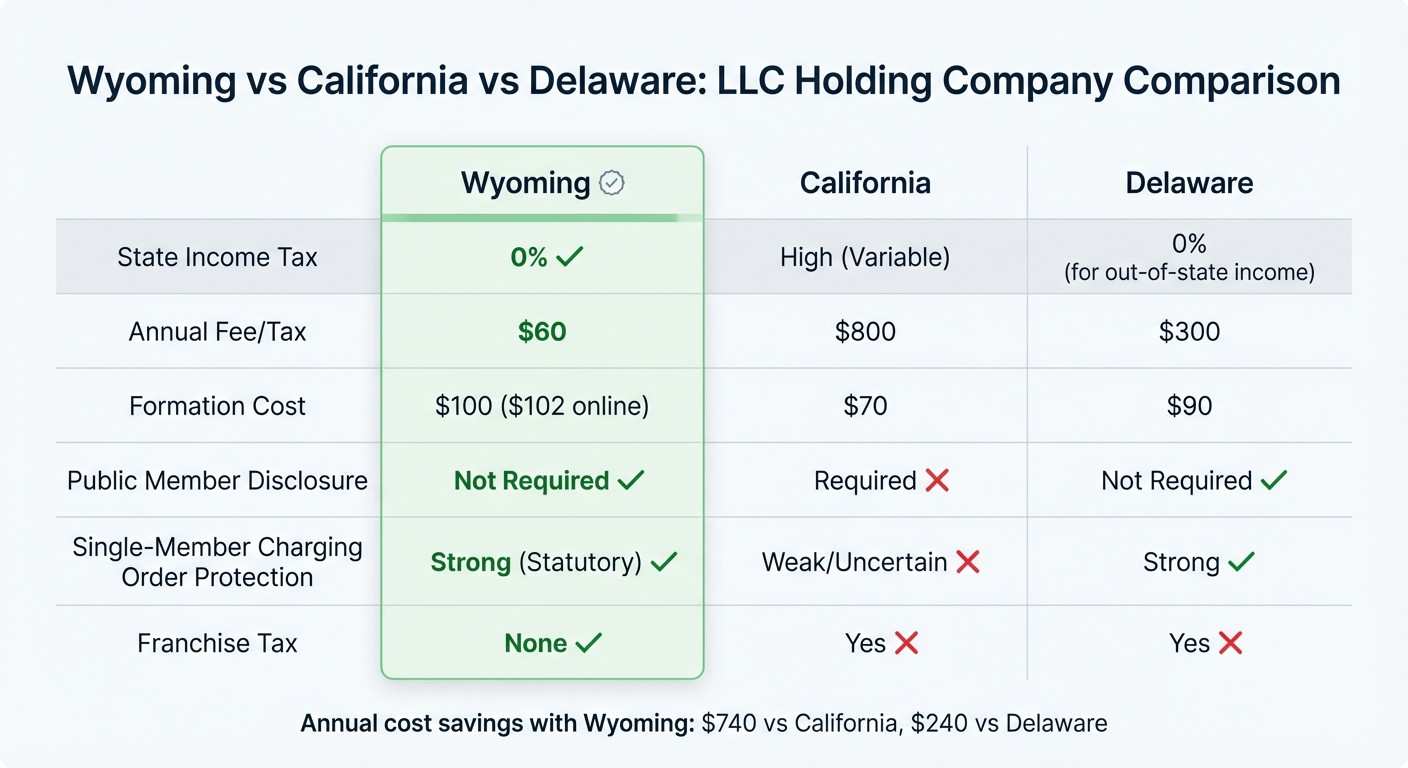
Wyoming offers three standout benefits for holding company LLCs: strong asset protection, no state income tax, and low fees. These advantages not only reduce legal risks but also help cut costs, especially when managing properties across multiple states. Here’s a closer look at why Wyoming is an appealing choice for your property management strategy.
Asset Protection and Privacy Features
Wyoming’s laws provide a robust layer of asset protection, particularly through its charging order protection. This ensures creditors can only claim distributions, even for single-member LLCs – a critical feature since many states limit this protection to multi-member LLCs.
Privacy is another key advantage. In Wyoming, only the registered agent and organizer are listed in public filings. Member and manager names remain confidential, as do operating agreements, which are not filed with the state. This level of privacy can deter frivolous lawsuits by making it harder for potential litigants to access ownership details.
No State Income Tax
Wyoming imposes no corporate income tax, franchise tax, or personal income tax. This means rental income flowing through your holding company won’t face state taxation. Compare this to states like California, where businesses must pay an $800 annual franchise tax, and the savings quickly add up. Additionally, if your Wyoming LLC owns 80% or more of a subsidiary’s voting stock, dividends from that subsidiary are also exempt from state taxes.
Low Fees and Simple Compliance
Forming and maintaining an LLC in Wyoming is straightforward and cost-effective. The state charges just $100 to form an LLC ($102 if filed online) and $60 annually for the required report. In contrast, Delaware charges $300 annually, and California requires an $800 minimum annual tax, regardless of profitability. Wyoming also keeps compliance simple – there’s no need for annual shareholder meetings, minimum capital reserves, or a general business license for holding companies. This makes administrative tasks manageable and costs predictable.
| Feature | Wyoming | California | Delaware |
|---|---|---|---|
| State Income Tax | 0% | High (Variable) | 0% (for out-of-state income) |
| Annual Fee/Tax | $60 | $800 | $300 |
| Public Member Disclosure | Not required | Required | Not required |
| Single-Member Charging Order Protection | Strong (Statutory) | Weak/Uncertain | Strong |
| Franchise Tax | None | Yes | Yes |
How the Wyoming Holding Company Structure Works
The Wyoming holding company structure operates using a parent-subsidiary LLC model to manage properties across different states. Here’s how it works: your Wyoming LLC acts as the parent company, owning 100% of the subsidiary LLCs that you set up in each state where you own property. For instance, if you have properties in Montana, Colorado, and Texas, you’d create one Wyoming parent LLC and separate subsidiary LLCs for each state.
The Parent-Subsidiary LLC Model
The parent company’s sole purpose is to own the subsidiary LLCs, keeping it separate from day-to-day operations. Each subsidiary LLC, in turn, owns a single property and handles the operational tasks like rent collection and property maintenance. This setup provides a "double corporate veil", offering an extra layer of protection. It also simplifies estate planning since you only need to manage your interest in the Wyoming parent LLC, instead of juggling multiple property deeds.
"The parent company only owns other companies. It does not engage in operations or other risky activities. The children companies own a single piece of real estate. This separates your business assets from each other, and your personal assets from business risks." – Andrew Pierce, Founder, Wyoming LLC Attorney
To make the process smoother, it’s recommended to form the Wyoming parent LLC first, followed by the subsidiary LLCs. This order simplifies obtaining EINs for the subsidiaries and ensures they are documented as wholly owned by the parent from the start. Structuring the subsidiaries as manager-managed LLCs, with you acting as the manager, keeps the parent company’s role passive and reduces the risk of it being classified as "doing business" in other states.
This model not only makes management easier but also strengthens asset protection, as explained below.
Separating Liability by Property
By holding each property in its own subsidiary LLC, you create a barrier that keeps liabilities confined to individual assets. For example, if a lawsuit is filed against a property in Florida, it won’t affect your assets held in LLCs for properties in other states. This structure is popular among professional real estate investors – more than 80% of those with 10 or more properties use a similar multi-entity setup.
This separation also aligns with lender requirements. Many DSCR (Debt Service Coverage Ratio) lenders insist that each financed property is held within its own borrowing entity. Keeping separate bank accounts for each subsidiary LLC helps maintain the corporate veil and ensures liabilities don’t spill over into other entities.
Centralized Management and Compliance
In addition to liability protection, the Wyoming holding company structure simplifies management. Even if you own multiple LLCs, you can oversee everything through the Wyoming parent company. Tax reporting is consolidated at the parent level, making compliance easier. Wyoming’s business-friendly regulations, which avoid complicated annual meetings and excessive reporting, further reduce administrative burdens.
Property titles list the subsidiary LLCs as the owners, while the Wyoming parent company remains behind the scenes. This arrangement keeps your name out of public property databases in states like Florida or California, offering a layer of privacy. This is especially appealing for small real estate businesses, over 73% of which operate as pass-through entities.
How to Set Up a Wyoming Holding Company LLC
Creating a Wyoming holding company involves a series of steps designed to simplify management and protect your assets. The process begins with establishing your Wyoming parent LLC and then creating subsidiary LLCs in the states where you own property. Here’s a straightforward guide to help you get started.
Form Your Wyoming LLC
Start by choosing a unique name for your LLC that includes "LLC" and isn’t already registered in Wyoming. Then, appoint a Wyoming-based registered agent to handle all legal documents on behalf of your company. Next, file your Articles of Organization with the Wyoming Secretary of State. If you file by mail, the fee is $100, while online submissions cost $102.
Once your LLC is officially formed, apply for an Employer Identification Number (EIN) through the IRS. This step is crucial for opening business bank accounts and managing tax obligations, even if you’re the sole member of the LLC. Additionally, draft an operating agreement for your holding company. While Wyoming doesn’t require you to file this document, having one is beneficial. It outlines ownership percentages, management roles, and the relationship between the parent LLC and its future subsidiaries. Experts often recommend a member-managed vs. manager-managed structure for holding companies, where you, as the individual manager, ensure the parent LLC remains passive.
Keep in mind that Wyoming requires an annual report fee of $60, which is due each year starting on the first day of your formation anniversary month. Once your Wyoming parent LLC is set up, you can move on to forming subsidiary LLCs in the states where you own property.
Create Subsidiary LLCs in Each Property State
With your Wyoming holding company in place, the next step is to establish separate LLCs in each state where you own property. When filing the formation documents for these subsidiaries, list your Wyoming LLC as the sole member. This ensures the ownership chain is clearly documented from the start. Each subsidiary will also need its own EIN. If the sole member is an entity rather than an individual, you may need to manually file the EIN application.
As Jason Watson, CPA and Senior Partner at WCG CPAs & Advisors, explains:
"This helps preserve that the Wyoming LLC is simply a holding company and is not considered doing business in Montana, Colorado and Texas. In other words, you, the human, are directing each child LLC."
Once the subsidiaries are formed, transfer the property titles from your name to the relevant subsidiary LLC using a deed. This step is essential for isolating liabilities associated with each property. Don’t forget to open a separate bank account for each subsidiary to avoid commingling funds, which is critical for maintaining the corporate veil.
Use BusinessAnywhere for Setup and Compliance

BusinessAnywhere offers tools to simplify the formation and compliance process. Their platform provides $0 LLC formation services (you only pay the state fees) and includes a free first year of registered agent service, making it a practical option for setting up multiple entities.
Through BusinessAnywhere’s centralized dashboard, you can manage compliance for all your entities in one place. This feature allows you to file for EINs, handle annual reports, and receive compliance alerts to avoid missing important deadlines. After the first year, registered agent services are available for $147 annually per entity. Additionally, BusinessAnywhere offers Beneficial Ownership Information Report (BOIR) filing for $37 per entity, ensuring you stay compliant with FinCEN regulations.
By using a single platform to handle formation, compliance, and reporting tasks, you can avoid the hassle of coordinating with multiple service providers and keep your operations running smoothly.
For more information, check out BusinessAnywhere’s LLC formation page.
sbb-itb-ba0a4be
Tax and Compliance Requirements for Multi-State Properties
Wyoming LLC Tax Benefits
Wyoming’s tax-friendly environment makes it an appealing choice for setting up a holding company. The state imposes no corporate, personal, or franchise taxes at the state level. This means any rental income or capital gains funneled into your Wyoming holding company won’t face state taxation in Wyoming.
Wyoming LLCs are structured as pass-through entities, which means profits and losses bypass corporate taxation and flow directly to your federal tax return. This setup is particularly advantageous, as 73% of small real estate businesses in the U.S. use pass-through structures like LLCs, partnerships, or S-corporations.
Another benefit is the flexibility in how the IRS can treat your Wyoming LLC for tax purposes. You can choose to have it taxed as a disregarded entity, partnership, C-corporation, or S-corporation. For those actively flipping properties rather than just holding rentals, electing S-corp status can help minimize self-employment taxes. Additionally, Wyoming exempts taxes on intangible assets such as stocks, bonds, and intellectual property owned by your holding company.
Keep in mind, though, that you’ll still need to file federal tax returns and obtain an EIN from the IRS for your holding company. Next, let’s look at how state-specific laws impact tax and reporting obligations for individual property LLCs.
State-Level Taxes and Reporting
While Wyoming offers notable tax advantages for your holding company, the story changes at the state level for your subsidiary LLCs. Each state has its own tax and filing requirements, and it’s crucial to understand these obligations.
- Property Taxes: These are non-negotiable and must be paid in the state where the property is located. Rates vary widely depending on the state.
- State Income Taxes: If your subsidiary LLCs earn rental income, you’ll need to file state income tax returns in states that have income taxes. Even though Wyoming doesn’t tax your holding company, income from properties in other states is subject to those states’ income tax laws through apportionment.
- Annual Reports and Fees: Each subsidiary LLC must file annual reports and pay state-specific fees to maintain good standing.
- Foreign LLC Registration: If your Wyoming holding company directly owns real estate in another state, you’ll need to register each subsidiary as a foreign LLC in the state where the property is located. This comes with additional filing fees and compliance requirements.
Maintaining Compliance Across States
Staying compliant across multiple states can be challenging, as each subsidiary has its own deadlines for tax filings, annual reports, and regulatory updates. Missing these deadlines could lead to penalties, loss of good standing, or even the administrative dissolution of your LLC.
All LLCs must also comply with federal Beneficial Ownership Information Reporting (BOIR) requirements through FinCEN. To simplify compliance, tools like BusinessAnywhere offer centralized dashboards that automate reminders for annual reports and tax filings. They also provide BOIR filing services for $37 per entity and registered agent services for $147 annually per entity.
If you decide to elect S-corp status for your holding company, BusinessAnywhere can file IRS Form 2553 on your behalf for $97. This election can lead to significant tax savings if your business involves active property operations instead of passive rental income. The platform also supports ongoing needs like state-level filings and annual reports.
Lastly, to protect your liability shield, it’s essential to maintain separate bank accounts for each subsidiary LLC. Commingling funds can jeopardize the corporate veil, exposing you to personal liability. Additionally, keep an eye on economic nexus thresholds, which typically range from $100,000 to $500,000, to ensure compliance with state tax laws.
Conclusion
Setting up a Wyoming LLC as a holding company for multi-state property ownership is a smart approach that blends strong asset protection, no state income tax, and privacy benefits. This structure not only safeguards your portfolio but also lowers costs significantly – just $60 annually compared to California’s $800 franchise tax.
The parent-subsidiary setup is particularly effective. It isolates liability for each property, ensuring that if one rental faces legal issues, your other assets and the holding company remain untouched. Beyond protection, this structure simplifies management. Wyoming’s business-friendly policies eliminate the need for annual meetings or excessive record-keeping. Plus, consolidated tax filings and anonymity provisions keep your personal information off public records.
For investors looking to expand, this model offers flexibility. Adding new properties is as simple as creating additional subsidiary LLCs, avoiding the hassle of overhauling your entire setup. With tools like BusinessAnywhere, managing compliance becomes even easier. Their centralized dashboard, automated filing reminders, BOIR filing for $37 per entity, and registered agent services at $147 annually per entity make staying organized straightforward.
FAQs
What are the advantages of setting up a Wyoming LLC as a holding company for multi-state property ownership?
A Wyoming LLC comes with several advantages, making it an excellent choice for a holding company. One of its standout features is strong asset protection, which keeps personal assets separate from liabilities tied to the businesses or properties it owns. Wyoming also has strict privacy laws, meaning member and manager names don’t need to appear in public filings – offering owners a high level of anonymity. On top of that, Wyoming stands out for its tax benefits, as it imposes no state income tax, franchise tax, or gross receipts tax, making it a very tax-friendly option.
But the benefits don’t stop there. A Wyoming LLC is particularly useful for managing multi-state property ownership. By consolidating property titles, financing, and management under a single entity, it reduces administrative headaches and simplifies bookkeeping. The state’s flexible LLC structure allows owners to tailor governance and easily scale operations as their portfolios expand. Plus, setting up a Wyoming LLC is quick, affordable, and involves minimal annual reporting, making it a practical and efficient choice for investors.
How does a Wyoming holding company with subsidiary LLCs work for managing properties across multiple states?
A Wyoming holding company structure involves setting up a parent LLC in Wyoming, which then owns subsidiary LLCs in the states where your properties are located. The parent LLC handles overall management, while each subsidiary LLC is responsible for holding the title to an individual property. This arrangement helps protect your assets by keeping liabilities isolated – problems with one property won’t spill over to others or jeopardize your personal assets.
The Wyoming parent LLC can manage operations like overseeing leases and collecting income from the subsidiary LLCs. Once property-level expenses are covered, profits can move up to the parent LLC. These funds can then be used for reinvestment, paying off debts, or distributing earnings to members. Since LLCs are pass-through entities, taxes are straightforward – you can consolidate income and losses from all properties into a single tax filing while still ensuring liability protection for each property.
What are the tax considerations when using a Wyoming LLC to own properties in multiple states?
Using a Wyoming LLC to hold properties across multiple states can offer perks like privacy and asset protection, but it’s important to understand the tax rules tied to where the properties are located. Wyoming itself doesn’t impose a state income tax, but the LLC will need to follow the tax regulations in each state where it owns property. This usually means registering the Wyoming LLC as a foreign LLC in those states and paying any required income or franchise taxes on the income generated there.
For a single-member LLC, the owner typically reports rental income on their personal federal tax return and files separate state tax returns for each state where the LLC owns property. For multi-member LLCs, which are treated as partnerships, the LLC must file a federal Form 1065 and issue Schedule K-1s to its members. Each member is then responsible for filing state tax returns to report their share of the income.
Beyond income taxes, there are other costs to consider, such as property taxes, state filing fees, and possibly sales or use taxes. Since tax laws can vary significantly from state to state, working with a tax professional is key to staying compliant, avoiding surprises, and making the most of the benefits a Wyoming LLC can offer.