

Short answer: An anonymous LLC keeps a real estate investor’s name off public property and business records. The LLC owns the property, and the state filing shows the registered agent, not the members. Wyoming, New Mexico, Delaware and Missouri allow anonymous LLCs. Investors in other states hold each property in a home-state LLC owned by an anonymous Wyoming or New Mexico holding LLC. If you are still deciding how to hold property, compare an LLC vs sole proprietorship for real estate investors.
Key Benefits of Anonymous LLCs:
- Privacy: Keeps your name off public property records.
- Asset Protection: Limits exposure to lawsuits and creditors.
- Cost Efficiency: States like New Mexico offer low fees and no annual reporting.
Top States for Anonymous LLCs:
- Wyoming: Strong asset protection, $100–$102 filing fee, $60 annual fee.
- Delaware: Ideal for complex portfolios, $110 filing fee, $400 annual franchise tax.
- Nevada: High asset protection but not anonymous, since its annual list names managers publicly. $425 initial cost, $350 annual fee.
- New Mexico: Maximum privacy, $50 filing fee, no annual fees.
Steps to Form an Anonymous LLC:
- Choose a privacy-focused state.
- Hire a professional registered agent.
- File Articles of Organization without disclosing member names.
- Obtain an EIN for banking and tax purposes.
- Transfer property deeds to the LLC for anonymity.
By combining strategies like using land trusts, nominee managers, or multiple LLCs, you can further enhance privacy and safeguard your real estate investments.
Why Real Estate Investors Need Privacy Protection
When you invest in real estate, your name, address, and property details often end up in public records. This kind of exposure can lead to serious risks. With around 40 million lawsuits filed in the U.S. each year, investors with visible portfolios often become easy targets.
One of the biggest dangers is what attorney Clint Coons describes as becoming a "walking bullseye" for lawsuits. If tenants, contractors, or even professional plaintiffs can look up your name and see that you own multiple properties, they might assume you have deep pockets worth pursuing. As Coons explains:
"When people see your name tied to multiple rental properties, you’re like a walking bullseye for lawsuits".
Even if a lawsuit is baseless, defending yourself can be incredibly costly. Public records don’t just increase your legal risks – they also jeopardize your financial security.
But lawsuits aren’t the only concern. Public records can also make you vulnerable to identity theft, a problem that affects about one-third of Americans at some point. Wealthy individuals, in particular, are prime targets because their accounts and investments offer bigger payoffs for thieves. When property records reveal your address or signal wealth, it’s like handing identity thieves a roadmap. Using an anonymous LLC can shield your personal information, keeping it out of reach.
There’s also the nuisance factor. Once your information is public, expect an avalanche of junk mail, spam calls, and scam offers. For those running home-based businesses, this exposure can even lead to uninvited visitors or disruptions. Public figures face even greater risks, like stalking or personal harassment.
Lastly, public ownership records can weaken your negotiating position. If sellers know you’re a wealthy investor with multiple properties, they might hike up their asking prices. By using an anonymous LLC, you can keep your identity – and the size of your portfolio – hidden, leveling the playing field during negotiations.
These risks highlight why protecting your privacy through an anonymous LLC is essential for safeguarding your real estate investments.
Top States for Anonymous LLC Formation
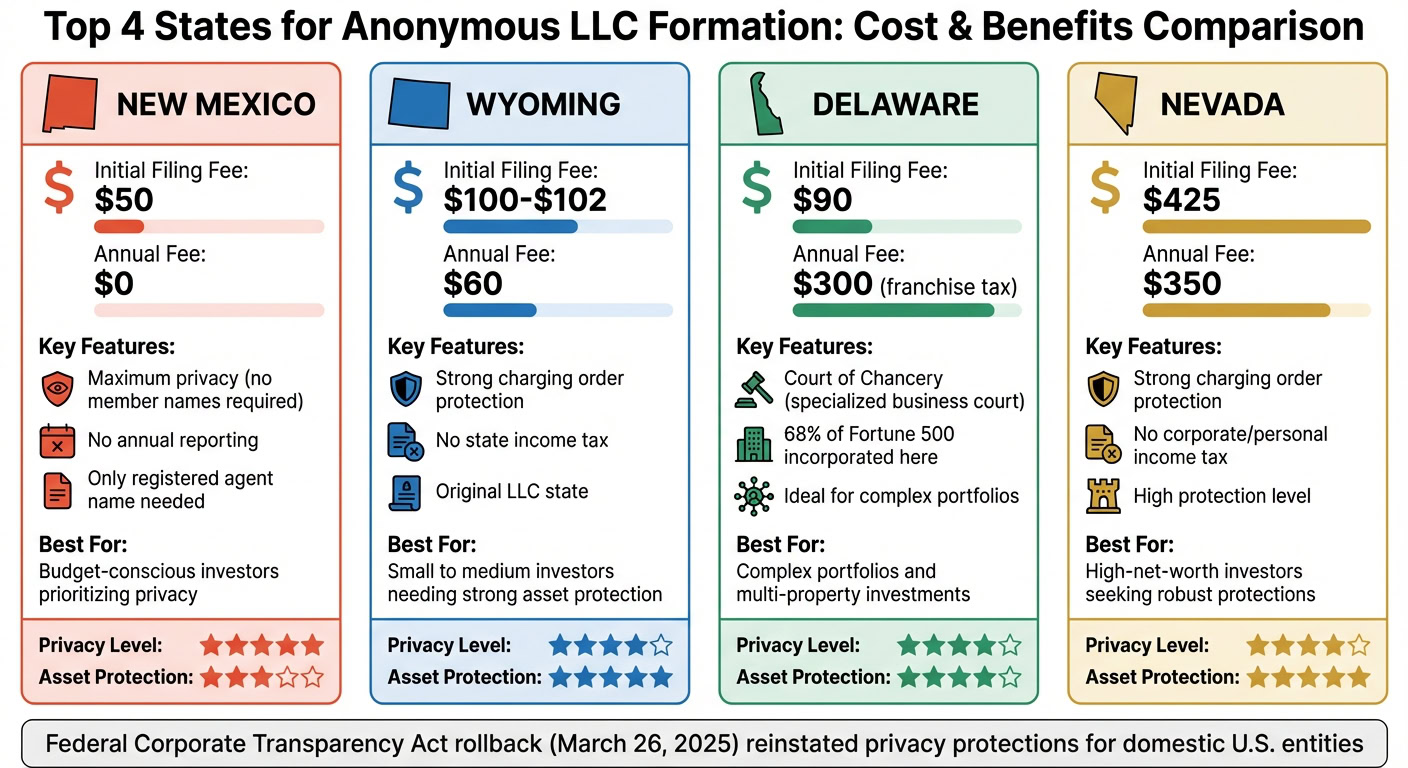
When it comes to forming an anonymous LLC, privacy protection varies significantly from state to state. The top contenders are Wyoming, Delaware, Nevada, and New Mexico, each offering distinct benefits tailored to different strategies and budgets.
On March 26, 2025, the federal rollback of the Corporate Transparency Act reinstated privacy protections for domestic U.S. entities. This change makes choosing the right state even more critical for maintaining anonymity.
Here’s a snapshot of what each state brings to the table:
| State | Initial Filing Fee | Annual Fee | Best For |
|---|---|---|---|
| New Mexico | $50 | $0 | Budget-conscious investors prioritizing privacy |
| Wyoming | $100–$102 | $60 | Small to medium investors needing strong asset protection |
| Delaware | $110 | $400 | Complex portfolios and multi-property investments |
| Nevada | $425 | $350 | High-net-worth investors seeking robust protections |
While cost is an essential factor, each state’s legal protections and administrative rules play a significant role in determining the best option for your privacy needs.
Wyoming: Privacy and Asset Protection Combined
Wyoming is a top choice for many real estate investors. The state does not require LLC members or managers to disclose their names on formation documents or subsequent filings, ensuring a high level of privacy. Plus, Wyoming offers charging order protection, which means if you’re personally sued, creditors can only place a lien on distributions – not dissolve your LLC.
Alex Recouso, Co-founder and CEO of CitizenX, highlights Wyoming’s appeal:
"Wyoming stands as the original LLC state… providing comprehensive privacy protections that have served as a model for other states."
Wyoming also boasts no state corporate or personal income tax. For entities with $300,000 or less in in-state assets, the annual report fee is just $60, making it both affordable and effective for asset protection in real estate.
Delaware: A Legal Powerhouse for Complex Investments
Delaware might not be the cheapest option, but its legal framework is unmatched. Its Court of Chancery – a specialized business court – handles disputes without juries, offering a streamlined process for resolving business matters. This court is a key reason why over 68% of Fortune 500 companies are incorporated in Delaware.
Instead of annual reports, Delaware requires an annual franchise tax of $400. This setup makes it ideal for investors managing complex, multi-property portfolios. As Alex Recouso explains:
"Delaware’s Court of Chancery… provides unique advantages for business entities… with decisions rendered by judges possessing deep expertise in business law."
For those planning partnerships, raising capital, or preparing for a future sale, Delaware’s stable legal environment is a strong advantage.
Nevada: High Protection at a Higher Price
Nevada is another state offering strong asset protection, comparable to Wyoming’s charging order protection. Like Wyoming, Nevada has no corporate or personal income tax. However, the cost of setting up and maintaining an LLC here is higher. The initial filing fee is $425, which includes a business license and the required "Initial List" of managers or members. Annual renewals cost around $350.
While Nevada requires filing the "Initial List", member anonymity is preserved in public records, with internal records kept confidential. This balance of privacy and protection makes Nevada a strong contender, particularly for high-net-worth individuals.
New Mexico: Maximum Privacy at Minimal Cost
For those seeking the highest level of anonymity, New Mexico is hard to beat.
In New Mexico, only the registered agent’s name is required during formation, and the state collects no additional member information or annual reports. The one-time filing fee is just $50, with no ongoing state fees, making it an affordable option for passive real estate investors. However, New Mexico’s asset protection features, such as charging order protections, are less robust compared to Wyoming or Nevada. For those focused primarily on privacy, though, New Mexico offers exceptional value.
How to Form an Anonymous LLC: 5 Steps
Creating an anonymous LLC is a straightforward process if you follow these five steps to set up an LLC. The goal? Keep your name off public records while maintaining legal compliance.
| Step | Action | Privacy Benefit |
|---|---|---|
| 1. Select State | Choose Wyoming, Delaware, New Mexico, or Nevada | Leverages privacy-focused laws to avoid public disclosure of owners |
| 2. Appoint Agent | Hire a professional registered agent | Keeps your personal address private |
| 3. File Articles | Submit formation documents without member names | Keeps your name out of state filings |
| 4. Get EIN | Obtain a tax ID from the IRS | Allows private banking without using your Social Security Number |
| 5. Transfer Deed | Record property deeds in the LLC’s name | Ensures only the LLC name appears on land records |
Let’s break down each step to help you protect your personal details.
Step 1: Select the Best State for Your Privacy Needs
Choosing the right state is critical, as privacy laws vary. Wyoming, Delaware, New Mexico, and Nevada are the top choices for anonymous LLCs. Each state offers unique advantages, so consider factors like whether member names are required on filings, ongoing costs, and the strength of asset protection laws.
For those with properties in multiple states, a holding company strategy can work well. Set up an anonymous LLC in a privacy-friendly state and use it to own local LLCs in the states where your properties are located. This adds an extra layer of privacy without sacrificing compliance.
If you own property out of state, registering as a foreign LLC allows you to maintain anonymity while meeting local requirements.
Step 2: Appoint a Registered Agent
Every LLC needs a registered agent to receive legal notices and official correspondence. Hiring a professional registered agent ensures their address, not yours, appears on public filings. This simple step keeps your personal address completely off the record.
Step 3: File Articles of Organization Without Member Names
The Articles of Organization officially establish your LLC. In states that allow anonymous LLCs, these documents don’t require you to list member or manager names – only the organizer’s name appears.
To maintain privacy, hire a formation service or attorney to act as the organizer. Their name will appear on the filing, not yours. As Nellie Akalp, CEO of CorpNet, explains:
"In New Mexico, only the names of the registered agent and the LLC organizer… are required – an LLC is anonymous by default."
Avoid adding optional details like ownership or management information, as these are not required in states like New Mexico. Once the paperwork is filed, you’ll need to secure an EIN for your LLC.
Step 4: Obtain an EIN for Private Banking and Tax Purposes
An Employer Identification Number (EIN) is your LLC’s tax ID. It’s essential for opening a business bank account and filing taxes. By using an EIN, you can avoid sharing your Social Security Number during financial transactions.
Applying for an EIN is free and can be done online through the IRS website in about 15 minutes. While the IRS requires identifying information for the "responsible party", this detail is not made public.
Banks may ask for additional documents like your Operating Agreement and EIN confirmation to verify your LLC’s legitimacy.
Step 5: Transfer Property Deeds to the LLC
The last step is transferring property deeds into the LLC’s name. If possible, purchase property directly in the LLC’s name to avoid having your personal name on the title at all. If the property is already in your name, you’ll need to execute a deed transfer – typically a quitclaim or warranty deed – to move ownership to the LLC.
Once the deed is recorded with the county, only the LLC’s name will appear in public land records. This ensures your privacy is maintained. As Scott Royal Smith, an asset protection attorney at Royal Legal Solutions, notes:
"Omitting your name from ownership records helps avoid frivolous lawsuits."
Keep your Operating Agreement private. While it’s not part of public records, you’ll need it to prove your authority to banks and title companies during the deed transfer process.
sbb-itb-ba0a4be
How BusinessAnywhere Simplifies Anonymous LLC Setup
Setting up an anonymous LLC can feel like navigating a maze of agencies and regulations. BusinessAnywhere takes the hassle out of the process by organizing every step, from choosing the right state to ensuring federal compliance – all while keeping your privacy intact.
Here’s how it works: You start with $0 registration, paying only state filing fees that range from $50 and up. Plus, your first year of registered agent service is included at no additional cost. This service helps keep your personal address off public records and can save you anywhere from $100 to $300 annually.
BusinessAnywhere handles the preparation of your Articles of Organization, ensuring your name stays off state records. The platform also helps you choose the best jurisdiction for your needs. Whether it’s Wyoming for its strong asset protection, New Mexico for full anonymity, or Delaware for managing multiple properties, their team leverages over 20 years of experience registering thousands of LLCs across all 50 states to guide you in making the right choice. This seamless support ensures your privacy remains a priority throughout the setup process.
The platform also takes care of your EIN application ($97) and BOIR filing ($37), keeping your IRS and FinCEN data secure while simplifying compliance. The BOIR filing meets federal transparency requirements without compromising state-level privacy. To top it off, BusinessAnywhere’s compliance dashboard provides calendar alerts for annual report deadlines by state, so you never miss an important filing.
Additional Privacy Strategies for Real Estate Investors
Once you’ve established an anonymous LLC, there are additional steps you can take to strengthen your privacy. These extra measures add layers of protection between you and your real estate assets, making it even harder for your ownership to appear in public records. Together, these strategies work seamlessly with the basic anonymity provided by an anonymous LLC.
Pairing land trusts with anonymous LLCs creates a robust privacy shield. By transferring property into a land trust and naming your anonymous LLC as the beneficiary, your ownership stays off county records. This approach ensures your name doesn’t appear in government filings. To add another layer, appoint a nominee trustee – such as a professional service or attorney – instead of listing yourself. This way, your name remains completely absent from the public deed.
Nominee managers are another effective tool to protect your identity. Instead of listing your name in the Secretary of State database, a professional nominee manager acts as the public face of your LLC. Meanwhile, you retain full control through your private Operating Agreement. This strategy is especially valuable for shielding your identity, as one expert explains:
"If your name isn’t on the public record, you’re harder to sue. And that’s exactly the kind of protection you want when building long-term wealth in real estate".
However, it’s important to note that nominee managers don’t eliminate all disclosures. You’ll still need to share your identity with banks and the IRS to meet legal and financial requirements. Still, this step significantly reduces your exposure in public-facing records.
Creating multiple LLCs is another way to enhance privacy and protect your portfolio. By isolating each property in its own LLC, you ensure that a lawsuit targeting one property doesn’t jeopardize your entire portfolio. A common approach is to establish a holding company in a privacy-friendly state like Wyoming or New Mexico. This holding company can then own individual subsidiary LLCs, each tied to a specific property. To maintain the legal integrity of this setup, it’s crucial to keep separate financial accounts for each entity.
The common thread in all these strategies is what privacy experts call "discouraging litigation." When your assets are hard to trace, you’re less likely to become a target for lawsuits. As Royal Legal Solutions explains:
"Anonymity is essential because it stops lawsuits before they start, as belligerent parties will be unable to find the actual target of the suit".
Conclusion
Anonymous LLCs offer a practical way to safeguard investor identities by keeping personal names off public records while maintaining key benefits like asset protection, pass-through taxation, and the option to elect S-Corp status.
States like New Mexico, Wyoming, Delaware, and Nevada each bring their own set of privacy perks, catering to various investor preferences. These tailored advantages make it easier to choose the right state for forming an anonymous LLC.
Platforms like BusinessAnywhere simplify the process by combining filings, registered agent services, and virtual mailbox management into a single, user-friendly dashboard.
However, compliance remains essential. While anonymous LLCs shield your name from public records, you’re still required to provide identification to banks and the IRS to meet legal obligations. Recent updates from FinCEN further emphasize the privacy benefits of anonymous LLCs, making them an increasingly valuable tool for protecting real estate investments.
FAQs
What are the benefits of using an anonymous LLC for real estate investments?
Using an anonymous LLC for real estate investments can provide a powerful combination of privacy and protection. By keeping the owner’s name out of public records, it becomes much more difficult for others – whether they’re potential litigants, contractors, or even nosy neighbors – to link specific properties to an individual. This extra layer of privacy helps minimize risks like lawsuits, identity theft, and unwanted solicitations.
Beyond privacy, an anonymous LLC also creates a clear separation between personal and business assets. This separation shields an investor’s personal wealth from creditors or legal claims tied to the business. By leveraging tools like third-party registered agents or virtual office addresses, investors can maintain their anonymity while still reaping the flexibility and tax advantages of an LLC. This setup not only safeguards your identity but also protects your financial assets, allowing you to focus on expanding your real estate portfolio with confidence.
How can an anonymous LLC protect my privacy and reduce legal risks?
An anonymous LLC offers a practical way to protect your privacy by keeping your personal name and contact details off public records. Instead of your information, only the LLC’s name and its registered agent appear, making it more challenging for someone to link your personal assets to potential legal actions. This extra layer of privacy can discourage unnecessary lawsuits and enhances the liability protection that an LLC already provides.
Another advantage is the protection of your personal data from identity theft. By working with a third-party registered agent or nominee manager, private information like your home address, phone number, or Social Security number stays out of public databases. This significantly lowers the risk of fraud. States such as Wyoming, Delaware, and Nevada are particularly popular for forming anonymous LLCs because of their strong privacy protections.
In essence, an anonymous LLC not only separates your personal identity from your real estate or business ventures but also acts as a safeguard against legal threats and identity theft.
What is the best state for forming an anonymous LLC that balances privacy and affordability?
Wyoming stands out as a prime location for forming an anonymous LLC, thanks to its strong privacy policies and affordability. The state ensures a high level of confidentiality by not requiring the public disclosure of LLC members’ or managers’ names, keeping your ownership details private. On top of that, Wyoming’s asset protection laws add an extra layer of security for your personal information.
Financially, Wyoming is appealing because it has no state income tax or corporate tax. Plus, its filing and annual fees are relatively low compared to many other states. This unique mix of privacy and cost-effectiveness makes Wyoming especially popular among real estate investors and others who value discretion in their business ventures.