
Wyoming, Delaware, and Nevada are the top three states for business incorporation, but each serves different needs. Here’s a quick breakdown:
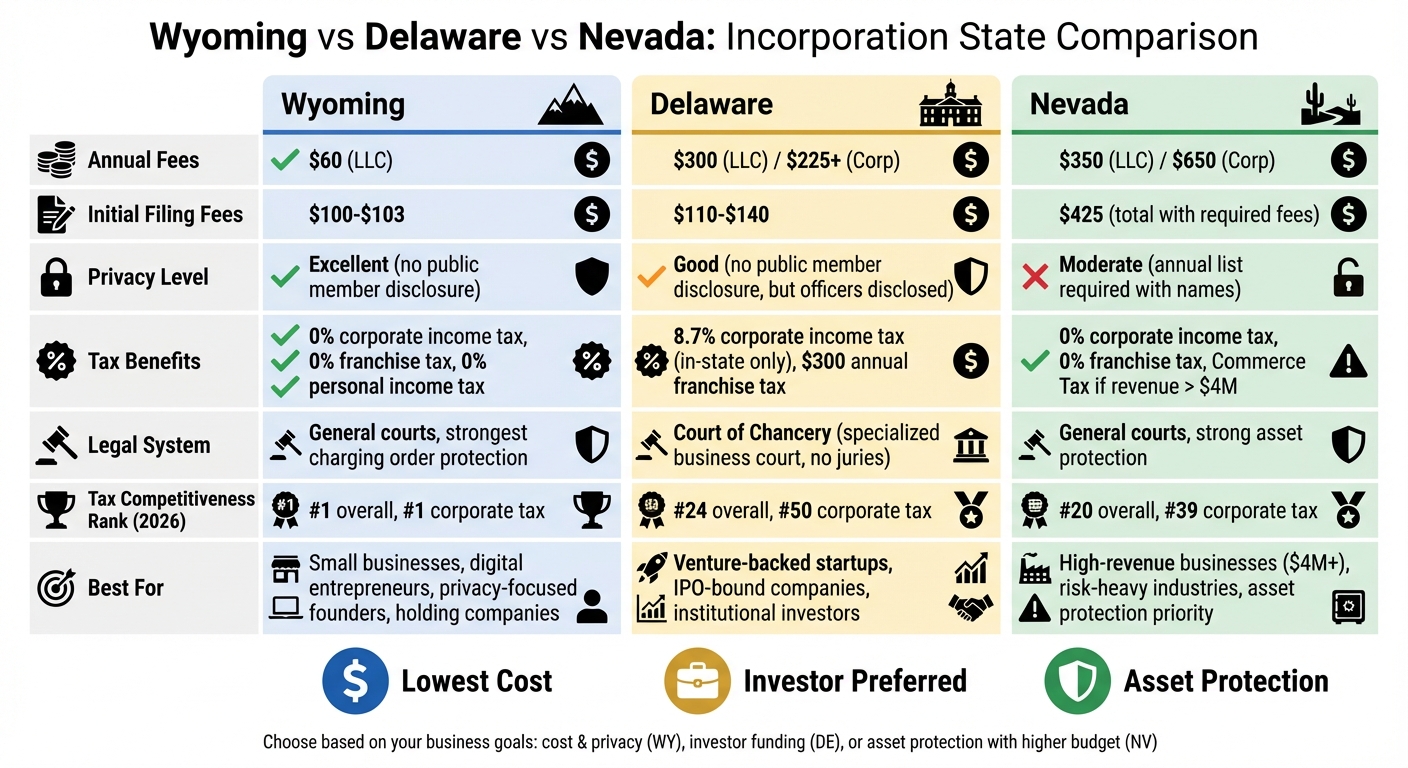
- Wyoming: Best for low costs and privacy. No corporate or personal income tax, $60 annual fee, and strong anonymity laws make it ideal for small businesses or digital entrepreneurs.
- Delaware: Preferred by startups seeking venture capital or planning IPOs. Its specialized Court of Chancery and investor-friendly laws support growth, but higher costs ($300 annual franchise tax) and public officer disclosures apply.
- Nevada: Offers no corporate income tax and strong asset protection, but higher annual fees ($350–$650) and less privacy than Wyoming. Suitable for high-revenue businesses or those in risk-heavy industries.
Quick Comparison:
| State | Annual Fee (LLC) | Privacy Level | Tax Benefits | Legal System | Ideal For |
|---|---|---|---|---|---|
| Wyoming | $60 | High | No income/franchise | General courts, strong asset protection | Small businesses, privacy-focused founders |
| Delaware | $300 | Moderate | No out-of-state income tax, but $300 franchise tax | Court of Chancery (business-focused) | Venture-backed startups, IPOs |
| Nevada | $350–$650 | Moderate | No income/franchise, Commerce Tax for $4M+ revenue | General courts, decent asset protection | High-revenue or risk-heavy industries |
Key Takeaway: Choose Wyoming for simplicity and privacy, Delaware for growth and investor trust, and Nevada for asset protection with a higher budget.
Wyoming for Incorporation
Wyoming has built a reputation as a top choice for incorporation, particularly for those who value privacy and cost-efficiency. The state offers zero corporate, franchise, and personal income taxes, allowing businesses to keep more of their earnings right from the start.
The initial filing fee is $100, with an additional $2 convenience fee for online submissions. One of Wyoming’s standout features is its strong privacy protections. The state doesn’t require LLC members or managers to be listed in public records, so you can remain completely anonymous by using a registered agent service. Additionally, Wyoming’s charging order protection prevents creditors from forcing the liquidation of company assets to cover personal debts – a safeguard that even applies to single-member LLCs.
"Wyoming is the clear winner for founders who want maximum privacy, iron-clad asset protection, and the absolute lowest annual costs." – TaxSym
Wyoming is also at the forefront of digital asset legislation. It was the first state to legally recognize Decentralized Autonomous Organizations (DAOs) and create laws tailored for blockchain businesses. For crypto and fintech companies, these regulations help reduce legal ambiguity and provide a more secure operating environment.
Let’s take a closer look at the benefits and challenges of incorporating in Wyoming.
Benefits of Incorporating in Wyoming
Wyoming’s tax structure is one of the most appealing in the country. With no corporate, franchise, or personal income tax, and a sales tax of just 4%, it’s an attractive option for holding companies and online businesses. The annual maintenance fee is only $60, which is far lower than Delaware’s $300 franchise tax or Nevada’s $350–$500 annual fees.
Privacy is another major perk. Wyoming doesn’t require your name to appear on public filings, allowing you to protect your identity by using a nominee service through a registered agent.
The state also excels in asset protection. Its charging order provision ensures that creditors cannot seize LLC assets, force distributions, or interfere with management – even for single-member LLCs.
Compliance is straightforward and affordable. The annual report is a simple filing with a flat $60 fee, and there’s no minimum capitalization requirement – you can start your LLC with as little as $1. Most LLCs can be formed online within 1–2 business days, with expedited services completing the process in as little as 8 hours.
"For founders prioritizing cost-efficiency, anonymity, and speed, a Wyoming LLC delivers unmatched value." – Artur Kuczmowski, Senior Partner, Thompson&Stein
Wyoming’s progressive approach to blockchain and digital assets also makes it a preferred destination for businesses in emerging industries. These regulations provide clarity and align with the state’s pro-business stance.
However, Wyoming isn’t the perfect fit for every business.
Limitations of Incorporating in Wyoming
While Wyoming offers many advantages, it may not be the best choice for businesses seeking venture capital or planning an IPO. Investors and institutions often favor Delaware due to its well-established legal precedents and specialized business court, the Court of Chancery. This can make Wyoming less appealing for companies requiring investor credibility or legal predictability for complex transactions.
"Wyoming is for privacy-focused founders who want low overhead. Delaware is for startups that need investor credibility and a predictable legal system for complex deals." – TaxSym
Wyoming’s legal system, while strong, doesn’t have the same prestige as Delaware’s, which is often seen as the "gold standard" by international partners and large financial institutions.
Another factor to consider is the potential for double compliance costs. If your business has a physical presence in a high-tax state – like employees or inventory in California – you may still owe taxes in that state. For example, a California resident with a Wyoming LLC would still have to pay California’s minimum franchise tax.
Lastly, some traditional banks may have stricter requirements for out-of-state entities like Wyoming LLCs. This could limit your options to fintech platforms or online-only banking solutions.
sbb-itb-ba0a4be
Delaware for Incorporation
Delaware is often considered the "gold standard" for incorporation, especially for businesses aiming for substantial growth. It’s no coincidence that two-thirds of Fortune 500 companies and over 90% of U.S. IPOs are registered there. With over 1.9 million business entities calling Delaware home, the state has created a legal system that inspires confidence among investors.
One of Delaware’s standout features is its Court of Chancery, a specialized court that handles business disputes without juries. Instead, expert Chancellors rely on established case law to resolve matters.
"Delaware courts are known for offering a level playing field, where cases are won on merit, not politics." – Molly Miller, Manager, Customer Service, Wolters Kluwer
Delaware’s appeal is further enhanced by corporate laws that offer flexibility. Businesses can issue multiple classes of stock, distribute employee stock options with ease, and manage complex transactions confidently. The state’s General Corporation Law also provides strong protections for directors and officers, making it easier to attract top-tier leadership. Costs include a flat $300 annual franchise tax, with initial filing fees ranging from $90 to $110.
However, Delaware’s advantages come at a price. Its annual costs are higher than states like Wyoming, which charges just a $60 annual fee. Privacy is another concern, as Delaware requires public disclosure of officers and directors. Additionally, businesses operating outside Delaware must foreign qualify to operate in another state, leading to extra filings and fees. For small businesses prioritizing cost savings and privacy, these drawbacks might outweigh the legal benefits Delaware offers.
Benefits of Incorporating in Delaware
Delaware’s legal system provides a level of predictability that’s hard to match. The extensive case history of the Court of Chancery allows attorneys, investors, and executives to anticipate outcomes for disputes like mergers or shareholder agreements. This foresight is a significant advantage during negotiations.
Operational flexibility is another major draw. Delaware allows a single individual to serve as officer, director, and shareholder, simplifying governance for startups. Its Series LLC structure is particularly useful for real estate investors and holding companies, as it lets businesses separate assets and liabilities under one umbrella. This combination of flexibility and legal precedent has solidified Delaware’s reputation as an investor-friendly jurisdiction.
For companies planning to go public, Delaware is the standard for U.S. business law. Institutional investors expect public companies to be incorporated there. The Court of Chancery resolves disputes, such as proxy contests or merger challenges, in relatively short timeframes. Additionally, the "business judgment rule" protects directors’ good-faith decisions, encouraging experienced professionals to join boards.
These factors make Delaware an attractive choice, but they should be considered alongside your business’s unique priorities.
Limitations of Incorporating in Delaware
Despite its strengths, Delaware’s higher costs and public disclosure requirements may deter some businesses.
The $300 annual franchise tax is significantly higher than Wyoming’s $60 annual fee. For corporations, the franchise tax is calculated based on share structure, which can lead to even steeper costs – an issue for small businesses or solo entrepreneurs who aren’t seeking outside investment.
Privacy is another potential downside. While Delaware LLCs don’t require members to be listed publicly, officers and directors must be disclosed in franchise tax reports, which are public records. Businesses prioritizing anonymity might find stronger privacy protections in other states.
Additionally, companies operating outside Delaware often face extra compliance obligations. For instance, a California-based business would need to pay Delaware’s $300 franchise tax and California’s minimum franchise tax, negating any potential tax savings.
Recent legal developments have also raised questions about Delaware’s predictability. In January 2024, the Court of Chancery voided Elon Musk’s $56 billion Tesla compensation package, prompting Tesla to reincorporate in Texas. Similarly, Coinbase Global Inc. left Delaware for Texas in November 2025, citing concerns over judicial unpredictability. By late 2025, at least 12 publicly traded companies with market caps exceeding $1 billion had made similar moves.
"Delaware will remain the go-to jurisdiction for large corporations." – Andrew Pierce, Founder, Wyoming LLC Attorney
Even with these high-profile departures, Delaware remains a top choice for venture-backed startups and large corporations. However, for small businesses without investor demands, the higher costs and reduced privacy could outweigh the legal advantages. Carefully weigh these factors against your business goals to determine if Delaware is the right fit.
Nevada for Incorporation
Nevada takes a different path from Delaware, offering a mix of tax advantages and operational flexibility that has drawn over 350,000 small businesses as of March 2026. With no corporate income tax, personal income tax, or franchise taxes, Nevada is a standout choice for businesses aiming to reduce their state-level tax obligations.
The state also excels in asset protection. Its charging order provisions for single-member and multi-member LLCs ensure creditors can only access distributions, not the business’s actual assets. Nevada’s dedicated business courts further streamline case management, reducing the impact of litigation on operations.
"Nevada has made itself an attractive choice as a place to incorporate by maintaining favorable limited liability protection for directors and officers." – Molly Miller, Manager, Customer Service, Wolters Kluwer
Privacy is another key selling point. While member and manager names must be disclosed publicly, Nevada allows nominee officers to act as a shield for the true owners. Additionally, under specific conditions, the state does not share business ownership details with the IRS.
When it comes to operational flexibility, Nevada shines. There are no residency requirements for shareholders, directors, or officers, and the state permits "noneconomic members" to participate in management and vote on major decisions. This setup is especially appealing for businesses with complex ownership structures. Although its legal framework is not as established as Delaware’s, Nevada’s straightforward approach to asset protection makes it an attractive choice for many.
Benefits of Incorporating in Nevada
Nevada’s zero-tax policy is a major draw, enabling businesses to keep more of their earnings. The only tax that may apply is the Nevada Commerce Tax, which affects businesses with over $4 million in gross revenue, with rates ranging from 0.051% to 0.331%. Combined with strong asset protection and management-friendly laws, these features make Nevada a compelling option for incorporation.
Limitations of Incorporating in Nevada
Despite its perks, Nevada’s cost structure and compliance requirements can pose challenges. Initial registration fees are around $425, and annual maintenance fees range from $350 to $650 for corporations, which can offset some of the tax savings.
"Nevada’s LLC Act was written to mimic the protections available in Wyoming… This success, though, has led Nevada to continually raise fees as it profits off of its name." – Andrew Pierce, Founder, Wyoming LLC Attorney
For businesses operating primarily outside Nevada, foreign qualification requirements can erode tax benefits. For instance, a Nevada-incorporated business operating in California would need to register as a foreign entity there, subjecting it to California’s taxes and fees. Under California’s Corporations Code Section 2115, such businesses might even have to comply with California’s corporate laws if most of their operations and shareholders are based there.
Privacy protections, while robust, are not absolute. Officer and director names must still be publicly disclosed, which offers less anonymity compared to states like Wyoming. Nevada also requires a written operating agreement signed by all members, unlike Wyoming, where this is optional.
Lastly, Nevada’s business courts lack the extensive case history of Delaware’s, which can make legal outcomes less predictable. This can be a concern for businesses planning to attract venture capital or pursue public offerings.
Cost Comparison: Filing Fees and Annual Expenses
When deciding where to incorporate, understanding the costs involved can make a big difference. Wyoming stands out as the most budget-friendly option. Its initial filing fees range from $100 to $103, with annual report fees between $52 and $60. Delaware, on the other hand, has slightly higher initial filing fees, typically between $110 and $140, but its ongoing expenses are steeper. For LLCs, there’s a flat $300 annual franchise tax, while corporations pay a minimum of $225 annually.
Nevada’s pricing structure can catch new business owners off guard. While the base filing fee is only $75, additional charges like the Initial List of Managers or Members ($150) and a State Business License ($200) bring the total initial cost to $425. For annual maintenance, Nevada businesses typically pay between $325 and $350, which includes the renewal of the annual list and business license.
"The Nevada Secretary of State charges nearly $300 to start an LLC and $500 for a Corporation. These fees are not all disclosed at the time of creation." – Andrew Pierce, Founder, Wyoming LLC Attorney
Here’s a breakdown of the costs:
| State | LLC Total Initial Fee | Corp Initial Filing Fee | Annual Report / Maintenance Fee |
|---|---|---|---|
| Wyoming | $100–$103 | $103 | $52–$60 |
| Delaware | $110–$140 | $140 | $300 (LLC) / $225+ (Corp) |
| Nevada | $425 | $75 (Base) + $325 (Initial Report) | $325–$350 |
It’s also worth noting that all states require you to have a registered agent, which typically costs between $50 and $200 annually. Delaware adds an extra layer of administrative costs – for example, changing your registered agent there could set you back around $50. Wyoming’s straightforward and low-cost structure makes it an appealing choice for startups looking to minimize expenses.
Tax Comparison: State Income Tax and Franchise Taxes
Taxes can significantly impact your business budget, so understanding state-specific regulations and costs is crucial. Both Wyoming and Nevada stand out with 0% corporate and personal income taxes, making them appealing for entrepreneurs looking to maximize profits. If you are ready to move forward, follow a guide for starting an LLC to ensure you meet all legal requirements. Delaware, on the other hand, charges an 8.7% corporate income tax on in-state income. However, if your Delaware corporation operates entirely outside the state, you won’t owe Delaware corporate income tax.
Delaware also imposes a flat $300 annual franchise tax, even if your business operates outside the state. Wyoming avoids franchise taxes altogether, though it does charge a minimal annual license tax based on assets within the state. Nevada doesn’t levy franchise taxes either but does have a Commerce Tax on gross revenues exceeding $4 million.
"The state where you form your LLC doesn’t create a state-level tax bill if you don’t actually do business there. Wyoming keeps it simple with no state income tax. Delaware, on the other hand, charges a flat $300 franchise tax every year, regardless of your business activity." – TaxSym
In the 2026 State Tax Competitiveness Index, Wyoming ranks #1 overall, while Nevada comes in at #20, and Delaware sits at #24. The corporate tax rankings tell an even starker story: Wyoming takes the #1 spot, while Delaware ranks last at #50. Delaware is also one of only two states that impose both income taxes and a gross receipts tax, making it less appealing for small businesses.
This comparison highlights how Wyoming and Nevada offer clear tax advantages over Delaware, particularly for businesses aiming to minimize tax burdens.
| Tax Category | Wyoming | Nevada | Delaware |
|---|---|---|---|
| Corporate Income Tax | 0% | 0% | 8.7% (in-state only) |
| Personal Income Tax | 0% | 0% | Up to 6.6% |
| Franchise Tax | None | None | $300 minimum (LLCs) |
| Commerce Tax / Gross Receipts Tax | None | Yes (if revenue > $4M) | Yes |
| 2026 Corporate Tax Rank | #1 | #39 | #50 |
It’s important to note that incorporating in a tax-friendly state won’t eliminate tax obligations in other states where your business operates. For example, a business based in California would still face California’s $800 minimum franchise tax, even if it incorporates in Wyoming.
Privacy Comparison: Ownership Disclosure Requirements
After addressing tax considerations, privacy is often the next priority for business owners. Wyoming offers a notable advantage here – LLC owners and managers are not required to be listed on the Articles of Organization, which keeps their names off public records. Delaware provides similar privacy by not publicly disclosing owners, managers, or officers. Additionally, Delaware LLCs avoid filing annual reports, minimizing ongoing exposure. These features make both states appealing for those prioritizing discretion.
Nevada, on the other hand, takes a different approach. It mandates filing an Initial/Annual List that includes at least one manager or owner, and this information is made public. Andrew Pierce, Founder of Wyoming LLC Attorney, highlights this shift:
"Nevada’s time as a haven has largely passed due to the new disclosure requirements and annual fees".
"Wyoming LLCs are sought after due to the strict privacy laws surrounding them." – Andrew Pierce, Founder, Wyoming LLC Attorney.
Another notable distinction is Delaware’s practice of sharing information with the IRS and cross-checking companies against Treasury databases. Wyoming, in contrast, does not collect corporate income tax information for sharing purposes. However, it’s important to note that all entities must comply with federal BOI (Beneficial Ownership Information) reporting requirements to FinCEN.
Here’s a quick breakdown of privacy features across Wyoming, Delaware, and Nevada:
| Privacy Feature | Wyoming | Delaware | Nevada |
|---|---|---|---|
| Member/Manager Names on Public Articles | No | No | No (but required on Initial List) |
| Annual List of Officers/Members Required | No (for LLCs) | No | Yes |
| State Income Tax Info Shared with IRS | No | Yes | No |
| Anonymity Rating | Excellent | Good | Moderate |
Wyoming’s privacy laws make it a top choice for founders looking to protect personal information while maintaining a strong corporate setup. To further enhance anonymity, consider using a professional registered agent to keep your personal details off the Articles of Organization. If you’re forming an anonymous LLC, drafting an internal Operating Agreement to privately list members and managers is a smart move – though banks will still require proof of ownership when opening business accounts.
Legal Protection Comparison: Courts and Asset Protection
When it comes to legal protection, the framework offered by each state plays a critical role in handling disputes or creditor claims. Delaware, Wyoming, and Nevada each bring something different to the table.
Delaware is renowned for its Court of Chancery, a specialized business court where expert judges (not juries) handle complex corporate disputes. This court relies on an extensive body of case law, offering businesses a high degree of predictability. It’s no surprise that over 60% of Fortune 500 companies call Delaware their legal home. The consistency and expertise of Delaware’s legal system make it especially appealing for companies looking to scale and attract institutional investors.
Wyoming, on the other hand, focuses on asset protection. It boasts the strongest "charging order protection" in the country, which is the sole remedy available to personal creditors. This means creditors cannot seize LLC assets or force liquidation – they can only claim a share of distributed profits. Notably, Wyoming is the only state with specific statutes protecting single-member LLCs in this way. For entrepreneurs looking to safeguard their assets, Wyoming is a strong contender.
Nevada offers protections similar to Wyoming’s, including strong charging order protections. However, it doesn’t have statutes explicitly covering single-member LLCs. Nevada does allow for "noneconomic members", who can manage and vote without owning a stake in the business. While this flexibility can benefit certain business structures, Nevada’s legal system lacks the specialized expertise of Delaware’s Court of Chancery and the statutory asset protection advantages found in Wyoming.
Here’s a quick comparison of these states’ legal protections:
| Feature | Wyoming | Delaware | Nevada |
|---|---|---|---|
| Court System | General state courts | Court of Chancery (expert judges, no juries) | General state courts |
| Charging Order Protection | Exclusive remedy for both single- and multi-member LLCs | Strong, but not an exclusive remedy | Strong, but lacks single-member LLC statutes |
| Asset Seizure | Creditors cannot seize assets or force liquidation | Standard corporate veil protection | Creditors are generally barred from seizing assets |
| Investor Preference | Solopreneurs and holding companies | Venture capitalists, institutional investors, IPO-bound companies | High-risk, digital-first businesses |
Compliance Comparison: Annual Requirements and Obligations
Annual compliance requirements can significantly shape how you manage your business, beyond just the cost and tax advantages. These obligations vary widely based on where you incorporate.
Wyoming keeps things simple. Businesses only need to submit an annual report and maintain a registered agent, all for $60. The annual report is due on the first day of your anniversary month. With no additional filings or state business license requirements, Wyoming offers a straightforward approach.
Delaware has different rules depending on your business structure. LLCs skip the annual report but must pay a flat $300 franchise tax by June 1st each year. Corporations, on the other hand, must file an annual report by March 1st and pay a franchise tax starting at $175, plus a $50 filing fee – usually totaling $225 or more. Like Wyoming, Delaware also requires a registered agent.
Nevada has the most intricate compliance obligations. LLCs are required to file an Annual List of Managers or Members for $150 and renew a State Business License for $200, bringing the total to $350 annually. Corporations face even higher costs, with a $150 fee for the Annual List and $500 for the business license renewal, totaling $650. Both filings are due by the end of your anniversary month. Nevada also mandates an annual state business license, and failing to meet deadlines can result in penalties ranging from $25 to over $2,000.
Here’s a quick comparison of the annual requirements:
| Feature | Wyoming | Delaware | Nevada |
|---|---|---|---|
| Annual Filing | Annual Report | Annual Franchise Tax (LLCs) / Annual Report (Corps) | Annual List + Business License Renewal |
| Annual Cost (LLC) | $60 | $300 | $350 |
| Annual Cost (Corporation) | $60 | $225+ | $650 |
| Deadline | 1st day of anniversary month | June 1st for LLCs; March 1st for Corporations | End of anniversary month |
| Registered Agent Required | Yes | Yes | Yes |
| Business License | Not required | Not required | Required annually |
| Complexity | Low | Low (payment-focused for LLCs) | High (multiple filings required) |
One important note: if your business operates outside the state where it’s incorporated, you’ll likely need to register as a "foreign" entity in your home state. This could effectively double your compliance obligations. For small businesses with a single physical location, incorporating in your home state is often simpler and more cost-effective. However, for location-independent businesses, holding companies, or those focused on privacy and asset protection, the compliance differences in Wyoming, Delaware, and Nevada might play a bigger role in your decision.
Which State Should You Choose?
When deciding where to incorporate, you’ll need to weigh taxes, legal protections, and compliance against your business strategy. The right choice depends on your goals, funding plans, and where your operations are based.
For startups aiming to attract venture capital or prepare for an IPO, Delaware is the go-to option. Investors and their legal teams often insist on Delaware entities before committing funds. As TaxSym aptly states:
"Delaware is the undisputed champion, hands down. It’s the state investors know and trust."
On the other hand, Wyoming stands out for its affordability and privacy. With an annual fee of just $60 and no requirement to disclose member names (if you use a registered agent), Wyoming is a top pick for small business owners, digital nomads, and privacy-conscious founders who don’t plan to seek institutional investment.
Nevada offers a balance between strong asset protection and privacy, making it a solid option for high-risk industries. However, its higher annual fees – around $350 for LLCs – might deter smaller businesses. Nevada also appeals to companies with gross revenues exceeding $4 million that can handle the Commerce Tax, thanks to its robust charging order protections.
If your business operates in a high-tax state like California, incorporating elsewhere may not save you money. California’s $800 minimum franchise tax could mean paying fees in both states. For businesses with a physical presence, it often makes sense to incorporate in your home state. However, location-independent businesses, holding companies, or online entrepreneurs might find Wyoming’s low costs or Delaware’s investor-friendly reputation more appealing, depending on their growth plans.
FAQs
Do I still pay taxes in my home state if I incorporate elsewhere?
If you incorporate in another state, you’ll likely still owe taxes in your home state. This is especially the case if you run your business or maintain a physical presence there. States generally tax income earned within their borders, regardless of where your business is incorporated.
When should I choose Delaware over a Wyoming LLC?
If your business plans involve raising venture capital, going public, or requiring a more advanced legal structure, Delaware might be the better choice. Its Court of Chancery is well-known for resolving business disputes quickly and effectively, making it appealing to investors.
On the flip side, Wyoming is a great option for small businesses that prioritize keeping costs low, maintaining privacy, and protecting assets. Delaware aligns well with companies focused on growth, while Wyoming is a solid fit for those emphasizing affordability and discretion.
Will a privacy-focused LLC still have to report owners to FinCEN?
A privacy-focused LLC is generally required to submit beneficial ownership information (BOI) to FinCEN, unless it falls under an exemption. While some U.S.-based entities and individuals may qualify for exemptions under the latest regulations, foreign entities that meet specific conditions are still obligated to file BOI reports. It’s essential to review the applicable exemptions carefully to determine whether your LLC has reporting responsibilities.