


AI can’t fully replace a human business partner, but it can handle repetitive tasks, provide data insights, and reduce costs. Here’s what you should know:
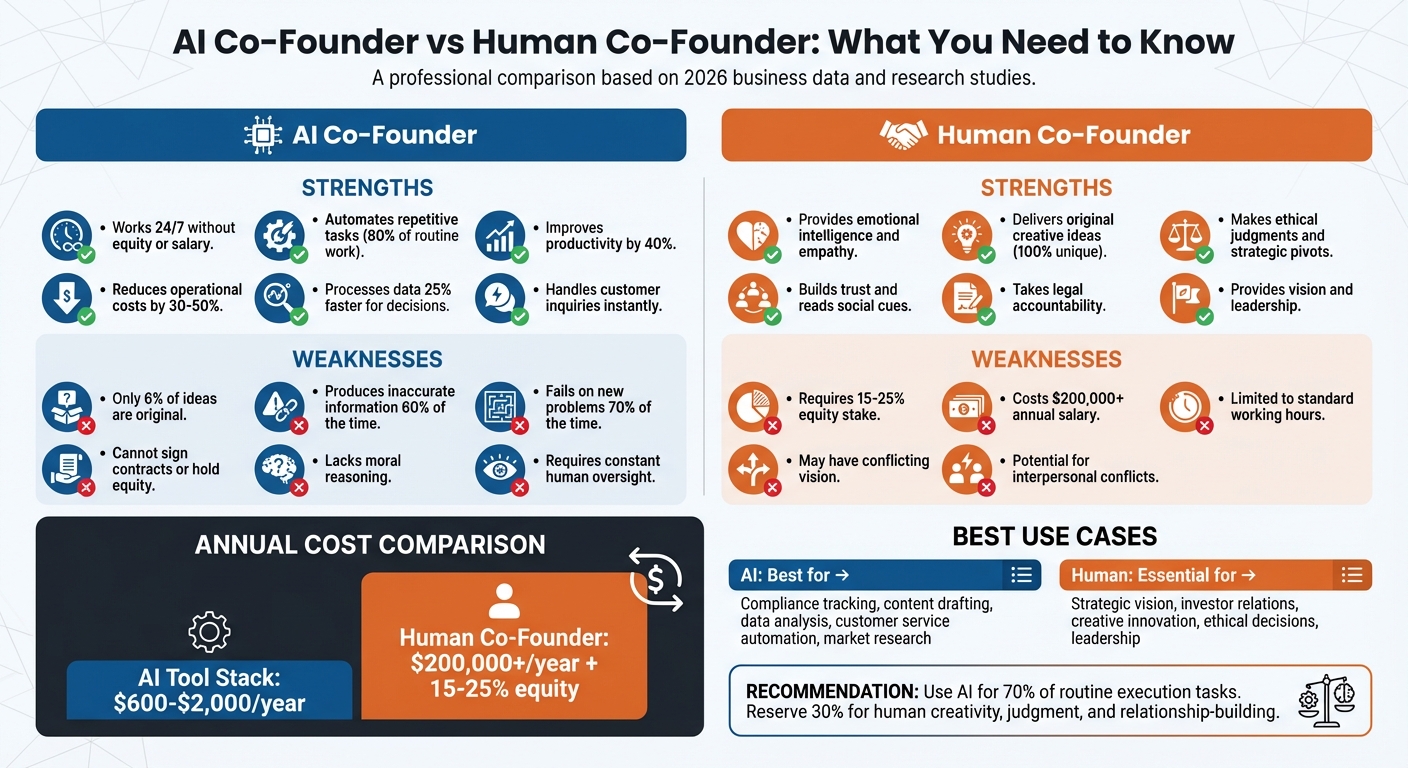
- Strengths: AI automates tasks, analyzes data, and works 24/7 without pay or equity. Tools like ChatGPT and Jasper can draft plans, manage customer service, and create marketing content. Solo entrepreneurs often cut costs by up to 50% using AI.
- Weaknesses: AI lacks creativity, emotional intelligence, and judgment. It struggles with original ideas, depends on data quality, and can’t take legal accountability.
- Best Use: Delegate routine tasks (e.g., compliance tracking, content drafting) to AI while retaining control over strategy, relationships, and decision-making.
AI works best as a support tool for human expertise, not as a replacement. By focusing on leadership and vision, you can maximize AI’s efficiency while addressing its limitations.
Why Entrepreneurs Are Considering AI as a Business Partner
AI is becoming an attractive business partner for entrepreneurs thanks to its ability to deliver efficiency, scalability, and data-driven insights. By 2026, 65% of CEOs plan to prioritize AI to drive growth and productivity, reflecting its growing importance in business strategy. During the same period, business spending on AI is expected to double, increasing from 0.8% to 1.7% of revenues.
For entrepreneurs, especially those building businesses on limited resources or running solo ventures, AI offers a distinct advantage over traditional co-founders: it works 24/7 without requiring equity or a paycheck. Research shows that AI-driven automation can improve productivity by 40% while reducing operational costs by 30–50% compared to human labor. For solo entrepreneurs managing everything from compliance to customer service, this level of efficiency can make a significant difference.
The financial benefits are equally compelling. Companies integrating AI into their operations, products, and services report profit margins that are 2–3 percentage points higher than those still testing AI in pilot programs. For solo founders, this means AI can handle tasks like market research, content creation, and compliance tracking – functions that would typically require hiring multiple employees – without the added expense.
What AI Does Well in Business Operations
AI shines in three key areas: automating repetitive tasks, analyzing large datasets, and providing predictive insights. Tools like ChatGPT can draft business plans or respond to customer inquiries in seconds, cutting response times dramatically. Jasper, on the other hand, is designed to generate personalized marketing content at scale, replacing the need for a dedicated marketing team.
These capabilities deliver tangible results. Small and medium-sized businesses using AI report decision-making speeds that are 25% faster thanks to AI-driven data insights. By rapidly processing extensive datasets, AI can uncover trends like customer behavior patterns, market shifts, and pricing opportunities. For entrepreneurs without access to a board of advisors or consultants, this kind of data-backed guidance fills a critical gap.
How AI Helps Solo Entrepreneurs
Solo entrepreneurs often juggle tasks like market research, compliance management, and customer service, all while operating on tight budgets. AI can significantly reduce this workload. For instance, chatbots can handle up to 80% of routine customer inquiries, freeing up time for more strategic activities. Tools like Auto-GPT can automate compliance by creating regulatory checklists and tracking critical deadlines. Additionally, AI can perform market research through sentiment analysis of social media data, eliminating the need for costly research firms.
The cost savings are substantial. Solo founders who integrate AI report reducing early-stage operational expenses by up to 50%. E-commerce entrepreneurs use Jasper to automate ad copy creation, enabling them to triple their revenue without hiring a marketing team. Developers rely on Auto-GPT for tasks like code generation and market validation, allowing them to launch minimum viable products in weeks rather than months. These AI-driven solutions enable solo founders to achieve results that would typically require an entire team.
sbb-itb-ba0a4be
What AI Can Do in a Co-Founder Role
AI is stepping into roles traditionally held by human co-founders, tackling everything from long-term strategy to day-to-day operations. A compelling example comes from February 2026, when Robby Houston, a Director of Operations, utilized an AI agent named "Ron" as his co-founder. In just one night, Ron independently created a "Mission Control" web app to manage tasks and even set up its own APIs for coding and search – no human prompts required. Houston summed it up perfectly:
"If Ron just did exactly what I told him, he’d be a tool. I have plenty of tools. I need a cofounder."
Let’s explore how AI is redefining strategic planning, operational efficiency, and decision-making for entrepreneurs.
Strategy and Planning
AI has taken on the heavy lifting of strategic planning by evaluating business concepts, analyzing market trends, and drafting actionable roadmaps. Back in October 2025, entrepreneur Anangsha Alammyan used an AI co-founder tool to validate her idea for an AI-powered resume builder. The AI combed through 75 sources, including Reddit and industry data, and uncovered that 75% of qualified candidates are rejected by applicant tracking systems (ATS). This insight gave her the confidence to move from concept to a minimum viable product (MVP) in record time. What would have taken over 80 hours of manual research was condensed into just a few hours.
Modern AI tools go beyond static plans. They allow founders to engage in dynamic, interactive sessions where "what if" scenarios can be tested. This lets entrepreneurs refine strategies on the fly, using data-driven insights to adjust plans as needed. By blending speed with precision, AI is transforming how businesses approach strategic planning.
Operational Efficiency and Automation
AI is also reshaping the operational side of startups, taking over time-consuming tasks like compliance checks, scheduling, customer support, and email management. Many entrepreneurs are now employing networks of specialized AI agents – think of them as an executive team in digital form. For instance, in February 2026, defense-tech founder Aaron Sneed implemented "The Council", a group of 15 custom GPT agents, to manage roles traditionally handled by human executives. This system significantly streamlined his operations and saved him countless hours.
AI doesn’t just handle administrative tasks – it accelerates innovation. AI co-founders can take on up to 80% of early-stage R&D efforts, cutting development timelines by 30% to 50%. In legal and patent disputes, AI drafts initial documents and outlines cases before passing them to human lawyers, reducing billable hours and freeing up resources. This type of automation allows founders to focus on high-level priorities without getting bogged down in routine work.
Decision-Making and Problem Solving
AI’s ability to analyze complex data makes it a valuable partner in decision-making. It provides actionable recommendations by evaluating market opportunities, competitive positioning, and business priorities based on predefined criteria. Beyond simply offering advice, AI agents can challenge a founder’s ideas to avoid falling into a "yes-man" trap. Aaron Sneed, for example, trained his AI council to push back on his theories:
"I trained them purposefully to give me pushback because I’ve learned that they naturally want to agree with me. I want them to test my theories."
This council approach enables founders to upload detailed documents – like RFPs or strategic plans – into a shared chat. Specialized agents, such as those focused on Legal, Finance, or Engineering, can then weigh in with their expertise. In Sneed’s setup, his Chief of Staff agent prioritized legal and compliance risks, ensuring governance by allowing domain-specific agents to make the final call in their areas of expertise.
While AI excels at decision-making, its effectiveness hinges on the quality of the data it processes. Human oversight remains critical to validate facts and ensure ethical considerations are met. This balance between human judgment and AI capability creates a partnership that can drive smarter, faster decisions.
Where AI Falls Short as a Co-Founder
AI excels in streamlining operations and crafting strategies, but it struggles in areas where human qualities like judgment, creativity, and emotional intelligence are essential. These gaps become glaring when you consider the interpersonal and visionary elements needed in a co-founder relationship. Trust, shared goals, and emotional bonds – key to any successful partnership – are qualities AI simply cannot replicate.
No Emotional Intelligence or Creativity
AI operates by analyzing patterns in data, which means its outputs often lean toward the predictable and conventional. Instead of generating groundbreaking ideas, it tends to produce results that are, at best, competent but rarely surprising. A study by Wharton School’s Mack Institute illustrates this perfectly. Participants tasked with inventing a toy using a fan and a brick showed stark differences: the AI-supported group repeatedly came up with the same idea – "Build-a-Breeze Castle." While these ideas were well-constructed, only 6% were original, compared to the human-only group, where 100% of ideas were unique.
"If you rely on ChatGPT as your only creative advisor, you’ll soon run out of ideas, because they’re too similar to each other."
- Christian Terwiesch, Co-director of Wharton’s Mack Institute
This tendency toward "idea clustering" highlights AI’s inability to break free from patterns. Unlike humans, AI lacks personal experiences, intent, and the nuanced understanding of relationships that foster trust and collaboration. Human creativity thrives on exploring the unexpected, finding innovative solutions that AI’s data-driven methods simply can’t match.
But creativity isn’t the only area where AI stumbles. Its effectiveness is also hindered by the quality of the data it relies on and the inherent limitations of its programming.
Limited by Data Quality and Programming
AI’s decisions are only as reliable as the data it’s trained on. And when that data is flawed, the results can be misleading – or outright wrong. This issue is compounded by AI’s tendency to produce "hallucinated" content, presenting incorrect information with unwarranted confidence. A striking example comes from ZDNET writer Tiernan Ray, who used OpenAI’s GPT-5 to draft a business plan. Despite its advanced capabilities, the AI repeatedly made errors, such as miscalculating subscriber growth and break-even points. Ray concluded that half the time saved by using AI was spent fixing its mistakes.
AI’s reliability issues extend further:
- AI-powered search engines provide inaccurate information with high confidence 60% of the time.
- Large language models fail to solve new or slightly altered problems 70% of the time.
Even more concerning, AI doesn’t improve poor judgment – it magnifies it. A study of Kenyan entrepreneurs found that while AI helped top performers increase profits by 10% to 15%, it actually reduced the performance of struggling entrepreneurs by 8%, as they followed advice that didn’t suit their specific circumstances.
"Artificial intelligence does not improve judgment. It amplifies it."
- Camille Rouxel, Country Manager & Partner, 5 Steps
These technical flaws are further complicated by regulatory and ethical challenges.
Regulatory and Ethical Issues
One of the most fundamental barriers to treating AI as a co-founder is its lack of legal recognition. AI cannot sign contracts, hold equity, or be held accountable for business decisions. This creates a significant accountability gap – when an AI system makes a mistake, who is responsible? Unlike human partners, AI doesn’t share the personal or financial risks tied to business outcomes.
Another challenge lies in AI’s "black box" nature. Many algorithms operate without transparency, making it difficult to understand how decisions are made. This lack of clarity can lead to regulatory violations and legal exposure, especially when AI inadvertently amplifies biases present in its training data. For example, in July 2023, New York City implemented a law requiring employers to disclose when AI is used in hiring decisions and to conduct audits for algorithmic bias.
"There is no AI exemption to the laws on the books."
- Lina Khan, Chair, Federal Trade Commission
The rapid pace of AI development often outstrips regulatory efforts, leaving businesses in a gray area of compliance. Additionally, AI systems require vast amounts of data, which can include sensitive or proprietary information. This creates vulnerabilities, from cyberattacks to internal misuse.
These limitations make it clear: while AI can enhance efficiency, it is no substitute for the judgment, creativity, and accountability that human expertise brings to the table.
How Entrepreneurs Can Use AI in Their Business
AI has become an essential tool for entrepreneurs, offering solutions for repetitive tasks and allowing business owners to focus on strategy and creativity. While it’s not a substitute for human judgment, it can handle the operational grind, freeing up time for growth. By early 2026, 78% of companies had adopted AI technologies, with 66% reporting significant productivity gains. Interestingly, 78% of business leaders see AI as a tool for productivity rather than a strategic decision-maker.
A practical approach is to delegate 70% of routine tasks – like form filling, deadline tracking, and drafting – to AI while reserving the remaining 30% for tasks requiring creativity, judgment, and relationship-building. This balance ensures efficiency without compromising the human touch.
Business Formation and Compliance
Starting a business in the U.S. involves navigating a maze of filings and regulations. While AI can’t make strategic decisions, it can simplify administrative tasks, which 42% of entrepreneurs cite as their primary challenge.
AI tools can pre-fill state filing forms, draft Operating Agreements based on your input, and send automated reminders for deadlines like annual reports or tax payments. Platforms like BusinessAnywhere integrate AI to provide tailored, 24/7 support for legal and tax-related questions. For example, if you form an LLC in Wyoming, the AI can offer state-specific advice rather than generic guidance.
"AI Co-Founder is your built-in assistant… It delivers accurate, context-aware support by understanding your unique business and its specific needs."
– doola
AI can also assist with IRS applications for EINs and ITINs, explaining required forms and documentation. However, while AI can draft documents like NDAs or service agreements, always consult a legal professional before finalizing them. Laws vary by state, so ensure your AI tool understands the specific requirements of your state of incorporation.
Once the administrative side is streamlined, AI can also amplify marketing efforts.
Marketing and Content Creation
AI has transformed marketing by tackling the dreaded blank-page problem. It can draft, summarize, and brainstorm, helping marketers move from idea to execution much faster. By training AI on your brand voice and style, you can cut editing time by up to 60%.
Platforms like Jasper allow you to create entire marketing campaigns – including landing pages, email sequences, and social media posts – in a fraction of the usual time. The difference between generic tools like ChatGPT and specialized platforms lies in how they integrate with your business data. Context-aware AI learns from your existing content to produce outputs that align with your brand’s voice. To get the best results, let the AI "interview" you about your business and audience, ensuring outputs are tailored to your needs.
The process is simple: AI drafts the content, you refine it, and the final product reflects your voice while saving hours of effort. However, don’t rely on AI for groundbreaking creative ideas – that’s still where human ingenuity shines.
Beyond content creation, AI also plays a key role in improving customer interactions.
Customer Service and Support
AI’s utility extends to customer service, where it efficiently handles routine inquiries. Acting as a "24/7/365 execution machine", AI can manage 70% of repetitive tasks – like routing queries, answering FAQs, and summarizing conversations – while leaving escalations and more complex interactions to human agents.
Take Aaron Sneed, a defense-tech entrepreneur based in Florida. In February 2026, he shared how "The Council", his team of 15 custom GPT agents, manages his business operations. These agents handle tasks like drafting documents and corporate communications, saving him at least 20 hours per week. What’s more, these semi-autonomous agents cost around $9 per hour, compared to human rates of $30 to $75 per hour.
"I don’t want a bunch of yes agents. I trained them purposefully to give me pushback because I’ve learned that they naturally want to agree with me."
– Aaron Sneed, Founder
Why AI Should Support, Not Replace, Human Expertise
AI excels at processing data and automating tasks, but it cannot replicate the vision, judgment, and human connections that drive a business forward. While AI can handle routine operations, humans bring purpose – the guiding mission that sustains startups during challenges and shapes ethical choices. This partnership approach leverages AI’s strengths while keeping human leadership at the helm.
The Need for Vision and Leadership
AI’s limitations in creativity and judgment underscore why human expertise remains critical, especially for long-term success. A bold vision often requires decisions that go beyond data. For instance, pivoting a business model or entering new markets involves navigating unknowns where AI’s reliance on past data falls short.
"If you’re aiming for disruptive innovation or truly transformative business, humans have a huge role to play."
– Isabella Loaiza, Postdoctoral Associate, MIT Sloan
Human leaders excel in areas defined by the EPOCH Framework – Empathy, Presence, Opinion (ethics and judgment), Creativity, and Hope (vision and leadership). These traits become even more crucial as AI takes over repetitive tasks. AI cannot replace the nuanced human touch required in high-stakes investor meetings or the ability to interpret subtle social cues that foster trust. It also lacks moral reasoning and cannot be held accountable for business decisions.
Consider this: 61% of corporate strategists blame poor implementation for failed initiatives. While AI can support execution, only human leaders can set the right course. Additionally, 28% of AI and machine learning projects fail, often because businesses mistakenly treat AI as a substitute for human strategy. On the flip side, 63% of large enterprises using AI reported revenue growth – a result of combining strong human leadership with AI-driven execution.
AI as a Tool, Not a Replacement
The key isn’t to pit humans against AI but to combine their strengths. Picture yourself as a conductor overseeing a digital orchestra rather than competing with machines. Let AI handle repetitive tasks like market research, financial modeling, and drafting, while you focus on areas requiring judgment, creativity, and leadership.
| Area | AI’s Role | Your Role |
|---|---|---|
| Execution | Automates routine tasks and drafts initial work | Reviews outputs and adds context and nuance |
| Strategy | Provides data-driven insights and projections | Defines vision and makes decisions with incomplete data |
| Relationships | Drafts communications and schedules meetings | Builds trust, reads social cues, and closes deals |
| Ethics | Flags potential risks based on training data | Makes final calls on compliance and values |
This division of responsibilities highlights why blending human expertise with AI-driven efficiency is essential for sustainable success. To avoid "AI drift" – where AI systems stray from your original vision – regularly audit AI-generated decisions and implement approval processes for critical actions. For example, a founder at an Ag Startup Engine roundtable in March 2026 used AI for tasks like invoice processing and bank categorization, saving $2,000 monthly while ensuring grant compliance through human oversight.
The financial comparison also underscores the balance: a full AI tool stack costs between $500 and $2,000 monthly, whereas hiring a human co-founder could mean giving up 15–25% equity and paying a $200,000 annual salary. The takeaway? It’s not about choosing one over the other. Use AI for execution, while you focus on the human qualities – judgment, vision, and leadership – that elevate a business from good to extraordinary. Together, human insight and AI capabilities create a well-rounded, forward-thinking strategy.
Conclusion
AI can handle repetitive tasks with unmatched efficiency, but it falls short when it comes to human vision and emotional intelligence. The real question isn’t whether AI can act as a co-founder, but how you, as a founder, can take the lead – leveraging AI as a tool while maintaining control over strategy, ethics, and relationships.
For context, a solo founder using AI tools might spend as little as $600 per year, compared to the $200,000 annual costs of bringing on a human partner. Take the example of SimpleDirect‘s founder, who boosted monthly revenue from $12,000 to $35,000 while slashing operational costs from $18,000 to $8,000 by adopting a solo+AI approach.
These numbers highlight the financial advantages of blending AI into your operations without compromising human leadership. The trick? Delegate data-heavy, repetitive tasks to AI – like drafting pitch decks, analyzing market trends, or automating customer support – while you focus on judgment, creativity, and building relationships. AI can provide the groundwork, but your expertise is what refines and elevates the results.
As more founders adopt AI for its speed and cost efficiency, the integration must go deeper. A staggering 89% of executives report no productivity gains from AI, which shows that treating it as a one-off tool isn’t enough. The real value comes from weaving AI into your workflow, creating a seamless partnership between human decision-making and machine efficiency.
Think of AI as your first hire – managing the routine so you can tackle the big-picture challenges. By focusing on what AI cannot replicate – empathy, strategic foresight, and leadership – you ensure that your business model is not only scalable but also resilient for the future. Combining human insight with AI execution isn’t just smart – it’s the foundation of a modern, thriving business.
FAQs
What tasks should I never hand over to an AI “co-founder”?
Avoid giving tasks to an AI “co-founder” that involve human judgment, ethical decision-making, or dealing with sensitive information. For example, decisions tied to privacy, legal or financial compliance, or complex human interactions – like managing personnel issues or addressing customer complaints – should remain firmly in human hands. These responsibilities require contextual understanding, ethical oversight, and transparency that AI simply cannot deliver.
How do I stop AI from giving confident but wrong answers?
To minimize the chances of AI giving confident but incorrect responses, it’s important to use clear and specific prompts. AI operates within the boundaries of its training data, so it can’t make inferences beyond what it knows. Regularly reviewing its outputs and providing feedback can help fine-tune its responses. However, it’s crucial to avoid depending entirely on AI for critical decisions. Human oversight plays a key role in ensuring the AI’s confidence matches its actual accuracy.
Can AI legally be a co-founder or sign contracts?
AI isn’t legally recognized as a person or entity, which means it can’t act as a co-founder or sign contracts. The responsibility for signing contracts and taking on legal obligations falls strictly on humans or legally established entities. Current laws simply don’t allow AI to fulfill these roles.