
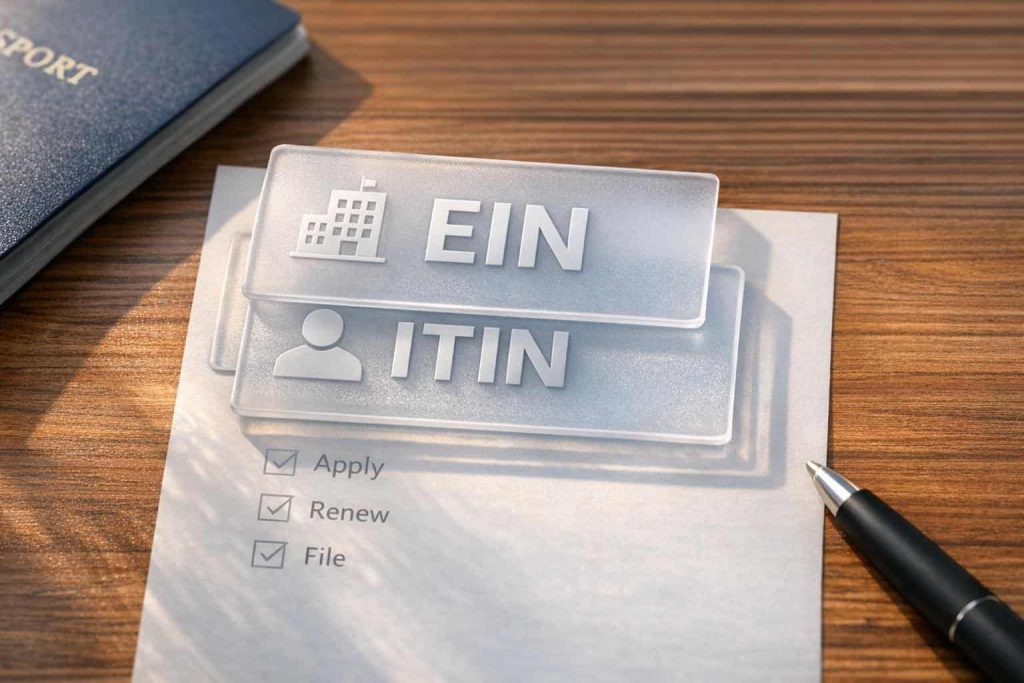
If you’re a non-resident running a U.S. business, you’ll need either an Employer Identification Number (EIN) or an Individual Taxpayer Identification Number (ITIN) to meet tax requirements. Here’s what you need to know:
- EIN: Used for businesses to file taxes, hire employees, open bank accounts, and more. It’s permanent and free to apply for through the IRS.
- ITIN: For individuals ineligible for a Social Security Number (SSN) to file U.S. taxes or claim treaty benefits. It expires after 3 years of non-use and requires renewal.
- Both are free from the IRS but have different application processes and purposes.
Key Differences:
- EIN is for businesses; ITIN is for individuals.
- EIN does not expire; ITIN does after 3 years of inactivity.
- EIN can be obtained online (for U.S.-based businesses) or by phone, fax, or mail. ITIN requires Form W-7 and proof of identity.
For non-residents, getting these numbers right is essential to avoid tax penalties and delays in business operations. Services like BusinessAnywhere can assist with applications, making the process smoother.
1. Employer Identification Number (EIN)
Purpose
An EIN, or Employer Identification Number, is a unique nine-digit federal tax ID (formatted as XX-XXXXXXX) that acts like a Social Security Number for your business. The IRS uses this number to track your business entity, whether it’s an LLC, corporation, partnership, or trust.
Having an EIN is essential for filing business tax returns, paying employment or excise taxes, and withholding taxes on income paid to non-resident aliens. Additionally, most U.S. banks require an EIN to open a business account. It’s also necessary for applying for business credit or obtaining certain licenses. If your business plans to hire employees – regardless of the owner’s residency status – you must have an EIN before bringing anyone on board.
Eligibility
All business entities, even those without employees, are eligible to apply for an EIN. This includes foreign entities like corporations, as long as they aren’t individuals. However, the application requires identifying a "responsible party" – a person who oversees the entity and must provide their SSN, ITIN, or EIN.
The IRS limits EIN issuance to one per responsible party per day. Before applying, make sure your LLC or corporation is officially registered with the state because the IRS considers the entity active once the EIN is issued. This activates a three-year window for required tax filings. Unlike ITINs, an EIN is permanent once assigned.
Expiration
An EIN is permanently tied to your business and does not expire. While the IRS cannot cancel an EIN once issued, they may deactivate your business account if it’s no longer needed. Be sure to keep your EIN notice secure – it’s often required for banking and licensing purposes.
Application Process
The EIN application process varies depending on your business location. If your principal place of business is outside the U.S., you won’t be able to use the online application tool. Instead, you can call the IRS at 267-941-1099 (available Monday through Friday, 6:00 a.m. to 11:00 p.m. Eastern time) to get your EIN immediately over the phone. Alternatively, you can fax Form SS-4 to 304-707-9471 and expect a response within about four business days. Mailing the form to:
Internal Revenue Service
Attn: EIN International Operation
Cincinnati, OH 45999
will take approximately four weeks for processing.
For U.S.-based businesses, the online application is an option if the responsible party has a valid SSN or ITIN. The IRS provides EINs free of charge, and you’ll receive your number immediately after completing the application. When filling out your business name, stick to letters (A–Z), numbers (0–9), hyphens (-), and ampersands (&). Avoid using symbols like "+" or "@" – spell them out instead.
If you’re an international entrepreneur or find the process overwhelming, services like BusinessAnywhere can assist. For $97, they handle the paperwork and communicate with the IRS on your behalf.
| Application Method | Eligibility | Processing Time |
|---|---|---|
| Online | U.S.-based businesses with a responsible party holding an SSN or ITIN | Immediate |
| Phone | International applicants (business outside the U.S.) | Immediate |
| Fax | All applicants | 4 business days |
| All applicants | 4 weeks |
Next, we’ll explore the ITIN, its purpose, and requirements.
sbb-itb-ba0a4be
2. Individual Taxpayer Identification Number (ITIN)
While an EIN is permanent, an ITIN has specific rules for its use and renewal that you need to understand.
Purpose
An ITIN, or Individual Taxpayer Identification Number, is a nine-digit tax processing number (formatted as NNN-NN-NNNN and always starting with "9") issued by the IRS for federal tax purposes. It’s meant for individuals who aren’t eligible for a Social Security Number (SSN) but need to file a U.S. tax return, report income, or claim tax treaty benefits.
"An ITIN is a 9-digit number the IRS issues if you need a U.S. taxpayer identification number for federal tax purposes, but you aren’t eligible for a Social Security number (SSN)." – Internal Revenue Service
Non-resident business owners often use an ITIN to file Form 1040-NR, report U.S. income, or claim tax treaty benefits. However, it’s important to understand that an ITIN does not authorize legal work in the U.S., change immigration status, or make the holder eligible for Social Security benefits. Its sole purpose is to ensure tax compliance.
Eligibility
To qualify for an ITIN, you must be a nonresident or resident alien who is ineligible for an SSN but requires a taxpayer identification number for federal tax purposes, such as filing a tax return or claiming treaty benefits. U.S. citizens, green card holders, and individuals with a U.S. work visa that allows them to obtain an SSN are not eligible for an ITIN.
If you already have an ITIN and later become eligible for an SSN, it’s your responsibility to inform the IRS so they can merge your tax records under the SSN.
These eligibility criteria are critical because they directly affect the ITIN’s validity and proper use.
Expiration
Unlike an EIN, an ITIN will expire if it hasn’t been used on a tax return for three consecutive years. To avoid delays, it’s essential to renew your ITIN promptly if it’s nearing expiration.
Application Process
Applying for an ITIN requires submitting Form W-7 along with a completed federal income tax return, such as Form 1040-NR. Both the tax return and the ITIN application must be sent together in the same package.
You’ll also need to provide original documents or certified copies from the issuing agency to verify your foreign status and identity. A passport is the only document that satisfies both requirements on its own. Alternatively, you can work with a Certifying Acceptance Agent (CAA) to have your documents verified in person.
The IRS typically processes ITIN applications within seven weeks. However, during peak filing seasons or for international applications, processing can take 9–11 weeks. If you send original documents, the IRS generally returns them within 60 days.
For those who find the process challenging, services like BusinessAnywhere offer ITIN application support to ensure everything is completed accurately.
| Application Option | Cost | Authenticates Documents | Helps Complete W-7 |
|---|---|---|---|
| IRS Taxpayer Assistance Center | Free | Yes | No |
| VITA Site | Free | Yes | Yes |
| Certifying Acceptance Agent (CAA) | Fee-based | Yes | Yes |
| Acceptance Agent (AA) | Fee-based | No | Yes |
One key detail: never send your tax return separately from your ITIN application. Both must be mailed together to the IRS Austin Service Center. If you’re making estimated tax payments before receiving your ITIN, write "ITIN TO BE REQUESTED" on the payment voucher to avoid confusion.
How EIN and ITIN Differ
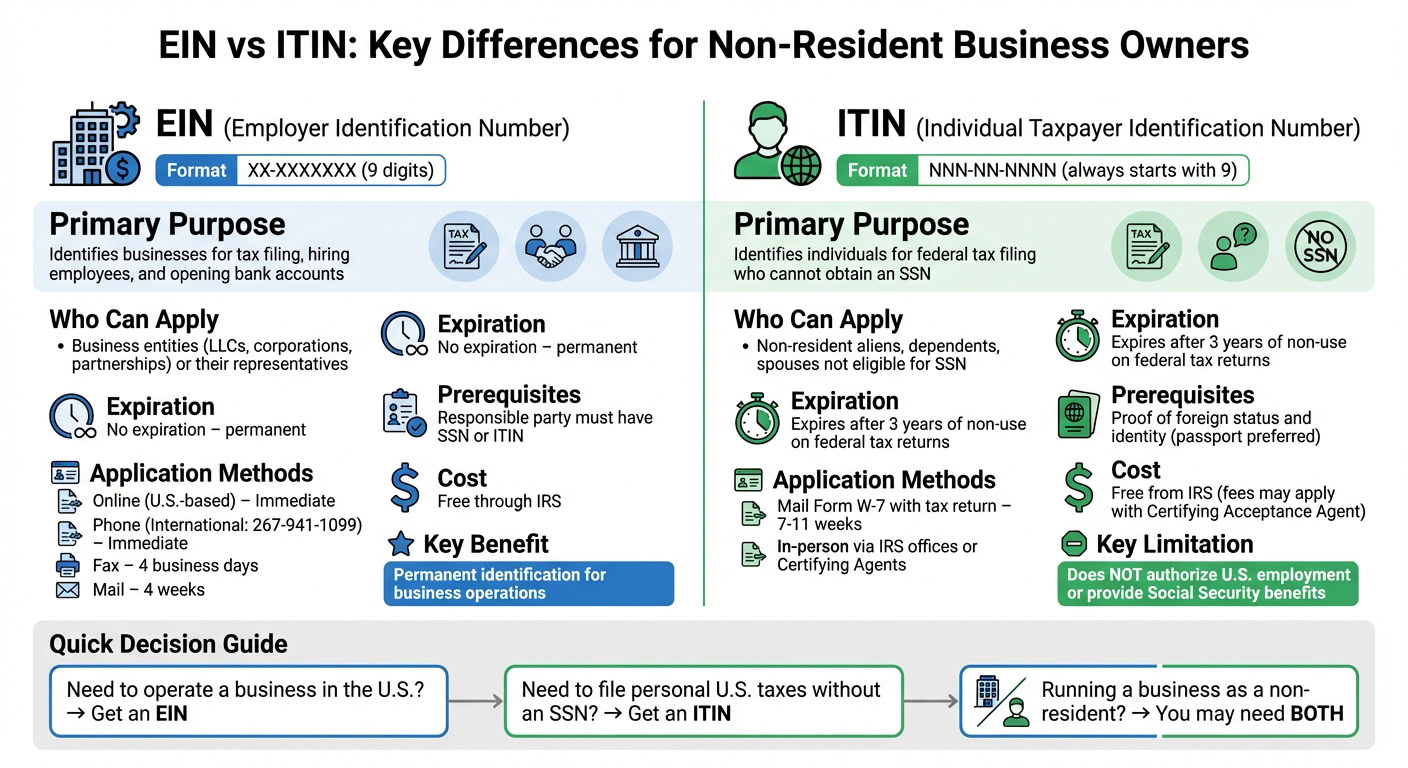
Let’s dive into the key differences between an Employer Identification Number (EIN) and an Individual Taxpayer Identification Number (ITIN). While both are nine-digit tax identification numbers issued by the IRS, they serve entirely different purposes and follow distinct rules for eligibility, expiration, and application.
An EIN is designed to identify business entities for tax-related purposes, such as filing taxes, hiring employees, and opening business bank accounts. On the other hand, an ITIN is intended for individuals who need to file federal tax returns but are not eligible for a Social Security Number (SSN). These fundamental differences also extend to their application processes and how long they remain valid.
One major distinction is that an ITIN expires if it hasn’t been used on a federal tax return for three consecutive years. In contrast, an EIN is permanently assigned to a business and does not expire.
Application Process Comparison
The steps to apply for these numbers vary significantly. U.S.-based businesses can secure an EIN instantly using the IRS online tool. International applicants, however, need to call 267-941-1099 to complete the process. For ITINs, the process is more time-consuming. Applicants must submit Form W-7, a completed federal tax return, and original or certified identity documents. Processing typically takes about 7 weeks but can stretch to 9–11 weeks during peak tax season.
Here’s a quick side-by-side breakdown of the main differences:
| Criterion | EIN | ITIN |
|---|---|---|
| Primary Purpose | Identifies businesses for tax filing, hiring, and banking. | Identifies individuals for federal tax filing who can’t obtain an SSN. |
| Who Can Apply | Business entities (LLCs, corporations, partnerships) or representatives. | Individuals not eligible for an SSN (e.g., non-resident aliens, dependents, spouses). |
| Expiration Rules | No expiration. | Expires after 3 years of non-use on federal tax returns. |
| Application Method | Online (U.S.-based), or by phone, fax, or mail. | Mail Form W-7 with a tax return or apply in person via IRS offices or Certifying Agents. |
| Processing Time | Immediate online (other methods vary). | Typically 7–11 weeks, depending on the season. |
| Prerequisites | Responsible party must have an SSN or ITIN. | Requires proof of foreign status and identity, with a passport being the preferred document. |
| Cost | Free through the IRS. | Free from the IRS (fees may apply when using a Certifying Acceptance Agent). |
BusinessAnywhere simplifies the application process for both EINs and ITINs, ensuring your forms are submitted correctly and processed efficiently.
Advantages and Disadvantages
Choosing between an EIN and an ITIN is a key decision for non-resident business owners looking to manage U.S. tax compliance effectively. Each identification number has its own set of benefits and drawbacks, which can impact everything from business operations to personal tax filing.
An Employer Identification Number (EIN) is crucial for establishing a business presence in the U.S. It allows you to open business bank accounts, hire employees, and apply for necessary licenses. The IRS issues EINs for free, and once assigned, the number is permanent. This makes it a reliable tool for managing US taxes for non-resident entrepreneurs and offers flexibility as your business grows and evolves. The application process, as noted earlier, varies depending on your location.
That said, EINs come with certain challenges. For instance, obtaining one means taking on ongoing compliance requirements, such as filing business tax or informational returns. The IRS also restricts the issuance of EINs to one per responsible party per day, which can slow down the process. Additionally, it may take up to two weeks for the EIN to be fully integrated into IRS systems, which could delay electronic filings and payments.
On the other hand, an Individual Taxpayer Identification Number (ITIN) serves a different purpose. Designed for federal tax reporting, it allows non-residents who don’t qualify for a Social Security Number to file tax returns and claim certain benefits. The application process is free if done directly through the IRS, and working with a Certifying Acceptance Agent (CAA) eliminates the need to send original documents like passports.
However, ITINs have notable limitations. They don’t authorize employment in the U.S., nor do they make you eligible for Social Security benefits or the Earned Income Credit. Processing times can vary, and ITINs expire if not used on a federal tax return for three consecutive years, requiring renewal and additional paperwork. If you later obtain an SSN, you’ll need to inform the IRS to merge your tax records.
For non-residents, services like BusinessAnywhere simplify the application process for both EINs and ITINs. Their EIN service is especially helpful for international entrepreneurs who need to set up their businesses quickly. Additionally, their Digital Nomad Kit offers a comprehensive package for managing both business and personal tax requirements. Carefully weighing the pros and cons of each identification number is essential for selecting the one that best fits your business goals.
Conclusion
Grasping the distinction between an EIN and an ITIN is crucial for non-resident business owners navigating U.S. tax requirements. An EIN serves as your business’s identification number, necessary for tasks like opening bank accounts, hiring employees, and filing business tax returns. On the other hand, an ITIN is a personal tax identification number used by individuals to file federal tax returns or claim treaty benefits when they don’t qualify for a Social Security Number.
If your business operates as an LLC or corporation, you’ll need an EIN. For individuals filing U.S. taxes, such as Form 1040-NR, an ITIN is required – and in many cases, you may need both. Choosing the right identifier ensures compliance with U.S. tax laws and avoids potential penalties. However, it’s worth noting that applying for these identifiers comes with its own set of challenges, especially for non-residents.
The process can be tricky for remote entrepreneurs. While both EINs and ITINs are free to apply for, non-residents often face hurdles like online restrictions and lengthy mail-based processing times, which can stretch up to 11 weeks. Additionally, applying for an EIN online requires a valid TIN, such as an SSN or ITIN.
To make this process easier, BusinessAnywhere offers services tailored for international entrepreneurs. Their EIN application service takes care of the IRS filing for a one-time fee of $97, simplifying the often-confusing Form SS-4. For ITIN applications, they assist with Form W-7, removing the hassle of mailing original documents. Their Digital Nomad Kit goes a step further, bundling services like tax identifier assistance, business formation, registered agent services, and compliance support – providing a comprehensive solution for managing both personal and business tax obligations.
FAQs
What is the difference between an EIN and an ITIN?
An Employer Identification Number (EIN) is a 9-digit number assigned to businesses by the IRS for tax-related activities. This includes filing taxes, hiring employees, or setting up a business bank account. It’s typically issued to entities like corporations, partnerships, sole proprietors, and trusts.
In contrast, an Individual Taxpayer Identification Number (ITIN) is designed for individuals who need a U.S. taxpayer identification number but don’t qualify for a Social Security Number (SSN). ITINs are primarily used by non-residents or individuals filing U.S. taxes who aren’t eligible for an SSN.
To sum it up, EINs are meant for business entities, while ITINs serve individuals who need to comply with U.S. tax laws but aren’t authorized to work or receive Social Security benefits.
How can I get an EIN if my business is located outside the U.S.?
If your business operates outside the U.S., you can still obtain an Employer Identification Number (EIN) directly from the IRS. For international applicants, the most straightforward way is to complete Form SS-4 and send it via fax or mail to the IRS office that handles requests from non-U.S. applicants. Make sure to include accurate information about your business, such as its legal structure and primary operations.
If you already have a valid Taxpayer Identification Number (ITIN or SSN), you might qualify to apply online. But for those without one, faxing or mailing the form remains the easiest route. An EIN is crucial for various business activities, including filing taxes, opening U.S. bank accounts, or importing goods into the country. It’s an essential step for non-resident business owners looking to operate in the U.S. market.
When do I need to renew my ITIN to ensure it stays active?
If you rely on your ITIN for tax purposes, it’s important to renew it before it expires. Generally, an ITIN needs renewal if it hasn’t been used on a tax return in the last three years or if it’s approaching its expiration date – typically five years after it was issued.
Renewing your ITIN promptly ensures there are no delays in processing your taxes and helps you stay compliant with U.S. tax laws. Take a moment to check your ITIN’s status and renew it in advance to avoid any disruptions.