

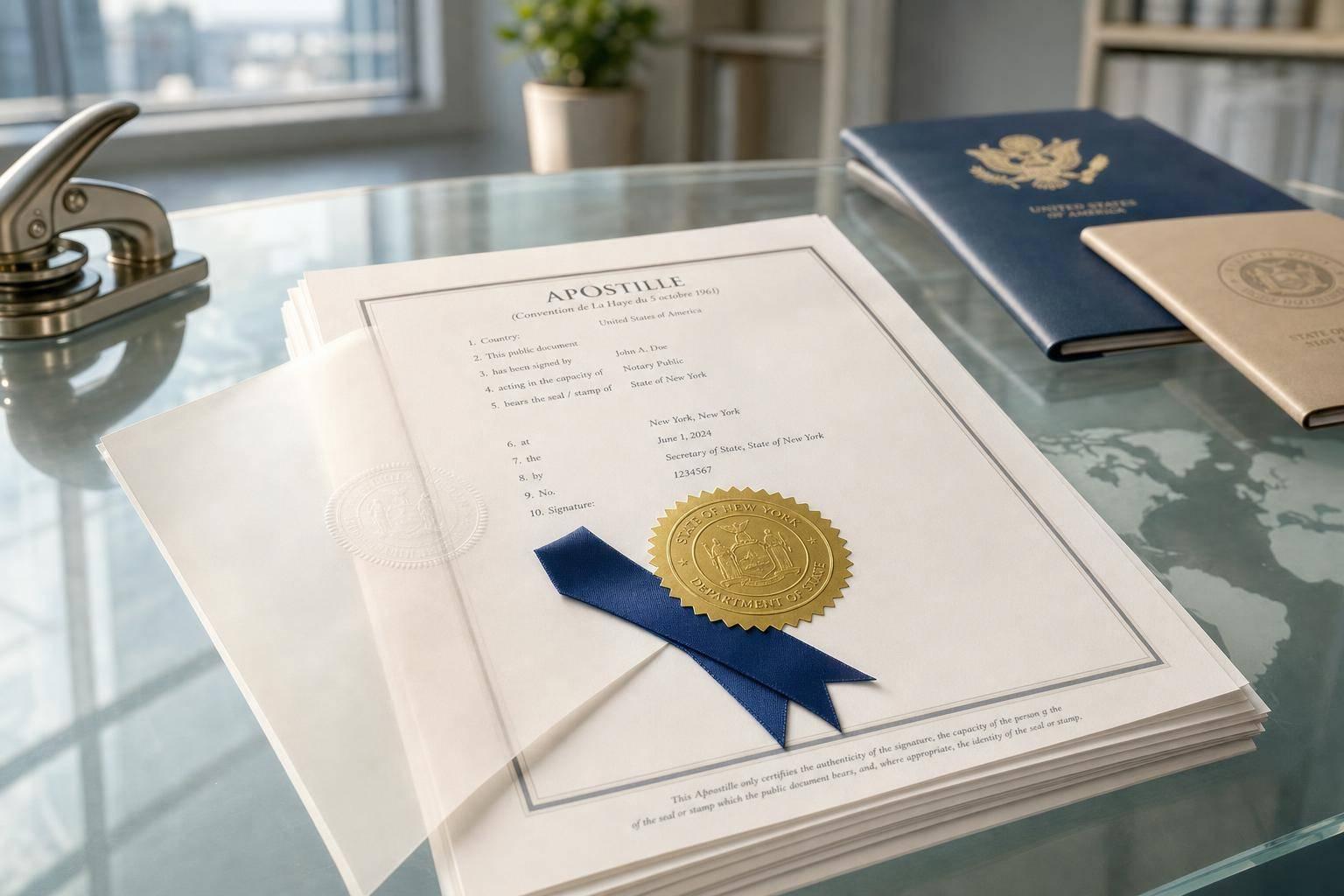
If a foreign bank, registry, court, or contract partner asks for proof that your U.S. document can be used abroad, you may need an apostille. An apostille is a certificate that confirms the signature or seal on a public or notarized document for use in countries that follow the Hague Apostille Convention.
Here’s the short version:
- Use an apostille when the destination country is in the Hague Convention
- Use legalization when the destination country is not in the Hague Convention
- Notarization and apostille are not the same thing
- State records often need certified copies
- Business-created documents often need notarization first
- Federal documents go through the U.S. Department of State, not a state office
In most cases, I’d check just 3 things first:
- Where is the document going?
- Did the foreign party ask for an apostille in writing?
- Is the document state-issued, notarized, or federal?
That’s usually enough to avoid the most common problem: a rejected filing caused by sending the wrong document to the wrong office.
A few facts matter here:
- The Hague Apostille Convention dates back to 1961
- It applies only when both countries are members
- An apostille confirms the official signature or seal, not the truth of the document itself
- A plain photocopy is often not accepted
- For many cross-border business tasks, one missing notary seal or one old company record can stop the process
Bottom line: if you’re opening an overseas bank account, registering a foreign branch, signing a cross-border deal, or filing in a foreign court, I’d confirm the country, the document type, and the issuing office before submitting anything.
This article explains when an apostille is needed, which business documents usually require one, and how to get an apostille for your business documents before you send your paperwork out.
What an Apostille Is and How It Differs From Notarization
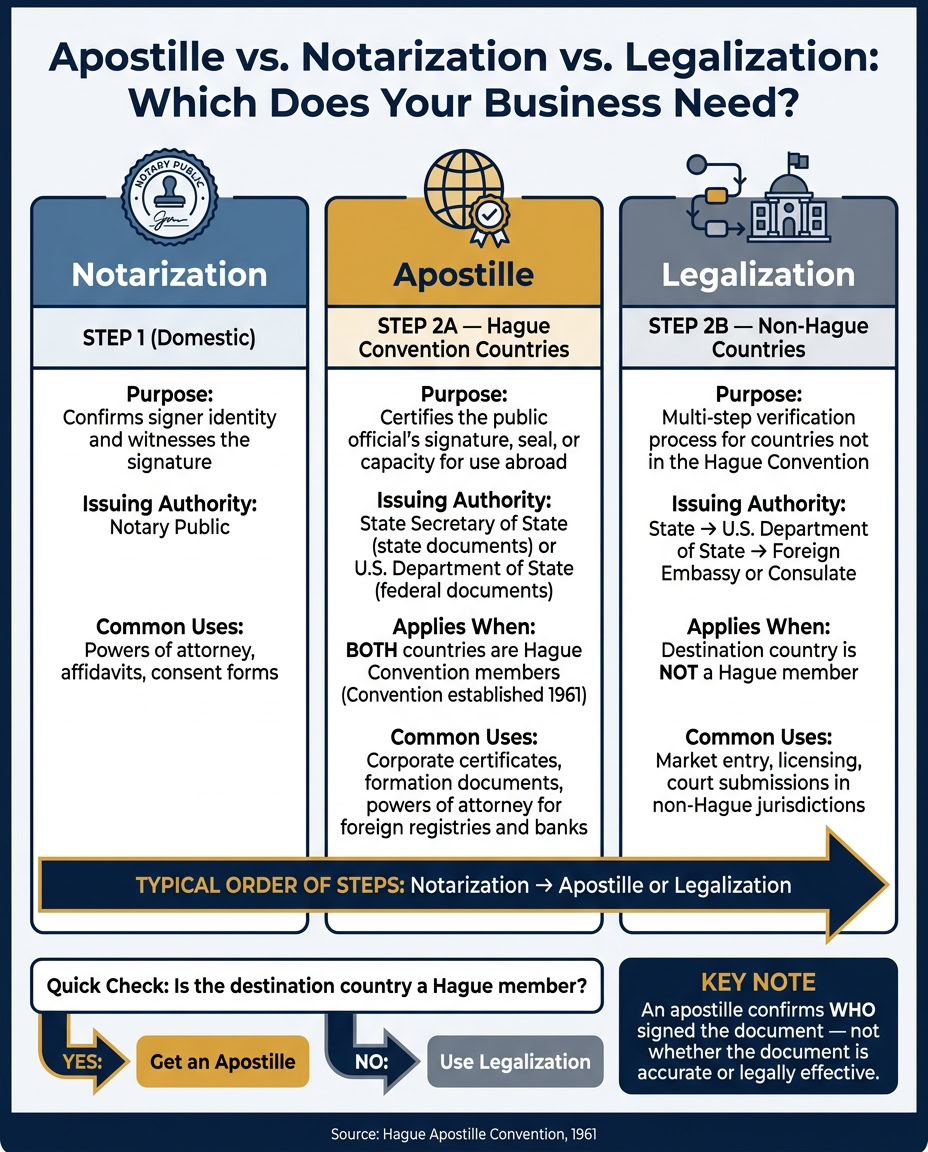
Once you know what an apostille does, the next step is understanding how it differs from notarization and other certifications.
An apostille is a government-issued certificate that verifies the signature, seal, or official authority on a U.S. public or notarized document. It does not verify the facts in the document or its legal effect.
In plain business terms, an apostille confirms who signed the document, not whether the document is accurate.
That matters because a document can still be rejected if it’s outdated, incomplete, or formatted the wrong way for the receiving country.
Apostille vs. Notarization vs. Authentication
These steps often get mixed up, but they do different jobs and usually happen in a set order. A notary public checks a signer’s identity and witnesses the signature. That’s a domestic step. An apostille comes after that and certifies the public official’s signature, seal, or capacity for use in Hague Convention countries. If the destination country isn’t a Hague member, the document goes through legalization instead.
| Step | Purpose | Issuing Authority | Common Business Use Cases |
|---|---|---|---|
| Notarization | Confirms identity, signature, or oath | Notary public | Powers of attorney, affidavits, consent forms |
| Apostille | Certifies the public official’s signature, seal, or capacity for Hague countries | State Secretary of State or U.S. Department of State | Corporate certificates and filings for Hague member countries |
| Legalization for non-Hague countries | Verifies documents for non-Hague countries through a multi-step legalization process | State, U.S. Department of State, and foreign embassy/consulate | Market entry into non-Hague jurisdictions, licensing, court submissions abroad |
A notarized power of attorney shows how these steps fit together. The notary validates the signing process. Then the state apostille certifies the notary’s authority so the document can be accepted abroad. One step doesn’t replace the other.
When the Hague Convention Applies
The 1961 Hague Apostille Convention applies only when both the issuing country and the destination country are members. For U.S. businesses, that decides which document path to follow.
Before you prepare any document for use overseas, check the destination country’s Hague membership status. If both countries are Hague members, an apostille is the right certification. If the destination country is not a Hague member, you’ll need the longer legalization process instead.
With that line drawn, the next section covers when a business actually needs an apostille.
sbb-itb-ba0a4be
When Your Business Needs an Apostille
Businesses usually need an apostille when a foreign authority has to verify a U.S. document for an official transaction. In plain English, this usually shows up when you’re setting up abroad, opening a bank account, or handling a big cross-border deal.
Forming a Foreign Subsidiary or Registering Abroad
Foreign registries usually want proof that your company exists, is active, and properly approved the move into a new country. If the country is part of the Hague Convention, the registry will often ask for apostilled articles of organization or incorporation, an apostilled certificate of good standing, and an apostilled board or member resolution that approves the foreign registration.
A fresh certificate of good standing matters here. It shows your company’s current status, not what was true months ago. So it’s smarter to order a new copy instead of pulling an old one from your files.
You’ll often need that same proof-of-status package for bank onboarding too.
Opening an Overseas Bank Account or Confirming Signer Authority
Foreign banks usually ask for apostilled formation documents, a certificate of good standing, a banking resolution, and, if someone local will act for the company, a power of attorney.
Here’s the part that trips people up: banks usually won’t open the account until they have the FULL apostilled package in hand. So don’t wait until onboarding starts. Get those documents lined up first.
This same issue shows up in contracts, procurement matters, and disputes as well.
Signing International Contracts or Proving Company Status Abroad
Apostilles also come into play in high-value cross-border contracts, public tenders, and foreign court or arbitration proceedings.
For high-value contracts, foreign counterparties often want proof that the signer has the authority to bind the company. That usually means an apostilled resolution or power of attorney, along with company records.
For government tenders, procurement agencies may require apostilled notarized affidavits that cover ownership disclosures or compliance declarations.
In arbitration or foreign litigation, tribunals may require apostilled corporate records and powers of attorney for legal representatives before they accept evidence or confirm who speaks for the company.
Typical document sets:
| Scenario | Core Document Package |
|---|---|
| Foreign subsidiary or branch registration | Apostilled articles of organization or incorporation, certificate of good standing, expansion resolution |
| Overseas bank account | Apostilled formation documents, certificate of good standing, banking resolution, power of attorney |
| International contract or tender | Apostilled resolution or POA confirming signer authority, company status records, notarized affidavits |
| Foreign court or arbitration | Apostilled notarized affidavits, POA for legal representative, certified corporate records |
Most of these requests start with the same small group of document types.
Business Documents That Are Commonly Apostilled
Most apostille requests fit into three buckets: state records, governance documents, and notarized statements. That split matters because it tells you what has to happen first. Some documents need certification. Others need notarization. Once you know the bucket, sorting the paperwork gets a lot easier.
State-Issued Company Records
These documents come from a Secretary of State or a similar state office. In most cases, they’re apostilled as certified copies. They usually do not need notarization first.
Foreign registries and banks often rely on these records to confirm that a company exists and is in good standing.
Common examples include:
- Articles of organization or incorporation
- Certificate of good standing (called a certificate of status in some states)
- Certified copies of filed company records
It’s smart to order more than one certified copy. Foreign agencies and banks often ask for original certified documents, not just one set.
Authority and Governance Documents
Governance documents show who has the power to act for the company overseas. Since these documents are created inside the business, they usually need to be notarized before they can receive an apostille.
One point trips people up all the time: the apostille does not verify what the document says. It verifies the notary’s signature and seal.
| Document | What It Confirms Abroad |
|---|---|
| Power of attorney | Who is authorized to act for the company |
| Board resolution or member consent | That a specific action was formally approved |
| Banking resolution | Who can open or manage a company bank account |
| Operating agreement | How the LLC is governed |
| Corporate bylaws | How the corporation is structured and managed |
| Partnership agreement | Ownership and authority in a partnership |
Small notarization mistakes can cause big delays. A missing seal, incomplete wording, or another notary error may stop the apostille from being issued.
Notarized Statements and Supporting Paperwork
Notarized affidavits and declarations are often apostilled when a business needs to make a sworn statement about ownership, control, or other company facts. Here again, the apostille certifies the notary, not the truth of the statement itself.
A simple rule helps here: if you have an official state record or a notarized business document that will be used in a Hague country, it will likely need an apostille. By contrast, photocopies, unsigned drafts, and informal files don’t qualify yet. They first need to become a certified copy or a notarized original.
Next, check whether the document needs to be notarized, certified, or reissued before you submit it.
How to Prepare Your Document and What to Do Next
A Simple Checklist Before You Submit
Once you know your document can be apostilled, run through this checklist before you send it in. Most rejections happen for a pretty simple reason: the document went to the wrong office, the copy wasn’t acceptable, or the notarization had a problem.
- Confirm Hague membership: Check whether the destination country is a Hague member. If it isn’t, you’ll need consular legalization instead.
- Ask the foreign bank, registry, or counterparty in writing whether it requires an apostille: This helps you avoid getting an apostille for a document that doesn’t need one.
- Check your copy type: Use an original or certified copy with a visible seal, signature, and date. Plain photocopies are often rejected.
- Submit to the correct office: State-issued or notarized documents go to the Secretary of State in the state where the document was issued or notarized. Federal documents, such as IRS letters or FBI background checks, go to the U.S. Department of State, Office of Authentications. For federal submissions, use Form DS-4194 and follow the current per-document fee requirements.
If your notarized document is missing the notary’s seal, commission number, or expiration date, the apostille office may reject it. It’s worth double-checking the notarization before you mail anything. That small step can save you time, money, and a lot of back-and-forth.
Conclusion: How to Quickly Decide If You Need an Apostille
If your document passes these checks, you already know which office to use and what to get ready next.
Stick with three checks: Hague status, recipient demand, and document type. If the destination country is a Hague member and the receiving institution asks for an apostille, get one. Then use the document type to choose the right office: state, notary-based, or federal. That’s the fastest way to avoid rejection.
FAQs
How long does an apostille take?
Apostille processing times can be all over the map. In some states, it takes just a few days. In others, it can stretch into several weeks, especially when offices are dealing with a high volume of documents.
To give yourself some breathing room, start the process 4 to 6 weeks before your deadline.
Some states also offer expedited service for an extra fee. That can cut processing down to 1 to 2 business days or even same-day service. For federal documents, apostilles from the U.S. Department of State usually take about seven business days.
Can I apostille a scanned copy?
No, you generally can’t apostille a scanned copy. Apostille requests usually require an original document or a certified copy.
Standard photocopies or plain digital prints usually aren’t accepted. A certified copy must be issued by the proper authority and include original seals, signatures, and a date of issuance.
What if the country is not in the Hague Convention?
If the destination country is not a Hague Convention member, an apostille will not work for your documents. In that case, you’ll need authentication or legalization instead.
That usually involves a few steps. First, your document is certified by a local or state authority. Then it goes to the U.S. Department of State for authentication. After that, the destination country’s embassy or consulate legalizes it.