

When managing rental properties or running a business, using your home address in leases, eviction notices, or state filings can expose your personal information. This makes your home accessible to tenants, legal servers, or even scammers. To protect your privacy while staying compliant with legal requirements, here’s what you can do:
- Avoid using your home address: State filings and leases often become public records, risking unwanted visits or identity theft.
- Understand legal requirements: Most states require a physical address for legal documents – PO boxes typically don’t qualify.
- Use a registered agent: For LLCs or corporations, a registered agent provides a physical address to receive legal documents on your behalf.
- Opt for a virtual business address: This offers a professional street address for leases and tenant communications while keeping your home private.
Both solutions are affordable and meet legal standards. Registered agent services cost around $125 per year, while virtual business addresses range from $20 to $100 monthly. These services safeguard your privacy and ensure you’re reachable for legal and business matters.
Why Using Your Home Address on Legal Documents Is Risky
Listing your home address on a lease or state filing might seem harmless, but it can open the door to serious privacy concerns. Once your address becomes public, you lose control over who can access it and how it might be used.
Privacy Issues with Leases and Eviction Notices
Including your home address in a lease essentially hands tenants a direct route to your residence. While landlord-tenant relationships are often peaceful, disputes or evictions can escalate into uncomfortable or even hostile situations. In some cases, disgruntled tenants may show up at your home uninvited, or you might find process servers delivering lawsuits or subpoenas to your doorstep.
"What started as a business problem became personal security concerns for her family’s safety." – MyLLC.com Education Team
But it’s not just tenant issues that pose a risk. State filings can further expose your home address, making it publicly available for anyone to find.
How State Filings Make Your Address Public
When you register an LLC or submit business formation documents with your Secretary of State, your address often becomes part of the public record. These databases are free to access online, meaning anyone – from nosy competitors to identity thieves – can search for your business and locate the registered agent’s physical address.
Adding to the problem, third-party data brokers frequently scrape this publicly available information to create business profiles that show up in Google search results. Even if you update your address later, the original records remain online, making it nearly impossible to completely remove your home address once it’s entered the public domain.
What the Law Requires for Addresses on Leases, Eviction Notices, and State Filings
When it comes to legal documents like leases, eviction notices, and state filings, having a valid physical street address is more than just a formality – it’s a legal necessity. While the exact requirements vary by jurisdiction, the underlying goal is consistent: ensure there’s a reliable way to deliver legal documents.
State Rules for Landlord Addresses
In most states, landlords are required to provide a physical address where they or their authorized agents can receive legal papers. For instance, California Civil Code Section 1962 specifies that landlords must disclose the "usual street address at which personal service may be effected" for the owner or property manager. Similarly, New York law mandates that written leases include "the name and address of the owner (landlord)". This is a critical consideration when learning how to set up an LLC for real estate.
"Disclose therein the name, telephone number, and usual street address at which personal service may be effected of each person who is… An owner of the premises or a person who is authorized to act for and on behalf of the owner for the purpose of service of process and for the purpose of receiving and receipting for all notices and demands." – California Civil Code Section 1962
This means the address provided must be a location where legal documents can be hand-delivered to a real person. If a landlord in California fails to provide a valid address, tenants are left with no choice but to use registered or certified mail for delivering legal notices. These requirements are in place to ensure tenants have a dependable way to communicate with their landlord, especially in situations where disputes arise.
The same principles apply to state business filings, which also enforce strict physical address requirements to ensure reliable legal contact.
Address Requirements for State Business Filings
State laws governing business filings are equally stringent. When registering an LLC or corporation, businesses must designate a registered agent with a physical street address in the state. This ensures that someone is physically present to accept lawsuits and official notices. For example, Virginia’s State Corporation Commission explicitly states that "a Post Office box is not acceptable" for a registered agent’s address. Similarly, Oregon law (ORS 63.111) prohibits using commercial mail receiving agencies, mail forwarding services, or virtual offices as registered agent addresses.
Starting July 1, 2025, Colorado will require registered agents to maintain a physical business address that is open during normal business hours. These rules are designed to prevent fraud and ensure that states can reliably contact businesses for legal matters. Additionally, the registered agent’s address will be publicly accessible on the Secretary of State’s website.
Why PO Boxes Don’t Work for Most Legal Documents
Using a PO box might seem like a good way to keep your home address private, but most states require a physical street address for legal documents. This creates challenges when important paperwork needs to be delivered reliably.
Legal documents often demand a physical address where someone is available during regular business hours to receive them.
"Many people think they can just use a P.O. box instead of their home address, but many states require a full business address and won’t accept your filing if you use a P.O. box." – Jacqueline Horani, Business Attorney
Another issue is that delivery services like UPS and FedEx don’t deliver to PO boxes. This can cause delays when time-sensitive documents need to reach you. Additionally, banks usually reject PO boxes for business accounts due to federal "Know Your Customer" rules, which mandate a verifiable physical address.
Even in unique situations, like small Virginia towns with fewer than 2,000 residents, PO boxes are rarely practical because of strict state regulations. To comply with legal requirements while maintaining privacy, a verified physical address is essential. Many landlords find that setting up a virtual business address is the most effective solution. Up next, we’ll look at alternatives that meet these legal standards without compromising your privacy.
Address Options That Protect Your Privacy
Now that we’ve covered why PO boxes might not meet your needs, let’s dive into two practical alternatives. These options not only safeguard your privacy but also ensure you comply with legal requirements.
Registered Agent Services for State Filings
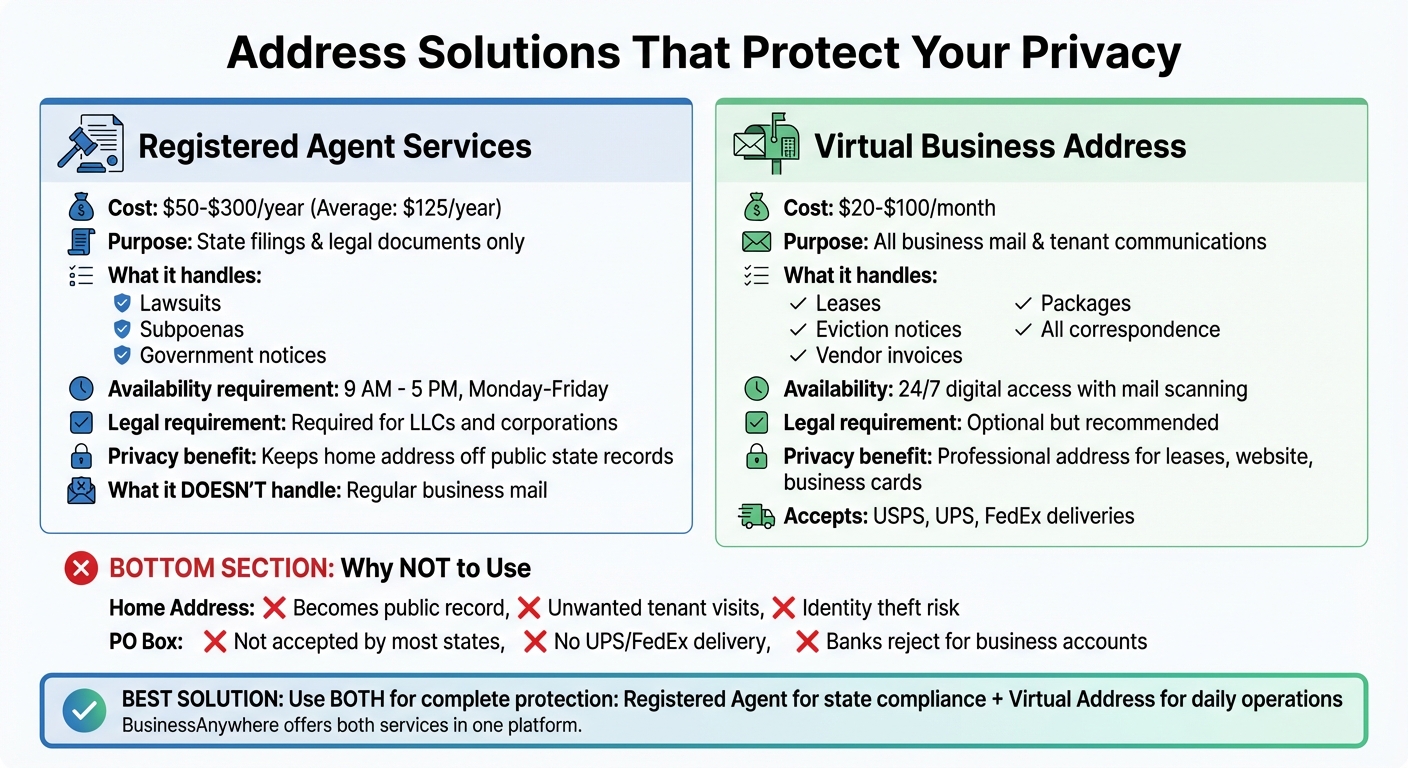
If you own an LLC or corporation, having a registered agent isn’t optional – it’s a legal requirement. A registered agent provides a physical street address in your state and handles official documents like lawsuits, subpoenas, and government notices on your behalf. By using their address instead of your home address, you keep your personal information off public records.
"If you serve as your own registered agent, your business address and your registered agent address will be one and the same… business formation documents are part of the public record, and the addresses you share on these forms will be viewable online." – Northwest Registered Agent
The cost of professional registered agent services typically falls between $50 and $300 per year, with $125 being the average. These services are required to be available during standard business hours (9 a.m. to 5 p.m., Monday through Friday) to receive legal documents. However, it’s important to note that registered agents only handle legal and government-related paperwork – they don’t manage your regular business mail.
Virtual Business Addresses for Leases and Notices
A virtual business address can provide a verified street location for your day-to-day operations. Unlike PO boxes, these addresses can receive mail and packages from carriers like UPS and FedEx, making them suitable for leases, eviction notices, and tenant communications.
Using a virtual address lets you present a professional image while keeping your home address private. You can include it on your website, business cards, and other materials. Many providers also offer mail scanning and forwarding services, giving you digital access to your correspondence.
Unlike registered agent services, virtual business addresses handle all types of mail, not just legal documents. This makes them a versatile choice, especially for landlords who need a reliable address for tenant communications, vendor invoices, and everyday business matters. Prices typically range from $20 to over $100 per month.
sbb-itb-ba0a4be
How to Set Up a Virtual Address with BusinessAnywhere

Setting up a virtual address is straightforward when you follow these steps for compliance and efficiency.
Choosing the Right Virtual Address Plan
BusinessAnywhere offers three virtual mailbox plans tailored to different needs:
- Basic Plan: Priced at $20 per month (billed annually), this plan supports up to 2 recipients, making it a great choice for solo landlords managing a few properties.
- Premium Plan: At $30 per month, this plan accommodates up to 5 recipients, ideal for those with a business partner or multiple LLCs.
- Advanced Plan: For $65 per month, this plan covers up to 20 recipients, perfect for larger operations with multiple team members or entities.
All plans include unlimited mail scanning, so you can access your mail digitally from anywhere. BusinessAnywhere provides virtual addresses in Florida, Arizona, New Mexico, and Wyoming – states known for their favorable business regulations and privacy safeguards.
When selecting a plan, think about how much mail you handle. If you’re managing several rental properties and regularly deal with tenant correspondence, vendor invoices, or legal notices, the Premium or Advanced plan may provide the flexibility you require. To authorize mail handling, complete USPS Form 1583, which requires notarization and two forms of ID (one must be a photo ID).
Once you’ve chosen your plan, update all business documents to reflect your new virtual address.
Updating Your Leases, Notices, and State Filings
After setting up your virtual address, the next step is to update your official records, leases, and notices.
Start by updating your filings with the Secretary of State. If your LLC or corporation currently lists your home address as its principal business address, submit a "Change of Address" or "Articles of Amendment" form to your state. Filing fees typically range from $25 to $100, depending on the state.
Next, update your business address with the IRS by submitting Form 8822-B (Change of Address or Responsible Party – Business). For leases, revise the "Notices" section to ensure tenants send all communications and payments to your virtual address. If you have existing leases, you can add a lease addendum to notify tenants of the change. For legal matters, make sure your virtual address is listed as the official landlord address for service of process and return mail.
Finally, update your bank records, payment processors, and marketing materials to reflect your new address. This ensures consistency across all platforms and correspondence.
The Benefits of Using Multiple BusinessAnywhere Services Together
Simplifying Paperwork with Multiple Services
Using BusinessAnywhere’s registered agent, virtual mailbox, and online notary services together makes managing your business a lot easier. Instead of juggling multiple platforms, you can handle everything – mail, scanned documents, and notary tasks – from a single dashboard. This setup not only saves time but also ensures you don’t miss important deadlines or legal notices.
In fact, businesses that streamline their workflows this way see 27% faster profit growth over three years. For landlords, this means spending less time on administrative tasks and more time managing properties. For example, if your registered agent forwards a legal notice, it appears instantly in your virtual mailbox as a searchable PDF. Need to notarize Form 1583 to authorize mail handling? BusinessAnywhere’s online notary service lets you do it remotely for $37 per session – no need to schedule an in-person appointment.
This integration doesn’t just simplify your operations; it also helps protect your privacy.
Getting More Privacy and Convenience
Bundling these services isn’t just about efficiency – it’s also about keeping your business address private. Together, they create a privacy shield that keeps your home address off public records. Your registered agent and virtual mailbox work together to meet legal requirements while keeping your actual address hidden. This means you can maintain privacy without sacrificing access to critical mail or legal documents.
The savings in time and money are substantial. Businesses using consolidated solutions save about $1,660 per employee annually by cutting down on trips to the bank, retrieving physical mail, and dealing with paperwork. For landlords managing multiple properties, this translates to fewer headaches and instant access to documents from your phone or laptop. With less time spent on administrative tasks, you can focus on what really matters – finding great tenants, keeping your properties in top shape, and expanding your rental portfolio.
Conclusion
Maintaining your privacy while staying compliant with legal requirements is entirely possible. Your home address doesn’t need to appear on leases, eviction notices, or state filings where it becomes publicly accessible. This exposure can be avoided with reliable solutions that align with legal standards.
By using a registered agent for state filings and a virtual business address for leases, you can keep your personal address off public records while meeting all legal obligations. These services are both affordable and practical, with registered agents typically costing around $125 per year and virtual mailboxes ranging from $20 to $100 per month. Not only do they protect your privacy, but they also enhance your professional image and ensure compliance with regulations.
"Customers may be more likely to trust a business that has a physical address rather than just a P.O. box address." – Jeb Smith, Founder, Parker Marker
With services like BusinessAnywhere, you can streamline everything in one place. They offer registered agent services, virtual mailboxes, and online notary options, including remote online notarization, all accessible from a single dashboard. This means you can manage mail scanning, legal documents, and notarizations without juggling multiple providers.
Take the step now – set up your virtual address and registered agent service before your next filing. It’s a simple way to safeguard your privacy and draw a clear line between your personal and business life.
FAQs
Why should I use a registered agent for my rental property business?
Using a registered agent for your rental property business can make life a lot easier. In most states, businesses like LLCs or corporations are required to appoint a registered agent to handle legal documents and official notices. This agent must have a physical address in the state where your business is registered and be available during regular business hours. That way, you won’t miss critical documents like tax notices or lawsuits.
But there’s more to it than just meeting legal requirements. A registered agent helps safeguard your privacy by keeping your personal address off public records. Instead, their address is used, which can protect you from unwanted visitors or even scams. They also provide a consistent mailing address, which is especially handy if you move or grow your business to new locations. For a relatively small yearly fee, you get dependable document management, stay legally compliant, and enjoy a little extra peace of mind.
How does a virtual business address help protect my privacy as a landlord?
A virtual business address serves as a shield for your personal privacy by replacing your home address on leases, eviction notices, and state filings. This means your home address won’t show up in public records, keeping tenants, process servers, and other unwelcome visitors from knowing where you live.
Beyond privacy, many virtual address services offer extras like mail forwarding or scanning. These features ensure that all your important correspondence reaches you securely, without anyone knocking on your door. It’s a practical way to enhance your safety while also meeting legal requirements for having a physical address tied to your rental business.
On top of that, a virtual address can give your business a polished, professional image. This can help reduce the risk of fraud, make it easier to open business bank accounts, and simplify license applications – all while keeping your personal residence off the radar.
How can I update my business address on legal documents while keeping my home address private?
To update your business address on legal documents while maintaining your privacy, the first step is to figure out which addresses need to be updated. This might include your registered agent address or principal office address. Keep in mind, these addresses usually require a physical street location – P.O. Boxes won’t cut it. Once you’ve identified the necessary changes, file the required forms with your state’s Secretary of State office, such as Articles of Amendment, making sure to include the new address and any other necessary details.
You’ll also need to notify the IRS by submitting Form 8822-B, update your state tax registrations, and inform banks, insurers, and other relevant organizations about the change.
If privacy is a concern, think about using a registered agent service or a virtual business address. These services fulfill legal requirements while keeping your personal address off public records.