

When running a real estate investment business, you’ll encounter registered agents and virtual mailboxes – two services that are often confused but serve entirely different purposes. Here’s the quick breakdown:
- Registered Agent: Legally required for LLCs and corporations in all 50 U.S. states. They receive lawsuits, tax notices, and official government documents on behalf of your business. Without one, your business risks fines, losing its good standing, or even being dissolved.
- Virtual Mailbox: Optional service that provides a professional address for receiving and managing mail online. It’s ideal for protecting your privacy, handling mail remotely, and keeping your home address off public records.
Key Takeaway: A registered agent is mandatory to stay compliant with state laws, while a virtual mailbox is a smart solution for privacy and convenience. Many investors use both to cover legal requirements and streamline business operations.
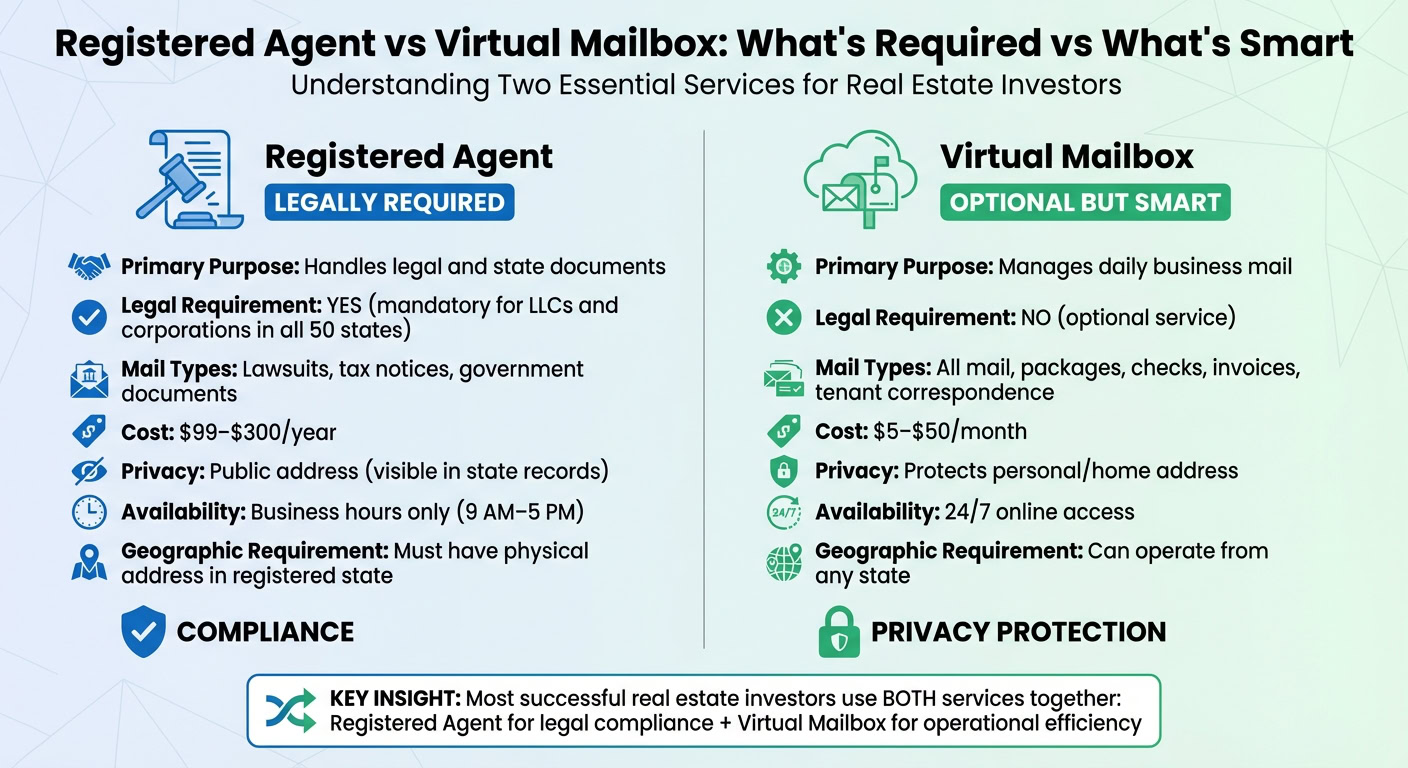
| Feature | Registered Agent | Virtual Mailbox |
|---|---|---|
| Primary Purpose | Handles legal and state documents | Manages daily business mail |
| Legal Requirement | Yes | No |
| Cost | $99–$300/year | $10–$50/month |
| Privacy | Public address | Protects personal/home address |
Using both services together ensures compliance while simplifying mail management. For investors managing LLCs across multiple states or working remotely, this combination is a practical choice.
Registered Agents: What Real Estate Investors Are Required to Have
What a Registered Agent Does
A registered agent acts as the official point of contact between your real estate business and the state government. Their main responsibility is to receive "service of process" documents – such as lawsuit notifications – along with tax forms, annual report reminders, and other official communications from the state. Essentially, they serve as your business’s legal mailbox. This role must be filled by either a real person or a company with a physical address (not a P.O. Box) in your state of formation. They also need to be available during normal business hours, typically Monday through Friday.
For real estate investors, this role becomes particularly critical when dealing with issues like property disputes, tenant lawsuits, or code violations. Missing a legal notice could result in an automatic default judgment. Additionally, the registered agent’s address is part of the public record, which is why many investors prefer using professional services rather than listing their home address.
Legal Requirements and Compliance Risks
Every LLC, Corporation, and PLLC across all 50 states is required to have a registered agent – this isn’t optional. The state enforces this rule to ensure there’s a reliable way for courts, government agencies, and the public to contact your business. Failing to appoint a registered agent can lead to severe consequences, including hefty fines, losing your Certificate of Good Standing (which is essential for financing or selling property), and even administrative dissolution, where the state shuts down your business.
If your business operates in multiple states, you’ll need a registered agent with a physical presence in each state where you conduct business. Professional registered agent services generally cost between $100 and $300 per year.
Why You Can’t Use a Registered Agent Address for Everything
A registered agent’s address is designated only for legal and state documents. It cannot be used as your general business address, for IRS filings, or for receiving regular tenant mail – unless you have additional service agreements in place.
Joe Horan, the owner of Wrightwood Homes, a property-buying firm based in Indianapolis, experienced this firsthand. Initially, he served as his own registered agent but later decided to appoint his attorney for the role at an annual cost of about $100. Reflecting on his decision, Horan shared:
I originally chose myself because it was the easiest way to start my LLC. But I’ve recently chosen my attorney to be my registered agent… She can handle all necessary paperwork and be the ‘legal face’ of my business. – Joe Horan, Owner, Wrightwood Homes
If you need an address for general business mail, client correspondence, or package deliveries, a virtual mailbox is a better solution. You can find answers to common questions about virtual mailboxes to see how they fit your specific business model. This distinction highlights the importance of having a separate mailing option to handle everyday business needs.
sbb-itb-ba0a4be
Virtual Mailboxes: What’s Smart but Not Required
While having a registered agent is a legal necessity, opting for a virtual mailbox can offer some practical perks for your business operations.
What a Virtual Mailbox Is
A virtual mailbox is a service that provides you with a professional street address where your mail is received, sorted, and managed through a secure online platform. Unlike a standard P.O. Box, this address looks more legitimate, making it suitable for business cards, contracts, and even bank applications.
Here’s how it works: When mail arrives, it’s scanned, and you can view, forward, or shred items using an online dashboard. Some services even allow you to deposit checks remotely, which is particularly helpful for handling rent payments or distributions.
To set up a virtual mailbox, you’ll need to complete USPS Form 1583. This form requires notarization and two forms of identification to authorize the provider to manage your mail. This simple process not only makes mail management easier but also adds a layer of privacy and flexibility – both valuable for business owners.
Benefits of Virtual Mailboxes for Real Estate Investors
A virtual mailbox offers more than just convenience. For real estate investors, it brings several key advantages:
- Privacy Protection: By using a virtual address, you can keep your home address off public records, invoices, websites, and marketing materials. This added privacy reduces the risk of identity theft, a concern shared by many Americans.
- Remote Accessibility: If you own properties across multiple states or travel often, a virtual mailbox ensures you can manage your mail from anywhere. This is especially useful for home-based businesses.
- Professional Image: A virtual address in a major city can elevate your credibility with lenders, vendors, and business partners. It’s also helpful for opening business bank accounts, registering domain names, and drafting contracts.
- Security: Mail is stored in secure facilities with encrypted servers and 2048-bit SSL connections, protecting sensitive documents and preventing issues like package theft.
How Virtual Mailboxes Handle Your Mail
Virtual mailbox services give you 24/7 digital access to your mail. When you receive a notification about new mail, you can instantly view a scanned image of the envelope and decide whether to open, forward, or shred it.
These services also handle packages, accepting deliveries from UPS, FedEx, DHL, and USPS. The cost typically ranges from $10 to $50 per month, depending on the level of service you choose, with additional fees for extras.
"A virtual business address is a real street address managed remotely through a virtual address services provider. It provides businesses with a professional address without the need for a physical location, allowing for privacy and security while receiving business mail."
– LegalZoom
Before using a virtual mailbox for registering your LLC for real estate, check with your local Secretary of State to confirm whether virtual addresses are accepted. Some states require a physical address for registration. Similarly, confirm with your bank when opening a business account, as certain institutions may require a physical location to comply with anti–money laundering regulations.
Registered Agents vs Virtual Mailboxes: Side-by-Side Comparison
Let’s break down the key differences between registered agents and virtual mailboxes to help you understand their distinct roles.
A registered agent acts as your legal anchor – required by law to receive lawsuits, tax notices, and other official government documents on behalf of your business. On the other hand, a virtual mailbox is a modern solution for handling everyday business mail, offering flexibility and privacy. One ensures you’re legally compliant, while the other simplifies managing your daily correspondence.
"Think of your registered agent as your legal safeguard and your virtual address as your professional front door."
– Erynn Ortanez, Anytime Mailbox
Comparison Table: What Each Service Does
Here’s a closer look at how registered agents and virtual mailboxes differ in purpose and functionality:
| Feature | Registered Agent | Virtual Mailbox |
|---|---|---|
| Primary Purpose | Ensures legal compliance and accepts service of process | Manages business mail and protects privacy |
| Legal Requirement | Required for LLCs and corporations | Optional service |
| Mail Types Handled | Official documents like legal notices and tax forms | All mail, including packages, checks, and invoices |
| Cost Structure | Annual fee ranging from $99–$300 | Monthly subscription ($10–$50) |
| Public Record Visibility | Address is listed on public records | Keeps personal addresses private |
| Forwarding Capabilities | Limited to official documents | Full-service options: scanning, forwarding, shredding |
| Physical Presence | Must be available during standard business hours (9 a.m.–5 p.m.) | Accessible online 24/7 |
| Geographic Restrictions | Must have a physical address in the registered state | Can operate from any state |
It’s important to note that these services are not interchangeable. A registered agent’s address cannot be used for tasks like receiving rent checks or vendor invoices. Similarly, most virtual mailbox addresses don’t meet state requirements for receiving legal documents. Each serves a unique and critical role in your business operations.
This comparison highlights why understanding their differences is crucial when deciding which service to use in specific scenarios.
When to Use Each Service: Real Examples for Real Estate Investors
Deciding when to use a registered agent versus a virtual mailbox becomes much simpler when you look at how they function in practical scenarios. Let’s explore three common situations that real estate investors often encounter. These examples show how legal obligations and everyday needs guide the choice of each service.
Example 1: Managing Properties in Multiple States
If you own rental properties in Florida, Arizona, and Texas, and each property is held under a separate real estate LLC, you’ll need a registered agent in each state. Why? Because state laws require a physical address for receiving legal and tax documents. On the other hand, a virtual mailbox can centralize all your operational mail – tenant notices, utility bills, vendor invoices, and even rent checks – into one easily accessible online dashboard. Some virtual mailbox services even allow you to deposit checks directly into your bank account, saving you a trip to the bank.
Example 2: Running Your Business While Traveling
Take Joe Horan of Wrightwood Homes as an example. He transitioned from representing himself to using his attorney as his registered agent, ensuring legal notices were handled even while he was traveling. A registered agent guarantees that critical legal documents are received during standard business hours – a task that’s hard to manage if you’re always on the move. At the same time, a virtual mailbox gives you 24/7 access to your business correspondence, letting you review important mail no matter where you are.
For those who travel often, these services not only simplify operations but also add a layer of convenience and reliability.
Example 3: Keeping Your Home Address Private
When you register an LLC, the registered agent’s address is listed in public records. If you act as your own agent and use your home address, your personal information becomes publicly accessible. By opting for a professional registered agent service – typically costing between $99 and $300 annually – you can keep your home address off state records. At the same time, a virtual mailbox offers a professional street address for things like contracts, marketing materials, and leases, further protecting your privacy.
This combination ensures your personal life stays separate from your business, while maintaining compliance and projecting a professional image. Together, a registered agent and a virtual mailbox create a solid foundation for managing both the legal and operational aspects of your real estate business.
Conclusion: Using Both Services Together
A registered agent is a legal must-have for any LLC or corporation, while a virtual mailbox simplifies handling operational mail like tenant communications, invoices, and bank statements. Skipping one for the other could lead to compliance headaches and missed legal deadlines. By combining these services, you ensure your business stays compliant and runs smoothly. The registered agent takes care of crucial legal documents, while the virtual mailbox keeps your daily communications organized and accessible through a single digital platform. Together, they create a reliable foundation for managing a real estate investment business effectively.
For real estate investors operating in multiple states, this combo is even more essential. Every state where you’ve set up an LLC requires a registered agent, with costs depending on the provider. Meanwhile, a virtual mailbox centralizes your mail for as little as $10 per month. This pairing offers the convenience and flexibility needed to handle modern business demands while sparing you the awkwardness of being served legal papers at the wrong time.
FAQs
What happens if my real estate business doesn’t have a registered agent?
Failing to designate a registered agent for your real estate business can have serious repercussions. Without one, you might miss important legal notices or official documents, which could lead to fines, lawsuits, or even the state shutting down your business.
A registered agent plays a key role in keeping your business compliant with state laws, ensuring it remains in good standing, and handling critical legal paperwork promptly. Skipping this step could expose your business to avoidable legal and financial troubles.
How can a virtual mailbox help real estate investors protect their privacy?
A virtual mailbox offers real estate investors a professional mailing address, helping them keep personal and property-site addresses private. By listing the virtual address on public documents like LLC filings, contracts, and marketing materials, investors can avoid revealing sensitive details, such as their home address or the locations of their investment properties. This added layer of privacy helps protect against unwanted solicitations, identity theft, and competitors trying to monitor their activities.
On top of that, all physical mail is received, scanned, and securely uploaded to an online portal for easy access. This means investors don’t have to share or disclose a personal mailbox location, adding another level of privacy. With a virtual mailbox, investors can project a professional image while safeguarding their personal and property information.
Can I use a virtual mailbox as my LLC’s address?
You can use a virtual mailbox as your LLC’s business address for general correspondence, offering convenience and ease of mail management. However, it’s critical to understand that this does not meet the legal requirement for a registered agent.
Every LLC must appoint a registered agent with a physical address in the state where the business is registered. This agent plays a key role in ensuring your LLC stays compliant by receiving official documents like legal notices or service of process. While a virtual mailbox can simplify how you handle mail, it cannot take the place of a registered agent for legal and regulatory purposes.