

Want to safeguard your business? Here’s the quick breakdown:
- Trademarks protect your brand identity (names, logos, slogans). Knowing how to trademark a logo is a critical first step for many.
- Copyrights secure creative works (content, software, videos).
- Patents cover functional inventions (products, processes).
Each serves a specific purpose and offers unique protections. For example, trademarks help distinguish your business, copyrights shield your original creations, and patents stop others from using your innovations.
Why it matters: Without proper protection, you risk losing your rights to competitors or counterfeiters. Registration strengthens your legal position, allowing you to enforce your rights and even increase your business’s value.
Quick Tip: Most businesses benefit from using all three protections together. For instance, a tech company might trademark its app name, copyright the code, and patent a unique feature.
Let’s dive into how each works and how to choose what your business needs.
Trademarks: Protecting Your Brand Identity
What Is a Trademark?
A trademark is a word, phrase, symbol, design, or a mix of these elements that represents your goods or services while setting them apart from competitors. Think of it as your unique signature in the marketplace.
"A trademark can be any word, phrase, symbol, design, or a combination of these things that identifies your goods or services. It’s how customers recognize you in the marketplace and distinguish you from your competitors." – United States Patent and Trademark Office
Trademarks cover a wide range of identifiers, including business names, logos, slogans, packaging designs (referred to as "trade dress"), sounds, colors, and even fragrances, as long as they serve to identify the source of your goods or services. However, trademark rights are tied to how the mark is used in connection with specific goods or services, not just the design or word itself.
Trademark protection begins the moment you start using the mark in commerce. These common law rights, however, are geographically limited. For instance, if you operate a coffee shop in Austin using an unregistered name, someone in another state could legally use the same name without infringing on your rights.
Benefits of Registering Your Trademark
Registering your trademark with the USPTO takes your protection to the next level, offering nationwide rights that go beyond local common law coverage. Once registered, your mark is exclusively yours to use across all U.S. states and territories, no matter where your business is based.
A federal registration certificate provides a legal presumption of ownership, making it easier to defend your rights if someone disputes them. It also allows you to take infringement cases to federal court, where you could be awarded significant damages for willful violations. Plus, your trademark will appear in the USPTO’s public database, serving as a warning to potential infringers.
Federal registration also bolsters your fight against counterfeit goods. By recording your trademark with U.S. Customs and Border Protection, you can block the import of unauthorized items. Additionally, your U.S. registration can serve as a stepping stone for international protection under agreements like the Madrid Protocol. After five years of consistent use and proper filings, your trademark may even achieve incontestable status, making it far more challenging for others to dispute its validity.
The process of registering a trademark typically takes 12 to 18 months and costs $350 per class of goods or services. While this requires an upfront investment, fewer than 3% of applications face formal opposition. With proper upkeep, your trademark can last indefinitely, making it a cornerstone of your business’s intellectual property strategy.
Examples of Trademarks
Trademarks go beyond just logos. For instance, Apple’s use of the word "apple" as an arbitrary mark has become inseparable from its tech products. Similarly, Nike’s swoosh design is instantly recognizable worldwide, and its slogan "Just Do It" is a vital part of its brand identity.
Trade dress examples include the iconic Coca-Cola bottle shape and the signature pink used for Barbie dolls. Even sounds can be trademarked, like the CBS ticking stopwatch that plays before broadcasts.
You can use the "TM" symbol for goods or "SM" for services as soon as your mark is in use, even if it’s not yet registered. Once the USPTO approves your registration, you should switch to the "®" symbol. However, using the "®" symbol before your mark is officially registered can cause issues with your application.
Next, we’ll dive into how copyrights safeguard your creative works.
sbb-itb-ba0a4be
Copyrights: Protecting Your Creative Works
What Is Copyright?
When it comes to your business’s creative assets – like marketing materials or digital content – copyright automatically kicks in the moment your work is fixed in a tangible form. Whether it’s text, code, video, or artwork, copyright offers legal protection for original creations as soon as they can be perceived or reproduced. Unlike trademarks, copyright doesn’t require you to use the work commercially to gain protection. The very act of creating something in a fixed medium grants you these rights.
"Copyright is a type of intellectual property that protects original works of authorship as soon as an author fixes the work in a tangible form of expression." – U.S. Copyright Office
Copyright grants you exclusive rights to reproduce, distribute, perform, display, and create derivative works. This applies to a wide range of business-related materials, such as marketing assets, training documents, website content, software, product photography, videos, and even databases.
For businesses, the "work made for hire" doctrine is a key consideration. If an employee creates something as part of their job, the company owns the copyright. However, for work done by independent contractors, ownership stays with the contractor unless a written agreement explicitly states that the work is "made for hire."
It’s important to note what copyright doesn’t cover. Ideas, procedures, methods, systems, processes, and facts are not protected – only the specific way you express them is. Similarly, domain names, titles, names, short phrases, and slogans fall under trademarks, not copyright.
How Long Copyright Protection Lasts
For works created on or after January 1, 1978, copyright protection generally lasts for the life of the author plus 70 years. For "works made for hire", the protection extends to 95 years from publication or 120 years from creation, whichever comes first.
Although copyright arises automatically, registering your work with the U.S. Copyright Office strengthens your ability to enforce your rights. Registration is essential if you want to file an infringement lawsuit for U.S.-based works. If you register within three months of publication or before an infringement occurs, you can pursue statutory damages and attorney’s fees in court, as opposed to just actual damages. Additionally, registering within five years of publication provides prima facie evidence in court, meaning your copyright is presumed valid, which can be a decisive advantage in legal disputes.
The registration process is straightforward and affordable. Online registrations cost $45 for a Single Application or $65 for a Standard Application, while paper forms cost $125 and take longer to process. Most businesses will find the Standard Application more suitable, especially for works created by employees or involving multiple authors.
Examples of Copyrighted Works
Copyright covers a broad spectrum of business content. Here are some examples:
- Literary and digital works: Books, blog posts, email newsletters, software code, and website content.
- Artistic and visual creations: Photographs, illustrations, graphic designs, architectural plans, and logos with enough original authorship.
- Media content: Promotional videos, sound recordings, musical compositions, and training videos.
- Business-specific materials: Sales presentations, employee handbooks, marketing brochures, and original research reports.
Here’s a practical example: if your company develops proprietary software, the source code is automatically copyrighted as soon as it’s written. However, registering the code with the Copyright Office before launch gives you the legal leverage to claim statutory damages if someone copies it. Similarly, original blog posts, product photos, and video tutorials created by your marketing team are protected under copyright – and registering them ensures you can enforce those protections effectively.
It’s worth remembering that copyright safeguards the expression, not the functionality. If you’ve created a novel business process or method, copyright won’t stop others from using the same approach. For that, you’ll need patent protection. Copyright will, however, protect your specific documentation or code from being copied.
Next, we’ll explore how patents safeguard functional innovations.
Patents: Protecting Your Inventions
What Is a Patent?
Trademarks and copyrights safeguard your brand identity and creative works, but patents are all about protecting the innovation behind them. A patent gives you exclusive rights to make, use, sell, or import your invention in the U.S. for a set period. Unlike copyright, which focuses on artistic or literary expression, patents protect functional creations – how something works, how it’s made, or what it does.
"A U.S. patent gives you, the inventor, the right to ‘exclude others from making, using, offering for sale, or selling’ an invention or ‘importing’ it into the U.S." – United States Patent and Trademark Office
To qualify for a patent, your invention must meet three criteria: usefulness (it has a practical purpose), novelty (it’s genuinely new), and non-obviousness (it’s not an obvious improvement). However, patents won’t cover laws of nature, abstract ideas, or natural phenomena.
There are three types of patents, each protecting a different kind of innovation:
- Utility patents: These cover how an invention works, including processes, machines, and chemical compositions. They make up about 90% of all patents issued, with 350,000 to 400,000 granted annually in the U.S..
- Design patents: These protect the unique visual appearance of a functional product, not how it works. A famous example is Apple’s lawsuit against Samsung over the iPhone’s rounded-rectangle design and icon grid, which resulted in over $1 billion in damages awarded to Apple.
- Plant patents: These apply to new plant varieties reproduced asexually, like certain fruits or flowers.
Here’s a quick comparison of the three types:
| Patent Type | Protects | Term | Maintenance Fees? |
|---|---|---|---|
| Utility | Function, process, or composition | 20 years from filing | Yes (3 intervals) |
| Design | Ornamental/Aesthetic look | 15 years from grant | No |
| Plant | Asexually reproduced plants | 20 years from filing | No |
If your invention is still in development, you can file a provisional patent application. This gives you 12 months to refine your product or secure funding while locking in a priority date and allowing you to use the "patent pending" status.
How to Apply for a Patent and What It Costs
The road to a patent takes time and effort – usually 24 to 36 months from filing to approval. Start by conducting a thorough search through the USPTO Patent Public Search system to confirm your invention is original and hasn’t been patented or publicly disclosed before. Skipping this step could lead to rejection.
"To get a US patent, you have to be able to tell the world, with the grant of a 20-year monopoly, what your particular invention is, and how it works." – Karan Jhurani, Patent Attorney, Fish & Richardson
Next, prepare your application. A formal nonprovisional application must include:
- A detailed description of how your invention works
- At least one claim defining the legal scope of protection
- Drawings (if necessary)
- A signed oath or declaration by the inventor
Because the process is legally and technically complex, the USPTO strongly advises hiring a registered patent attorney or agent. Once you submit your application electronically via the USPTO Patent Center, an examiner will review it. Expect a first office action within 18–27 months, with the entire process taking up to three years.
Costs vary depending on the type of patent. Here’s a breakdown:
- Utility patents: Filing fees range from $400 to $1,600, depending on entity size, but attorney fees can add $8,000 to $20,000 or more. Over its 20-year term, including maintenance fees, the total cost can reach $20,000 to $60,000.
- Design patents: These are more affordable, with USPTO fees between $220 and $900, and attorney fees ranging from $1,500 to $5,000.
- Provisional applications: Filing costs are lower, with USPTO fees between $60 and $320, plus attorney fees of $1,500 to $4,000.
Small businesses and individuals may qualify for reduced fees – 50% for small entities and 80% for micro entities. Filing a provisional application first can be a cost-effective way to secure your innovation while you decide whether to proceed with a full application.
Examples of Patented Inventions
Patents cover a wide array of innovations. Here are some examples:
- Utility patents: These protect functional inventions like manufacturing processes, software algorithms (if they solve technical problems), mechanical devices, and chemical formulations. For instance, a company creating a new battery technology would patent both the material composition and manufacturing process.
- Design patents: These focus on a product’s visual appeal, such as the casing of electronics, furniture styles, packaging shapes, or user interface layouts. Because design patents hinge on drawings, it’s wise to hire a professional draftsperson to ensure your design is well-documented and hard to replicate.
- Plant patents: These are used by agricultural businesses to protect new plant varieties developed through asexual reproduction.
Interestingly, AI-assisted inventions are also eligible for patents, as long as a human inventor played a significant role in their creation. However, software and cloud-based products face stricter scrutiny to ensure they go beyond automating basic tasks.
"The goal of a patent strategy is not to file one patent and hope for the best. It’s to build layered protection that is difficult and expensive for competitors to design around." – Michael Meyer, USPTO-Registered Patent Attorney
While patents offer powerful protection, they’re just one piece of a broader intellectual property strategy. For many businesses, trademarks, copyrights, and trade secrets are equally important tools for maintaining a competitive edge.
Comparing Trademarks, Copyrights, and Patents
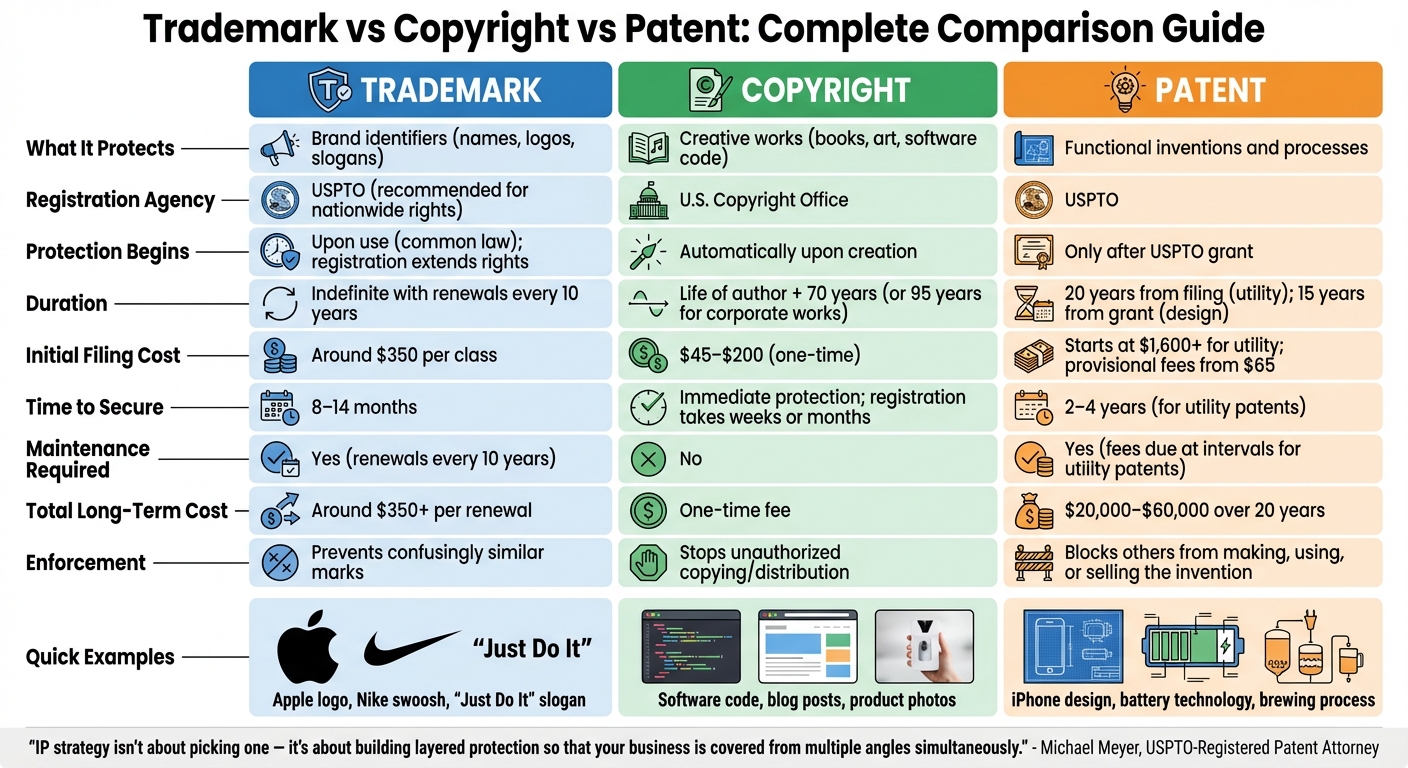
Trademark vs Copyright vs Patent: Key Differences and Comparison Chart
Trademarks, copyrights, and patents each play a unique role in protecting intellectual property, differing in purpose, duration, cost, and how they’re obtained.
Here’s how they work: trademarks safeguard brand elements like names, logos, and slogans; copyrights protect creative expressions such as books, software, and artwork; and patents secure functional innovations, such as inventions or processes. For instance, a smartphone’s technology might be patented, its software copyrighted, and its name trademarked.
The process for obtaining protection also varies. Copyright protection is automatic as soon as a work is created in a tangible form. Trademarks gain rights through use, but federal registration with the USPTO ensures nationwide protection. Patents, on the other hand, require a formal grant from the USPTO.
"Copyright protects the expression of an idea, not the idea itself." – Michael Meyer, USPTO-Registered Patent Attorney
The duration of protection also sets them apart. Trademarks can last indefinitely with 10-year renewals, copyrights extend through the author’s life plus 70 years (or 95 years for corporate works), and patents offer either 20 years of protection for utility patents or 15 years for design patents before entering the public domain.
Side-by-Side Comparison Table
Here’s a quick breakdown of the key differences:
| Feature | Trademark | Copyright | Patent |
|---|---|---|---|
| What It Protects | Brand identifiers (names, logos, slogans) | Creative works (books, art, software code) | Functional inventions and processes |
| Registration Agency | USPTO (recommended for nationwide rights) | U.S. Copyright Office | USPTO |
| Protection Begins | Upon use (common law); registration extends rights | Automatically upon creation | Only after USPTO grant |
| Duration | Indefinite with renewals every 10 years | Life of author + 70 years (or 95 years for corporate works) | 20 years from filing (utility); 15 years from grant (design) |
| Initial Filing Cost | Around $350 per class | $45–$200 (one-time) | Starts at $1,600+ for utility; provisional fees from $65 |
| Time to Secure | 8–14 months | Immediate protection; registration takes weeks or months | 2–4 years (for utility patents) |
| Maintenance Required | Yes (renewals every 10 years) | No | Yes (fees due at intervals for utility patents) |
| Total Long-Term Cost | Around $350+ per renewal | One-time fee | $20,000–$60,000 over 20 years |
| Enforcement | Prevents confusingly similar marks | Stops unauthorized copying/distribution | Blocks others from making, using, or selling the invention |
When planning your intellectual property strategy, it’s important to understand these differences to protect your work effectively. Also, remember that U.S. protections don’t automatically apply internationally. If you need global coverage, you’ll need to file separately through systems like the Madrid Protocol for trademarks or the Patent Cooperation Treaty for patents.
Choosing the Right IP Protection for Your Business
When it comes to safeguarding your business, understanding the roles of trademarks, copyrights, and patents is just the start. The right combination of protections depends on the assets you need to secure. Most businesses benefit from a mix that covers various aspects simultaneously.
Consider what drives your business’s value. Trademarks protect your brand identity – names, logos, and taglines. Copyrights automatically safeguard original creative works like designs, written content, or software code. And if you’ve developed something groundbreaking that solves a problem, patents grant you exclusive rights to that invention.
"IP strategy isn’t about picking one – it’s about building layered protection so that your business is covered from multiple angles simultaneously." – Michael Meyer, USPTO-Registered Patent Attorney
Let’s break down how businesses apply these protections in real-world scenarios.
Common Business Scenarios
The type of protection you prioritize will depend on the nature of your business and its unique assets.
Take a craft brewery, for example. This type of business often needs all three forms of protection. The brewery’s name and logo are safeguarded by trademarks, ensuring no competitor can mimic its branding. The creative label designs on beer bottles are covered by copyright. And if the brewery invents a new brewing method or equipment, patents protect that innovation. This multi-layered approach shields the brand, creativity, and technical ingenuity.
Tech startups also rely on layered protections. For instance, the name of an app or software platform can be trademarked. The source code is automatically protected by copyright, while any innovative algorithms or technical processes may qualify for patent protection. A software company might copyright its code, patent its unique technology, and trademark its app name, creating a comprehensive safety net.
For product manufacturers, the strategy is equally diverse. They often secure utility patents for how their products function, design patents for the product’s appearance, trademarks for the brand and packaging, and copyrights for materials like user manuals and promotional content. Each type of protection addresses a specific element of the business.
Using Multiple IP Protections Together
In many cases, assets benefit from overlapping protections. A logo, for instance, can be both trademarked and copyrighted. This dual approach ensures that no one can replicate either the branding or the artistic design.
Software products are another example where layered protection is critical. A tech company might trademark its app name, copyright the source code and user interface, patent unique technical processes, and keep proprietary algorithms as trade secrets. Each layer safeguards a different aspect of the product.
Even physical inventions can leverage multiple protections. A utility patent can secure the invention’s functionality, a design patent can protect its appearance, and a trademark can safeguard the product’s brand identity. This strategy ensures competitors can’t replicate the product’s function, look, or branding.
The key is to start with protections that align with your current business needs and expand as you grow. By layering multiple forms of IP protection, you can create a robust defense for your business assets.
How to Secure IP Protection
Protecting your brand, invention, or creative work involves specific steps to secure intellectual property (IP) rights. Whether you’re pursuing a trademark, patent, or copyright, the process follows a structured path through the appropriate federal agency.
Search for Existing IP
Before filing, confirm your IP is available – USPTO fees are non-refundable if conflicts arise.
For trademarks, search the USPTO database for marks that could cause confusion. This includes marks that look similar, sound similar, or have related meanings. Think about whether consumers might mistakenly associate your goods or services with an existing mark. Use tools like wildcards (e.g., asterisks) to find variations and search phonetically for alternative spellings. Also, check state registries, domain data, and online sources for unregistered but actively used brand names. Even unregistered names can challenge your use if they were in commerce first.
For patents, look for "prior art" – existing patents, published applications, journal articles, or industry literature describing similar inventions. Narrow your search by identifying relevant classes and subclasses. Tools like Google Patents, which compiles data from the USPTO and European Patent Office, can simplify this process.
Copyright searches are more straightforward. The U.S. Copyright Office offers an online database for works registered or renewed since January 1, 1978. For older works, you may need to consult the copyright card catalog at the Library of Congress or hire staff to assist.
The USPTO advises hiring a U.S.-licensed attorney, especially for trademark clearance searches, as assessing the "likelihood of confusion" can be complex. If you choose to search on your own, focus on "live" trademarks, as only these can block your registration. However, "dead" marks might still indicate common-law rights.
Once you’re confident your IP is available, you can proceed with filing.
File Your Applications
Filing requirements vary depending on the type of IP, but all applications must go through the appropriate federal agency.
For trademarks, applications must be submitted online via the USPTO’s Trademark Center. Since January 18, 2025, online filing has been mandatory. You’ll need a USPTO.gov account and must complete identity verification before filing. The application requires your contact details, legal entity type, a clear drawing of the mark, and a precise description of goods or services using the USPTO ID Manual. You’ll also need to select a filing basis: "Use in Commerce" (for marks already in use) or "Intent to Use" (for planned use). Filing fees start at $350 per class of goods or services.
For patents, applications are filed electronically through the Patent Center. Utility patents require an Application Data Sheet, a detailed specification, drawings, and a signed oath or declaration. Design patents need similar documentation, including a preamble, figure descriptions, and a single claim. Alternatively, you can file a provisional patent application first, which secures an early filing date for 12 months without formal claims or oaths.
For copyrights, applications are filed with the U.S. Copyright Office at the Library of Congress. You’ll need to submit an application form, pay a non-refundable filing fee, and provide a copy of the work being registered.
Trademark registration typically takes 12–18 months from filing to final approval. As of March 2026, the USPTO is examining trademark applications submitted in September and October 2025.
BusinessAnywhere offers trademark filing services that simplify the application process and ensure your documentation is complete.
After filing, maintaining and monitoring your IP is essential to keeping your rights intact.
Maintain Your IP Protections
Protecting your IP requires ongoing effort. For trademarks, continued use in commerce is critical – three years of nonuse is usually considered abandonment. Federal trademark registrations need maintenance filings between the 5th and 6th years after registration and renewals every 10 years thereafter. Missing these deadlines could lead to cancellation or expiration of your registration.
"A registration has a lifespan; trademark rights have a lifecycle." – Promise Legal
Set reminders 12–18 months before maintenance deadlines to gather necessary specimens, like screenshots, packaging photos, or advertising materials that show continued use. When renewing, remove goods or services no longer in use to avoid over-claiming, which could jeopardize your registration’s validity.
While the USPTO registers your IP, it’s your responsibility to monitor the marketplace and enforce your rights. Regularly search online platforms and app stores for potential infringements. You can also record your registered trademark with U.S. Customs and Border Protection to block counterfeit goods from entering the country.
Keep your contact information updated and check your USPTO status every 3–4 months to avoid missed deadlines.
BusinessAnywhere’s compliance services can assist with tracking deadlines and managing renewals, allowing you to focus on your business while keeping your IP protections current.
Conclusion
Understanding the distinctions between trademarks, copyrights, and patents is key to safeguarding your business’s core assets. Trademarks protect elements like names, logos, and slogans. Copyrights secure your creative works, such as written content, music, or art. And patents defend your inventions and technological advancements.
Successful businesses often rely on more than one type of protection. By layering these defenses, companies can shield their intellectual property from different angles. This approach not only deters competitors but also strengthens the overall value of the business.
"IP strategy isn’t about picking one – it’s about building layered protection so that your business is covered from multiple angles simultaneously." – Michael Meyer, USPTO-Registered Patent Attorney
Crafting a tailored intellectual property strategy ensures comprehensive protection for your brand, creative output, and innovations. Acting quickly is just as important – delaying registration can put your rights and competitive position at risk. In the U.S., where a first-to-file system prevails, early registration provides legal advantages, such as the ability to sue for statutory damages and the right to use the ® symbol.
FAQs
Do I need a trademark if I’m only selling locally?
Even if your business operates locally, securing a trademark can play a key role in protecting your brand. A trademark helps prevent others from using a name or logo that’s too similar to yours. While common law rights may offer some protection through usage, registering your trademark with the USPTO provides stronger legal safeguards. It also makes enforcement easier and sets the stage for potential growth down the line. If maintaining your brand identity matters to you, registering a trademark is a wise move – even for a local business.
When should I file a provisional patent vs a full patent?
Filing a provisional patent is a smart move when your invention is still a work in progress, but you want to lock in an early filing date and gain the "patent pending" label. This gives you a 12-month window to fine-tune your invention or secure funding before taking further steps.
On the other hand, file a full patent once your invention is fully developed and you’re ready to secure full legal protection. A granted patent ensures others can’t make, use, or sell your invention without your permission.
What should I protect as a trade secret instead of a patent?
Protecting information as a trade secret is a smart move when keeping it confidential gives your business an edge and when it’s difficult for others to replicate or figure out independently. Unlike patents – which require you to publicly disclose details – trade secrets are perfect for things like proprietary formulas, methods, or processes that would lose their value if exposed. Think about a secret recipe or a unique manufacturing process; keeping these under wraps can help preserve their competitive advantage.