


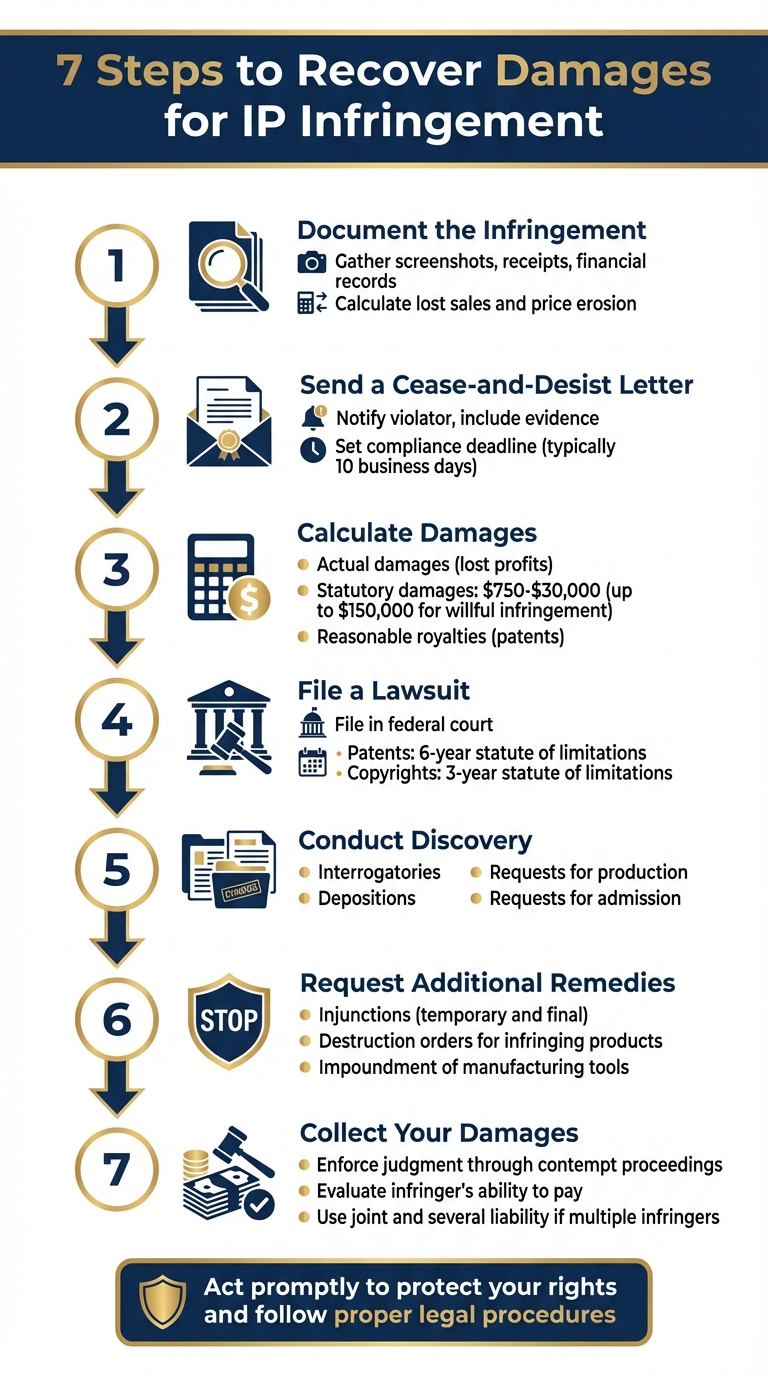
If someone uses your intellectual property (IP) without permission, you have the right to seek financial compensation and stop further violations. This guide outlines the key steps to recover damages:
- Document the Infringement: Gather evidence like screenshots, receipts, and financial records. Calculate financial losses, such as lost sales or price erosion.
- Send a Cease-and-Desist Letter: Notify the violator of your rights and demand they stop infringing. Include evidence and legal references to strengthen your claim.
- Calculate Damages: Choose between actual damages (lost profits, price erosion) or statutory damages (up to $150,000 for willful copyright infringement). For patents, reasonable royalties may apply.
- File a Lawsuit: If the issue persists, file a detailed complaint in federal court. Ensure you meet deadlines, like the 3-year limit for copyrights.
- Conduct Discovery: Use legal tools to obtain evidence from the infringer, such as sales records or manufacturing data.
- Request Additional Remedies: Seek injunctions to stop further violations and destruction orders to eliminate infringing products.
- Collect Damages: Enforce the judgment through legal actions if the infringer refuses to pay.
Act promptly to protect your rights and ensure you follow proper legal procedures to recover damages effectively.
Step 1: Document the Infringement
To build a solid case, you need strong evidence. The moment you realize someone is using your intellectual property (IP) without permission, act quickly to gather and secure proof. Courts won’t just take your word for it – you’ll need to show both that the infringement happened and how it financially impacted you. This documentation is essential for calculating your losses and supporting any legal actions you take later.
Collect Evidence
Start by gathering official registration records from the Copyright Office or USPTO. If your products are patented, ensure they display proper markings, such as "patent" or "pat." followed by the patent number. Alternatively, use a URL that links to a public list of patent numbers (virtual marking). Without these markings, you might not be able to recover damages for any infringement that occurred before sending a cease-and-desist letter.
Next, document the infringement itself. For online violations, take screenshots of websites, social media posts, or online listings showing the unauthorized use. Make sure the screenshots include visible timestamps. For physical products, collect samples, take detailed photographs, and save receipts or shipping details. If the infringement is digital, capture URLs, archive web pages, and record metadata. Check domain registrations too – if the infringer provided false contact details to the registrar, this could serve as evidence of willful infringement.
Also, preserve any contracts, non-disclosure agreements, or email correspondence that could prove the infringer had access to your IP or knew about your rights. Courts may even order the seizure of records related to the production, sale, or receipt of infringing goods, so keep all relevant files organized by date.
Calculate Financial Losses
Once you’ve secured evidence, focus on calculating the financial impact. If you’re claiming lost profits, you’ll need to show that you would have made specific sales if the infringement hadn’t occurred. Keep detailed records of your sales forecasts, production capacity, and market share data from before and after the infringement. Track how many units you could have sold and the profit margin on each.
For price erosion claims, collect data showing the higher prices you would have charged if the infringer’s products hadn’t entered the market. Include historical pricing trends, competitor analysis, and proof that you had to lower your prices because of the infringement. If you sell unpatented items alongside patented ones as part of a "functional unit", document these related sales too – they can be factored into your damage claims.
In copyright cases, the burden of proof is lighter. You only need to show the infringer’s gross revenue from their infringing activities. It’s then up to them to prove deductible expenses or profits unrelated to your copyrighted work. Focus on collecting evidence of their total sales, such as invoices, bank statements, or publicly available financial reports, rather than trying to estimate their costs yourself.
These calculations will form the backbone of your cease-and-desist letters and any legal action that follows. Proper documentation and thorough financial analysis can make all the difference in protecting your IP.
Step 2: Send a Cease and Desist Letter
Before diving into litigation, it’s essential to send a formal cease and desist letter. While this letter by itself doesn’t carry legal weight, it serves as a clear signal of your intent to take legal action. It also documents that the infringer is aware of your intellectual property (IP) and its unauthorized use, which can strengthen your case if the issue escalates. If your IP lacks proper markings, this letter can also kickstart the process of recovering damages.
A well-prepared cease and desist letter can sometimes resolve the issue without the need for court proceedings. To maximize its impact, ensure your letter is both detailed and legally sound.
What to Include in the Letter
To make your letter effective, include specific details and legal references. Start by clearly identifying your intellectual property rights. For example, provide registration numbers from the USPTO or U.S. Copyright Office, mention creation dates, and describe your work thoroughly. Then, outline the infringement with concrete evidence – such as URLs, dates, screenshots, or photos – to substantiate your claim.
Cite the legal statutes that back your position. For trademarks, reference the Lanham Act; for copyrights, refer to Title 17. If dealing with patent infringement, describe the patented process or invention in question and explain why you believe it’s being used unlawfully. Set a compliance deadline – typically 10 business days – to encourage prompt action. Demand that the infringer immediately stop all unauthorized activities and, if applicable, request the destruction of infringing products.
To ensure your letter is taken seriously, send it via certified mail with a return receipt requested. This creates a verifiable record of delivery. Ideally, have an attorney draft and send the letter on official letterhead. Maintain a professional tone throughout and avoid language that might provoke counterclaims or escalate tensions unnecessarily.
Negotiate a Settlement
Once your claims are outlined, be prepared to negotiate. Many infringers will reach out after receiving a cease and desist letter to discuss a resolution. Settling is often the most cost-effective way to resolve disputes. You might negotiate terms such as licensing agreements, royalty payments, or a one-time settlement in exchange for dropping your claims. Keep detailed records of all communications and involve legal counsel early in the process to safeguard your interests.
If the infringer ignores your letter, it can actually strengthen your case. For instance, in copyright disputes, proving willful infringement can significantly increase statutory damages – from as little as $200 for "innocent" infringers to as much as $150,000 per work. In patent cases, courts may triple the damages if willful infringement is demonstrated. Ultimately, the cease and desist letter is a crucial first step in building a strong legal foundation for your case.
Step 3: Calculate Damages
Once you’ve gathered evidence and sent a cease-and-desist letter, the next step is to determine the financial impact of the infringement. Calculating damages involves assessing your losses and deciding on the best method to quantify them. The approach you take depends on the type of intellectual property you’re protecting and how well you can document your financial losses. By understanding your options early on, you can make informed decisions about whether to negotiate a settlement or take the matter to court. Let’s break down the different types of damages to help you choose the method that aligns with your situation.
Types of Damages Available
Actual damages account for measurable financial losses, such as lost sales or diminished market value. In copyright cases, you may be entitled to both your actual damages and any profits the infringer gained from the violation. House Report No. 94–1476 explains that damages serve two purposes: compensating for losses and preventing the infringer from benefiting unjustly. During discovery, you’ll need to prove the infringer’s gross revenue, while they bear the burden of justifying any deductions. This evidence is crucial for building your case.
Statutory damages are a simpler alternative when proving actual losses is difficult. These damages range from $750 to $30,000 per work, with the amount climbing to $150,000 for willful infringement. On the other hand, if the infringer can prove they were "innocent" and unaware of the violation, the penalty may be reduced to as little as $200. Statutory damages remain an option until the final judgment, making them a flexible choice when your financial records are incomplete. Well-organized documentation can significantly strengthen your argument in court.
Reasonable royalties come into play for patent infringement cases. Courts award these damages based on what a fair market license for the patent would have been. According to 35 U.S.C. § 284:
Upon finding for the claimant the court shall award the claimant damages adequate to compensate for the infringement, but in no event less than a reasonable royalty for the use made of the invention by the infringer.
Expert testimony is often required to determine what a "willing buyer" would have paid a "willing seller" at the time the infringement began. This method relies heavily on solid financial evidence to support the claim.
Enhanced damages can amplify your recovery significantly. In patent cases, courts may triple the damages awarded under certain conditions. For trademark claims, you can seek compensation for harm to your reputation, loss of goodwill, and costs for corrective advertising. To succeed, you’ll need to provide strong evidence of reputation damage and lost goodwill. These factors are key to calculating damages and presenting a compelling case during trial.
Comparing Calculation Methods
The best method for calculating damages depends on your business size, the type of IP involved, and the quality of your documentation. The table below offers a quick comparison of calculation methods based on IP type:
| IP Type | Primary Damage Methods | Proof Requirements | Financial Limits | Best For |
|---|---|---|---|---|
| Copyright | Actual Damages + Profits OR Statutory Damages | Proof of lost sales or infringer’s revenue, or proof of work registration | Statutory: $750–$30,000 (up to $150,000 for willful infringement) | Small businesses with hard-to-quantify losses |
| Patent | Lost Profits OR Reasonable Royalties | Demonstration of "but-for" causation for lost profits or established license rates | No fixed floor except a "reasonable royalty"; potential multiplier up to 3x | Established businesses with clear sales data |
| Trademark | Actual Damages OR Infringer’s Profits | Evidence of reputation damage and lost goodwill | No statutory ceiling; based on proven harm or unjust enrichment | Cases involving brand confusion or reputation harm |
For smaller businesses, statutory damages in copyright cases are often the most practical option since they require less extensive financial records. However, if you aim to recover lost profits, you’ll need to establish a clear connection between the infringement and your financial losses. This involves showing that customers chose the infringer’s product specifically because of your intellectual property. Detailed sales data and expert testimony are essential for this approach.
If you’re assessing the infringer’s profits, higher sales on their part could lead to a larger recovery through disgorgement than through actual damages. Engaging industry experts can help you determine fair market values and navigate complex financial calculations. Courts and juries may not be familiar with the nuances of your market, so presenting well-documented evidence – such as customer confusion or the costs of repairing your brand’s reputation – can significantly bolster your case. Every detail matters when calculating damages and preparing for discovery.
Step 4: File a Lawsuit
When cease-and-desist efforts don’t work, the next step is to file a lawsuit in federal court. This formalizes your legal claim and opens the door to recovering damages through the legal system. Filing also acts as official notice of the infringement, which is crucial for defining the timeline during which you can claim damages – especially if your products weren’t previously marked with patent or trademark notices. Your documented evidence and prior settlement attempts will play a pivotal role in supporting your case.
Choose the Right Court
Intellectual property cases are handled by United States District Courts. Most patent, trademark, and copyright lawsuits should be filed in the district where the infringer is located or where the infringement occurred.
For cases involving cyberpiracy or domain name disputes, you can file an in rem action against the domain name itself. This approach is helpful if you can’t track down the infringer or establish personal jurisdiction over them. File this type of lawsuit in the judicial district where the domain name registrar or registry is based. To show due diligence, make sure to send notices to the infringer’s listed contact addresses.
If you’re a nonresident patent holder without a designated U.S. agent, you may file your case in the Eastern District of Virginia.
Prepare and File Your Complaint
Once you’ve determined the proper jurisdiction, the next step is drafting your complaint. This document is the foundation of your legal claim, so it needs to be detailed and precise. Include key information such as the names and addresses of all parties involved and proof of ownership, like registration numbers from the USPTO or the U.S. Copyright Office.
Clearly state which intellectual property right was violated. For copyright cases, list the title of the work, the author’s name, and the copyright registration number. In trademark cases, note whether the ® symbol was used or if the defendant had actual notice of your registration – this can impact your ability to recover damages. For patent cases, remember that each claim is presumed valid, and the defendant bears the burden of proving otherwise.
Explain how the infringement occurred. Detail whether the defendant engaged in unauthorized reproduction, distribution, display, or other activities that violated your rights. If you’re seeking enhanced damages, include evidence of willful infringement. For instance, providing false contact information to a domain registrar could create a rebuttable presumption of willfulness.
Specify the remedies you’re asking for. These could include:
- Actual damages, statutory damages, or reasonable royalties
- Injunctions to stop further infringement
- Impoundment and destruction of infringing materials
- Full costs and reasonable attorney’s fees
For copyright cases, you can choose to recover statutory damages instead of actual damages at any point before the final judgment.
Be mindful of the statute of limitations for your claim. For patent cases, you can only recover damages for infringements that occurred within six years prior to filing your complaint. Copyright claims must be filed within three years of when the claim accrues. Acting promptly not only preserves your rights but also shows that you’re taking the infringement seriously.
sbb-itb-ba0a4be
Step 5: Conduct Discovery and Prove Your Case
Once your lawsuit is filed, the next step is the discovery phase, where you gather evidence to support your claim. This phase is critical because it allows you to obtain information directly from the infringer. Depending on the complexity of your case, this process might be relatively simple or highly intricate.
Use Discovery Tools
Discovery relies on four primary tools to collect evidence:
- Interrogatories: These are written questions that the opposing party must answer under oath. They help clarify key details about the infringing activities.
- Depositions: Witnesses provide oral testimony, usually in the presence of a court reporter, which can be used to uncover critical facts.
- Requests for Production: These require the opposing party to hand over documents, whether physical or electronic. Examples include sales records, marketing materials, manufacturing data, and financial statements.
- Requests for Admission: These are used to narrow down the issues by asking the opposing party to admit or deny specific facts.
When requesting documents, prioritize those that establish a direct link between the infringement and the infringer’s revenue. For copyright cases, you only need to show the infringer’s gross revenue; the burden then shifts to them to prove any deductible expenses or profits unrelated to your copyrighted work. In patent disputes, focus on evidence related to the DAMP test. This involves proving market demand for your patented product, showing there are no viable non-infringing alternatives, and demonstrating your ability to meet market demand through manufacturing and marketing.
These tools are essential for building a strong case and quantifying the financial harm caused by the infringement.
Demonstrate Financial Harm
Once you’ve gathered the necessary evidence, the next step is to quantify the financial damages. It’s not enough to prove that infringement occurred – you need to show the precise financial impact. Expert testimony is often indispensable here, as it helps translate raw evidence into clear, quantifiable damages. Under 35 U.S.C. § 284, courts frequently rely on expert analysis to assess damages, turning market data into measurable losses.
Use the discovery phase to link lost sales directly to the infringement. Experts can validate key aspects like market demand, the lack of acceptable substitutes, and lost profit margins. Additionally, document price erosion and losses from related products to present a complete picture of the financial harm.
For cases involving reasonable royalty calculations, focus on reconstructing a hypothetical negotiation between you and the infringer at the time the infringement began. Courts use the 15 "Georgia-Pacific" factors to analyze what both parties would have agreed upon in such a scenario. To support this, gather historical licensing agreements, industry-standard royalty rates, and comparable deals. If your case involves multi-component products, narrow your focus to the smallest salable patent-practicing unit (SSPPU) – the specific component that infringes your patent. This ensures that your royalty calculation reflects only the value of the infringing features, not the entire product’s market value.
Step 6: Request Additional Remedies
When dealing with infringement, monetary compensation alone might not be enough to stop the violators from continuing their activities. To address this, courts offer additional legal tools like injunctions and destruction orders, which aim to directly address and eliminate the source of the infringement.
Request an Injunction
An injunction is a powerful court order designed to stop further infringement in its tracks. According to 17 U.S.C. § 502 for copyright cases and 35 U.S.C. § 283 for patent disputes, courts can issue both temporary injunctions (while the case is ongoing) and final injunctions (as part of the final judgment). These laws authorize courts to "grant temporary and final injunctions on such terms as it may deem reasonable to prevent or restrain infringement".
Securing a temporary injunction early in the process is critical. It not only halts the infringer’s profits but also prevents them from destroying evidence. Once a final injunction is granted, it applies nationwide, allowing any U.S. court with jurisdiction to enforce it. Violating such an order can lead to serious consequences, including fines or even jail time for contempt of court.
When requesting an injunction, it’s important to be precise. Avoid vague language like "stop infringement." Instead, clearly outline the specific activities you want to be stopped – such as the production, sale, or distribution of particular products. This level of detail ensures that the injunction can be effectively enforced. Combined with monetary damages, injunctions provide a robust defense for your intellectual property.
To further strengthen your case, ensure that infringing products are completely removed from circulation.
Request Destruction of Infringing Products
Stopping production alone isn’t enough if counterfeit goods are still out there. Under 17 U.S.C. § 503, courts can order the impoundment and destruction of infringing products, both during and after litigation. This remedy extends not just to the finished goods but also to the tools used in their creation, such as molds, plates, and other manufacturing equipment.
Focusing on the destruction of manufacturing tools is particularly important. If the infringer retains these items, they could easily restart production. By eliminating these resources, you remove their ability to continue operations.
Additionally, courts can order the seizure of business records related to the production and sale of infringing goods. While these records are typically protected to maintain confidentiality, they can provide valuable evidence. In cases where outright destruction isn’t practical, the law allows for "other reasonable disposition" of the infringing items.
It’s essential to pair destruction requests with a permanent injunction. This combination ensures that the infringer cannot resume their activities without facing serious legal consequences, such as contempt of court. Together, these remedies provide a comprehensive approach to protecting your intellectual property.
Step 7: Collect Your Damages
After securing remedies like injunctions and destruction orders, the final step in protecting your intellectual property (IP) is collecting the damages awarded to you. Winning the case is only part of the process – actually obtaining the funds can be a whole new challenge. Many IP owners learn that a judgment doesn’t guarantee payment, especially when infringers either refuse to pay or lack the financial means to do so.
Enforce the Judgment
If the infringer doesn’t pay voluntarily, you’ll need to take steps to enforce the judgment. This can involve contempt proceedings, asset impoundment, or using joint and several liability. According to 17 U.S.C. § 502(b), injunctions can be enforced across the United States through contempt proceedings or other legal actions taken by any court with jurisdiction over the infringer. If the infringer defies the court’s order, contempt proceedings can result in serious consequences.
When dealing with multiple infringers, joint and several liability allows you to recover the full amount of damages from any one of the responsible parties, rather than having to pursue each individual infringer separately. In cases of willful criminal infringement, additional remedies like criminal forfeiture, destruction of infringing materials, and restitution may also be available under federal law.
Evaluate the Infringer’s Ability to Pay
Before diving into litigation, it’s important to assess whether the infringer has the financial capacity to pay. Reviewing their assets, revenue, debts, and liens can help you determine if pursuing legal action is worth the effort. This kind of pre-litigation financial assessment can save you from a lengthy legal battle that ends with an uncollectible judgment.
If the infringer lacks sufficient assets, it might make more sense to focus on non-monetary remedies. Injunctions can stop ongoing infringement, while court orders for the impoundment and destruction of infringing items can address the issue at its source.
For cases involving damages under $30,000, the Copyright Claims Board offers a quicker and more cost-effective option, with capped damages to simplify the process. Evaluating the infringer’s financial situation not only helps you decide whether to pursue monetary recovery but also complements earlier efforts to quantify your losses, ensuring a well-rounded approach to safeguarding your IP.
Conclusion
Key Points to Remember
Recovering intellectual property (IP) damages requires swift and organized action. Start by thoroughly documenting every instance of infringement and the losses tied to it. If a cease-and-desist letter doesn’t resolve the issue, you’ll need to calculate damages. This can be done by choosing between actual losses combined with the infringer’s profits or statutory damages, which typically range from $750 to $30,000 per work – and can go as high as $150,000 for cases of willful infringement. When filing a lawsuit, ensure it’s submitted to the correct court with a detailed complaint. During the legal process, leverage discovery and expert testimony to prove financial harm. For patent cases, damages must meet or exceed a reasonable royalty. Additionally, seek injunctions and destruction orders to stop further violations.
Timing is everything. Patent claims are subject to a six-year statute of limitations. For copyright cases, registering within three months of publication preserves your right to statutory damages and attorney’s fees. Also, marking patented products with the patent number ensures damages start accruing as soon as infringement occurs.
While recovering damages is essential, protecting your IP early on can significantly reduce the risk of infringement.
Protect Your IP with BusinessAnywhere

Recovering damages is a reactive step, but taking proactive measures strengthens your legal position. For instance, registering copyrights with the U.S. Copyright Office is essential for federal lawsuits, while trademark registration establishes clear ownership – key evidence when building your case.
BusinessAnywhere’s trademark filing service makes the registration process straightforward for entrepreneurs and remote business owners. By securing formal ownership records early, you lay the groundwork for future enforcement actions, whether it’s issuing a DMCA takedown notice or pursuing a federal lawsuit. With additional compliance support and document management tools, BusinessAnywhere equips you to safeguard your intellectual property while staying focused on growing your business.
FAQs
What evidence is essential for proving intellectual property infringement?
To establish a case for intellectual property infringement, the most crucial evidence revolves around records of the infringer’s gross revenue or sales and documentation of your actual damages or lost profits caused by the infringement. Together, these pieces of evidence demonstrate the financial harm resulting from the violation and form the foundation of your claim for damages.
Other supporting evidence can also play a key role. For example, proof that you own the intellectual property, detailed records of the infringing activities, and any correspondence with the infringer can add weight to your case and help make your argument more compelling.
What is the difference between statutory damages and actual damages in intellectual property cases?
Statutory damages and actual damages play distinct roles in intellectual property (IP) disputes.
Actual damages represent the tangible financial losses a plaintiff incurs due to infringement. This could include lost profits or revenue that can be directly linked to the violation. To claim these damages, the plaintiff must provide solid evidence and documentation to demonstrate the economic harm.
In contrast, statutory damages are fixed amounts established by law, often used when calculating actual damages is either too complex or not feasible. These damages aim to both compensate the plaintiff and discourage future violations, even when the precise financial impact can’t be determined. The rules governing statutory damages, including their limits, vary depending on the specific IP laws relevant to the case.
What steps can you take if someone refuses to pay damages after an intellectual property judgment?
If someone refuses to pay damages after a court judgment, there are legal steps you can take to enforce the decision. These might include requesting writs of execution to seize their assets, pursuing garnishment of their wages or bank accounts, or asking the court to hold them in contempt for failing to comply.
Make sure to keep detailed records of all communications and efforts to collect payment, as these can be crucial for enforcement. For more complex situations, working with an IP attorney is highly advisable. They can guide you through the legal process and help increase your chances of recovering the damages owed.