
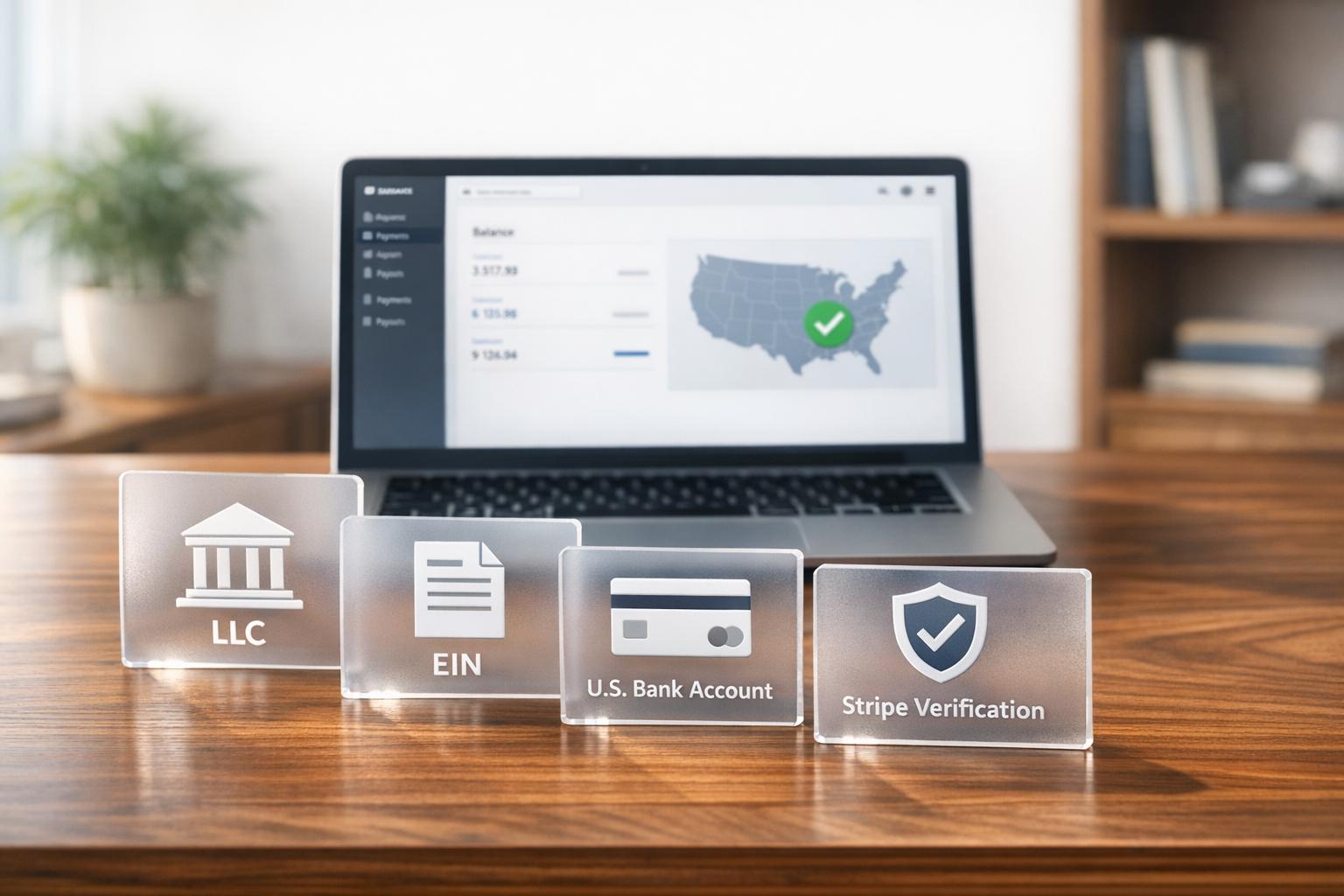
If you’re a non-resident looking to use Stripe but find it unavailable in your country, there’s a solution: form a U.S. business entity. This allows you to access Stripe’s features, improve your business’s credibility, and save on transaction fees. Here’s a quick summary of the steps:
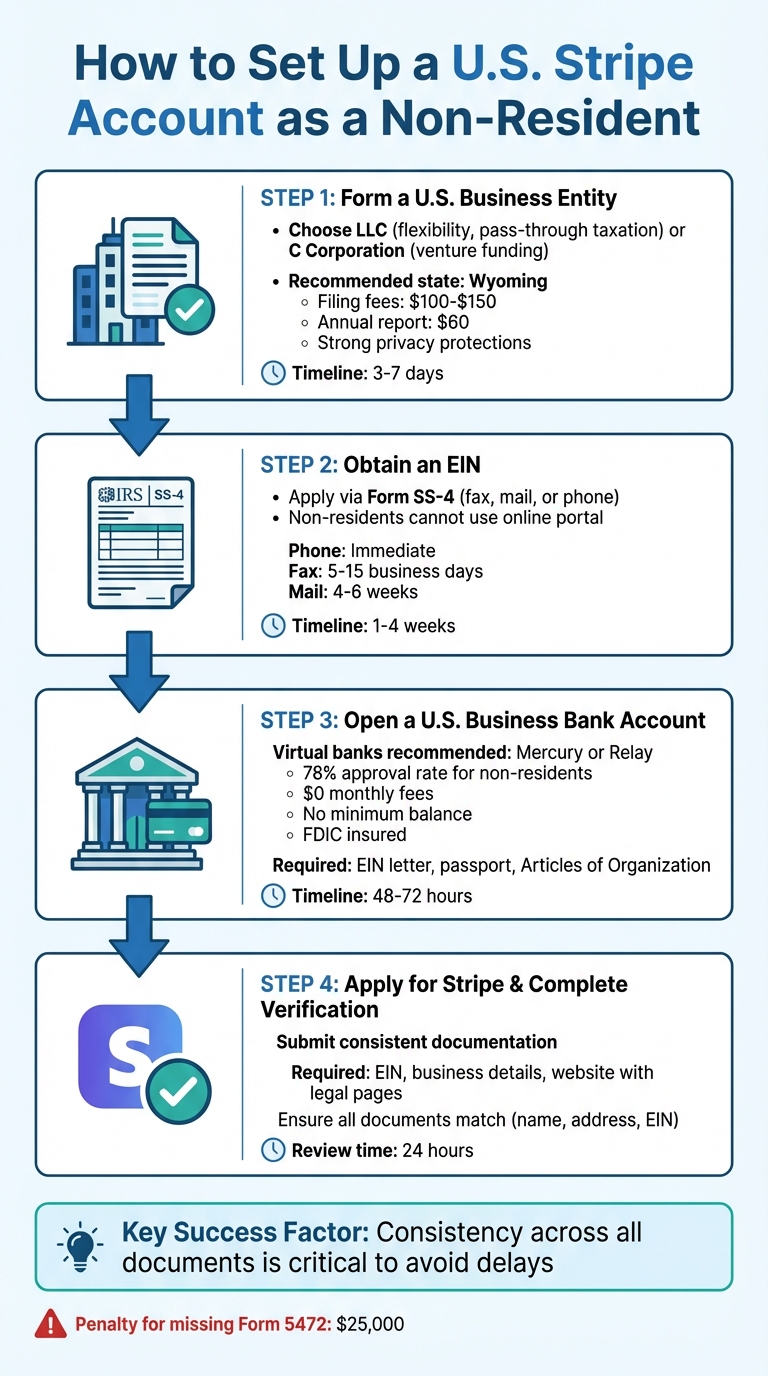
- Create a U.S. Business Entity: Choose an LLC for flexibility or a C Corporation for venture funding. States like Wyoming are cost-effective and privacy-friendly for non-residents.
- Obtain an EIN: Apply for a federal Employer Identification Number, essential for tax purposes and opening a U.S. bank account.
- Open a U.S. Bank Account: Use online-friendly banks like Mercury or Relay to receive Stripe payouts.
- Apply for a Stripe Account: Submit consistent, accurate documentation (e.g., EIN, business details, and website policies) for approval.
Consistency across all documents is critical to avoid delays. Services like BusinessAnywhere can simplify the process, from entity registration to compliance management. This guide ensures you’re equipped to navigate Stripe’s requirements while keeping your U.S. business compliant.
Step 1: Form a U.S. Business Entity
Before applying for Stripe, the first step is to set up a compliant U.S. business entity.
Choosing the Right Business Structure
You’ll need to decide between two main options: an LLC or a C Corporation. For most non-resident founders, an LLC is the better choice. Why? It offers pass-through taxation (meaning profits are taxed only once at the owner level) and involves fewer formalities. If you’re running an e-commerce store, offering digital services, or bootstrapping a SaaS product, an LLC is usually the way to go.
On the other hand, a C Corporation might be more suitable if your plans include raising venture capital or going public in the future. U.S. investors often prefer C Corporations because they have a standardized stock structure and a well-established legal framework. Keep in mind, however, that C Corporations come with double taxation (profits are taxed at both the corporate and shareholder levels) and require more ongoing administrative work.
It’s important to note that S Corporations are not an option for non-residents. U.S. law prohibits non-resident aliens from being shareholders in S Corporations. Both LLCs and C Corporations, however, provide liability protection, separating your personal assets from business debts or legal issues.
Once you’ve decided on a structure, the next step is choosing the best state for registration.
Selecting a State for Business Registration
The state you choose can have a big impact on your business operations and costs. Here’s a breakdown of popular options:
- Wyoming: A favorite for many non-resident founders. Why? Wyoming’s low costs and strong privacy protections make it stand out. Initial filing fees are just $100–$150, and the annual report costs only $60 – among the lowest in the U.S.. Plus, Wyoming keeps member names out of public records and has no state income tax.
- Delaware: Known as the go-to state for startups seeking institutional funding. Its Court of Chancery is highly efficient at handling business disputes, and venture capitalists are very familiar with Delaware’s corporate laws. However, Delaware’s annual fees for LLCs are around $300, and it offers less privacy than Wyoming. Unless you’re planning to raise significant funding, the higher costs and reduced privacy might make it less appealing for bootstrapped businesses.
- Nevada: Offers no state income tax and robust privacy protections. However, the initial filing costs are higher – around $425 – with annual fees near $350.
- New Mexico: A budget-friendly option with strong privacy protections. It doesn’t require annual reports, but it’s less recognized by banks and payment processors.
"Wyoming is often best for foreign-owned LLCs because of low fees, privacy, and business-friendly laws." – Vincenzo Villamena, CEO, Entity Inc.
Choosing the right state can simplify the Stripe verification process and align with your business needs. Once you’ve selected a state, the next step is to handle the registration process efficiently.
Using BusinessAnywhere for Registration
BusinessAnywhere is a service that makes registering your U.S. business entity simple and remote. They take care of filing your Articles of Organization, provide a free first-year registered agent service, and assist with obtaining an EIN – all you pay are the state filing fees.
Why is a registered agent important? U.S. law requires you to have a physical address in the state where your business is formed to receive legal and tax documents. BusinessAnywhere handles this for you, ensuring compliance.
They also help you create essential documents like an Operating Agreement (for LLCs) or Bylaws (for Corporations). These documents outline your ownership structure and operational guidelines, which are critical for meeting the standards required by banks and Stripe during the verification process. For non-residents, this service eliminates much of the complexity, making it easier to stay compliant and focus on your business.
Step 2: Obtain an Employer Identification Number (EIN)
After registering your business entity, the next move is to get an Employer Identification Number (EIN). This nine-digit number is crucial for opening a U.S. business bank account and completing Stripe’s verification process.
What is an EIN and Why Do You Need It?
An EIN, issued by the IRS, acts as your business’s unique identifier, similar to a Social Security Number but for business purposes. It’s essential for tax filings and nearly all aspects of running a business in the U.S. For non-resident founders, having an EIN is a must for setting up a Stripe account, as Stripe uses it to verify your business. Additionally, you’ll need an EIN to open a U.S. business bank account (necessary for receiving Stripe payouts), file tax returns, hire U.S.-based employees or contractors, and apply for business licenses.
"An EIN identifies your business for tax purposes. It is also required for opening a US bank account, registering with Stripe, and filing your business tax returns."
– Vincenzo Villamena, CEO, Entity Inc.
The good news? Non-residents can obtain an EIN even without a U.S. Social Security Number or physical address. The IRS provides EINs for free, and once issued, the number never expires – it stays with your business entity permanently.
How to Apply for an EIN
To apply for an EIN, you’ll need to complete IRS Form SS-4. However, non-residents without a U.S. Social Security Number (SSN) or Individual Taxpayer Identification Number (ITIN) cannot use the IRS’s online portal. Instead, you must apply via fax, mail, or phone. Attempting the online application without an SSN will result in rejection.
| Application Method | Typical Processing Time | Best For |
|---|---|---|
| Fax | 5–15 business days | Non-residents needing quicker results |
| 4–6 weeks | Applicants without fax or phone access | |
| Telephone | Immediate (during call) | International applicants able to call the IRS directly |
When filling out Form SS-4, you’ll need to include details such as your business’s legal name, entity type (e.g., LLC or C-Corp), a U.S. mailing address (your registered agent’s address works), and a description of your business. The "responsible party" must be an individual who has control over the entity, not another company. Here’s a helpful tip: if you’re asked for the responsible party’s tax ID on Line 7b and you don’t have an SSN or ITIN, enter "ForeignUS" to indicate your non-resident status. For fax applications, include a return fax number to receive your confirmation letter (CP 575) faster.
"Non‑residents can obtain a US Employer Identification Number (EIN) without an SSN or US address. The online portal is unavailable to non‑SSN holders, so fax or mail of Form SS‑4 is required."
– Vincenzo Villamena, CPA and CEO at Entity Inc.
If the process feels overwhelming, BusinessAnywhere’s EIN application service can help. For $97, they handle the IRS form preparation, track your application, and minimize errors that could delay approval – making it easier for non-residents to navigate the IRS’s requirements.
Once you have your EIN, you’re ready to open a U.S. business bank account, bringing you closer to setting up your Stripe account.
Step 3: Open a U.S. Business Bank Account
Once you have your EIN, the next step is to open a U.S. business bank account – an essential requirement for receiving Stripe payouts.
Why You Need a U.S. Bank Account for Stripe
Stripe mandates a U.S. bank account to process payouts from your customer transactions. Here’s how it works: when customers pay you through Stripe, the funds are deposited directly into your U.S. business account, typically within two business days. This setup simplifies handling international payments. Your customers can pay in their local currency, while Stripe manages the conversion, ensuring you receive USD without dealing with multiple payment processors or cross-border complications.
Having a U.S. business bank account also allows you to handle refunds, pay U.S.-based contractors, and manage vendor payments, all while reinforcing your business’s credibility as a U.S. entity.
Options for Non-Residents: Traditional vs. Virtual Banking
If you’re a non-resident, you have two primary banking options: traditional U.S. banks or virtual banking platforms.
Traditional Banks
Banks like Chase, Bank of America, and Wells Fargo offer comprehensive services such as loans and credit lines. However, they reject over 95% of non-resident applications. Most require you to visit a branch in person for identity verification, which isn’t feasible for remote applicants. Additionally, monthly fees range from $15 to $50, and maintaining balances of $1,500 to $3,000 is often necessary to avoid these fees.
Virtual Banks and Fintech Platforms
Platforms like Mercury and Relay are popular among non-residents for their remote-friendly processes. With an approval rate of 78% for non-residents, they charge no monthly fees, require no minimum balances, and integrate easily with tools like Stripe. They also provide FDIC insurance via partner banks, sometimes covering up to $3 million.
"Virtual banks offer most of the same features and benefits that real banks offer, including wire transfers, business debit cards, and FDIC insurance."
– Vincenzo Villamena, CEO, Entity Inc.
Electronic Money Institutions (EMIs)
EMIs like Wise Business present another option, boasting approval rates of around 92%. Wise doesn’t charge monthly fees but applies a currency conversion fee between 0.41% and 2.85%, depending on the currency pair. While EMIs don’t offer FDIC insurance, they excel in handling multi-currency transactions and global payments.
| Feature | Traditional Banks | Neobanks (Mercury, Relay) | EMIs (Wise) |
|---|---|---|---|
| Remote Opening | No (in-person required) | Yes | Yes |
| Approval Speed | 4–8 weeks | 48–72 hours | 24–48 hours |
| Monthly Fees | $15–$50 | $0 | $0 |
| Minimum Balance | $1,500–$3,000 | $0 | $0 |
| FDIC Insured | Yes | Yes (via partners) | No (safeguarding) |
| Best For | Large entities needing credit | U.S. LLC owners, SaaS | Multi-currency transactions, freelancers |
Tips for a Smooth Account Setup
To avoid delays or rejections, ensure your documents are in order before applying. Here’s what you’ll need:
- A confirmed IRS EIN letter (CP 575 or 147C). Pending confirmations or screenshots won’t be accepted.
- High-quality PDF scans of your passport, Articles of Organization, Operating Agreement, and EIN letter. Avoid using phone photos or cropped images, as these can lead to rejections.
- Consistent business details across all documents. Your business name, address, and ownership information must match exactly. If a physical address is required, provide supporting proof like a lease agreement or utility bill. P.O. Boxes or mailbox-style addresses are usually not accepted.
An online presence can also strengthen your application. A simple website or LinkedIn company page that outlines your business, products, or services helps demonstrate legitimacy. Be prepared to explain your business model, including your suppliers, target audience, and expected transaction volumes.
For example, a Brazilian software developer who formed a Wyoming LLC applied to Mercury with a complete document package, including an EIN letter, Articles of Organization, and a utility bill. Their account was approved in just 51 hours. This underscores the importance of thorough preparation.
If the process feels overwhelming, services like BusinessAnywhere can assist with document preparation and guide you in selecting the right banking platform. Their expertise can help you navigate the challenges non-residents face and avoid common pitfalls.
Once your bank account is set up, you’ll be ready to apply for your Stripe account and continue building your business.
Step 4: Apply for a Stripe Account and Complete Verification
Once your business setup is complete with a U.S. entity, EIN, and bank account, the next step is verifying your Stripe account. This process is relatively simple, but consistency across your documents is crucial. Any discrepancies in the information provided to the IRS, your bank, and your website can lead to verification delays.
Creating a Stripe Account
To begin, head to stripe.com and select "United States" as your business location. When entering your legal business name, make sure it matches exactly as shown on your EIN confirmation letter. Whether or not "LLC" is included in your business name depends on how it’s listed in your official IRS documentation. Even small formatting differences can cause issues during verification.
You’ll also need to provide your personal details, such as your full name, date of birth, and home address. If you don’t have a U.S. Social Security Number, you can verify your identity using a valid passport. Next, link your U.S. business bank account by providing the routing and account numbers. Be sure to describe your products or services clearly and include your business website URL.
Meeting Stripe Verification Requirements
Stripe generally reviews identity and documentation within 24 hours. However, they may request additional verification after your first few transactions. To avoid delays, ensure you have clear, accurate documentation ready to submit.
| Document Category | Required Item | Specific Requirements |
|---|---|---|
| Identity | Passport | Must be full-color, unexpired, with all borders visible (no screenshots) |
| Business | EIN Letter (CP 575) | Legal name must match the name in your Stripe settings |
| Address | Proof of Home Address | Utility bill, bank statement, or lease dated within the last 6 months |
| Entity | Articles of Organization | Official state-filed document for your LLC |
| Financial | U.S. Bank Details | Routing and account numbers for a U.S.-based business account |
Your website also plays a key role in Stripe’s manual review process. Make sure it includes an "About" page, detailed product descriptions with pricing, and essential legal pages like a Terms of Service, Privacy Policy, and Refund/Return Policy. Using a professional business email address (e.g., [email protected]) instead of a generic Gmail account adds credibility.
To avoid rejections, submit documents as clear scans or images in PDF, JPEG, or PNG format. Keep a compliance folder with all your essential documents organized and ready for submission.
Troubleshooting Common Issues
If Stripe asks for additional verification, respond promptly with the specific documents they request. One common problem is mismatched information between your IRS records, bank account, and Stripe profile. Double-check that your business name and address formatting are standardized across all platforms.
"Stripe is not ‘anti-foreigner.’ Stripe is anti-risk. This guide focuses on the exact risk signals Stripe evaluates and how to make your LLC look like a real operating business, not a shell."
– Foreign Founder Team
Avoid sudden spikes in transaction volume, as these can trigger fraud alerts. Instead, scale your business activity gradually and keep your dispute rate below 0.75% by providing clear policies and excellent customer service.
If you encounter persistent challenges, consider reaching out to BusinessAnywhere. Their team specializes in assisting non-resident founders with documentation and can help you navigate complex verification requests to prevent delays.
sbb-itb-ba0a4be
Common Challenges and Solutions Summary Table
Non-resident founders face several hurdles when trying to secure a U.S. Stripe account. Success often depends on maintaining consistency in documentation and adhering to compliance requirements. Below is a summary table that highlights common challenges and practical solutions to address them.
| Challenge | Common Cause | Recommended Solution |
|---|---|---|
| Identity Verification Without SSN | Non-resident status; lack of U.S. Social Security Number | Use a valid passport for identity verification and your EIN for the business. If account limits remain, consider applying for an ITIN through a Certifying Acceptance Agent (CAA). |
| Bank Account Rejection | Traditional banks require in-person visits; absence of an in-person U.S. presence | Opt for fintech banks like Mercury or Relay, which offer fully remote onboarding for non-residents. |
| Address Verification Failure | Use of P.O. Box or inconsistent address formatting across documents | Secure a physical street address via a CMRA (Commercial Mail Receiving Agency) and ensure consistent formatting across LLC documents, EIN letter, bank account, and Stripe profile. |
| EIN Application Delays | Non-residents cannot use the IRS online portal | Submit Form SS-4 via fax or phone (processing takes 15 to 30 business days) or use BusinessAnywhere’s EIN application service for $97 to expedite the process. |
| Stripe Account Freeze | Sudden transaction volume spikes or high dispute rates | Gradually scale your processing volume over several months. Keep dispute rates below 0.75% by enforcing clear refund policies and leveraging Stripe Radar. |
| Two-Factor Authentication Issues | VoIP numbers (like Google Voice) commonly blocked by U.S. banks and Stripe | Use a physical U.S. SIM or eSIM from providers like Tello or Ultra Mobile (around $10/month) for SMS and Wi-Fi calling. |
| Documentation Inconsistency | Discrepancies in business name or address formatting | Ensure your legal name and address are formatted consistently. For instance, use "Suite 123" uniformly instead of mixing terms like "#123" or "Ste 123". |
| Website Policy Red Flags | Missing essential legal pages or unclear business model | Include dedicated pages for Terms of Service, Privacy Policy, Refund Policy, and a clear "About Us" section with product details and pricing before applying. |
Carefully review these solutions to sidestep common obstacles encountered by other non-resident entrepreneurs.
Additionally, be mindful of IRS compliance requirements. Failing to file Form 5472 can result in penalties of $25,000, while late BOI report filings carry fines of $500 per day. To avoid these costly mistakes, consider using BusinessAnywhere’s compliance management services, which offer automated reminders and filing support. Addressing these areas thoroughly will help ensure smooth Stripe account operations.
Maintaining Compliance for Ongoing Stripe Use
Setting up your Stripe account is just the beginning. Keeping your U.S. business compliant is an ongoing responsibility, especially for non-resident founders. Overlooking these requirements can lead to account suspensions, frozen funds, or hefty penalties.
Annual Compliance Requirements
Running a U.S.-based business entity comes with recurring federal and state obligations. For instance, foreign-owned single-member LLCs must file Form 5472 and Form 1120 with the IRS every year, regardless of whether the business made a profit. Missing these filings can result in a minimum penalty of $25,000 per form annually. If the issue isn’t resolved within 90 days of an IRS notice, penalties increase by $25,000 every 30 days.
On the state side, businesses need to file annual reports and pay franchise taxes to remain in "Good Standing." For example:
- Wyoming: Annual costs are around $60.
- Delaware: LLCs pay a minimum of $300 in annual franchise taxes.
Failing to meet these state requirements can lead to the dissolution of your business entity. This is a serious risk, as Stripe accounts rely on the legal existence of the entity backing them.
Additionally, maintaining a registered agent with a physical address is mandatory, typically costing between $100 and $200 annually. Filing the Beneficial Ownership Information (BOI) report is another critical task, as missing it can result in fines of $500 per day. To manage these tasks efficiently, consider using centralized compliance tools.
Using BusinessAnywhere for Compliance Management
BusinessAnywhere offers a streamlined way to handle these compliance challenges. Their platform provides automated reminders for key deadlines, including annual reports, tax filings, and BOI updates – all accessible from a single dashboard.
For just $37, BusinessAnywhere files your BOI report in line with FinCEN regulations. Their registered agent service, priced at $147 annually after the first free year, ensures you don’t miss important correspondence that could jeopardize your Stripe account.
Another critical step is ensuring consistency across all your documentation. Your legal name, EIN, and address must match exactly in IRS records, bank accounts, your website, and Stripe. Even small discrepancies can lead to account freezes, so double-checking these details is essential to keeping your Stripe account active and secure.
Conclusion: Simplify Your Stripe Setup with BusinessAnywhere
Setting up a U.S. Stripe account as a non-resident requires four main steps: forming a U.S. business entity, getting an EIN, opening a U.S. bank account, and completing Stripe’s verification process. It’s important to ensure your legal name, address, and EIN match across all platforms to avoid delays during verification.
The timeline for this process varies. Forming an LLC typically takes 3 to 7 days, while obtaining an EIN can take anywhere from 1 to 4 weeks. For many, the paperwork and compliance requirements can feel overwhelming, especially when dealing with unfamiliar systems.
That’s where BusinessAnywhere steps in to simplify things. They handle entity formation, provide a free first-year registered agent service, and assist with EIN applications for a fixed fee. This ensures your documents stay consistent, making Stripe’s verification process smoother.
Once your account is active, staying compliant is just as important as setting it up. BusinessAnywhere’s dashboard helps you stay on track with automated reminders for annual reports, franchise tax deadlines, and BOI filings. With over 5.5 million new business applications filed in the U.S. during 2023, having a dependable partner like BusinessAnywhere can mean the difference between seamless operations and compliance headaches.
FAQs
Do I need an ITIN to get approved on Stripe?
No, you don’t need an ITIN to get approved on Stripe. What you’ll need instead is an EIN (Employer Identification Number) or Tax ID, a U.S. business entity like an LLC, and a linked U.S. bank account. These are the key requirements for setting up a Stripe account as a non-resident founder.
What address should I use for Stripe and banking if I don’t live in the U.S.?
If you’re not based in the U.S., you’ll need a U.S. business address that aligns with your physical or registered location. For non-residents, this typically means using a virtual office or a registered agent service to secure a U.S. address. Make sure the address is a physical location (not a PO Box) and matches your official documents when necessary. It’s important to ensure the address adheres to Stripe’s specific requirements for U.S. accounts.
What ongoing U.S. filings are needed to keep my Stripe account active?
To maintain an active Stripe account in the U.S., it’s important to stay on top of tax reporting and verification requirements. Stripe is required to report your payment volume to the IRS using Form 1099-K if your transactions exceed $600 annually.
Additionally, Stripe conducts periodic checks to verify your business details, which include your legal entity, Employer Identification Number (EIN), and address. Ensuring this information is accurate and keeping up with your tax obligations is crucial to avoid any disruptions to your account.