


Deciding between Shopify and Amazon FBA depends on your business goals. Shopify gives you full control over your brand, customer data, and store design, making it ideal for long-term brand building. Amazon FBA, on the other hand, offers access to millions of shoppers and handles logistics for you, but limits branding and customer relationships.
Key Takeaways:
- Shopify: Build your own store, own customer data, focus on branding. Requires effort to drive traffic and manage fulfillment.
- Amazon FBA: Leverage Amazon’s massive audience and fulfillment services. Higher fees and limited control over branding.
Quick Overview:
| Factor | Shopify | Amazon FBA |
|---|---|---|
| Audience | No built-in traffic; self-marketing | 300M+ active shoppers ready to buy |
| Brand Control | Full customization and ownership | Limited; Amazon-branded experience |
| Fees | $39–$399/month + transaction fees | Referral + fulfillment fees (20–40%) |
| Fulfillment | Self-managed or 3PL | Fully handled by Amazon |
| Best For | Long-term branding | Quick sales and product validation |
If branding and customer retention are your priorities, Shopify is the better choice. For quick sales and logistics ease, Amazon FBA works best. Many businesses successfully use both platforms to balance reach and control.
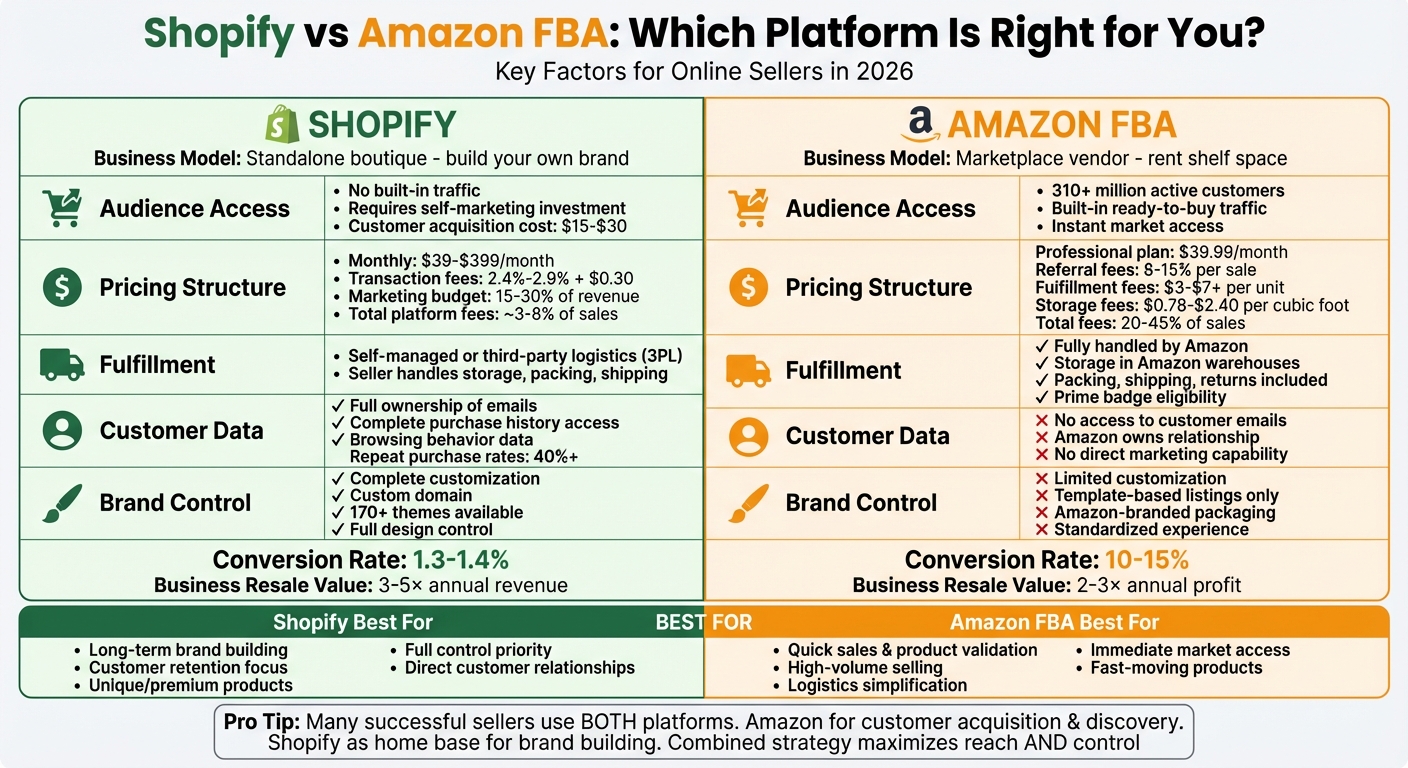
How Shopify and Amazon FBA Differ
What Shopify Offers
Shopify is an independent e-commerce platform that allows you to create and fully control your online store. From the design and branding to the overall customer experience, everything is in your hands. This means you can craft a shopping environment that reflects your brand’s identity.
However, Shopify doesn’t come with a built-in audience. You’ll need to attract customers yourself, which often involves strategies like SEO, paid ads, social media campaigns, and content marketing. On average, the cost to acquire a customer on Shopify ranges between $15 and $30.
One major advantage of Shopify is the ownership of customer data. You gain access to valuable information, such as email addresses, purchase history, and browsing behavior. This data enables you to run targeted email campaigns and retargeting efforts, with some businesses achieving repeat purchase rates of 40% or more. In contrast, Amazon FBA provides access to a large audience but limits your control over customer relationships and data.
What Amazon FBA Offers
Amazon FBA works as a massive online marketplace, giving your products exposure to over 300 million active global customers. This built-in audience means you’re marketing to people who are already looking to buy, which can save time and effort compared to driving traffic to your own store.
Through Fulfillment by Amazon (FBA), the platform takes care of logistics. Once your inventory is stored in Amazon’s warehouses, they handle packing, shipping, and even customer service. Products listed through FBA are eligible for Prime shipping, which often boosts conversion rates. Sellers using FBA typically see a 20% to 25% increase in sales compared to those fulfilling orders themselves.
However, there are trade-offs. Amazon limits your access to customer data, so you can’t collect email addresses or build direct relationships with buyers. Branding opportunities are also restricted, as product listings follow Amazon’s standardized templates. Buyers often perceive their purchase as an "Amazon item" rather than something tied to your brand. Additionally, Amazon’s fees – including referral, fulfillment, and storage costs – can take up 30% to 40% of your revenue per sale.
These factors highlight how Amazon FBA caters to businesses looking for quick sales and market validation, while Shopify focuses more on long-term brand building.
Side-by-Side Comparison
Here’s a breakdown of the key differences between Shopify and Amazon FBA:
| Factor | Shopify | Amazon FBA |
|---|---|---|
| Business Model | Standalone boutique – build your own brand | Marketplace vendor – rent shelf space |
| Customer Access | Zero initial traffic; requires marketing investment | Instant access to 300M+ active shoppers |
| Fulfillment | Self-managed or third-party logistics (3PL) | Fully handled by Amazon (storage, shipping, returns) |
| Customer Data | Full ownership of emails and purchase history | Restricted – Amazon owns the relationship |
| Branding Control | Complete customization of design and experience | Template-based listings with limited personalization |
| Fees | $39–$399/month + 2.4%–2.9% + $0.30 per transaction | $39.99/month + 8%–15% referral + $2.99–$6.00+ fulfillment per unit |
| Best For | Building long-term brand equity and customer loyalty | Rapid sales volume and product validation |
"Amazon is the most busiest place in America… I don’t know how anybody selling in a retail store would not want to be there. But at the same time, your website is your home base."
– Andrew Morgans, Founder and CEO, Marknology
These differences make it clear that your choice between Shopify and Amazon FBA should depend on your business priorities – whether you’re aiming for quick sales or establishing a lasting brand presence.
sbb-itb-ba0a4be
Shopify: Pricing, Features, and Trade-Offs
Let’s dive deeper into Shopify’s pricing, features, and the trade-offs that could impact your business decisions.
Shopify Pricing and Features
Shopify uses a subscription-based pricing model with five main tiers: Starter ($5/month), Basic ($39/month), Grow ($105/month), Advanced ($399/month), and Plus (starting at $2,300/month). These prices are for monthly billing, but switching to annual billing can save you 25% on the Basic, Grow, and Advanced plans.
Transaction fees differ depending on the plan. For instance, Shopify Payments charges 2.9% + $0.30 per transaction on the Basic plan, while the Advanced plan lowers this to 2.5% + $0.30. If you opt for a third-party payment gateway, expect additional fees ranging from 0.5% to 2.0%, which can cut into your profit margins.
On average, merchants spend around $120 monthly on apps to enhance their store’s functionality. These apps cover areas like email marketing, loyalty programs, and analytics. Premium themes range from $180 to $420 as a one-time cost, though free options like the ‘Dawn’ theme are ideal for new businesses. Domain registration adds an extra $11–$20 annually.
The platform offers over 170 themes and a drag-and-drop builder for easy store customization. Advanced users can also tweak their designs with HTML and CSS. Shopify integrates AI-driven tools like "Shopify Magic" for content creation and "Shopify Sidekick" for merchant support. Sellers can manage sales across multiple platforms – TikTok, Instagram, Facebook, and even physical retail through Shopify POS – all from one dashboard.
For businesses looking to scale, Shopify provides 60+ reports, inventory tracking across up to 200 locations, and automated marketing workflows. Its suite of financial tools includes Shopify Balance (business accounts), Shopify Capital (credit lines), and Shopify Bill Pay (bill management). For international sellers, "Shopify Markets" simplifies global operations by handling localized pricing, currency conversion, and duty calculations.
While Shopify offers a robust toolkit, it’s not without its trade-offs.
Shopify Advantages and Drawbacks
Shopify’s biggest strength lies in the control it gives over your brand and customer data. You retain ownership of critical customer information like email addresses, purchase history, and browsing behavior, allowing for targeted marketing and better customer retention. Plus, Shopify doesn’t charge per-sale referral fees, which helps you keep more of your profits as your business grows.
The platform’s flexibility is another standout feature. With access to over 8,000 apps, you can tailor nearly every aspect of your store. Additionally, Shopify stores tend to have higher resale values, often selling for 3 to 5 times annual revenue, compared to Amazon businesses, which typically sell for 2 to 3 times annual profit.
However, there are challenges. Shopify doesn’t come with a built-in audience, meaning you’ll need to invest in SEO, paid ads, or social media to drive traffic to your store. Fulfillment is another area where sellers bear the responsibility. While you can outsource logistics to third-party providers or use Shopify Fulfillment Network, tasks like storage, packing, and shipping remain on your plate. Lastly, beginners may find Shopify’s deeper customization options come with a learning curve.
| Advantages | Drawbacks |
|---|---|
| Full ownership of customer data and email lists | No built-in audience; requires marketing investment |
| No per-sale referral fees (preserves profit margins) | Fixed costs for subscriptions and apps |
| Extensive customization and unlimited product variants | Steeper learning curve for advanced customization |
| Advanced tools for SEO and content marketing | Seller-managed fulfillment and returns |
| Higher resale value (3–5× annual revenue) | Transaction fees if not using Shopify Payments |
These insights into Shopify’s strengths and weaknesses provide important context as we move on to evaluate Amazon FBA’s pricing and operational model.
Amazon FBA: Pricing, Features, and Trade-Offs
Getting a handle on Amazon FBA’s pricing and how it operates is important before diving in. Unlike Shopify’s fixed subscription fees, Amazon FBA uses a variable cost model that changes based on factors like product size, sales volume, and how you manage your inventory.
Amazon FBA Pricing and Features
Amazon FBA charges sellers through several fee tiers. Sellers can choose between the Professional plan at $39.99/month or the Individual plan, which costs $0.99 per item (ideal for those selling fewer than 40 items monthly). Beyond that, Amazon takes referral fees, usually 8–15% of the sale price, and fulfillment fees, which range from $5 to $15 per item as of 2026. When you add in returns and advertising costs, these fees can eat up 20–45% of your sale price.
Storage fees make things even trickier. During off-peak months (January–September), storage costs $0.78 per cubic foot, but this jumps to $2.40 during the holiday season (October–December). If inventory sits for more than 181 days, you’ll face aged inventory surcharges starting at $6.90 per cubic foot, plus inbound placement fees ranging from $0.27 to $1.58 per unit.
"It’s not one fee going up. It’s storage, transportation, and placement fees all increasing at once. When they hit together, the real impact is much bigger."
- Blair Forrest, CEO, AMZ Prep
In 2026, Amazon stopped offering in-house prep services. Now, sellers must handle labeling and packaging themselves or hire third-party services to avoid inbound defect fees ($0.32–$5.72 per unit). This shift has pushed many mid-sized brands to explore third-party logistics providers, which can cut costs by 25–40% for sellers operating across multiple channels.
FBA’s appeal lies in its comprehensive services. It handles storage, picking, packing, shipping, customer service, and returns. Products also earn the coveted Prime badge, putting them in front of more than 310 million active customers. Prime members, who spend an average of $1,170 annually (compared to $570 for non-Prime shoppers), represent a lucrative audience. FBA listings also perform better in Amazon’s algorithm, with conversion rates of 10–15% – far above the 1.3–1.4% typical for independent e-commerce stores. On average, Amazon sellers generate about $140,000 in yearly revenue, with profits hovering around $29,000.
While these features are attractive, the variable costs highlight the trade-offs of using Amazon’s fulfillment model.
Amazon FBA Advantages and Drawbacks
Amazon FBA’s fee structure shapes its strengths and challenges. The platform’s greatest strength is its access to massive, ready-to-buy audiences. With Amazon controlling 37.6% of the U.S. e-commerce market, sellers benefit from built-in traffic without needing heavy investments in SEO or paid ads.
However, FBA comes with limitations. One major downside is the lack of control over branding and customer relationships. Amazon doesn’t share customer data like email addresses or purchase history, making it hard for sellers to build their own marketing lists or engage directly with buyers. Products are shipped in Amazon-branded packaging, which limits opportunities for custom branding or unique unboxing experiences. Additionally, sellers must use Amazon’s listing templates, which restrict creative control over how your brand is presented.
"Amazon dictates the customer experience… They own the buyer’s email address and purchase history."
- Tanveer Abbas, E-commerce Expert, Ecombrainly
Competition on Amazon is another challenge. Similar products and competitor ads often appear alongside your listings, diluting brand identity. Sellers also face risks like sudden policy changes, fee increases, or even account suspensions, which can disrupt operations.
| Advantages | Drawbacks |
|---|---|
| Access to 310+ million active customers | No access to customer data or email lists |
| Prime badge boosts conversion rates to 10–15% | Limited branding with standardized packaging |
| Full-service fulfillment and customer support | Fees consuming 20–45% of sales |
| Lower shipping costs (up to 70% cheaper than premium carriers) | Risk of inventory penalties and management issues |
| Built-in traffic reduces reliance on marketing spend | Weaker brand loyalty as customers associate with Amazon |
| Strong Buy Box advantage through Amazon’s algorithm | Dependency on Amazon and its policies |
Amazon FBA works best for fast-moving, smaller products but can be tricky for businesses that value control over their customer relationships or long-term brand building.
Comparing Shopify and Amazon FBA Across 5 Factors
Each platform caters to different business needs, whether you’re focused on managing costs, ease of setup, or connecting with customers. Deciding between Shopify and Amazon FBA depends on how each platform addresses the core aspects of running an online business. Let’s break down how they compare across five key areas.
Cost and Fees
Shopify uses a straightforward subscription model. The Basic plan costs $39 per month, with transaction fees ranging from 2.4% to 2.9% + $0.30 per order. However, these fees are waived if you use Shopify Payments. On top of that, many Shopify sellers typically allocate 15–30% of their revenue to marketing efforts to attract customers.
Amazon FBA, on the other hand, operates on a variable fee structure. Sellers pay a $39.99 monthly Professional account fee, plus referral fees (usually 8–15% of the sale price) and fulfillment fees (ranging from $3 to over $7 per unit). Seasonal storage fees also apply, costing between $0.78 and $2.40 per cubic foot. Altogether, Amazon’s fees can take up 20–40% of each sale.
For instance, a business generating $10,000 in monthly revenue (200 orders at $50 each) would spend around $2,500 on Amazon fees, compared to approximately $369 in Shopify costs (excluding marketing). Similarly, a $30 phone case might yield $8–$10 in profit per unit on Amazon after fees, whereas on Shopify, the profit could range from $18–$20 before advertising expenses. This comparison highlights Shopify’s predictable costs versus Amazon’s fluctuating fee structure.
Now, let’s explore how each platform handles the initial setup process.
Setup and Learning Curve
Amazon FBA offers a faster route to making your first sale, thanks to its massive audience of over 300 million active buyers. The platform takes care of technical aspects like payment processing and hosting, making it easier to get started.
Shopify, however, requires more effort upfront. You’ll need to select a theme, customize your store, set up payment processing, and configure shipping options. While Shopify’s interface is easy to use, creating a store optimized for conversions often involves extra expenses, such as app subscriptions that can exceed $100 per month.
This trade-off boils down to simplicity versus control. Amazon simplifies the process but limits customization, while Shopify gives you full control over your store’s design and functionality.
Next, let’s see how each platform supports brand-building efforts.
Branding and Customer Data Control
Shopify allows full ownership of your customer data, including emails, purchase history, and browsing behavior. This gives you the tools to create personalized marketing campaigns, loyalty programs, and a unique brand identity using a custom domain.
Amazon, by contrast, keeps control of the customer relationship. You won’t have access to buyers’ contact details, and your products are shipped in Amazon-branded packaging, limiting your ability to showcase your brand.
| Factor | Shopify | Amazon FBA |
|---|---|---|
| Brand Identity | Full control (custom domain, themes) | Limited (Amazon-branded packaging) |
| Customer Data | Complete ownership | No direct access |
| Marketing | Demand generation (ads, SEO, social) | Demand capture (search intent, PPC) |
For businesses focused on building a lasting brand, Shopify’s flexibility in branding and data control is an important advantage.
Scaling and Fulfillment
Amazon FBA simplifies logistics with its end-to-end fulfillment services, including eligibility for the Prime badge. This can increase conversion rates by 20–40% and reduce shipping costs from $10–$13 per shipment to $2.99–$6.00 per unit.
Shopify requires you to manage logistics independently or partner with third-party fulfillment providers. You can also use Amazon’s Multi-Channel Fulfillment to handle Shopify orders, though the per-unit costs are often higher. Shopify’s strength lies in helping you grow through brand-building, while Amazon focuses on high-volume, streamlined sales.
"Amazon is the most busiest place in America… I don’t know how anybody selling in a retail store would not want to be there. But at the same time, your website is your home base." – Andrew Morgans, CEO, Marknology
Customer Support
Shopify offers tiered support based on your plan, including 24/7 phone and chat assistance for paid plans, along with a wealth of documentation and active community forums.
Amazon FBA handles most post-sale customer service through automated systems, which saves time but limits your ability to build direct relationships with customers.
Choosing the Right Platform for Your Business
Selecting the right platform depends on your business model and growth aspirations. If your priority is building a brand and maintaining direct relationships with customers, Shopify equips you with tools to own your customer data and create a tailored shopping experience. On the other hand, if your focus is on quick sales and leveraging a massive audience, Amazon FBA provides access to millions of ready-to-buy customers.
That said, you don’t have to choose just one. Many businesses successfully use both – Amazon as a discovery tool and Shopify to establish long-term brand loyalty. The key is to assess these platforms in light of your specific business strategy.
When to Choose Shopify
Shopify shines when your goals revolve around brand identity and customer retention. This platform is perfect for businesses selling unique, story-driven, or premium products where elements like packaging, personalization, and repeat purchases are essential. By owning your storefront, you can design a shopping experience that reflects your brand and engage customers directly through tools like email marketing.
Another advantage of Shopify is reduced vulnerability to sudden platform changes. Unlike Amazon, where policy shifts or account suspensions can jeopardize your business, Shopify gives you more control. However, driving traffic to your store often requires a paid strategy, with costs averaging around $2–$5 per click.
When to Choose Amazon FBA
Amazon FBA is ideal for testing products and achieving high-volume sales. With conversion rates often between 10% and 15%, Amazon’s massive customer base can quickly generate revenue. Its end-to-end fulfillment system simplifies operations, making it especially appealing for new sellers.
However, keep in mind that Amazon’s fees – covering referrals, fulfillment, and storage – can take 30% to 40% of your revenue. This means thinner margins, so it’s better suited for businesses prioritizing scale and speed over brand autonomy.
Using Both Platforms Together
Combining Shopify and Amazon can be a smart strategy. This approach lets you tap into Amazon’s audience while maintaining control over your brand on Shopify. For example, in 2025, Mina Elias of Trivium highlighted a partner brand that earned $2 million on Shopify, only to see its Amazon marketplace revenue surpass direct sales due to the "halo effect", where Amazon visibility boosted overall brand trust.
You can also streamline operations by using Amazon’s Multi-Channel Fulfillment (MCF) to handle storage and shipping for Shopify orders. This way, you benefit from Amazon’s logistics without compromising your brand identity.
| Strategy | Best For | Key Benefit |
|---|---|---|
| Shopify Only | Established brands with marketing budgets | Full control over customer data |
| Amazon FBA Only | Product testing and fast sales | Built-in traffic and fulfillment |
| Both Platforms | Long-term growth | Broader reach and brand equity |
Conclusion
When it comes to deciding between Shopify and Amazon FBA, there’s no one-size-fits-all answer. The right choice depends on what aligns best with your business goals.
If building a brand, owning customer data, and fostering long-term loyalty are at the top of your list, Shopify offers the control and flexibility you need. On the other hand, if your focus is on testing products quickly and tapping into an enormous customer base, Amazon FBA excels with its speed and fulfillment capabilities.
That said, these platforms don’t have to operate in silos. As Andrew Morgans, CEO of Marknology, insightfully explains:
"Amazon is the busiest place in America… I don’t know how anybody selling in a retail store would not want to be there. But at the same time, your website is your home base".
This perspective highlights how many successful sellers approach e-commerce: leveraging Amazon for customer acquisition while using Shopify as the foundation for brand-building.
Before you decide, take a close look at your margins, logistics, and growth strategy. Can your product handle Amazon’s 30%–40% fee structure? Are you prepared to manage fulfillment on your own, or would Amazon’s streamlined logistics be a better fit?
Many businesses find success by integrating both platforms. Based on the comparisons discussed earlier, align your strategy with your operational capabilities and long-term vision. Whether you choose Shopify, Amazon FBA, or a combination of both, make sure your decision supports sustainable growth and adapts as your business evolves.
FAQs
Which platform is more profitable for my products?
Amazon FBA tends to deliver higher profit margins, typically around 50-80%, thanks to reduced fulfillment costs. On the other hand, Shopify margins often fall between 30-50% after factoring in expenses. That said, Shopify can become more profitable over time for businesses with repeat customers or products that carry higher margins. Why? Because Shopify gives you more control over your branding and customer relationships. Ultimately, the right platform for your business will depend on factors like your product margins, overall goals, and how you plan to handle operations.
Can I use Amazon to fulfill orders from my Shopify store?
Yes, you can fulfill Shopify orders using Amazon’s services, like Fulfillment by Amazon (FBA). To make this work, you’ll typically need third-party tools or apps to link your Shopify store with Amazon’s fulfillment system. This integration lets you take advantage of Amazon’s reliable logistics and fast shipping while keeping your Shopify store branded and customer-focused. It simplifies the order and shipping process for your business and enhances the experience for your customers.
How do I build a customer list if I sell on Amazon FBA?
If you’re selling on Amazon FBA, building a customer list is a smart way to connect directly with your audience. Two effective strategies for this are using product inserts and landing pages.
Product inserts are small cards or notes included in your packaging. These can encourage customers to visit a specific page, leave a review, or sign up for exclusive offers in exchange for their email. It’s a simple yet powerful way to start collecting contact information.
Landing pages take it a step further. These are dedicated web pages designed to capture customer details, like email addresses, often in exchange for something valuable – think discounts, free guides, or exclusive updates. By directing customers to these pages, you create a direct line of communication outside Amazon’s ecosystem.
To make this process easier, you can use tools that help design landing pages and automate email marketing. These tools save time and allow you to grow your customer database while also building brand loyalty. Plus, having your own list means you’re less dependent on Amazon for future sales and customer engagement.