
If you run a company alone, people judge the business by judging you first. That is why a clear founder brand can help you win trust faster, especially when buyers find you online. Research in the article points to this shift: 74% of Americans are more likely to trust someone with an established personal brand, and 73% of B2B decision-makers trust thought leadership more than marketing materials.
So here’s the short version: I’d build my brand around one clear niche, one simple message, one repeatable visual style, and one weekly publishing system. Then I’d back it up with proof like case studies, testimonials, a clean website, and visible business details such as my LLC, U.S. address, and EIN.
Here’s what matters most:
- Pick a tight niche so people know who I help and what problem I solve
- Write one positioning line and use it across LinkedIn, X, my site, and my newsletter
- Keep visuals consistent with the same photo, colors, fonts, and templates
- Publish every week with a small system in Notion and Canva
- Show proof fast with numbers, client results, testimonials, and public business details
- Use my name to open doors, but let company assets carry trust over time
This is not about looking famous online. It is about making it easy for someone to say, “I get what this person does, and I’d feel fine doing business with them.”
Step 1: Define your niche and founder positioning
Find a niche where your skills meet real demand
Most solo founders make the same mistake at the start: they try to speak to everyone. That sounds smart, but it usually makes the offer harder to remember and harder to buy. A tighter niche gives people a fast answer to two things: why should I trust you? and is this for me?
A simple way to find your niche is to map four things:
- what you’re good at
- what you care enough about to keep talking about
- what your audience needs
- what people already spend money to fix
If you can’t explain the problem and the solution in one sentence, the niche is still too broad.
For solo founders serving global founders, the strongest niches usually sit around high-stakes, high-friction problems. Think forming a compliant U.S. LLC without being in the country, handling official mail from abroad, or keeping up with annual state compliance work. People pay to solve these problems. That’s the clearest signal that demand is there.
That niche becomes the base for your positioning statement.
Write a one-sentence positioning statement
Once your niche is clear, boil it down to one sentence. This line becomes the backbone of your LinkedIn headline, X bio, website copy, and intro in content.
A solid template is: "I help [specific audience] achieve [specific outcome] through [your distinct approach]."
For example: "I help global founders form and run compliant U.S. businesses remotely through streamlined registration, registered agent coverage, virtual mailbox support, and step-by-step compliance guidance."
Your first version doesn’t need to be perfect. Treat it like a working draft. Put it in your LinkedIn headline and X bio, then watch the response over two to four weeks. If prospects say, "that’s exactly what I need", you’re on the right track. If they ask what you do, make it tighter. Test two or three versions, then update your profiles with the one that gets the clearest reaction.
Use that sentence everywhere you introduce yourself.
Connect your personal brand to business credibility
A positioning statement means a lot more when the setup behind it matches the promise. Your business structure, registered agent, and virtual mailbox should line up with the brand you’re putting in public.
Your brand works better when your business setup backs it up. It shows there’s a real company behind the founder.
When people check you out, they aren’t only judging your content. They’re deciding whether the business behind the founder feels real and dependable. A properly registered entity, a professional registered agent, and a U.S. address help answer that before they even ask.
"Naming a limited liability company after yourself is a strategy for brands where owners are the face of the business." – Rick Mak, Global Entrepreneur and Business Strategist
Once the message and the business setup match, you can move that into your visuals and core assets.
Step 2: Build your message, visuals, and core brand assets
Write your mission statement and brand message
Next, turn your positioning into copy you can actually use. That means writing three core assets: a mission statement, a short bio, and a long bio. Each one has a different job.
A practical mission statement uses a simple formula: who you help + what outcome you deliver + how your approach is different. Keep it under 75 words. For example: "I help global founders form and run compliant U.S. businesses remotely." Tie the message to the business result you sell.
Your founder story should give that mission context and weight. Skip the résumé-style version. Instead, build it around four parts: the problem you kept seeing, the moment you decided to do something about it, the proof that you can get results, and who you serve now. Use the short version on LinkedIn and X. Put the longer version on your About page and in pitch materials.
Create a small message bank at the same time. Include:
- Your core positioning line
- Three proof points
- Three recurring content themes
This becomes your go-to source every time you write a post, update a profile, or prep for a call. Use the same opening line across every profile. Then use this copy as the base for your LinkedIn bio, X bio, About page, and content templates.
Build a simple visual system with Canva
Your visual system doesn’t need to be fancy. It needs to be consistent. The goal is recognition, not decoration. Pick a small color palette, one font pair, and a few templates you can reuse.
Start with a brand kit in Canva: two to three core colors, one to two fonts, and a simple logo or wordmark. That’s enough. A neutral background color, one main accent color, and one secondary accent color will cover most needs. For fonts, a clean sans-serif like Inter or Open Sans for headings, paired with an easy-to-read body font, works well. Once those pieces are set, build five reusable templates: a LinkedIn carousel, an X image post, a LinkedIn banner, a founder one-pager, and a basic 10-12 slide pitch deck.
The Canva Brand Kit feature keeps your colors, fonts, and logos in one place, so every new design pulls from the same look. When visuals keep changing, people notice – and not in a good way. Stick to one palette, one font pair, and one repeatable layout. The simpler the setup, the easier it is to manage on your own, and the faster people start recognizing your content in a crowded feed. Once the look is locked in, the next job is packaging the proof behind it.
Prepare the trust assets people check first
Once your message and visuals are in place, get the proof assets ready. These are the first things people check when they want to know if the founder and company are the real deal.
Before you post anything, have these ready: a current headshot, short and long bios, an About page, a services summary, and company details. Research shows people form an impression in roughly 100 milliseconds, with 80%-90% of that impression based on perceived trustworthiness and competence.
Your headshot should be current, well lit, and taken against a neutral or on-brand background. Use the same photo on LinkedIn, X, your website, and pitch decks. Keeping that image consistent across platforms strengthens recognition and shows the brand is being managed with care. Your services summary should clearly name three to five offers, include short descriptions, and, where it makes sense, show starting or indicative price ranges in USD so prospects can screen themselves before they reach out.
Include your legal structure, U.S. business address, and EIN. A clearly stated legal structure, a U.S. business address, and an EIN on file show clients and partners that there’s an actual operating business behind the founder – not just a social media profile. Put these details in your footer, profile, and client-facing documents.
Step 3: Set up your platforms and a weekly content system
Optimize LinkedIn, X, and your website around one clear message
Use the positioning, bios, and proof assets from the earlier steps to keep every platform aligned. Each channel should do one job. That’s what makes the whole setup easier to run as one person.
LinkedIn is your main trust channel, especially in B2B and tech. Use a simple headline formula: role + niche + outcome. For example: "Solo SaaS founder helping B2B startups convert more demos into paying customers." Your Featured section should include three to five items that back up that same promise, such as a case study, a high-performing post, a podcast or interview, or a lead magnet. Every part of the profile should reflect the same business promise so each visit tells a clear story about who you are and what your company does.
X helps with steady visibility. Keep the bio short: niche + outcome + one proof point. Your pinned post should spell out your promise, proof, and next step. Share short, direct observations from client work, industry commentary, or fast lessons. You can sound a bit more casual here than on LinkedIn, but the main message should not change.
Your personal website is the home base that connects everything. The homepage hero section should start with a one-sentence value proposition that matches your LinkedIn headline. Then add a services overview, a proof section with specific, verified results in plain U.S. dollar figures, and one clear call to action – either a 30-minute intro call or a newsletter signup. Update testimonials and case studies every quarter, or after a major client win. Make the newsletter signup your main backup call to action. That way, the site can turn attention into subscribers or calls.
Use a newsletter to build trust over time
A newsletter gives you a channel that no algorithm controls. For most solo founders, a monthly schedule is realistic. Twice a month can work once the workflow is in place.
Each issue should follow the same repeatable structure:
- a short personal note about a recent decision or milestone
- one deep-dive lesson or framework tied to your niche
- a brief "what we’re testing" section
- a single call to action, like replying with a question, sharing the issue, or booking a call
Trust grows from consistency and specific results. If you share a real outcome – like closing your first $20,000 annual contract – people get something they would never get from a short social post. Keep the writing in plain U.S. English, use exact numbers, and write each issue like a direct note to the people most likely to hire you, partner with you, or invest in you.
Run a simple content workflow with Notion and Canva
Once your public channels are set, use one system to plan and reuse content. Notion works as the backend for the whole process. Build one master database with fields for title, platform, content pillar, status (idea, drafting, scheduled, published), and publish date. That database should hold posts tied to the same niche and promise from Step 1.
Add a calendar view filtered by platform so you can see LinkedIn posts, X threads, newsletter issues, and website updates in one place. Also keep a separate idea bank. Drop in observations, client questions, or half-formed framework ideas as they come up. It’s a small habit, but it saves you from staring at a blank page on content day.
A simple weekly cadence looks like this:
- two to three LinkedIn posts
- three to five X posts
- one thread
- one newsletter per month
Batch your content in one or two 90–120 minute sessions each week. If a newsletter section gets a strong response, turn it into two or three LinkedIn posts. If an X thread picks up traction, expand it into a longer LinkedIn post. One good idea can do more than one job.
Use your existing Canva templates for every post format. Rotate content across three pillars: expertise, proof, and founder lessons. That mix keeps the feed balanced between authority and relatability, which matters when you want to attract clients, partners, and early investors at the same time.
sbb-itb-ba0a4be
Step 4: Add proof and trust signals that turn attention into opportunities
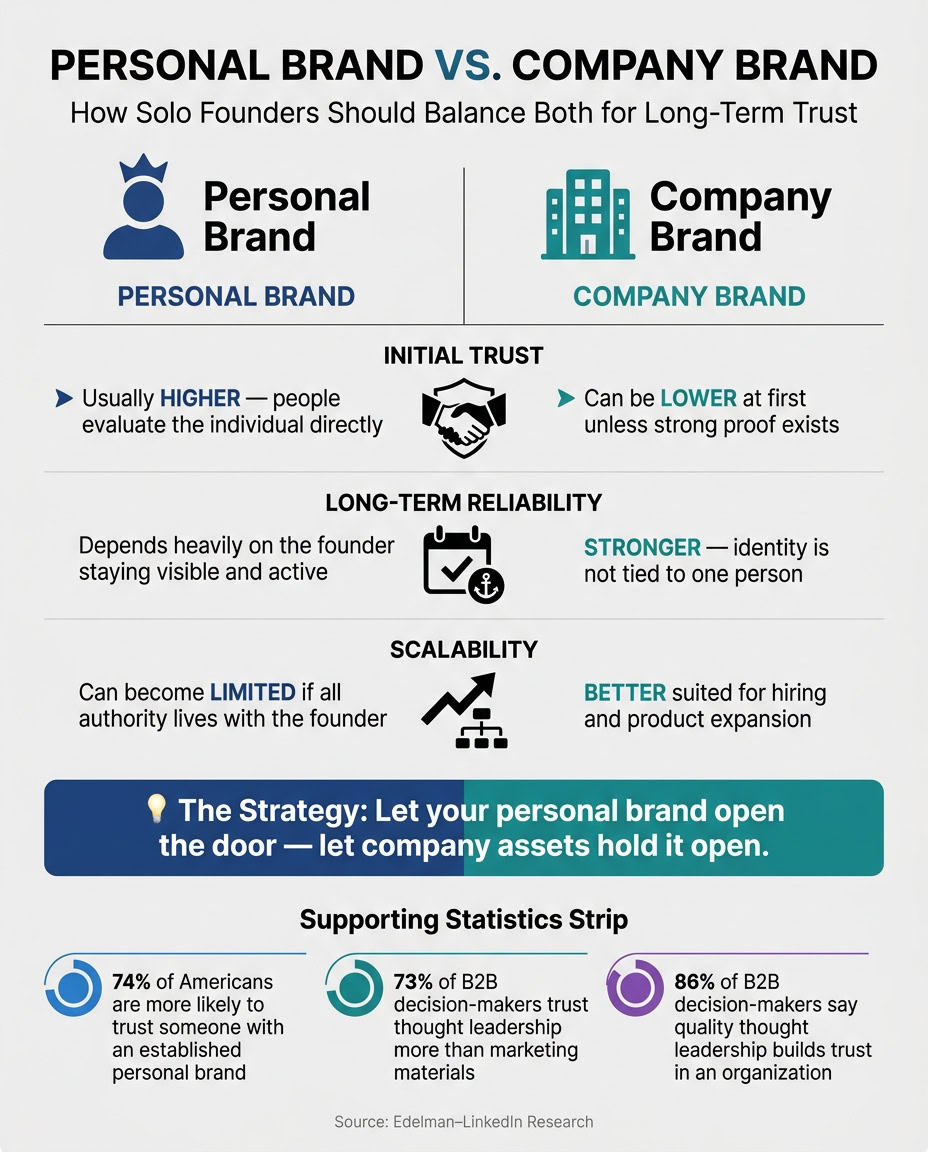
Personal Brand vs. Company Brand: Trust Dimensions for Solo Founders
Publish proof of expertise and results
Once your content is live, your next job is simple: make your claims easy to check.
Content gets you noticed. Proof helps people decide. When a client, partner, or investor finds you, they usually want a fast answer to one question: Why should I trust this business? If they can’t find that answer quickly, they move on.
The assets that work best are the ones people can verify in minutes. Think a short case study with a clear result, a testimonial with a real name and job title, a recorded talk, or a guest podcast appearance. According to Edelman–LinkedIn research, 86% of B2B decision-makers say quality thought leadership builds trust in an organization, and 75% say a specific piece of thought leadership led them to research a product or service they weren’t previously considering.
A good short case study doesn’t need to be long. It just needs to be clear:
- the client’s problem
- your approach
- the result
- one sentence on why it mattered
Use exact numbers when you can – reduced onboarding time by 30%, closed 12 qualified leads in 60 days, or helped a client go from idea to launch in three weeks. If you don’t have exact data, show a before-and-after change that a reader can picture without much effort.
Start small. Add testimonials and one case study first, then publish a recorded appearance or guest post. Each new asset makes the next sales call, intro meeting, or due diligence check a little shorter. These are also the proof assets your LinkedIn, X, website, and newsletter can point to, so every platform from Step 3 has something concrete behind it.
Show the business infrastructure behind the brand
After you show results, show that the business itself is real and organized.
If you don’t have a physical office, you miss one of the old-school trust signals people are used to seeing. No one can walk past your building or get a feel for your operation in person. So they look for other signs. They check whether the business is real, reachable, and set up in a serious way.
For remote founders, public trust signals can include verified U.S. registration, a registered agent, a professional U.S. address, and organized records. These details answer the first questions a careful buyer tends to ask: Is this real? Can I contact them? Will they stay organized?
A virtual mailbox gives you a U.S. street address that you can use on formation documents, banking, and your website. On public-facing pages, say that your business is U.S.-registered, uses a registered agent, and keeps organized records. Even a simple footer with your legal business name, state of formation, and a clear contact method can do a lot of work.
Balance founder visibility with company reliability
Use your visibility to start trust. Then use company assets to keep that trust in place.
A personal brand often builds trust fast because people feel like they’re buying from someone they can judge directly. Early on, that’s a big plus. But there’s a catch. If all trust sits with you – your face, your name, your online presence – the business gets shaky the second you step back.
The answer is to pair personal visibility with company-level assets: clear services, repeatable process language, outcome-based testimonials, and onboarding materials that show a system instead of just a person.
| Dimension | Personal Brand | Company Brand |
|---|---|---|
| Initial trust | Usually higher because people can evaluate the individual directly | Can be lower at first unless the company already has strong proof |
| Long-term reliability | Depends heavily on the founder staying visible and active | Stronger because the identity isn’t tied to one person |
| Scalability | Can become limited if all authority lives with the founder | Better suited for hiring and product expansion |
The practical move is to let your personal brand open the door while your company assets hold it open. That gives you early traction without making the whole business depend on one person.
Conclusion: Keep the system simple, consistent, and credible
Once you’ve nailed down your niche, message, platforms, and proof, the main job left is consistency. Pick a narrow niche, use the same core message across every channel, and publish on a schedule you can actually keep.
A fast gut-check can tell you if that consistency is doing its job. Show your LinkedIn headline and your website hero section to someone who doesn’t know your business. Then ask them:
- Who do you help?
- What problem do you solve?
- What kind of business do you run?
If they can’t answer with ease, your niche may be too broad or your message needs a rewrite.
It also helps to keep the system up to date with a monthly Notion review. Look at your profiles, content, and proof and see if they still tell the same story. Check whether the niche still feels clear, whether your platforms still line up, which posts or emails did best, and what proof you should add next month.
When the founder brand lines up with company proof, trust is easier to earn. Case studies, testimonials, and clear business details can turn attention into real opportunities.
FAQs
How long does it take to build a personal brand that creates trust?
Building a personal brand that earns trust takes time. It doesn’t happen overnight.
For most creators, the first signs of traction show up after 6 to 12 months of steady, high-quality work.
If you’re a solo founder running a service business, you may start seeing early organic leads around weeks 8 to 10. That often happens as your authority grows through assets like case studies and blog posts.
A lasting reputation usually takes 1 to 3 years of consistent effort.
What should I do if I do not have client testimonials or case studies yet?
If you don’t have testimonials or case studies yet, you can still build trust.
Start with educational content that speaks to client pain points, industry benchmarks, and common questions. That shows people you know your stuff, even if you’re still building a client track record.
Another smart move is to create a personal project or test site and document the results. You can also offer a limited-time beta deal at a discounted rate to land those first few projects.
Then let your expertise and strong results do the talking, and use that early work to earn your first testimonials.
How do I balance my personal brand with building a company brand?
Position yourself as the face of the business, but keep clear lines between you and the company. Your story, point of view, and experience can help people trust you. They also make the business feel more human. At the same time, your work setup should show that this is a company with proper boundaries, not just a personal side project.
Form an LLC to separate personal assets from business liabilities. That step helps draw a legal line between your personal life and the business. From there, make sure contracts and invoices are signed in the LLC’s name, not your personal name.
It also helps to use business-only tools for day-to-day communication, such as a company email address, phone number, and invoicing system. That way, clients deal with the business in a clear, professional way – not a one-person show that blurs personal and company roles.