


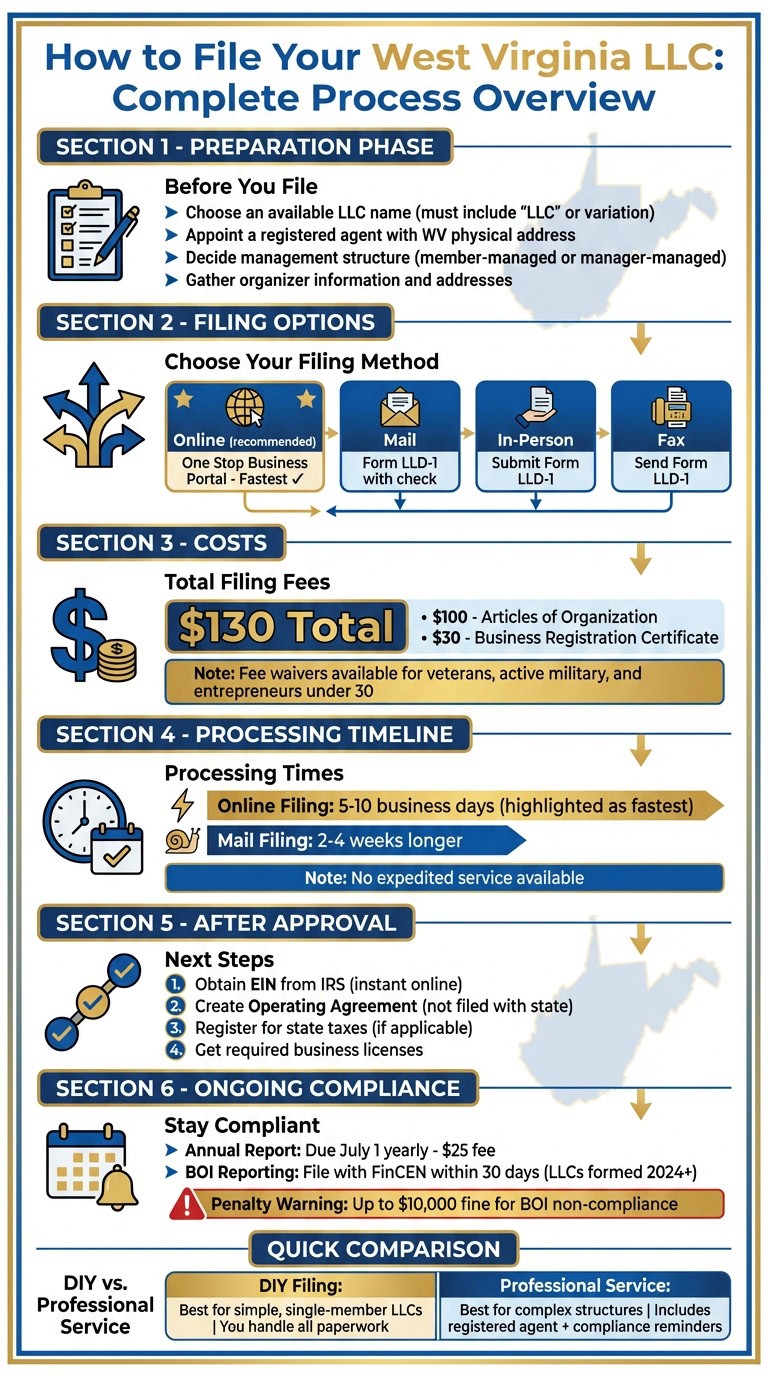
To officially form an LLC in West Virginia, you must file the Articles of Organization with the Secretary of State. Here’s a quick breakdown of the process:
- Purpose: Filing creates a legal entity, separating personal and business liabilities.
- Cost: $100 filing fee, plus $30 for a Business Registration Certificate.
- Filing Options: Online via the West Virginia One Stop Business Portal, by mail, in person, or by fax.
- Key Details Required:
- LLC name (must follow state naming rules).
- Registered agent with a physical address in West Virginia.
- Principal office address.
- Management structure (member-managed or manager-managed).
- Organizer’s name(s) and address(es).
- Business purpose (general or specific).
Online filing is the fastest method, with approval typically within 5–10 business days. Paper filings take longer. After approval, you’ll receive a Certificate of Organization and can proceed with obtaining an EIN, creating an operating agreement, and registering for taxes.
Compliance: File an annual report by July 1 each year ($25 fee) and ensure federal Beneficial Ownership Information (BOI) reporting if required. Missing deadlines can result in penalties or dissolution.
This guide simplifies the process, ensuring you meet all requirements to legally establish and maintain your LLC in West Virginia.
Requirements Before You File
Before filing your LLC paperwork in West Virginia, make sure you have all the necessary details ready. Proper preparation can help you avoid delays or rejections.
West Virginia LLC Naming Rules
Your LLC name must stand out from other registered entities in West Virginia. To check if your desired name is available, use the West Virginia business entity search tool.
Every LLC name in West Virginia must include "limited liability company" or an abbreviation such as LLC, L.L.C., LC, L.C., Ltd., or Co. For instance, names like "Mountain View Consulting LLC" or "River City Ventures L.L.C." meet this requirement.
Avoid using terms like "incorporated", "corporation", "Inc.", or "Corp." in your LLC name. Additionally, if you want to use regulated terms like "banking", "insurance", or "engineering", you’ll need the proper licensing or a business purpose that aligns with those terms. For example, "Mountain Engineering LLC" would require one of the LLC’s principals to be a licensed engineer in West Virginia.
If you’re not ready to file immediately, you can reserve an available name for up to 120 days by paying a fee of about $25.
Registered Agent Requirements
Every LLC in West Virginia must appoint a registered agent with a physical street address in the state (P.O. boxes are not allowed) to handle legal and tax-related documents.
Your registered agent can be:
- An individual resident of West Virginia
- A domestic business entity
- A foreign business entity authorized to operate in the state
While you can act as your own registered agent, keep in mind that your personal address will become public, and you must be available during regular business hours to receive documents. To maintain privacy and ensure compliance, many business owners opt for professional registered agent services. These services provide a West Virginia address, handle documents year-round, and keep your personal information private. Costs for these services range from $100 to $300 annually.
Management Structure and Address Information
Decide how your LLC will be managed. You can choose between:
- Member-managed: All owners participate in daily operations.
- Manager-managed: Designated managers handle operations, which is often preferred for LLCs with passive investors.
When filing your Articles of Organization, you’ll need to include several addresses:
- The registered agent’s physical address in West Virginia
- Your principal office address, which can be located anywhere, even outside West Virginia
- A mailing address, if it’s different from your principal office
You’ll also need to list at least one organizer’s name and address.
Lastly, outline your LLC’s business purpose. You can choose a broad "General Purpose" to allow flexibility for any legal activity or specify a more focused purpose, such as "software development".
With all these details in place, you’ll be ready to file your Articles of Organization and officially establish your West Virginia LLC.
How to File Articles of Organization in West Virginia
Once you’ve gathered all the necessary details, you’re ready to file your Articles of Organization. In West Virginia, there are a few ways to file, but using the One Stop Business Portal is the quickest and most convenient option.
Filing Online Through the One Stop Business Portal
The West Virginia One Stop Business Portal allows you to handle the entire process online. Start by creating an account and logging in. Follow the system’s prompts to enter your LLC’s details, including:
- LLC name
- Business and mailing addresses
- Registered agent information
- Management structure
- Business activity description (e.g., "providing marketing consulting and social media services")
When you’re ready to submit, pay the $100 fee using a credit or debit card. Be aware that processing fees may apply. If you’re a veteran, active military member, or an entrepreneur under 30 with at least 51% ownership, you can upload the required documentation to waive the $100 Articles fee. However, the $30 fee for the Business Registration Certificate will still apply.
Once your submission is reviewed and approved, the Secretary of State will email you a stamped and approved copy of your Articles of Organization, along with a Certificate of Organization. Online filings are generally processed within 5–10 business days.
Prefer not to file online? There are other options.
Filing by Mail, In-Person, or Fax
If you’d rather file offline, here’s what you’ll need to do:
- Download Form LLD-1 from the West Virginia Secretary of State website.
- Complete the form by typing or printing legibly. Make sure all required fields are filled out.
- Sign and date the form in original ink.
- Include a $100 check or money order payable to "West Virginia Secretary of State."
- Submit the form by mail, in person, or via fax, following the submission instructions provided on the form.
Keep in mind that processing times for paper filings are slower than online submissions. Additionally, after your LLC is approved, you’ll need to separately apply for a Business Registration Certificate with the State Tax Department.
Mistakes to Avoid When Filing
To avoid delays, double-check the following:
- Ensure your LLC name is available and meets West Virginia’s naming requirements.
- Verify that all addresses, especially the registered agent’s physical address in West Virginia, are complete and accurate.
- Confirm that your registered agent has agreed to serve in this role.
- Make sure the payment is exactly $100 and that all required fields are completed.
Lastly, if you’re submitting multiple documents, ensure the information is consistent across all forms. Taking the time to review everything thoroughly can save you from unnecessary delays in the approval process.
Fees, Processing Times, and Amendments
Filing Fees and Payment Options
In West Virginia, forming an LLC comes with a $100 filing fee plus a $30 Business Registration Certificate fee, for a total of $130 when filing online. If you use the One Stop Business Portal, both fees are bundled together, and you can pay conveniently with a credit or debit card.
For those filing by mail, you’ll need to send a check or money order for the $100 fee, made payable to "WV Secretary of State." Keep in mind, mail filers must also apply separately for the Business Registration Certificate, which adds extra steps to the process.
Processing Times and Expedited Service
When planning your filing, it’s important to consider processing times. If you file online through the One Stop Business Portal, expect your application to be processed within 5–10 business days. Once approved, you’ll receive a stamped copy of your Articles of Organization and your Certificate of Organization via email. Filing by mail, however, takes longer due to postal transit and the additional step of obtaining the Business Registration Certificate, which can extend the timeline by 2–4 weeks.
West Virginia does not offer expedited processing. Filing online is your quickest option.
How to Amend Your Articles of Organization
If you need to make changes to your LLC – such as updating its name, address, registered agent, or management structure – you’ll need to file Articles of Amendment using Form LLF-2 with the Secretary of State. The amendment filing fee is $25, payable by check to the "WV Secretary of State". You can submit amendments either online via the One Stop Business Portal or by mail. The form should include your LLC’s name, the specific changes being made, the effective date, and authorized signatures.
sbb-itb-ba0a4be
What to Do After Filing
Once your Articles of Organization are approved, there are a few important steps to take to get your West Virginia LLC fully up and running.
Getting an EIN and Creating an Operating Agreement
Start by applying for an Employer Identification Number (EIN) through the IRS. You can apply online at IRS.gov and receive your EIN instantly. This nine-digit tax ID is essential for opening a business bank account, hiring employees, and filing federal taxes. If you prefer assistance, BusinessAnywhere offers EIN application services for $97.
Next, create an operating agreement for your LLC. While West Virginia doesn’t require you to file this document with the state, it’s a key internal document that outlines how your business will operate. Your operating agreement should detail ownership percentages, capital contributions, management structure (whether member-managed or manager-managed), voting procedures, profit and loss distribution, and how to handle membership changes. This document is also necessary for opening a business bank account. If you skip creating your own operating agreement, West Virginia’s default LLC laws will automatically govern these aspects.
Once you’ve secured your EIN and finalized your operating agreement, you’ll need to handle licensing and tax registrations.
Business Licenses and Tax Registration
Make sure you have your Business Registration Certificate from the West Virginia State Tax Department – this serves as your official business license. If you filed your Articles of Organization online through the One Stop Business Portal, you likely completed this step during the process.
In addition to the Business Registration Certificate, register for any state taxes applicable to your business. For example, if you’re selling goods, you’ll need a sales and use tax permit. If you plan to hire employees, register for employer withholding tax and unemployment insurance. Don’t forget to check for local licensing or zoning requirements – many cities and counties in West Virginia require additional permits depending on your business activities.
Annual Reports and Compliance Requirements
Once your tax registrations are complete, you’ll need to stay on top of ongoing compliance.
Every West Virginia LLC must file an annual report by July 1 each year. The filing fee is $25, and failing to meet the deadline could result in penalties or even dissolution.
Additionally, there’s a federal compliance requirement: Beneficial Ownership Information (BOI) reporting to FinCEN. Most LLCs formed after January 1, 2024, are required to report details about their beneficial owners – anyone who holds at least 25% ownership or significant control over the company. LLCs formed in 2025 or later must file this information with FinCEN within 30 days of formation. Failure to comply can lead to fines of up to $10,000 or even two years of imprisonment. If you’d like help with this, BusinessAnywhere offers BOI reporting services for $37.
Keep all essential documents, such as your Certificate of Organization, Business Registration Certificate, EIN confirmation, operating agreement, and compliance filings, organized and accessible. These documents will be crucial for opening bank accounts, applying for loans, and preparing for potential audits.
Conclusion
With your filing process completed, your LLC is ready to hit the ground running. To file your West Virginia Articles of Organization, make sure to: pick an LLC name that meets state requirements, appoint a registered agent based in West Virginia, fill out Form LLD-1 with accurate management details and addresses, and pay the $100 filing fee along with $30 for the Business Registration Certificate. You can submit everything through the One Stop Business Portal or by mail. Filing online is often faster, with approvals typically processed in 5–10 business days, and it conveniently includes the Business Registration Certificate application in one streamlined process. Afterward, don’t forget to tackle other key steps like getting an EIN, drafting an operating agreement, and organizing your important documents.
To keep your LLC in good standing, it’s critical to stay on top of both annual and federal compliance requirements. This includes filing annual reports and meeting any federal obligations tied to your business. By following these steps, you can ensure that no important detail slips through the cracks as you finalize your filing.
Whether you decide to handle the filing yourself or hire a professional service, the choice depends on your specific needs. DIY filing is a good option if your LLC is straightforward, like a single-member or small multi-member setup, and you’re comfortable managing paperwork and deadlines. On the other hand, a filing service can be a lifesaver for those with more complex ownership structures or for business owners located out of state. Whichever route you take, remember that forming your LLC is just the first step – maintaining compliance through annual reports, tax registrations, and careful recordkeeping is equally important.
If you’re ready to file your West Virginia Articles of Organization, use this guide to confidently navigate the process. Alternatively, consider services like BusinessAnywhere for a hassle-free experience that covers registered agent duties, compliance reminders, and amendments. Whatever you choose, you’re now equipped to move forward with confidence.
FAQs
What are the rules for naming an LLC in West Virginia?
When choosing a name for your LLC in West Virginia, it’s essential that the name stands out and is unique compared to other registered businesses in the state. The name must include "Limited Liability Company" or an abbreviation such as "LLC" or "L.L.C.". Avoid using any terms that could mislead or imply an association with government agencies. To ensure your desired name is available, check the state’s business name database before submitting your filing.
How do I select a registered agent for my West Virginia LLC?
When selecting a registered agent for your West Virginia LLC, it’s important to ensure they meet specific criteria. They must either be a resident of West Virginia or a business authorized to operate within the state. Additionally, they need to have a physical address in West Virginia (P.O. boxes won’t cut it) and be available during standard business hours to accept legal and official documents on your behalf.
You have a few options: you can take on the role yourself, choose someone you trust, or hire a professional registered agent service. Whichever route you go, picking a dependable agent is essential because they help ensure your LLC stays compliant with state requirements.
What should I do after filing Articles of Organization in West Virginia?
Once you’ve submitted the Articles of Organization in West Virginia, there are a few important steps to fully establish your LLC. Start by applying for an Employer Identification Number (EIN) through the IRS. This number is crucial for handling taxes, hiring employees, and setting up a business bank account.
Next, determine if your business activities require you to register for state-specific taxes. Depending on what your LLC does, this could include sales tax, use tax, or other obligations.
While not mandatory in West Virginia, drafting an Operating Agreement is highly recommended. This document lays out the rules for managing your LLC, helping to avoid misunderstandings or conflicts down the road.
Lastly, ensure your LLC remains in good standing by filing annual reports and paying any necessary state fees on time. Staying on top of these requirements will keep your business compliant and running smoothly.