


Filing your Articles of Organization is the first step in forming an LLC in Wisconsin. This document legally establishes your business, protects your personal assets, and allows you to operate under a recognized entity. Here’s how to get started:
- Filing Options: You can file online or by mail. Online filing costs $131 and is processed within one business day. Filing by mail costs $170 and takes longer.
- Requirements: You’ll need an LLC name (including "LLC"), a Wisconsin-based registered agent, and a decision on management structure (member-managed or manager-managed).
- Steps After Approval: Obtain an EIN, draft an operating agreement, and open a business bank account to keep finances separate.
Online filing is faster and cheaper, while mail filing is available for those who prefer paper forms. After filing, remember to comply with annual reporting and tax obligations to maintain your LLC’s standing.
What Are Wisconsin Articles of Organization?
Definition and Legal Requirements
The Articles of Organization serve as the official document you file with the Wisconsin Department of Financial Institutions (DFI) to legally establish your limited liability company (LLC). According to Wis. Stat. § 183.0201, forming an LLC requires one or more organizers to sign and submit this document to the DFI for approval. Once the DFI accepts your filing, your LLC is officially created, giving it legal recognition under Wisconsin’s LLC laws. This process establishes your business as a separate legal entity, protects your personal assets from business liabilities, and allows you to take essential steps like obtaining an Employer Identification Number (EIN), opening a business bank account, and entering into contracts under your LLC’s name.
Under Wis. Stat. § 183.0202, your Articles of Organization must include the following details:
- A statement affirming that the LLC is formed under Chapter 183
- The LLC’s name, which must include terms like "limited liability company", "limited company", "LLC", "L.L.C.", "LC", or similar variations
- The street and mailing addresses of the LLC’s principal office
- The name, street address, mailing address, and email address of the initial registered agent
- The name and address of each organizer
- Any delayed effective date and time, if applicable
While these elements are mandatory, you can also include optional provisions, such as details about the LLC’s management structure or terms that might later appear in your operating agreement. However, most business owners prefer to keep such governance details in the operating agreement itself, as this allows for easier updates without needing to refile with the state.
Filing Methods and Fees
In Wisconsin, you can file your Articles of Organization using two methods: online or by mail.
- Online filing costs $131 (a $130 filing fee plus a $1 portal fee). This method is faster, with approvals often completed within one business day. Once approved, you’ll receive immediate electronic confirmation and access to your documents.
- Mail filing costs $170 and requires you to send two duplicate copies of the completed form to the DFI’s Division of Corporate & Consumer Services. Since the process involves physical delivery and manual review, it typically takes several business days or longer, depending on mail and processing times.
Both filing fees are non-refundable. Most business owners prefer the online method for its speed and convenience, as it provides instant access to approved documents, which can be downloaded immediately for use with banks and other institutions. Before filing, ensure you have all the necessary information ready to streamline the process.
Preparing to File Your Articles of Organization
Before you start filing, gather all the essential information: the principal office address of your LLC, contact details for your registered agent, and the names of your organizers. You’ll also need to decide whether your LLC will be member-managed or manager-managed – a decision that can save you from costly mistakes, as filing fees are non-refundable. Once you’ve got everything in place, carefully review each step to ensure your submission is accurate.
Choosing Your LLC Name
Picking the right name for your LLC is one of the first and most crucial steps. Your chosen name must include "LLC", "L.L.C.", "LC", or an approved abbreviation, and it has to stand out from other registered names in Wisconsin. To check availability, use the Wisconsin business entity search tool on the DFI website. Be thorough – search for variations and shortened versions of your preferred name to identify any potential conflicts.
It’s important to note that search results are not final and don’t guarantee approval, so it’s smart to have a backup name ready in case your first choice doesn’t make the cut. If you’re not ready to file right away, you can reserve your desired name with the DFI to ensure no one else claims it while you finalize your paperwork.
Appointing a Registered Agent
Every LLC in Wisconsin is required to have a registered agent with a physical address in the state – P.O. boxes won’t cut it. The registered agent must be available during standard business hours to receive legal documents, service of process, and official correspondence on behalf of your LLC.
You have options here: you can act as your own agent, appoint another Wisconsin resident, or hire a professional registered agent service. Acting as your own agent can save money, but it does mean your address will be publicly listed, and you’ll need to be consistently available. On the other hand, a professional service provides privacy and ensures reliability, which can be a big plus if you work from home, travel often, or operate your business remotely.
Selecting Your Management Structure
Before filing, you’ll need to decide how your LLC will be managed. In a member-managed structure, all owners share responsibility for daily operations. In a manager-managed setup, specific managers are appointed to handle the business’s day-to-day decisions. This choice determines who has the authority to sign contracts and interact with third parties on behalf of the LLC.
To avoid misunderstandings or disputes, align your Articles of Organization with a draft operating agreement that clearly outlines roles, voting rights, and responsibilities. Making this decision early on can save you from having to amend documents later and ensures a smoother filing process. With these preparations complete, you’ll be ready to move forward with filing online or by mail, as outlined in the next steps.
How to File Your Wisconsin Articles of Organization
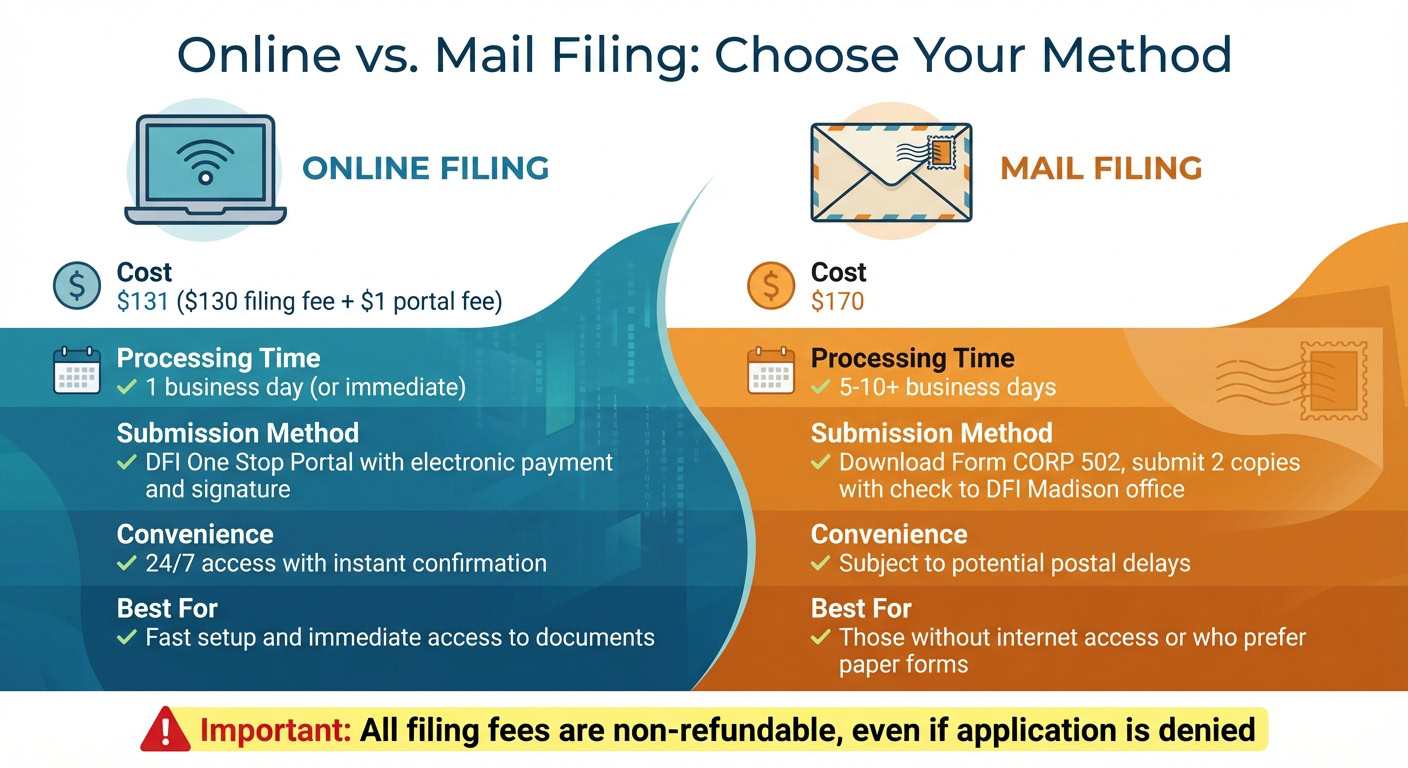
Once you’ve gathered all the necessary information, it’s time to file your Articles of Organization. In Wisconsin, you have two main options: filing online through the Department of Financial Institutions (DFI) portal or submitting your paperwork by mail. Filing online is faster and less expensive, but mailing is an alternative if you prefer paper forms.
Filing Online Through the Wisconsin DFI Portal
The fastest way to form your LLC is by using the Wisconsin DFI One Stop Business Portal at dfi.wi.gov. Start by navigating to "Business Services" and selecting "File Online." You’ll first need to create a free account by providing your basic contact information. Once logged in, choose the option to "File Articles of Organization" for LLCs.
The online form will require details such as your LLC name, registered agent information (including their Wisconsin street address, mailing address, and email), your principal office address, the management structure (member-managed or manager-managed), and organizer details. Make sure to double-check all fields, especially addresses and your LLC name, which must include the appropriate designator (e.g., LLC or Limited Liability Company). The filing fee is $130, plus a $1 portal fee, payable by credit card. After reviewing your information, you can electronically sign and submit the form. Online filings are typically processed within 1 business day.
Filing by Mail
If you’d rather file by mail, download Form CORP 502 from the DFI website. Complete the form with the required information, including your LLC name, registered agent details, principal office address, management structure, and the organizer’s name, address, and signature. You’ll need to prepare two duplicate copies of the completed form.
Include a check for $170, made payable to "Department of Financial Institutions", and send everything to the following address:
Wisconsin DFI
Division of Corporate & Consumer Services
P.O. Box 7846
Madison, WI 53707-7846
Mail filings generally take 5-10 business days or longer to process, depending on when your documents are received and reviewed by the DFI. Keep in mind that all filing fees are non-refundable, even if your application is denied.
Here’s a side-by-side comparison to help you decide which filing method works best for you:
Online vs. Mail Filing Comparison
| Aspect | Online Filing | Mail Filing |
|---|---|---|
| Cost | $131 ($130 + $1 portal fee) | $170 |
| Processing Time | 1 business day or immediate | 5-10+ business days |
| Submission Method | DFI One Stop Portal, electronic payment/signature | Download CORP 502, 2 copies, check, mail to DFI Madison |
| Convenience | 24/7 access, instant confirmation | Potential postal delays |
| Best For | Fast setup | Those without internet access or who prefer paper forms |
Before submitting your Articles of Organization, make sure your desired LLC name is available by using the Wisconsin business entity search tool. This step can save you from rejection and losing your filing fee. Once your filing is complete, you can move on to the next steps to finalize your LLC formation.
sbb-itb-ba0a4be
What to Do After Filing
Receiving Your Approval
Once the Wisconsin DFI processes your Articles of Organization, you’ll get confirmation that your LLC is legally established. If you filed online, you’ll typically receive electronic confirmation within one business day. For those who filed by mail, a stamped copy of your Articles will be sent back to you by post. This approval is your proof of formation and confirms your LLC’s legal status. Be sure to store this document securely. With this done, your next step is getting an EIN to comply with federal requirements.
Obtaining an EIN
The Employer Identification Number (EIN) is a nine-digit tax ID issued by the IRS. It’s required for multi-member LLCs and single-member LLCs if they have employees or choose corporate taxation. Even if you’re a single-member LLC without employees, having an EIN is a smart move. Most banks require it to open a business account, and it simplifies tax filings. The good news? You can apply for an EIN for free at IRS.gov, and most applicants get it instantly. If you’re unsure about the process, BusinessAnywhere offers an EIN application service for $97. Once you’ve secured your EIN, it’s time to establish your company’s internal structure.
Creating an Operating Agreement
Although Wisconsin doesn’t mandate it, drafting an operating agreement is highly recommended. This document outlines your LLC’s ownership, member roles, profit-sharing arrangements, management structure, and how disputes will be handled. For multi-member LLCs, it’s especially useful to avoid potential conflicts in the future. Some banks may also ask for an operating agreement when you open a business account. Make sure your agreement covers key details like management responsibilities and profit distribution. If you’re part of a multi-member LLC, consulting an attorney can be a good idea to ensure nothing important is overlooked.
Opening a Business Bank Account
Once your LLC’s internal structure is in place, it’s crucial to separate personal and business finances. This step is vital for maintaining your LLC’s limited liability protection. To open a business bank account, you’ll need your approved Articles of Organization, EIN confirmation, operating agreement, and a valid personal ID. Look for banks offering low-fee accounts and features that suit your business needs. Having a dedicated business account not only simplifies tax reporting but also reinforces the legal separation of your business. If you need help navigating this process, BusinessAnywhere provides bank account setup services.
Maintaining Your Wisconsin LLC
After filing your Articles of Organization, keeping up with ongoing requirements is essential to ensure your Wisconsin LLC remains compliant and operates smoothly.
Filing Annual Reports
Every Wisconsin LLC is required to submit an annual report to the Department of Financial Institutions (DFI) to maintain its good standing. This report serves to update important details, including your LLC’s legal name, principal office address, registered agent information, and management structure. You can file it online through the Wisconsin DFI Business Entity portal, and it’s due during the month of your LLC’s formation anniversary. Filing fees typically range from $25 to $40, so it’s a good idea to check the DFI website for the most up-to-date fee schedule.
Missing the filing deadline can lead to your LLC being marked as delinquent or even administratively dissolved. If dissolved, your LLC loses its liability protection and may face challenges such as being unable to obtain certificates of good standing or complete critical business transactions until reinstated. Reinstating a dissolved LLC often involves filing all overdue reports, paying accumulated fees, and covering an additional reinstatement fee. To avoid these issues, set a reminder for your LLC’s anniversary month.
Additionally, keeping your registered agent details current is just as important to ensure you don’t miss essential notifications.
Keeping Your Registered Agent Current
If you need to update your registered agent, you’ll need to file a Statement of Change form with the DFI, which can be done online for a small processing fee. Failing to update your registered agent information – or not having a replacement if your agent resigns – can result in missed legal documents and costly penalties. To simplify this process, many businesses opt for professional registered agent services. For instance, BusinessAnywhere offers registered agent services for $147 per year, ensuring you never miss critical legal notices.
Beyond annual filings and registered agent updates, staying on top of tax and compliance obligations is key to keeping your LLC in good standing.
Tax and Compliance Requirements
When it comes to federal taxes, the IRS treats single-member LLCs as disregarded entities, meaning income is reported on the owner’s Schedule C. For multi-member LLCs, the IRS classifies them as partnerships, requiring the filing of Form 1065 along with K-1s for each member. Wisconsin aligns with this federal classification, so LLC income typically passes through to the owners and is not taxed at the entity level. However, if your LLC is profitable and actively managed, you might want to consider electing S-Corporation status by filing IRS Form 2553. This can help reduce self-employment taxes by splitting income between wages (subject to payroll taxes) and distributions (not subject to self-employment taxes). Keep in mind that S-Corp status comes with additional responsibilities, like running payroll, filing corporate tax returns (Form 1120-S), and meeting compensation guidelines – consulting a CPA is highly recommended.
Another important compliance step is submitting the Beneficial Ownership Information Report (BOIR) to FinCEN, as required under the federal Corporate Transparency Act. This report identifies your LLC’s beneficial owners and must be filed within specific timelines after formation or when ownership changes occur. Additionally, Wisconsin LLCs may face state-level tax obligations, such as income tax, sales and use taxes (if selling taxable goods or services), and employer withholding taxes if you have employees. Professional filing services can assist with meeting these federal and state reporting requirements effectively.
Conclusion
Setting up your Articles of Organization in Wisconsin is a manageable process if you follow the right steps. Opting for the online filing method saves both time and money compared to mailing your documents. After your LLC is approved, make sure to secure your EIN from the IRS, create an operating agreement to clarify roles and profit sharing, and open a dedicated business bank account to keep your finances organized and separate.
After forming your LLC, staying on top of compliance is key. File your annual report with the DFI during your LLC’s anniversary month to avoid administrative dissolution. Keep your registered agent information updated, and ensure you’re meeting both federal and state tax requirements. With online filings processed almost instantly and the DFI allowing 120-day name reservations, Wisconsin offers a straightforward path to starting and running your LLC.
Leveraging available resources can make the process even smoother. For example, BusinessAnywhere provides registered agent services for $147 annually and offers tools to assist with formation, compliance, and ongoing management. Explore additional resources to help keep your Wisconsin LLC on track and thriving.
FAQs
What’s the difference between a member-managed and a manager-managed LLC?
A member-managed LLC operates with its members (owners) taking charge of daily operations and decision-making. In this structure, the owners are hands-on, directly overseeing the business’s activities. On the other hand, a manager-managed LLC designates one or more managers to handle the business’s operations, allowing the members to step back and act more like passive investors.
Deciding between these two setups largely depends on how involved the members want to be. Member-managed LLCs tend to suit smaller businesses with fewer members, where everyone is actively engaged. Meanwhile, manager-managed LLCs are a better fit for larger businesses or situations where members prefer to delegate the management tasks.
Why do I need a registered agent for my Wisconsin LLC?
A registered agent plays a crucial role for your Wisconsin LLC by serving as the official point of contact for your business. They make sure you promptly receive critical legal documents, like lawsuits or state notifications. Beyond that, a registered agent helps ensure your business complies with Wisconsin’s regulations, keeping it in good standing with the state. It’s an essential requirement for forming and running an LLC in Wisconsin.
How can I check if my desired LLC name is available in Wisconsin?
If you’re planning to register an LLC in Wisconsin, the first step is to check if your desired business name is available. You can do this by searching the Wisconsin Secretary of State’s business name database. This tool ensures your chosen name isn’t already taken or too similar to another business.
Your LLC name must also meet Wisconsin’s specific naming requirements. For instance, it must include “LLC” or “Limited Liability Company” and steer clear of restricted terms unless you have the necessary permissions. Choosing a name that’s both unique and compliant is a crucial part of filing your Articles of Organization successfully.