


Starting a business in the U.S. as a non-resident? Here’s what you need to know:
- You can own a U.S. business while living abroad, but working for it in the U.S. requires proper visas.
- Key U.S. visa options include:
- E-2 Visa: For investors from treaty countries; requires substantial investment but has no direct path to a Green Card.
- L-1 Visa: For transferring executives or managers from a foreign company to a U.S. affiliate; offers a potential route to permanent residency.
- EB-5 Visa: Provides a direct path to a Green Card with a significant investment ($800,000–$1,050,000) and job creation.
- Compliance is critical. Missteps like managing daily operations without authorization can lead to fines, deportation, or visa bans.
- Passive ownership (e.g., receiving dividends or attending board meetings) is allowed without a visa, but active management isn’t.
- Business formation essentials include choosing the right entity, obtaining an EIN, and filing required forms like Form 5472.
Quick Tip: Immigration planning is as important as business strategy. Choose the right visa, follow compliance rules, and structure your business for long-term success.
Key U.S. Visa Options for Non-Resident Entrepreneurs
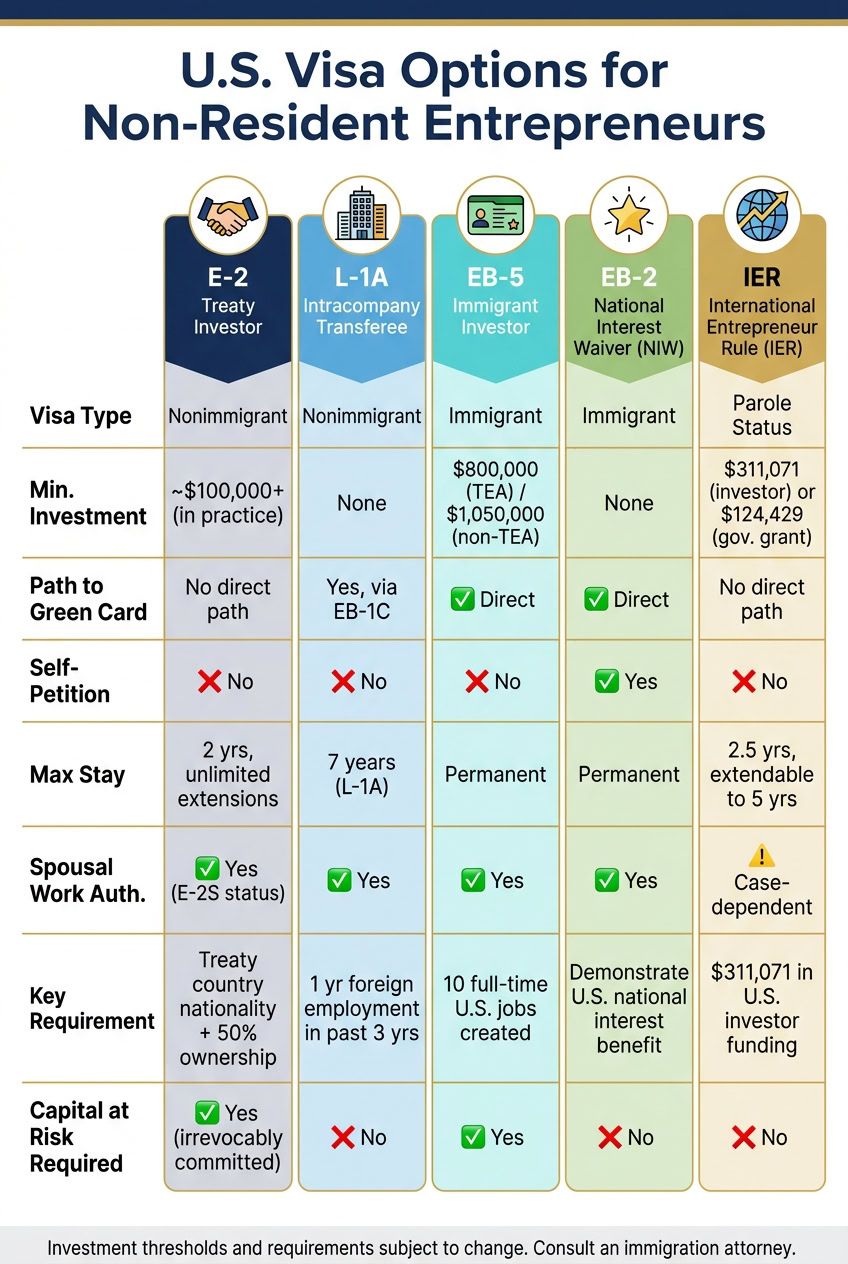
Visa requirements depend on factors like nationality, investment size, and existing business operations. Below is a breakdown of key visa options and their main features.
E-2 Treaty Investor Visa
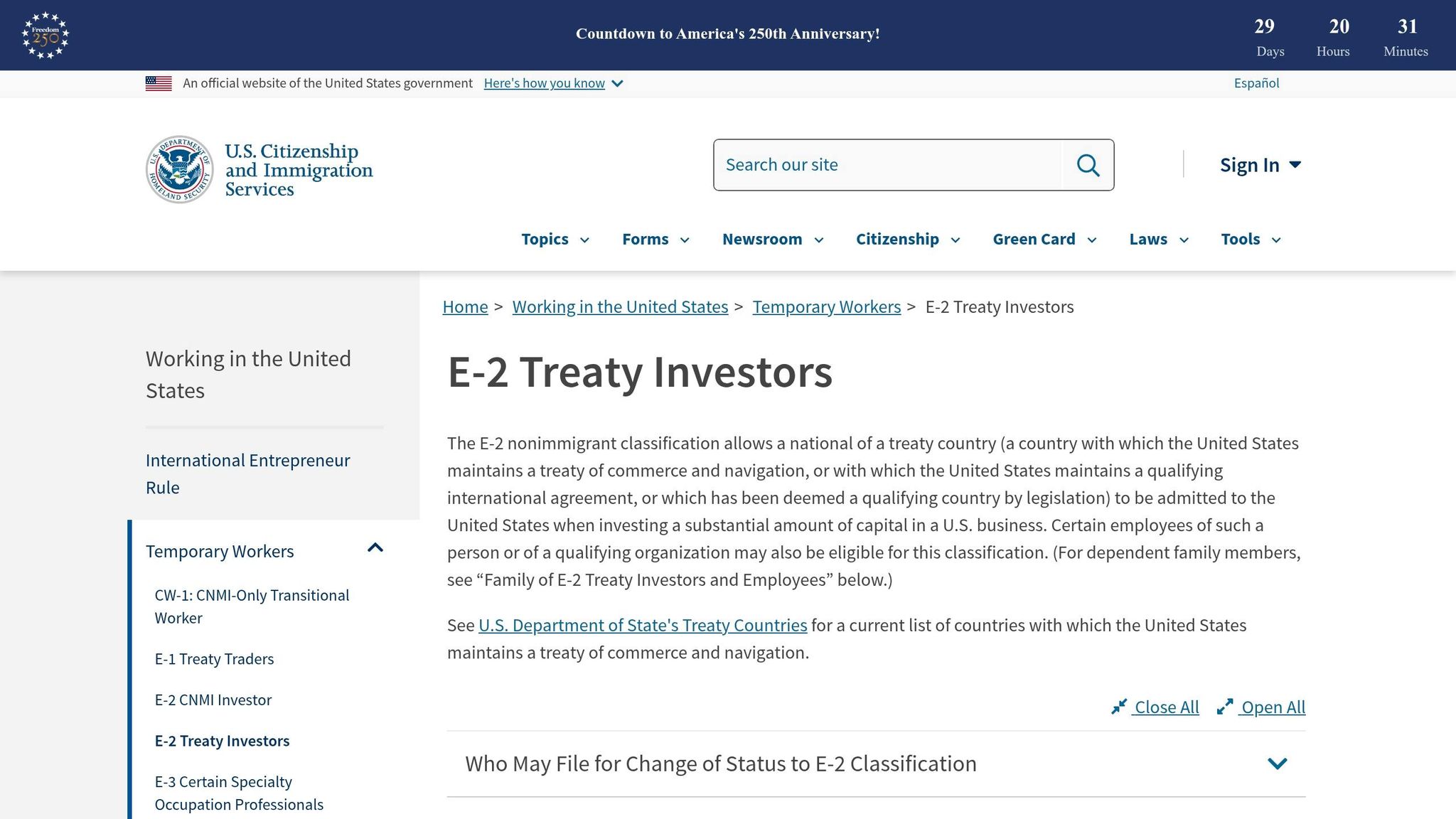
The E-2 Treaty Investor Visa is a common choice, but eligibility hinges on whether your home country has a qualifying treaty of commerce and navigation with the U.S.. For instance, citizens of countries like Canada, Germany, Japan, and the U.K. usually qualify, whereas nationals from some other countries may not.
To qualify, you need to make a substantial, irrevocable investment – whether through leases, equipment purchases, or escrow deposits – in a legitimate, operating U.S. business. Additionally, you must own at least 50% of the business or have operational control in a managerial role. The business itself must generate enough income to support you and your family within five years, beyond just covering minimal living expenses.
| Feature | E-2 Treaty Investor Visa Details |
|---|---|
| Initial Stay | Up to 2 years |
| Extensions | 2 years per extension; unlimited extensions allowed |
| Ownership Requirement | 50% ownership or operational control |
| Spousal Work Authorization | Yes (spouses can work under "E-2S" status) |
| Path to Green Card | No direct pathway |
Important Tip: Spouses of E-2 visa holders can work in the U.S. but need to ensure their Form I-94 lists the "E-2S" admission code as proof of work authorization.
L-1 Intracompany Transferee Visa
The L-1 Intracompany Transferee Visa is ideal for entrepreneurs looking to expand a foreign business into the U.S. by starting a U.S. LLC This visa allows executives, managers, or employees with specialized knowledge to transfer from a foreign company to a U.S. affiliate, subsidiary, or parent company.
Eligibility requires that you’ve worked for the foreign company for at least one year within the three years before entering the U.S. Your role must be executive/managerial (L-1A) or involve specialized knowledge (L-1B). Founders often qualify under the L-1A category, which allows a maximum stay of 7 years, compared to 5 years for L-1B holders.
One key advantage of the L-1 visa is that it doesn’t require a large capital investment; it’s based on your company’s structure. Additionally, it offers "dual intent", meaning you can pursue permanent residency without affecting your visa status. For faster processing, USCIS offers premium processing for L-1 petitions, guaranteeing a response within 15 calendar days for a fee of $2,805.
EB-5 Immigrant Investor Program
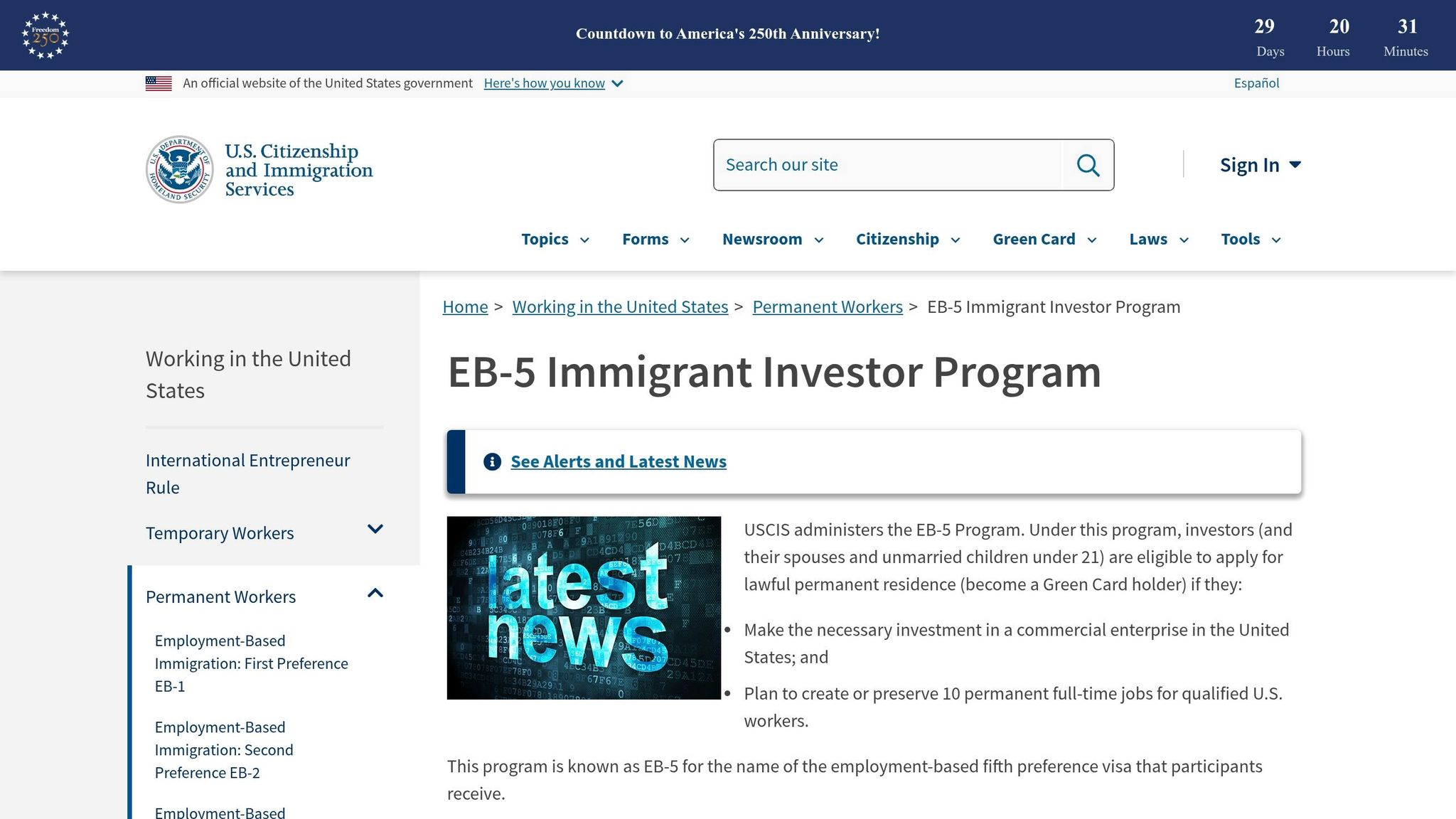
Unlike the E-2 or L-1 visas, the EB-5 Immigrant Investor Program directly leads to a Green Card. This program requires a significant capital investment in a new U.S. commercial enterprise and a commitment to create jobs for U.S. workers.
The application process includes multiple steps, such as USCIS petition approval, processing by the National Visa Center, a medical exam, and a visa interview at a U.S. Embassy or Consulate. Visas are issued based on your priority date – the date you filed your initial petition.
The EB-5 program also covers your spouse and unmarried children under 21, including same-sex spouses, providing a direct route to permanent residency for those focused on job creation.
Immigration Compliance Rules for Business Operations
Understanding your U.S. work limitations based on your visa status is just as important as choosing the right visa. Many business owners unintentionally break the rules simply by being active in their own companies while in the U.S.
Passive Ownership vs. Active Management
Here’s the bottom line: owning a business in the U.S. and being legally allowed to work for it are two entirely different things. As a foreign national, you can fully own a U.S. company – receive dividends, invest funds, and attend board meetings – without requiring any visa or work authorization.
"Ownership of a business and authorization to work in the United States are different legal concepts." – I.S. Law Firm
However, the moment you step into the U.S. and start managing daily tasks – like writing code, overseeing staff, pitching to clients, or making operational decisions – you need proper work authorization. A practical workaround is to delegate daily operations to a U.S. citizen or green card holder while managing remotely from outside the U.S..
"Managing an LLC while within the U.S., even without a salary, could be considered unauthorized work, and may result in significant fines and possible deportation." – EPGD Business Law
A manager-managed LLC can help keep you compliant. This structure allows you to appoint someone with the necessary work authorization to handle operations, while you remain in a passive ownership role. This setup is often safer than a member-managed LLC, where all members are presumed to be actively involved in running the business.
These distinctions underline why maintaining clear operational boundaries is essential for staying within the law.
Risks of Non-Compliance
Once roles are defined, it’s important to address the serious consequences of non-compliance. Unauthorized work or overstaying your visa can result in deportation, hefty fines, and even permanent bans from re-entering the U.S..
For E-2 visa holders, there’s an additional challenge known as the marginality rule. If your business only generates enough income to support you and your family – without showing the ability to hire U.S. employees or contribute to the economy – you risk having your visa denied or revoked. In fiscal year 2024, the E-2 visa approval rate was 90.1%, meaning nearly 10% of applicants faced denials, often due to missing documentation or failing this specific requirement.
Another common issue is capital compliance. Funds sitting idle in a corporate bank account don’t meet E-2 requirements. To qualify, the investment must be irrevocably committed – think signed leases, purchased equipment, or inventory orders that put the capital "at risk". If your business stops meeting the required thresholds, your legal status ends immediately, and you’ll need to leave the U.S..
| Action | Permitted Without Authorization | Requires Work Authorization |
|---|---|---|
| Receiving dividends | Yes | – |
| Attending board meetings | Yes | – |
| Investing capital | Yes | – |
| Day-to-day operations (in U.S.) | No | Yes |
| Drawing a salary from a U.S. source | No | Yes |
| Hiring/firing staff (while in U.S.) | No | Yes |
Lastly, don’t try to shortcut the process by listing a friend or relative as the "Responsible Party" on your IRS EIN application. The IRS requires this person to have actual control over the business, and using a nominee can lead to legal, tax, and immigration issues. If the Responsible Party changes, you must inform the IRS by filing Form 8822-B within 60 days.
Following these rules not only protects your business but also ensures a smoother path to operating legally in the U.S.
Temporary vs. Permanent Residency Options
After addressing operational compliance, it’s important to understand the difference between temporary and permanent residency options. This distinction shapes how you plan your business, hire employees, and map out your future in the U.S.
Temporary Non-Immigrant Visas
Temporary visas, such as the E-2, L-1, and O-1A, allow you to work in the U.S. for a limited time but don’t provide a direct route to a Green Card. For example, the E-2 visa, while renewable indefinitely, requires nonimmigrant intent.
"The E-2 visa has no built-in transition to permanent residency. While E-2 holders can apply for other immigrant categories, the E-2 itself is a nonimmigrant status." – EB5 Status Editorial Team
Another option is the International Entrepreneur Rule (IER). While technically a parole status rather than a visa, the IER allows startup founders to stay in the U.S. for up to 2.5 years, with the possibility of extending to 5 years. To qualify, founders must show at least $311,071 in U.S. investor funding or $124,429 in government grants (as of October 1, 2024). However, IER holders generally cannot adjust their status in the U.S. and must apply for an immigrant visa at a U.S. consulate.
The L-1A visa is a standout among temporary options because it offers a potential pathway to permanent residency. If you’ve managed or directed a foreign company for at least one year and are transferring to a U.S. affiliate, the L-1A visa can lead to an EB-1C Green Card.
These distinctions highlight the importance of aligning your visa choice with your long-term goals. Now, let’s look at immigrant pathways that lead directly to a Green Card.
Pathways to a Green Card
For those ready to establish long-term roots in the U.S., two primary options stand out: the EB-5 Immigrant Investor Program and the EB-2 National Interest Waiver (NIW).
The EB-5 program requires a minimum investment of $800,000 in a targeted employment area (TEA) or $1,050,000 in a non-TEA area. Additionally, you must create at least 10 full-time jobs for U.S. workers within two years. While this offers a direct path to a Green Card, the financial commitment is substantial.
The EB-2 NIW is a strong alternative for entrepreneurs who lack the capital required for EB-5 but can demonstrate that their work benefits the U.S. national interest. Unlike most EB-2 cases, the NIW allows for self-petitioning, meaning you don’t need an employer sponsor or labor certification.
| Pathway | Type | Min. Investment | Path to Green Card | Self-Petition |
|---|---|---|---|---|
| E-2 | Nonimmigrant – No path | ~$100,000+ in practice | No direct path | No |
| L-1A | Nonimmigrant | None | Yes (via EB-1C) | No |
| IER | Parole | $311,071 (or $124,429 for government grants) | No direct path | No |
| EB-5 | Immigrant | $800,000–$1,050,000 | Direct | No |
| EB-2 NIW | Immigrant | None | Direct | Yes |
It’s worth noting that each fiscal year, about 140,000 employment-based immigrant visas are issued across all categories. High demand often leads to long wait times, depending on your country of birth and visa type. By incorporating these options into your business strategy, you can better navigate potential immigration delays.
"The most successful founders treat immigration as part of their business strategy." – Canero Fadul Reis Law
sbb-itb-ba0a4be
Checklist for U.S. Business Formation and Immigration Compliance
If you’re setting up a business in the U.S. as a non-resident, it’s essential to follow the necessary steps to ensure compliance with both corporate and immigration regulations. Overlooking even a single requirement could lead to fines or jeopardize visa applications.
Core Business Formation Requirements
Starting with the right structure and steps can save you both time and money in the long run. Here’s what you need to do:
- Choose the right entity type
For visa applicants (like E-2 and L-1), LLCs are often a good fit. C-Corporations are ideal for multinational expansions and startups seeking venture capital. However, S-Corporations are off the table for non-resident aliens. - Select your state of formation
Delaware is a favorite for venture-backed startups, offering a flat $400 annual franchise tax for LLCs. Wyoming is attractive to digital nomads and online businesses, thanks to its $60 annual report fee and privacy protections. New Mexico stands out for its low costs and no annual report requirement. - Appoint a registered agent
A registered agent with a physical address in your chosen state is mandatory – P.O. boxes won’t cut it. Registered agent services typically cost between $50 and $200 per year. - Obtain an EIN
An Employer Identification Number (EIN) is essential for opening a bank account or filing taxes. Non-residents without a Social Security Number must apply via IRS Form SS-4, either by fax or mail. Processing can take 10–15 business days, but delays could stretch this to 4–8 weeks. - File your Beneficial Ownership Information (BOI) report
Under the Corporate Transparency Act, new entities must file a BOI report with FinCEN within 30 days of registration. Missing this deadline can result in civil fines up to $591 per day. - Submit Form 5472 annually
If you’re a foreign owner of a single-member LLC, you’re required to file Form 5472 along with a pro-forma Form 1120 each year. Failure to comply comes with a hefty $25,000 minimum penalty.
Immigration-Specific Considerations
While business formation and immigration compliance are separate processes, they must align seamlessly. A common misconception among non-resident entrepreneurs is that owning a U.S. business automatically grants residency or work rights.
"Ownership of a U.S. business does not automatically allow a foreign national to live or work in the United States." – Kodem Law
Your Operating Agreement or Corporate Bylaws should clearly outline capital contributions, voting rights, and executive authority to meet USCIS requirements. Additionally, ensure your business is listed in the USCIS Validation Instrument for Business Enterprises (VIBE) database. This database helps USCIS verify your company’s legitimacy during visa reviews. For E-2 visa seekers, confirm that your home country has a qualifying treaty with the U.S. before making any investments.
Another critical step is opening a dedicated U.S. business bank account as soon as you receive your EIN. Mixing personal and business funds (known as "commingling of assets") can weaken liability protections and complicate tax filings like Form 5472.
Given the complexity of these requirements, having access to reliable tools and services can make all the difference.
How BusinessAnywhere Can Help
BusinessAnywhere simplifies U.S. business formation and compliance for non-residents, offering a range of services through a single online platform.
- LLC Registration: Register an LLC at $0 (state fees apply), with the first year of registered agent service included.
- EIN Application: For $97, BusinessAnywhere handles EIN preparation, submission, and follow-up – perfect for non-residents unable to apply online.
- Tax Filing Services: Foreign-owned LLCs can use their $700 tax filing service, which includes Form 5472, a pro-forma Form 1120, and a review call.
- Additional Services: Options include BOI reporting, annual state filings, virtual mailbox services (starting at $20/month, billed annually), and remote notarization at $37 per document – all accessible remotely.
For an all-inclusive solution, the Digital Nomad Kit bundles LLC setup, EIN services, registered agent support, and more, starting at $3,200 – offering up to 35% savings compared to standard rates.
"The single most common mistake non-US founders make is forming a US entity on tax advice that only considers US rules, without anyone checking what that structure means back home." – Antravia Advisory
Avoid costly errors by ensuring you have the right guidance and support from the start.
Key Takeaways
When it comes to navigating U.S. immigration as a non-resident entrepreneur, Comparing U.S. visa options depends on several factors: your nationality, the amount of capital you’re investing, and how involved you plan to be in running your business. Here’s a quick breakdown:
- The E-2 Visa is ideal for entrepreneurs from treaty countries with personal investment capital.
- The L-1 Visa works well for those expanding an existing foreign business into the U.S.
- The EB-5 Visa provides a direct path to a green card, but it requires a significant investment – ranging from $800,000 to $1,050,000 – and the creation of at least 10 U.S. jobs.
One key point to remember: owning a U.S. business doesn’t automatically grant you the right to work in it. While you can legally establish an LLC or corporation without a visa, actively managing the business or earning income in the U.S. requires proper work authorization. This distinction is critical for staying compliant.
"If you lack the proper visa strategy, you may be unable to fully run your business in the United States." – CFR Law
For entrepreneurs aiming for long-term residency, the EB-1A (Extraordinary Ability) and EB-2 National Interest Waiver are two strong self-petition options. These don’t require sponsorship from an employer or a PERM labor certification. If you’re considering these routes, start gathering evidence – like awards, press mentions, or speaking engagements – 12 to 24 months before filing.
Immigration planning should be part of your business strategy from the very beginning. Choosing the right visa, setting up the right business structure, and following compliance steps early on can help you avoid costly mistakes later.
FAQs
Can I visit the U.S. and work on my own company without a work visa?
No, you cannot actively work on or manage your company while in the U.S. unless you have proper work authorization. Handling daily operations or performing tasks that employees typically do is considered unauthorized employment and violates immigration laws.
With a B-1 visa or ESTA, you’re allowed to engage in certain business-related activities, such as attending meetings or conferences. However, actively managing your business requires an appropriate work visa.
Which visa is best for starting a new U.S. business versus expanding a foreign one?
The right visa for you will hinge on your business goals and personal qualifications. If you’re planning to launch a business in the U.S., the E-2 Treaty Investor visa is a popular option – provided you’re from a treaty country and are making a significant investment. For founders with a track record of exceptional achievement, the O-1A visa might be the better fit. On the other hand, if your goal is to expand an existing foreign business, the L-1A visa could work, as long as you’ve held a managerial position abroad for at least one year.
What filings do foreign-owned U.S. LLCs commonly miss (EIN, BOI, Form 5472)?
Foreign-owned U.S. LLCs often overlook critical filings, which can result in hefty penalties. One essential step for compliance is obtaining an EIN (Employer Identification Number). These LLCs are also required to file Form 5472 each year, accompanied by a pro-forma Form 1120. Failing to do so can lead to a $25,000 penalty.
In addition to tax-related filings, these LLCs must also submit a Beneficial Ownership Information (BOI) report to FinCEN. This report is separate from tax filings and is used to disclose ownership details.