

Owning rental properties comes with risks, such as lawsuits that could threaten your personal assets. Using an LLC (Limited Liability Company) protects your personal finances by isolating liability to the property owned by the LLC. But how many LLCs should you use for multiple rentals? Here’s the short answer:
- 1–2 Properties: A single LLC is often enough.
- 3–10 Properties: Separate LLCs for each property provide better protection but increase costs and admin work.
- 11+ Properties: Consider a Series LLC if your state allows it. This structure can reduce costs and simplify management.
Key Takeaways:
- A traditional LLC creates strong legal separation but can become expensive and complex when managing many properties.
- A Series LLC groups multiple properties under a single "master" LLC, with individual "series" for each property. It’s cheaper but only recognized in certain states.
- Costs vary by state. For example, California charges $800 annually per LLC or series, while Oklahoma charges much less.
Choosing the right structure depends on your portfolio size, state laws, and how much time and money you want to spend on management. Below, we’ll break down the costs, liability protection, and when a Series LLC might save you money.
Traditional LLC vs. Series LLC: What’s the Difference?
How Traditional LLCs Work for Rental Properties
A traditional LLC functions as a single legal entity. Frame Zeller, LLC explains it like this:
"A traditional LLC is one legal ‘box.’ All of your business activities and assets live in that box. A lawsuit or major debt tied to one part of the business can put everything inside the box at risk."
For rental property owners, it’s common to place each property in its own separate LLC to ensure liability protection. This approach is highly effective and recognized across all 50 states. However, managing multiple LLCs brings added complexity, including higher formation costs and ongoing administrative work. While this method provides strong asset protection, it can be a logistical headache – prompting many property owners to look for alternatives like the Series LLC.
How Series LLCs Work
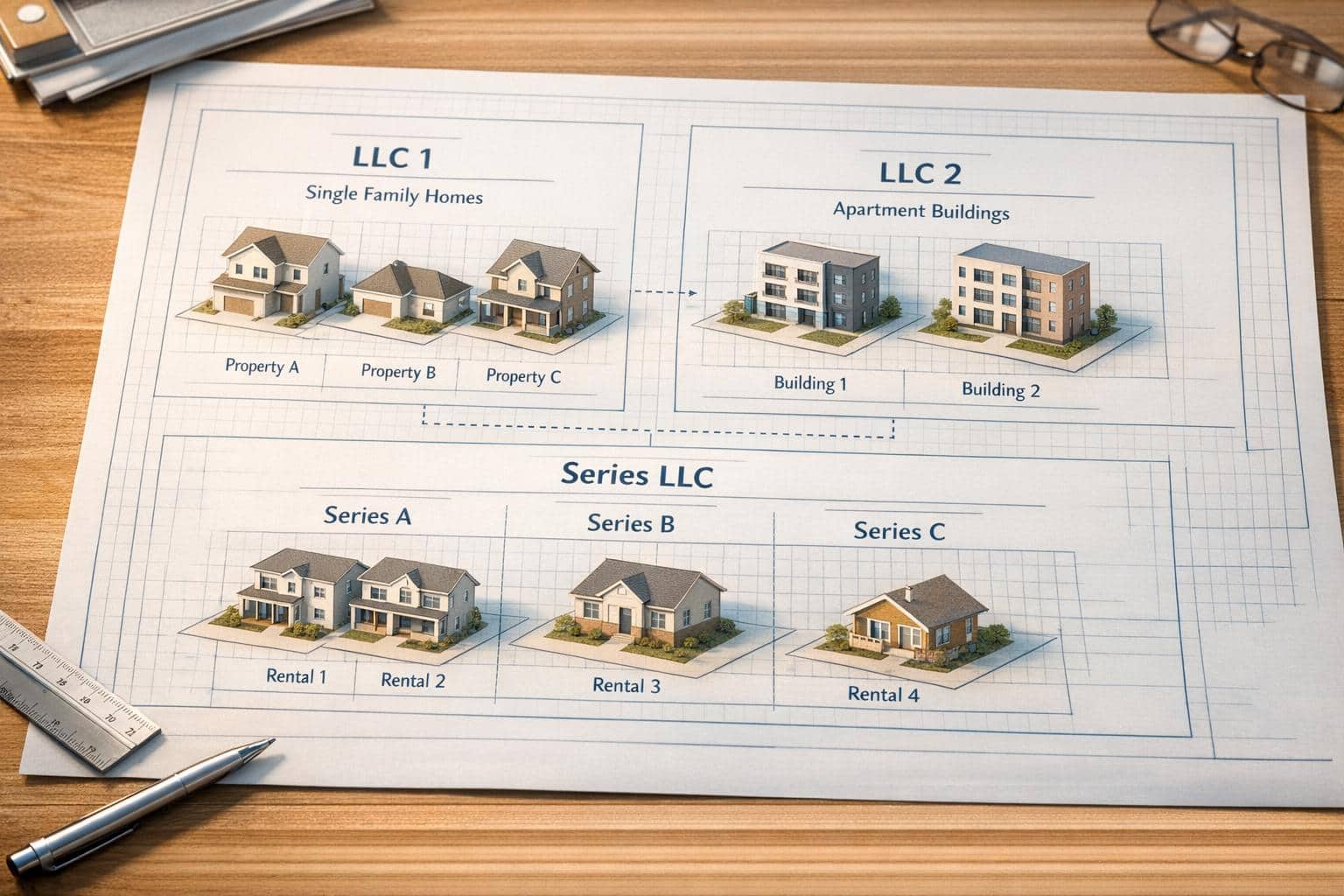
To simplify the management of multiple properties, some owners turn to the Series LLC structure. A Series LLC operates as a master LLC that encompasses smaller, distinct units called series. Blake Cantrell of CLCantrell Law Firm offers a helpful analogy:
"Think of a Series LLC as an apartment building. The building itself is the master LLC, while each apartment represents an individual series."
With this setup, you file a single master formation document with the state and assign each property to its own series. If legal issues arise with one property, only the assets within that specific series are at risk. The master LLC and other series remain unaffected. However, this protection hinges on keeping separate bank accounts and maintaining detailed records for each series. Mixing funds or failing to document properly could lead courts to disregard the liability shield.
Which States Allow Series LLCs
Series LLCs are not an option everywhere. As of 2025, around 20 states and territories permit this structure, including Alabama, Arkansas, Delaware, the District of Columbia, Illinois, Indiana, Iowa, Kansas, Missouri, Montana, Nebraska, Nevada, North Dakota, Ohio, Oklahoma, Puerto Rico, South Dakota, Tennessee, Texas, Utah, Virginia, and Wyoming. Delaware introduced the Series LLC in 1996, and Florida is set to join the list on July 1, 2026.
In states that don’t recognize Series LLCs, such as South Carolina or California (where domestic Series LLC formation is not allowed), courts might treat the entire Series LLC as a single entity. This could jeopardize the liability protection of individual series, exposing all assets in a lawsuit. By contrast, traditional LLCs benefit from widespread recognition and decades of established legal precedent.
This patchwork of state laws highlights the importance of researching local regulations before deciding between a traditional LLC and a Series LLC. Knowing where Series LLCs are legally supported is key to selecting the right structure for your property portfolio.
sbb-itb-ba0a4be
Cost Comparison: When Series LLCs Save Money
Setup and Annual Maintenance Costs
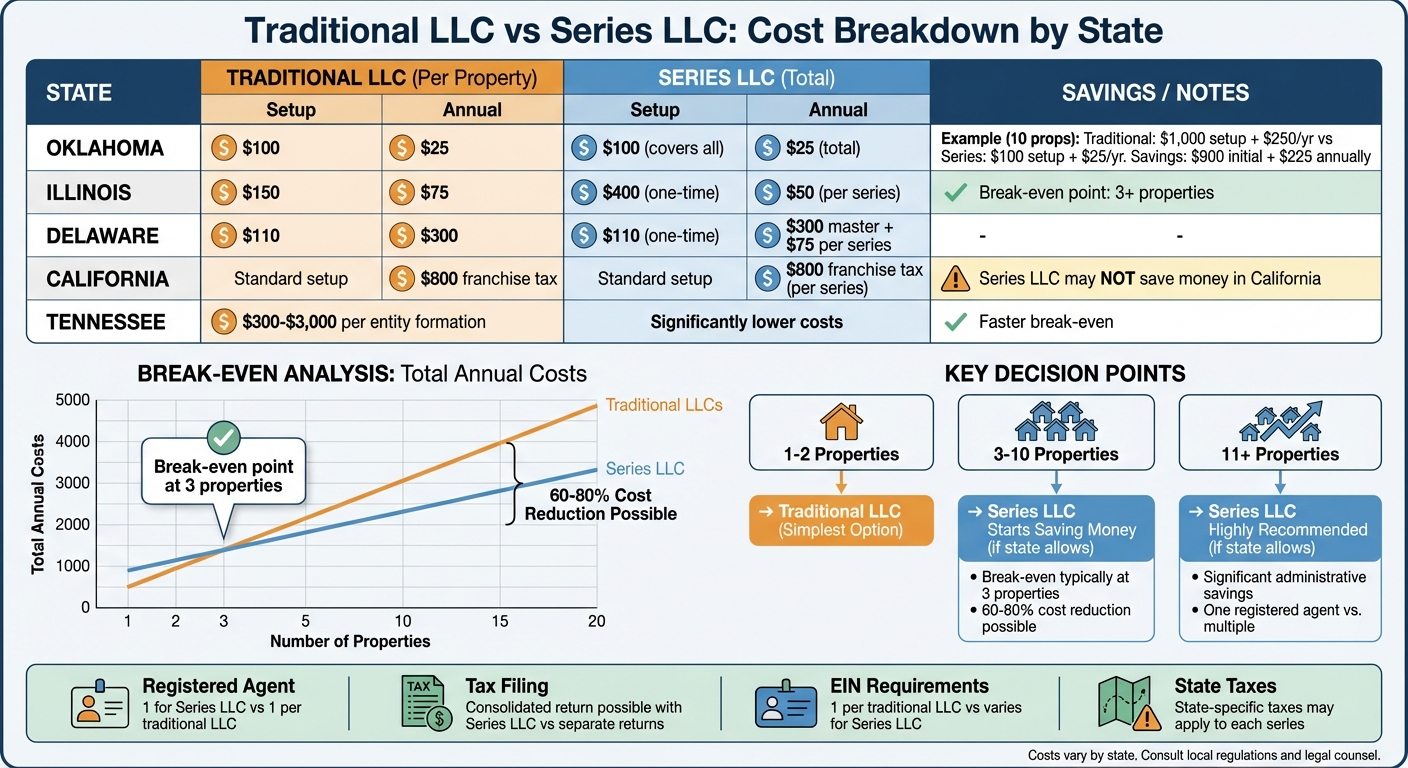
Managing multiple properties through traditional LLCs can get expensive fast, as each property requires its own formation filing and annual fees. For instance, in Oklahoma, setting up a traditional LLC costs $100 per property. By contrast, a Series LLC requires just one $100 fee to cover all properties under its umbrella. In Illinois, the numbers change: a traditional LLC costs $150 to establish and $75 annually, while a Series LLC has a $400 setup fee and a $50 annual fee per series. In this scenario, Series LLCs start saving you money when you own three or more properties.
The comparison shifts slightly in Delaware, where both structures have a $110 formation fee. However, traditional LLCs face a $300 annual fee per entity. A Series LLC, on the other hand, pays $300 annually for the master LLC, plus $75 for each registered series.
Another advantage? A Series LLC typically requires just one registered agent service, while traditional LLCs need one per entity.
Now, let’s look at how the advantages and disadvantages of an LLC for a rental property stack up regarding tax filing and administrative costs.
Tax Filing and Administrative Expenses
Beyond the initial setup, ongoing administrative and tax filing costs can add up. One of the key benefits of a Series LLC is the potential for streamlined tax preparation, which can save both time and money. Traditional LLCs require each entity to have its own Employer Identification Number (EIN) and file separate tax returns, which increases administrative complexity and costs. In contrast, many Series LLCs allow all series to be consolidated into a single federal tax return.
However, there’s a catch: some states, like California, Illinois, Tennessee, and Texas, may still require separate state-level filings for each series. California, in particular, imposes an $800 annual franchise tax on every series, which can significantly impact costs.
At What Point Does a Series LLC Cost Less?
The cost-effectiveness of a Series LLC depends on your state and the size of your property portfolio. Attorney Blake Cantrell highlights the advantage of Series LLCs, stating:
"The savings in administrative overhead alone can justify the Series LLC structure for businesses with three or more separate ventures".
Similarly, Matt Horwitz, founder of LLC University, suggests:
"10 properties or less, one LLC for each is a good setup. 11 properties or more: you’ll want to look at some more advanced real estate strategies, like Series LLCs".
For example, an Oklahoma investor with 10 properties would pay $1,000 in formation fees and $250 annually for traditional LLCs. A Series LLC, by comparison, would cost just $100 upfront and $25 annually – saving $900 initially and $225 every year after.
In states like Tennessee, where traditional LLC formation fees range from $300 to $3,000 per entity, Series LLCs can become cost-effective even faster. On the flip side, in California, where every series faces an $800 annual tax, traditional LLCs might actually be the cheaper option unless you’re managing a very large portfolio.
Liability Protection: Comparing Both Structures
How Multiple Traditional LLCs Protect You
Using a separate traditional LLC for each rental property creates distinct legal entities. This setup ensures that if one property faces a lawsuit, only that LLC’s assets are at risk – your personal finances and other properties in separate LLCs remain protected. Traditional LLCs are widely recognized across all 50 states and have decades of established case law, making their legal framework highly reliable.
Matt Horwitz, founder of LLC University, underscores this approach:
"For the best asset protection it’s best to put every single property in its own LLC for real estate, without those LLCs being engaged in any other businesses".
The predictability of traditional LLCs is a major advantage. Courts are familiar with their structure, lenders are comfortable working with them, and title companies know how to handle transactions involving them. Each LLC operates independently, with its own EIN, bank account, and state filings. While Series LLCs aim to offer similar protection, they do so with a more consolidated structure.
How Series LLCs Separate Liability
Series LLCs take a different approach, designed for modern multi-property management. In this model, a single master LLC houses multiple "series" or cells, each meant to isolate liability. When properly maintained, a lawsuit against one series should only affect that series, leaving the others untouched. Nellie Akalp, CEO of CorpNet, explains:
"If one series gets sued, other series aren’t liable. For example, if someone falls and becomes injured at one property, only the assets of the series set up for that property are at risk".
However, Series LLCs come with legal uncertainties. They are recognized in only about two dozen jurisdictions, and their structure has limited court testing. For instance, forming a Series LLC in Delaware but owning property in a state like South Carolina – where Series LLCs aren’t recognized – could lead to a court treating the entire setup as one entity. This would allow creditors to access assets across all series.
Bankruptcy is another gray area. It’s unclear whether an individual series can file for bankruptcy independently. If courts determine that only the master LLC can file, all series’ assets might be exposed during the proceedings.
How to Maintain Strong Liability Protection
No matter which structure you choose, strict administrative practices are crucial to preserving liability protection. Attorney Blake Cantrell advises:
"Liability protection isn’t automatic – you must maintain it via proper business practices… If you ignore the separate nature of your series, courts may as well".
To ensure strong liability protection, follow these key steps:
- Keep separate bank accounts for each property or series, avoiding fund mixing.
- Maintain individual accounting records for each property.
- When signing contracts under a Series LLC, clearly specify the involved series (e.g., "ABC Holdings, LLC, Series A").
- Obtain a unique EIN for each series from the IRS.
- Ensure your operating agreement explicitly states that each series operates independently and isn’t liable for the debts of others.
| Feature | Multiple Traditional LLCs | Series LLC |
|---|---|---|
| Liability Shield | Complete separation; highly predictable in court | Asset isolation; less established case law |
| State Recognition | Recognized in all 50 states | Recognized in about 24 jurisdictions |
| Veil Piercing Risk | Lower, provided basic formalities are met | Higher due to complex record-keeping |
| Lender Comfort | Preferred by lenders and title companies | May require additional documentation |
Frame Zeller adds:
"Series LLCs tend to work best when your assets and operations are concentrated in one or a small group of states that clearly authorize and recognize the structure".
For property owners with holdings in multiple states, especially those without Series LLC statutes, traditional LLCs may offer more dependable protection.
How to Choose the Right Structure for Your Properties
Choosing Based on Number of Properties and Costs
The size of your rental portfolio plays a huge role in deciding which structure makes financial sense. If you’re managing 1–2 small rentals, a traditional LLC is often the simplest and most cost-effective option. Its straightforward setup and lower administrative demands usually outweigh any potential savings you might get from a Series LLC.
For portfolios with 10 or fewer properties, using one traditional LLC per property works well. But once you surpass 10, more advanced options like a Series LLC can save time and money.
The break-even point for a Series LLC usually kicks in at 3 or more properties. At this stage, a Series LLC can slash entity-related costs by 60% to 80% compared to managing multiple traditional LLCs. For instance, in California, where each LLC incurs an $800 annual franchise tax, owning four properties would cost $3,200 annually with separate LLCs. With a Series LLC, that cost drops to $800 for the entire structure.
However, managing over 10 traditional LLCs can quickly become overwhelming. At this scale, a Series LLC or a holding company structure with subsidiary LLCs often becomes necessary to streamline operations.
These cost considerations are just the beginning. State laws also play a key role in shaping your decision.
How State Laws Affect Your Choice
State recognition of Series LLCs is a critical factor in deciding whether this structure is right for you. By 2025, only around 20 to 22 U.S. jurisdictions will have specific statutes recognizing Series LLCs. If you own properties in a state that doesn’t recognize them – like South Carolina – courts might treat your entire Series LLC as a single entity. This could eliminate the liability protection you were aiming for.
Frame Zeller highlights this risk:
"Series LLCs tend to work best when your assets and operations are concentrated in one or a small group of states that clearly authorize and recognize the structure."
Before committing to a Series LLC, you’ll need to confirm that every state where you own property recognizes the structure. If your properties span multiple states, particularly those without Series LLC statutes, traditional LLCs or a holding company structure may offer more reliable legal protection.
While costs and state regulations are essential, your ownership goals and future plans should also guide your decision.
Considering Ownership Structure and Future Plans
Once you’ve factored in costs and state-specific rules, the next step is to align your structure with your ownership strategy and long-term plans.
Your ownership setup and growth strategy can heavily influence your choice. Series LLCs are particularly flexible for partnerships. For example, you can fully own one property while bringing in partners for others, all within the same master entity. Each property can have its own ownership arrangement without the need to create separate LLCs.
Exit plans also matter. Holding properties in separate LLCs can make selling easier. Instead of selling the property itself, you can sell the LLC entity, potentially avoiding state or local transfer taxes in some areas. However, this strategy requires professional legal advice and may not work with all lenders. Some banks are unfamiliar with Series LLCs and may prefer traditional LLCs for underwriting purposes.
Risk isolation is another key consideration. Properties with higher risks – like short-term vacation rentals or homes with pools – should always be separated from lower-risk long-term rentals. Whether you use traditional LLCs or individual series within a Series LLC, keeping these assets apart ensures liabilities from one property don’t spill over to others.
If you’re planning to expand into multiple states, traditional LLCs offer more consistent legal protection. For portfolios in Series LLC-friendly states like Texas or Oklahoma, a Series LLC can be an efficient choice. But if your properties span multiple jurisdictions, traditional LLCs or a holding company structure provides better legal predictability.
Conclusion: Choosing the Best Structure for Your Rental Portfolio
Deciding on the right real estate LLC structure for your rental portfolio comes down to balancing liability protection, costs, and administrative effort. Traditional LLCs are a reliable choice, recognized across all 50 states with decades of case law to back them up. On the other hand, Series LLCs offer potential cost savings when managing multiple properties – but only in states where this structure is explicitly recognized.
For those with just 1–2 properties, a traditional LLC is often the simplest and most lender-friendly option. However, if you’re managing 3–10 properties in states like Texas or Oklahoma, where Series LLCs are recognized, the cost benefits can become more appealing.
As your portfolio grows beyond 10 properties, handling separate traditional LLCs can become a logistical headache. Learning how to manage a large real estate portfolio effectively becomes essential at this stage. In this case, a Series LLC might be worth considering – provided your properties are located in states that support this structure. Alternatively, for multi-state portfolios, a holding company with subsidiary LLCs could be a better fit. These decisions should be made with both your current needs and future expansion plans in mind.
Before making a final choice, confirm whether your state recognizes Series LLCs, ensure your lenders are on board, and check that transferring properties won’t trigger due-on-sale clauses. Keep in mind that the best structure isn’t always the one with the lowest upfront cost – it’s the one that provides strong asset protection, fits your operational needs, and can grow with your portfolio without introducing unnecessary legal headaches.
Ultimately, choose a structure that reduces risk, simplifies management, and scales with your ambitions. This way, your LLC setup will not only help protect your investments but also support the long-term success of your rental business.
FAQs
What’s the difference between a traditional LLC and a Series LLC for managing rental properties?
A traditional LLC operates as a separate entity, meaning each rental property you own typically requires its own LLC, along with a dedicated bank account and annual fees to maintain liability protection. On the other hand, a Series LLC works as a single "umbrella" entity, allowing you to create multiple series within it. Each series functions like its own LLC, with distinct assets, liabilities, and records, all tied to one overarching master filing.
One of the key benefits of a Series LLC is that the assets in one series are shielded from lawsuits or claims involving another series. This makes liability management across multiple properties much simpler. It can also save money since you pay a single formation fee and might be able to consolidate tax filings. In contrast, with traditional LLCs, each entity comes with its own set of expenses. However, it’s important to note that Series LLCs aren’t recognized in every state, so their availability and compliance depend on your location.
If your state allows Series LLCs, they can offer a cost-efficient way to manage multiple rental properties while still providing strong liability protection. If not, traditional LLCs remain a solid and widely accepted alternative.
How do state laws influence the use of a Series LLC for multiple rental properties?
State laws heavily influence whether a Series LLC is a practical choice for managing multiple rental properties. States like Delaware, Nevada, Illinois, and Texas explicitly recognize Series LLCs and allow each "series" to enjoy separate liability protection. This setup lets you form a single umbrella LLC and create individual series for each property, which can help cut costs by streamlining filing fees and tax reporting.
On the other hand, states such as California, New York, and South Carolina either don’t recognize Series LLCs or have unclear legal guidelines. In these states, a lawsuit targeting one series might jeopardize the assets of the entire LLC. If your property is located in a state that doesn’t support Series LLCs, you might need to set up a traditional LLC for each property or register the Series LLC as a foreign entity in that state. Both options can increase administrative work and expenses.
Before moving forward with a Series LLC, make sure the state where you plan to form it allows this structure. Additionally, check if foreign registration requirements in the states where your properties are located are manageable. This will help you make a decision that’s both cost-effective and legally secure for your rental property portfolio.
When is a Series LLC more cost-effective than using multiple traditional LLCs for rental properties?
A Series LLC can save money when the expenses tied to creating and managing separate LLCs for each rental property surpass the cost of maintaining a single "master" LLC. With a Series LLC, you typically pay just one formation fee and one annual renewal fee, no matter how many properties you include under its umbrella. On the other hand, traditional LLCs require separate filing fees and annual upkeep for each entity.
This setup tends to be more economical and practical if you own three to five properties or more, depending on the filing fees in your state. Beyond cost savings, a Series LLC simplifies administrative tasks. Instead of juggling separate bank accounts and records for each property, you can consolidate these efforts under one structure. This efficiency not only reduces hassle but also saves time and money as your portfolio expands.