


A Series LLC is a cost-effective way for real estate investors to protect individual properties under one umbrella entity. Instead of forming separate LLCs for each property, a Series LLC allows you to isolate liabilities for each property within its own "series", offering legal and financial protection across your portfolio.
Key Takeaways:
- Liability Protection: Each property is shielded from lawsuits or debts tied to other series.
- Cost Savings: One master LLC filing can replace multiple standalone LLCs, cutting entity-related expenses by up to 60-80%.
- Simplified Management: Only one registered agent and annual report and compliance requirements are typically required, reducing administrative work.
- State-Specific Rules: 21 U.S. jurisdictions, including Delaware, Texas, and Wyoming allow Series LLCs, with varying fees and regulations.
By maintaining separate bank accounts and records for each series, you ensure liability protection and compliance. For investors managing multiple properties, this structure streamlines operations while safeguarding assets.
What Is a Series LLC?
A Series LLC is essentially a parent company that can create multiple separate units, often called "series" or "cells". Imagine it as a single legal entity that houses several independent divisions. Each of these divisions operates like its own mini-LLC, but you only need to file one master formation document with the state.
This structure was first introduced in Delaware in 1996, initially designed for the mutual fund industry to manage multiple portfolios under a single SEC registration. Over time, it became a popular option for real estate investors looking to hold multiple properties without the hassle of forming separate LLCs for each one.
Blake Cantrell, an attorney at Cantrell Law Firm, offers a helpful analogy:
"Think of a Series LLC as an apartment building. The building itself is the master LLC, while each apartment represents an individual series… If one tenant causes damage or incurs liability, that liability stays within that specific apartment."
Each series can have its own name, members, managers, assets, and purpose. For real estate investors, this means you could place one property in Series A, another in Series B, and so on – all under the umbrella of the parent LLC.
Core Features of a Series LLC
The standout feature of a Series LLC is its internal liability shield. This means that any debts, liabilities, or obligations of one series are limited to that series alone – they don’t affect the parent LLC or other series. For instance, if a tenant at Property A (held in Series A) files a lawsuit, only the assets in Series A are at risk. The assets in Series B, Series C, and the parent LLC remain untouched.
To preserve this liability protection, it’s crucial to treat each series as a separate entity. This includes maintaining individual bank accounts, financial records, and obtaining unique Employer Identification Numbers (EINs) for tax and banking purposes.
The parent LLC’s operating agreement defines the relationship between the master entity and its series, detailing liability limitations. In many states, such as Oklahoma, creating new series is straightforward and does not require additional state filings – just an amendment to the operating agreement. In Oklahoma, for example, the entire structure can be maintained with a flat $100 fee.
| Feature | Traditional LLC | Series LLC |
|---|---|---|
| Structure | Single entity | Parent with multiple divisions |
| Liability Protection | All assets at risk if sued | Assets protected by series |
| Formation Cost | One filing fee | One master filing fee |
| Annual Reports | One report | Typically one report overall |
| Record-Keeping | Simple | Separate records for each series |
This setup provides clear liability separation, making it a strong option for protecting assets.
How Series LLCs Protect Real Estate Assets
In practice, this structure ensures that contracts, lease agreements, or loans are tied to the specific series involved. For example, instead of using the parent entity, you would list the contracting party as "ABC Holdings LLC, Series A." This ensures that only the assets within Series A are at stake.
SMC Law Firm highlights the appeal of this structure:
"The series LLC structure is popular among real estate investors because it minimizes liability obligations between properties, simplifies overall management burdens, and can be cheaper to set up."
For investors managing three or more properties, a Series LLC can reduce entity-related costs by 60–80% compared to setting up multiple standalone LLCs. However, these cost savings and protections depend on strict financial separation. If proper documentation isn’t maintained, courts could "pierce the corporate veil", potentially eliminating the liability protection that makes a Series LLC so effective.
States That Allow Series LLCs
As of 2025, 21 U.S. jurisdictions permit the formation of Series LLCs: Alabama, Arkansas, Delaware, District of Columbia, Illinois, Indiana, Iowa, Kansas, Missouri, Montana, Nebraska, Nevada, North Dakota, Oklahoma, Puerto Rico, South Dakota, Tennessee, Texas, Utah, Virginia, and Wyoming. Let’s take a closer look at some key states and how their specific laws shape the formation and management of Series LLCs.
Delaware has long been considered the benchmark for Series LLCs, thanks to its extensive case law and a legal framework that’s both predictable and well-established. As the first state to enact Series LLC legislation, it has set the tone for others to follow.
Texas and Wyoming have gained popularity, particularly among real estate investors. Texas law (Sections 101.601–101.621 of the Texas Business Organizations Code) allows each series to operate independently – this includes the ability to sue, be sued, and hold assets in its name. Wyoming, on the other hand, is known for its strong privacy protections, offering anonymous LLC ownership and lifetime proxy services.
Meanwhile, some states, like Colorado, Washington, and Pennsylvania, explicitly prohibit Series LLCs. California takes a different approach – it recognizes only foreign Series LLCs and imposes an $800 annual franchise tax on each series.
Understanding the specific costs and filing requirements in each state is critical. The next section breaks down these details.
State Requirements for Series LLCs
The rules and costs for forming Series LLCs vary widely depending on the state. Most states follow the "Protected Series" model, where new series are created internally through the operating agreement, eliminating the need for additional state filings. Delaware, however, offers two options: the Protected Series and the "Registered Series." The Registered Series requires state filings and fees, but it provides added legal clarity, especially when dealing with lenders.
| State | Formation Fee | Annual Fee | Per-Series Filing Fee |
|---|---|---|---|
| Delaware | ~$90 | $400 (Franchise Tax) | $0 (Protected); $75 (Registered) |
| Texas | $300 | Based on revenue | $0 |
| Illinois | $150+ | $75 (Master) + $50 per series | $50 |
| Oklahoma | $100 | $25 | $0 |
| Wyoming | ~$100 | $60 | $0 |
| Nevada | $75 | $350 | $0 |
When operating across state lines, it’s essential to confirm how series LLC liability shields vary by state. For example, courts in states that don’t recognize these entities may treat the Series LLC as a single LLC. To preserve the internal liability shield, it’s critical to maintain separate bank accounts and financial records for each series. Contracts should clearly identify the series involved, listing its name explicitly (e.g., "Smith Properties LLC – Series A"), rather than just referencing the parent entity.
This attention to detail is vital. As Blake Cantrell, Attorney at Cantrell Law Firm, cautions:
"If you ignore the separate nature of your series, courts may as well".
Benefits of Series LLCs for Real Estate Investors
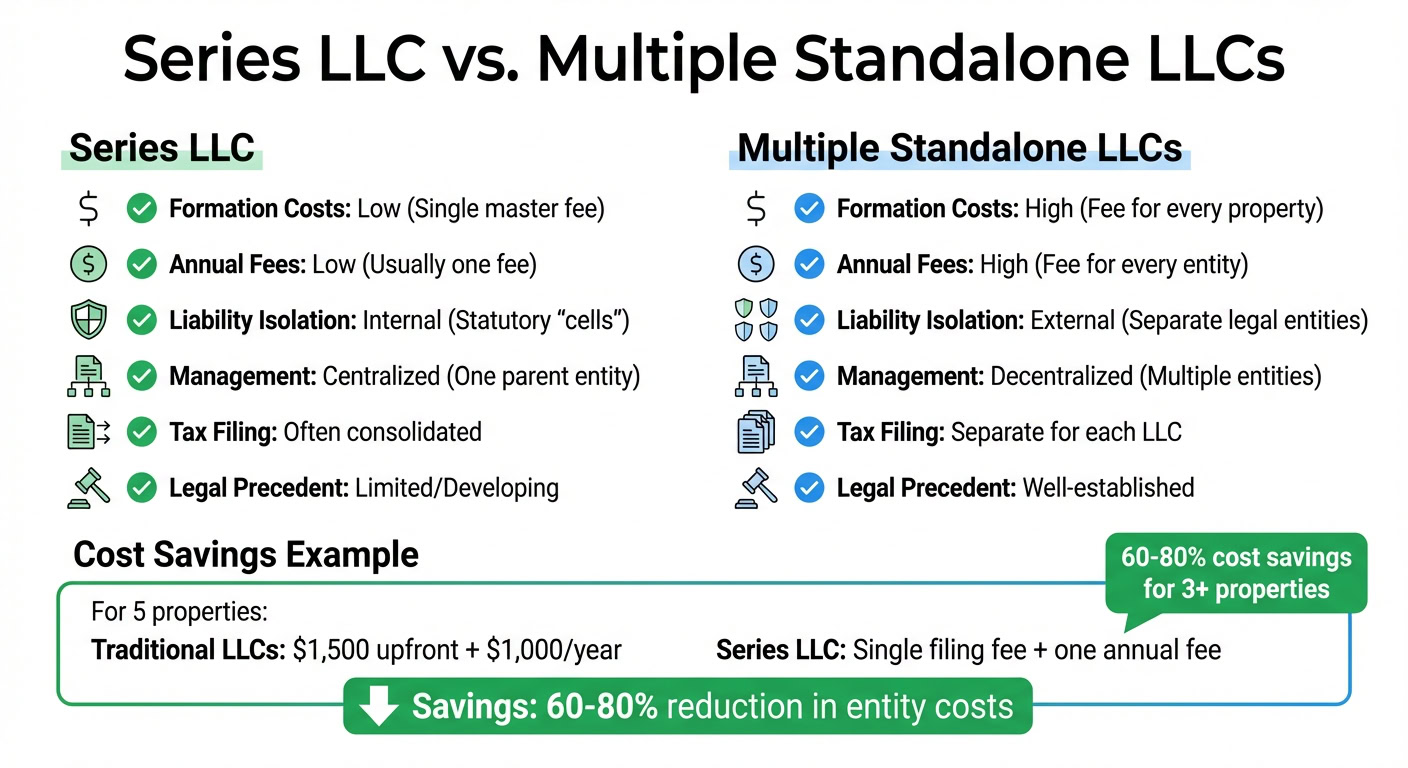
For real estate investors managing multiple properties, Series LLCs offer a practical way to save money, simplify operations, and maintain strong asset protection. Let’s take a closer look at these advantages, starting with cost savings and easier management.
Lower Costs and Easier Management
When you compare the costs, the savings with Series LLCs are clear. For instance, managing five properties using a traditional LLC setup might cost you $1,500 in upfront fees and $1,000 annually in maintenance fees (based on $300 for formation and $200 in yearly fees per LLC). In contrast, a Series LLC requires these fees only once. Delaware, for example, charges a $300 annual franchise tax for the entire Series LLC, regardless of whether you own two properties or twenty. Wyoming is even more affordable, with just a $60 annual report fee.
On top of the cost benefits, the administrative burden is significantly reduced. With a Series LLC, you only need one registered agent, one master operating agreement, and often just a single annual report filing. As Nellie Akalp, CEO of CorpNet.com, puts it:
"The series LLC structure can benefit real estate investors with multiple properties in several ways… Reduce liability… Minimize expense… Consolidate federal income tax preparation".
Adding a new property is also straightforward. Instead of forming a new LLC for each property, you can simply amend the existing operating agreement. But the benefits don’t stop there – Series LLCs also provide excellent asset protection.
Better Asset Protection
The structure of a Series LLC doesn’t just make management easier; it also isolates risk to protect your assets. Clint Coons, Founding Partner at Anderson Law Group, describes the Series LLC as:
"one company with multiple subsidiaries… you set up one LLC and have the ability to create multiple subsidiaries to hold your various properties without having to incur any additional state fees".
Each property is placed in its own protected "cell", meaning that financial issues like debts or lawsuits tied to one property won’t affect the parent LLC or any other series within the structure.
This setup is especially useful for isolating high-risk properties – like those with swimming pools or high tenant turnover – from lower-risk investments. If something catastrophic happens at one property, it won’t jeopardize your entire portfolio. Additionally, this protection works both ways: a personal judgment against you typically results in a charging order against your LLC interest, which prevents creditors from directly seizing your real estate.
Series LLC vs. Multiple Standalone LLCs
| Feature | Series LLC | Multiple Standalone LLCs |
|---|---|---|
| Formation Costs | Low (Single master fee) | High (Fee for every property) |
| Annual Fees | Low (Usually one fee) | High (Fee for every entity) |
| Liability Isolation | Internal (Statutory "cells") | External (Separate legal entities) |
| Management | Centralized (One parent entity) | Decentralized (Multiple entities) |
| Tax Filing | Often consolidated | Separate for each LLC |
| Legal Precedent | Limited/Developing | Well-established |
The choice between a Series LLC and multiple standalone LLCs often comes down to balancing cost efficiency with legal certainty. While Series LLCs are more affordable and easier to manage, standalone LLCs have the advantage of being backed by well-established legal precedent across all 50 states. However, to maintain the liability protections of a Series LLC, it’s essential to keep separate bank accounts and financial records for each series and ensure that all contracts clearly identify the specific series (e.g., "Smith Properties LLC – Series A") rather than just the parent LLC.
How to Form a Series LLC with BusinessAnywhere

BusinessAnywhere makes setting up a Series LLC simple and hassle-free. They take care of the paperwork and compliance, leaving you free to focus on expanding your real estate ventures.
Registering Your Series LLC
The first step is choosing a state that allows Series LLC formation. States like Delaware and Wyoming are popular choices. Delaware is known for its well-established legal framework, while Wyoming offers strong privacy protections and anonymous ownership options. If you’re looking for affordability, Oklahoma stands out with a formation fee of just $100 and no extra costs for adding series.
BusinessAnywhere will file your Articles of Organization for free (state fees still apply). These articles must specify that your LLC is allowed to create separate series with limited liability. The platform also provides a one-year registered agent service, which includes a physical address in your chosen state for receiving legal documents.
Next, you’ll need to name your parent LLC and establish a clear naming system for each series. For instance, you could use a format like "Parent LLC – Series A" to ensure liability separation when managing contracts or opening bank accounts. Once your LLC is registered, the next step is securing the necessary tax identification numbers.
Getting an EIN for Your Parent LLC
After registering your Series LLC, it’s time to obtain an Employer Identification Number (EIN) from the IRS. This number is essential for tax reporting, opening business bank accounts, and conducting other financial transactions. BusinessAnywhere offers an EIN application service for $97, handling the paperwork and submission process for you.
Each series within your LLC should also get its own EIN. This is crucial for maintaining liability separation and allows each series to choose its own tax classification, such as a partnership or S Corporation.
If you apply for an EIN online, approval is instant. Mail applications, however, can take 4 to 6 weeks to process. BusinessAnywhere can assist with obtaining EINs for both your parent LLC and its series, ensuring everything stays compliant and your assets remain protected.
sbb-itb-ba0a4be
Operating and Maintaining Your Series LLC
Once your Series LLC is up and running, one of the most important tasks is keeping each series distinct. If you fail to maintain this separation, a court might treat your entire structure as a single entity, wiping out the liability protection you’ve carefully built.
Keeping Separate Records for Each Series
The first step in maintaining separation is opening a separate bank account for each series. This ensures that funds for one series don’t get mixed with another, which could lead courts to disregard your liability protection. Every financial transaction – whether it’s a rent payment, a repair expense, or a property tax bill – should flow through the correct series account.
"To maintain the liability protection of each series, their assets should not be mingled, and separate bank accounts should be established for each. Basically, you need to treat each series of your series LLC as though it is a separate business." – Drake Forester, SCORE
In addition to separate accounts, independent bookkeeping records are a must. Track income, expenses, and tax details for each series individually. If you need to transfer funds between series, make sure to document these as formal loans.
Using Virtual Tools for Management
Managing records for multiple series might sound overwhelming, but digital tools can make things much easier. For example, BusinessAnywhere’s virtual mailbox service centralizes correspondence, helping you stay on top of important legal documents. Their compliance alert system can also track deadlines for annual reports and tax filings across states, reducing the risk of penalties or accidental dissolution of your LLC.
Additionally, digital document management tools offer templates for series-specific operating agreements and contracts, ensuring that each property is properly documented. You can also use property management software like TurboTenant to handle tasks like rent collection, tenant screening, and accounting for all your series. These tools not only simplify the management process but also help you stay compliant with legal and operational requirements across your series.
Compliance and Tax Requirements
Keeping a Series LLC compliant means following both federal and state rules. While the structure can simplify tax filings compared to managing multiple standalone LLCs, knowing the filing requirements upfront is crucial before diving into tax strategies.
Filing Annual Reports and Staying Compliant
Maintaining compliance starts with filing annual reports for the parent LLC, but the rules for individual series can vary significantly by state. For example, Delaware requires an annual franchise tax for the master LLC, while Wyoming charges a smaller annual report fee. In Illinois, each series must file a $50 Certificate of Designation, and Texas has its own unique requirements for each series.
If your Delaware-based Series LLC owns property in California, you’ll need to register as a foreign entity in California and comply with local tax and filing requirements. This may include paying California’s $800 annual franchise tax for each series. It’s important to check the rules in every state where you own property, not just the state where your Series LLC is formed.
On top of state requirements, the Corporate Transparency Act mandates that Series LLCs file Beneficial Ownership Information (BOI) reports with FinCEN. However, it’s unclear whether you need one report for the parent LLC or separate reports for each series. Until this issue is settled, it’s wise to consult a compliance expert to steer clear of penalties.
Once you’ve handled compliance through accurate record-keeping and state filings, the next step is understanding how taxes apply to each series.
How Series LLCs Are Taxed
For federal taxes, the IRS generally treats a Series LLC as one entity, allowing you to file a single consolidated return. However, each series has the option to choose its own tax classification. A single-member series is typically treated as a disregarded entity, while a multi-member series defaults to partnership taxation. Alternatively, a series can elect to be taxed as an S-Corp or C-Corp.
"Proposed federal tax regulations align with commentators’ long-held prediction that the eventual federal tax treatment of series LLCs would be to treat the individual series as separate entities." – American Bar Association
Each series should obtain its own EIN, even if you plan to file a consolidated return. This not only reinforces the legal separation between series but also simplifies banking and financial operations.
State tax rules, however, are far from consistent. In California, for instance, each series is treated as a separate taxable unit, requiring an $800 annual franchise tax per series. Other states might treat the entire Series LLC as a single entity. Before forming your Series LLC, research how your home state and any other states where you own property handle taxation. This preparation can help you avoid surprises like unexpected franchise taxes or additional fees when tax season rolls around.
Conclusion
The Series LLC model offers a smart solution to the challenges faced by real estate investors. It provides an efficient way to protect each property while also reducing costs and streamlining management. By organizing multiple properties under a single parent LLC, investors can avoid paying separate filing fees, registered agent costs, and annual report expenses. Each series operates as an independent liability shield, ensuring that a lawsuit targeting one property won’t impact the others or the parent LLC. For those with three or more properties, this setup can lower entity-related costs by an impressive 60-80% compared to traditional standalone LLCs.
Scaling with a Series LLC is straightforward. Adding a new property only requires amending the operating agreement. It also offers tax flexibility, as each series can choose its own classification. For instance, one series might opt for S-Corp taxation for flipping projects, while another remains a pass-through entity for long-term rentals.
To maintain the liability protection, it’s crucial to keep the finances and records of each series completely separate. Commingling funds or administrative records could jeopardize the legal protections.
BusinessAnywhere makes managing a Series LLC hassle-free. From registering the Series LLC and obtaining EINs for each series to providing registered agent services and compliance support, they handle the heavy lifting. Their tools, like virtual mailboxes for real estate investors, online notary services, and a centralized dashboard for record management, allow you to manage your properties remotely – whether you’re operating across state lines or working from anywhere in the world.
FAQs
What are the benefits of using a Series LLC for managing real estate investments?
A Series LLC provides strong liability protection for real estate investors by separating each property into its own series. This setup ensures that if one property encounters a lawsuit, debt, or judgment, the other properties – and the parent LLC – stay protected. For investors managing multiple properties, this structure acts as a safeguard, shielding the entire portfolio from risks associated with any single asset.
Beyond liability protection, a Series LLC is also budget-friendly and flexible. Instead of paying separate formation fees for each property, you only need to cover the cost of forming the parent LLC. Additional series can be created without the expense of setting up new LLCs for every asset. Plus, tax reporting is streamlined – since all series can be included on a single federal tax return, it reduces both paperwork and time spent on administrative tasks. This structure is perfect for investors aiming to expand their portfolios efficiently while keeping their assets secure.
How does a Series LLC protect each property from liability?
A Series LLC gives real estate investors a way to manage multiple properties under one main LLC while keeping liability separate for each property. Each property is placed into its own "series", which acts like an independent legal entity. This setup ensures that if one series faces a lawsuit or debt, only that series’ assets are at risk. The other series and the parent LLC stay shielded.
To preserve this liability protection, it’s essential to treat each series as its own entity. That means maintaining separate bank accounts, keeping individual financial records, and avoiding any mixing of assets between series or with the parent LLC. Additionally, a well-crafted operating agreement that aligns with your state’s Series LLC laws is key to securing these protections. When structured properly, a Series LLC provides the same level of asset protection as forming multiple individual LLCs, but with added efficiency and cost savings.
Which states allow Series LLCs, and how do their rules differ?
Series LLCs are allowed in several states, including Alabama, Delaware, Illinois, Indiana, Iowa, Kansas, Missouri, Montana, Nevada, Oklahoma, Tennessee, Texas, Utah, and the District of Columbia. Delaware, which first introduced this structure back in 1996, is often a go-to choice for investors thanks to its well-established legal framework.
However, the rules for Series LLCs can vary widely depending on the state, especially when it comes to filing fees, reporting requirements, tax treatment, and liability protections. For instance, in states like Delaware and Texas, you can establish multiple series under a single filing fee, which can save money. On the other hand, states like Illinois might require separate filings or annual reports for each series, which could increase administrative costs. Tax treatment is another area where states differ – some treat each series as its own taxable entity, while others view the Series LLC as a single entity for tax purposes. Liability protections also vary; Delaware, for example, has strong case law supporting the liability shield for Series LLCs, while other states may still be working to establish clear legal precedents.
Because of these differences, it’s crucial to understand the specific rules in the state where you plan to form your Series LLC. Working with a local legal or tax professional can help you navigate the requirements and ensure your structure meets your needs for asset protection and compliance.