

When deciding how to structure your rental property business, the choice between an LLC and an S Corp can significantly impact your taxes, liability protection, and administrative workload. Here’s the quick answer:
- LLCs are simpler to set up and maintain, offering strong liability protection and pass-through taxation for rental income, which is generally considered passive and exempt from self-employment tax. They’re ideal for most landlords, especially those with one or two properties or a long-term buy-and-hold strategy.
- S Corps allow for potential tax savings by splitting income into salary and distributions (reducing self-employment tax), but this rarely applies to rental income since it’s passive. S Corps are better suited for active real estate professionals managing properties full-time or flipping houses.
Key Takeaways:
- LLC Advantages: Easier setup, fewer administrative requirements, strong liability protection, and flexibility in profit distribution.
- S Corp Advantages: Tax savings for active income but limited benefits for traditional rental income due to IRS passive income rules.
- Costs: LLCs are less expensive to form and maintain, while S Corps involve higher costs due to payroll and compliance requirements.
Quick Comparison:
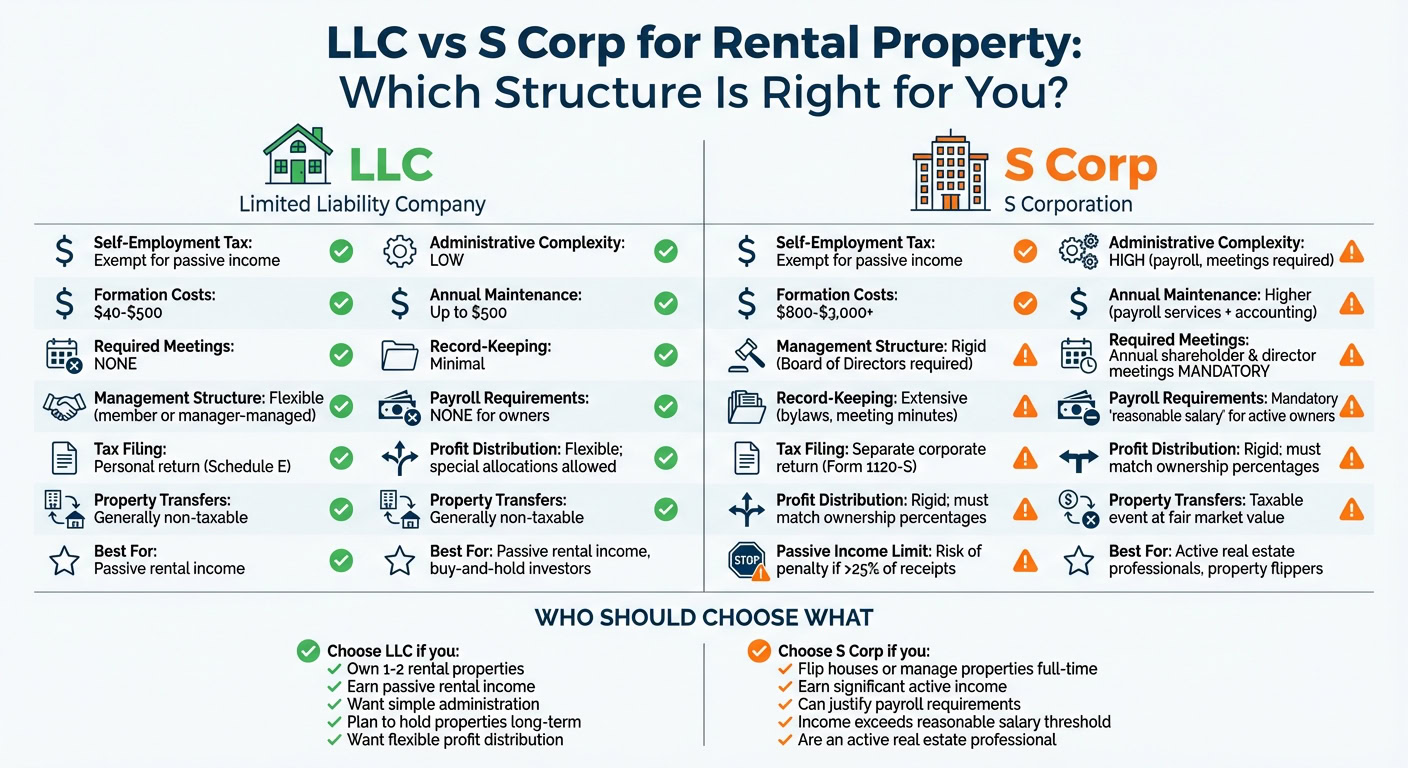
| Feature | LLC | S Corp |
|---|---|---|
| Self-Employment Tax | Exempt for passive income | Exempt for passive income |
| Administrative Complexity | Low | High (requires payroll, meetings) |
| Formation Costs | $40–$500 | $800–$3,000+ |
| Best For | Passive rental income | Active real estate professionals |
For most rental property owners, an LLC is the simpler, more cost-effective choice. S Corps might make sense if you’re actively managing properties or earning significant active income. Always consult a tax professional to ensure your choice aligns with your goals.
Setup Process and Requirements
How to Form Each Structure and What It Costs
Setting up an LLC for real estate is straightforward. Start by picking a unique business name and registering it with your state’s Secretary of State. You’ll also need to appoint a registered agent with an in-state address to handle legal documents. After that, file your Articles of Organization (sometimes called a Certificate of Formation) and pay the state filing fee, which can range anywhere from $40 to $500 depending on the state.
Once that’s done, it’s a good idea to draft an Operating Agreement. This document outlines how your LLC will function – covering ownership, decision-making processes, and what happens if a member leaves or if assets need to be transferred.
"If a member commingles personal and business funds, they jeopardize the liability protection an LLC can provide." – Holly Akins, REI Hub
If you’re not comfortable handling the process yourself, hiring a lawyer or using a professional service can cost between $1,000 and $1,500. Alternatively, services like Business Anywhere offer LLC formation for $0 plus state fees, and they even include a year of registered agent service at no extra cost.
On the other hand, setting up an S Corp involves more steps and stricter rules. First, you need to establish a legal entity, such as an LLC or corporation. Then, file IRS Form 8832 to have your entity taxed as a corporation, followed by Form 2553 ("Election by a Small Business Corporation") to officially elect S Corp tax status. Timing is critical: the election must be filed within two months and 15 days after the start of the tax year you want it to apply, and the IRS may take up to 60 days to process it. To qualify, your business must meet specific criteria: it must be a U.S.-based entity, have no more than 100 shareholders (all of whom must be U.S. citizens or residents), and maintain only one class of stock.
The cost of setting up an S Corp can vary widely. If you handle it yourself, it might cost between $800 and $3,000. Hiring a professional, however, can push that figure to $3,000 or more. Companies like Business Anywhere offer S Corp tax election filing services for $97, which can be a budget-friendly alternative to hiring an accountant.
Annual Compliance and Filing Requirements
Once your LLC or S Corp is up and running, you’ll need to stay on top of ongoing compliance. LLCs are relatively low-maintenance. Most states require you to file an annual or periodic report with the Secretary of State and pay a fee, which can go up to $500 per year. Unlike corporations, LLCs aren’t obligated to hold annual meetings or keep formal meeting minutes.
"LLCs also have fewer compliance requirements than corporations. For instance, LLCs do not have to write bylaws or adhere to other corporate management requirements. They aren’t required to have mandatory annual meetings or take meeting minutes." – Kathleen Crampton, LegalZoom
For taxes, rental income from an LLC typically flows directly to your personal tax return via Schedule E. If your LLC has multiple members, you’ll file Form 1065 and issue K-1s to each member.
S Corps, however, come with more administrative responsibilities. They must hold annual shareholder and board meetings, keep detailed corporate minutes, and maintain thorough records. Tax-wise, S Corps file a separate corporate tax return (Form 1120-S) and issue Schedule K-1s to shareholders. If you’re managing rentals yourself, you’ll also need to pay yourself a reasonable salary, withhold taxes, and file quarterly payroll tax reports. These added tasks often require professional bookkeeping or accounting services, which is why S Corps tend to make sense only when the tax benefits outweigh the extra administrative effort.
sbb-itb-ba0a4be
Tax Treatment and Savings Potential
Once your LLC or S Corp is set up and compliant, it’s time to consider how tax treatment impacts your potential savings.
How LLCs Are Taxed for Rental Income
LLCs are typically considered pass-through entities for tax purposes. This means that if you own a single-member LLC, the rental income flows directly to your personal tax return and is reported on Schedule E as passive income. The good news? Passive income isn’t subject to self-employment tax. For multi-member LLCs, the income is reported using Form 1065, with each member receiving a K-1 outlining their share of the income or loss.
One of the standout benefits of an LLC is that rental income is classified as passive. While you’ll pay ordinary income tax on your net rental income (after deductions like mortgage interest, depreciation, and maintenance costs), you won’t owe the 15.3% self-employment tax that applies to active income.
LLCs also allow for special allocations. This means members can divide profits, losses, and depreciation in ways that don’t necessarily align with their ownership percentages, offering flexibility in how income is distributed.
Now, let’s see how this compares to an S Corp’s approach to rental income.
How S Corps Are Taxed for Rental Income
An S Corp isn’t a separate type of legal entity; it’s a tax classification you elect for your LLC or corporation. The main advantage of an S Corp is the ability to split income between a reasonable salary and shareholder distributions, with the latter not subject to self-employment taxes.
However, this benefit rarely applies to rental properties since rental income is already considered passive. In fact, if more than 25% of an S Corp’s gross receipts come from passive income for three consecutive years, the IRS may impose taxes at the highest corporate rate – or even revoke the S Corp status.
"Collecting rent is considered passive income and if more than 25 percent of an S Corporation’s income is considered passive… the IRS can terminate the S Corporation’s special tax status." – Nellie Akalp, CEO of CorpNet
The S Corp structure is generally more useful for active real estate professionals. If you’re flipping properties, managing a large portfolio of rentals full-time, or providing extensive services beyond basic landlord responsibilities, your income might be classified as active. In such cases, electing S Corp status could help reduce self-employment taxes. But for traditional rental property owners, the risks and restrictions tied to passive income make the LLC structure a simpler, more practical choice.
Tax Savings Comparison: LLC vs S Corp
For most buy-and-hold rental property owners, an LLC is the better option. It avoids the administrative complexity and passive income limitations that come with an S Corp.
Here’s a quick comparison of the key tax differences:
| Feature | LLC (Default) | S Corp (Tax Election) |
|---|---|---|
| Self-Employment Tax on Rental Income | Generally exempt (passive income) | Generally exempt (passive income) |
| Profit Distribution | Flexible; special allocations allowed | Rigid; distributions must match ownership percentages |
| Passive Income Limit | None | Risk of penalty if >25% of receipts |
| Property Transfers | Generally non-taxable distributions | Considered a taxable event at fair market value |
| Administrative Costs | Approximately $40–$500 in annual fees | Approximately $800–$3,000+ (including payroll and filings) |
While S Corps can be appealing for businesses earning over $150,000 annually, where salary and distribution splits offer tax advantages, this doesn’t hold true for rental properties. Unless you’re an active real estate professional providing substantial services, the added administrative burden and higher costs of an S Corp likely outweigh any potential tax benefits. For most rental property owners, sticking with an LLC is the simpler and more cost-effective route.
Personal Liability Protection
Let’s examine how different business structures safeguard your personal assets.
How LLCs Protect Your Personal Assets
An LLC acts as a shield, creating a clear separation between your rental business and personal life. If legal issues arise – whether it’s a tenant injury or a contractor dispute – creditors are generally limited to the assets held by the LLC. This means your personal home, car, and savings are typically off-limits .
"Limited liability essentially puts a wall up between your business and personal assets." – BizFilings
This protection also extends to actions taken by co-owners or employees. For example, if your property manager makes a mistake, your personal liability remains limited as long as you’re not directly involved. Additionally, if you face personal debts unrelated to the rental business, creditors can only issue a "charging order" against your LLC interest. This allows them to access distributions without taking control of the business .
However, this safeguard isn’t foolproof. Courts can "pierce the veil" of an LLC if you mix personal and business finances – like paying a personal mortgage from the LLC account or vice versa. Doing so can jeopardize your liability protection . You’re also still personally liable for acts such as negligence, loan guarantees, unpaid taxes, or fraud .
To maintain your liability shield, it’s essential to:
- Keep separate bank accounts for personal and business use.
- Ensure the LLC has adequate funding.
- Document all business decisions thoroughly.
For even greater protection, consider placing each property in its own LLC or a series LLC to isolate liabilities. While LLCs offer a straightforward way to protect your assets with relatively few formalities, S Corps require stricter adherence to corporate rules to maintain their liability protection.
How S Corps Protect Your Personal Assets
Similar to LLCs, S Corps create a division between personal and business assets. Shareholders’ liability is limited to the amount of their investment in the company.
However, S Corps come with stricter formalities to uphold this protection. These requirements include holding annual shareholder and director meetings, recording detailed meeting minutes, maintaining bylaws, and having a board of directors . Ignoring these formalities increases the risk of courts "piercing the corporate veil", which could expose personal assets to business debts.
"While the level of liability protection is comparable between the two structures, LLCs are often considered simpler to maintain for liability purposes due to their fewer formal requirements." – UpCounsel
For most rental property owners, the administrative demands of an S Corp don’t provide much additional benefit. Both LLCs and S Corps offer similar liability protection, but LLCs are generally easier to manage and involve less red tape.
Management Requirements and Ongoing Costs
When it comes to running a rental property business, the choice of structure – LLC or S Corp – significantly impacts daily operations and long-term management. Each option comes with its own set of administrative responsibilities and costs, which can influence its practicality for landlords.
Running an LLC: Administrative Tasks
LLCs are known for their simplicity when it comes to ongoing management. Unlike corporations, LLCs don’t require formal meetings, board appointments, or detailed record-keeping. The primary focus is keeping personal and business finances separate and ensuring annual state reports are filed.
"An LLC is the simplest to form and maintain… the LLC is expected to document its processes in articles of organization or an LLC operating agreement." – Nellie Akalp, CEO, CorpNet
Tax-wise, LLCs are straightforward. Rental income passes directly to your personal tax return via Schedule E, so there’s no need for a separate corporate tax filing. While most states don’t mandate an Operating Agreement, having one can strengthen your liability protection and clarify business operations.
For landlords, this low-maintenance structure means more time to focus on property management and less time spent on administrative tasks. However, S Corps introduce a much more involved process.
Running an S Corp: Administrative Tasks
Managing an S Corp comes with a heavier administrative workload. By law, S Corps must hold annual shareholder and director meetings, maintain a stock register, follow corporate bylaws, and keep detailed meeting minutes. Skipping these formalities can weaken liability protection.
One of the most demanding requirements is payroll processing. If you actively manage your properties, the IRS requires you to pay yourself a "reasonable salary", which involves running payroll regularly, withholding taxes, and filing quarterly payroll tax returns. You’ll also need to handle Federal Unemployment Tax Act (FUTA) obligations.
"S Corps, while offering potential tax savings, come with higher administrative demands. Owners must manage payroll, file separate tax returns for the corporation, and ensure compliance with corporate formalities." – UpCounsel
In addition to payroll, S Corps must file an annual corporate tax return (Form 1120-S), which adds complexity and often requires professional accounting services. For many rental property owners, these extra responsibilities can outweigh the potential tax savings an S Corp might offer.
Cost and Complexity Comparison
When comparing LLCs and S Corps, the trade-offs between simplicity and complexity become apparent. Here’s a breakdown of the key differences in managing rental properties under each structure:
| Feature | LLC | S Corp |
|---|---|---|
| Formation Costs | $40–$500 (DIY) or $1,000–$1,500 (professional) | $800–$3,000 |
| Annual Maintenance | Up to $500 for state filings | Higher due to payroll services and accounting |
| Management Structure | Flexible; member- or manager-managed | Rigid; Board of Directors and Officers required |
| Required Meetings | None | Annual shareholder and director meetings mandatory |
| Record-Keeping | Minimal; an Operating Agreement is recommended | Extensive; bylaws and meeting minutes are required |
| Payroll Requirements | None for owners | Mandatory "reasonable salary" for active owners |
| Tax Filings | Personal return (Schedule E) | Separate corporate return (Form 1120-S) |
| Compliance Workload | Low; manageable for DIY landlords | High; often requires professional assistance |
LLCs are easier to manage and typically involve lower costs, making them a practical choice for landlords with one or two properties. On the other hand, S Corps may only be worth the added administrative demands if your rental income is high enough to justify paying yourself a "reasonable salary" and still seeing significant tax savings.
Which Structure Is Right for Your Rental Business
Choosing between an LLC and an S Corp boils down to finding the real estate LLC structure that aligns with your property portfolio and how you prefer to manage your business.
What to Consider Before Deciding
Start by looking at your portfolio size and annual rental income. If you own just one or two rental properties, the extra administrative work of an S Corp might not be worth the potential tax savings. S Corps typically make sense only if your income is high enough to pay yourself a reasonable salary while leaving enough profit to take distributions. For landlords with mostly passive rental income, S Corp status can lead to unnecessary complications.
Next, think about how much time and energy you’re willing to dedicate to administrative tasks. If you’re comfortable managing payroll, quarterly tax filings, and other corporate requirements, an S Corp could work. But if you’d rather focus on running your properties instead of dealing with paperwork, an LLC is usually the better choice.
Finally, consider your long-term goals. If you plan to hold onto your properties for years and eventually pass them down to heirs or partners, an LLC offers more flexibility. Transferring property out of an S Corp can trigger taxes on unrealized gains since it’s treated as a taxable event at the property’s fair market value.
These factors provide a foundation for determining the best structure for different types of landlords.
Best Structure for Different Owner Types
The right structure often depends on the type of landlord you are and how you manage your properties.
- Single-property landlords: An LLC is usually the simplest and most cost-effective option. Filing costs for an LLC range from $40 to $500 if you handle it yourself.
- Portfolio investors: If you own multiple properties, consider setting up separate LLCs for each property or group of properties. This approach helps protect your assets, ensuring a lawsuit involving one property doesn’t put your entire portfolio at risk.
- Active real estate professionals: If you flip houses or manage properties full-time, S Corp status could be advantageous – especially if your operating income is well above what you’d pay yourself as a reasonable salary. By splitting your income between a salary and distributions, you might lower your self-employment tax liability.
"If you’re asking where to put your rental property, the default answer is often an LLC." – MGO CPA
- Passive buy-and-hold investors: An S Corp is generally not ideal for landlords focused on long-term rental income and property appreciation. Its strict rules on profit distribution, passive income, and taxable property transfers make LLCs a better fit for this type of investor.
Conclusion
Deciding between an LLC or S Corp for your rental properties isn’t a one-size-fits-all decision – it’s about aligning the structure with your specific needs. For landlords who primarily earn passive rental income, an LLC often provides straightforward liability protection without the added burden of payroll management or corporate formalities. Since rental income is typically considered passive and not subject to self-employment taxes, most buy-and-hold investors don’t see significant tax advantages from choosing S Corp status .
S Corps, on the other hand, may appeal to active investors who can split income between a reasonable salary and distributions. However, strict IRS rules on passive income, ownership restrictions, and taxable property transfers often make S Corps less practical for traditional buy-and-hold landlords .
"The choice of entity cannot be made as a standalone decision. All elements, including the type of activity to be conducted, availability of cash, use of leveraged debt… all come into play."
– Mark H. Cooter, Partner, Cherry Bekaert Advisory LLC
Both LLCs and S Corps offer strong asset protection, but LLCs are generally easier to manage and less expensive to maintain. Formation costs for LLCs range from $40 to $500, while S Corps can cost between $800 and $3,000 due to additional payroll and compliance requirements .
When making your decision, consider your portfolio size, income structure, management style, and long-term goals. For most rental investors, an LLC strikes the right balance of protection, simplicity, and affordability. If you’re thinking about an S Corp, consult a tax professional to ensure the potential tax savings justify the added complexity. Ultimately, your choice should reflect your operational approach and future strategy. For more detailed guidance, explore our blog’s additional resources on entity selection.
FAQs
What are the key tax advantages of using an LLC instead of an S Corp for rental properties?
An LLC provides several tax benefits for rental property owners when compared to an S Corp. For starters, an LLC operates as a pass-through entity, meaning all rental income, deductions, depreciation, and losses are reported directly on your personal tax return. This setup allows you to use expenses like mortgage interest, repair costs, and property management fees to offset rental profits. Even better, if your rental property generates excess losses, you can use those to reduce other taxable income – a perk not available with an S Corp due to its requirement to pay a "reasonable salary" that’s subject to payroll taxes.
Another advantage is that rental income earned through an LLC is classified as passive income, so it’s not subject to self-employment taxes, such as Social Security and Medicare. This can lead to substantial savings, especially if you’re not actively involved in managing the property. Finally, an LLC offers tax classification flexibility, letting you start with a straightforward structure and later switch to S Corp status if your income grows and the benefits make it worthwhile.
What’s the difference in liability protection between an LLC and an S Corp for rental property owners?
Both LLCs and S Corps help rental property owners safeguard their personal assets by establishing a legal boundary between the individual and the business. However, the way they provide this protection and the effort required to maintain it differ.
An LLC shields your personal assets by keeping the company’s debts and obligations separate. If a tenant sues or a creditor demands payment, only the LLC’s assets are at stake – not your personal bank account, home, or car. Managing an LLC is relatively straightforward, with fewer formal requirements like meetings or extensive record-keeping, which makes it easier to uphold this protection.
An S Corp, on the other hand, isn’t a business type but a tax designation that can be chosen by either a corporation or an LLC. It also provides liability protection but comes with stricter rules. These include holding annual meetings, keeping detailed records, and following state-specific governance protocols. Failing to comply with these formalities could compromise the liability protection.
In essence, both structures protect your personal assets, but an LLC is simpler to manage, while an S Corp demands more administrative diligence to maintain its benefits.
What are the main administrative differences between an LLC and an S Corp for rental property owners?
An LLC is typically easier to operate than an S Corp. To establish an LLC, you need to file Articles of Organization and, in most states, submit an annual report along with a small fee. Unlike S Corps, LLCs don’t require formalities such as shareholder meetings, corporate minutes, or issuing stock. The business is managed by its owners – referred to as members – under an operating agreement. Taxes for LLCs are straightforward: single-member LLCs report income on a Schedule C, while multi-member LLCs file a Form 1065 and issue K-1s to members. Since LLCs are pass-through entities, there’s no obligation to pay a salary or process payroll unless the owners opt for corporate taxation.
An S Corp, however, comes with more administrative requirements. It begins as a corporation by filing Articles of Incorporation and then elects S Corp status with the IRS. Corporations must adopt bylaws, issue stock, hold annual meetings for shareholders and directors, and keep detailed records to maintain liability protection. On the tax side, S Corps file Form 1120S and distribute Schedule K-1s to shareholders. Additionally, any owner actively working in the business must be paid a "reasonable" salary, which means setting up payroll and handling quarterly tax filings. These extra compliance requirements make managing an S Corp more involved than running an LLC.