
Late filing Form 990-PF? My advice: file a complete return now, pay what you can, and keep proof of IRS acceptance. Don’t wait for a notice – or until you can pay in full.
Here’s the order I recommend:
- Check your deadline. Confirm your tax year, any timely six-month extension, and IRS disaster relief. An extension to file does not extend the payment deadline.
- File and track acceptance. Gather the required records and attachments, use the correct filing method, and respond to IRS notices by their deadlines.
- Address penalties and errors. Check the filing year’s penalty rules, request reasonable-cause relief when your facts support it, and amend material errors. Some tax issues also require Form 4720 or other action.
- Prevent another missed return. Assign a filing owner and backup, keep records together, and set deadline reminders.
<u>Three consecutive missed annual returns can trigger automatic revocation of tax-exempt status.</u> Filing overdue returns alone won’t restore it; reinstatement requires a separate IRS process.
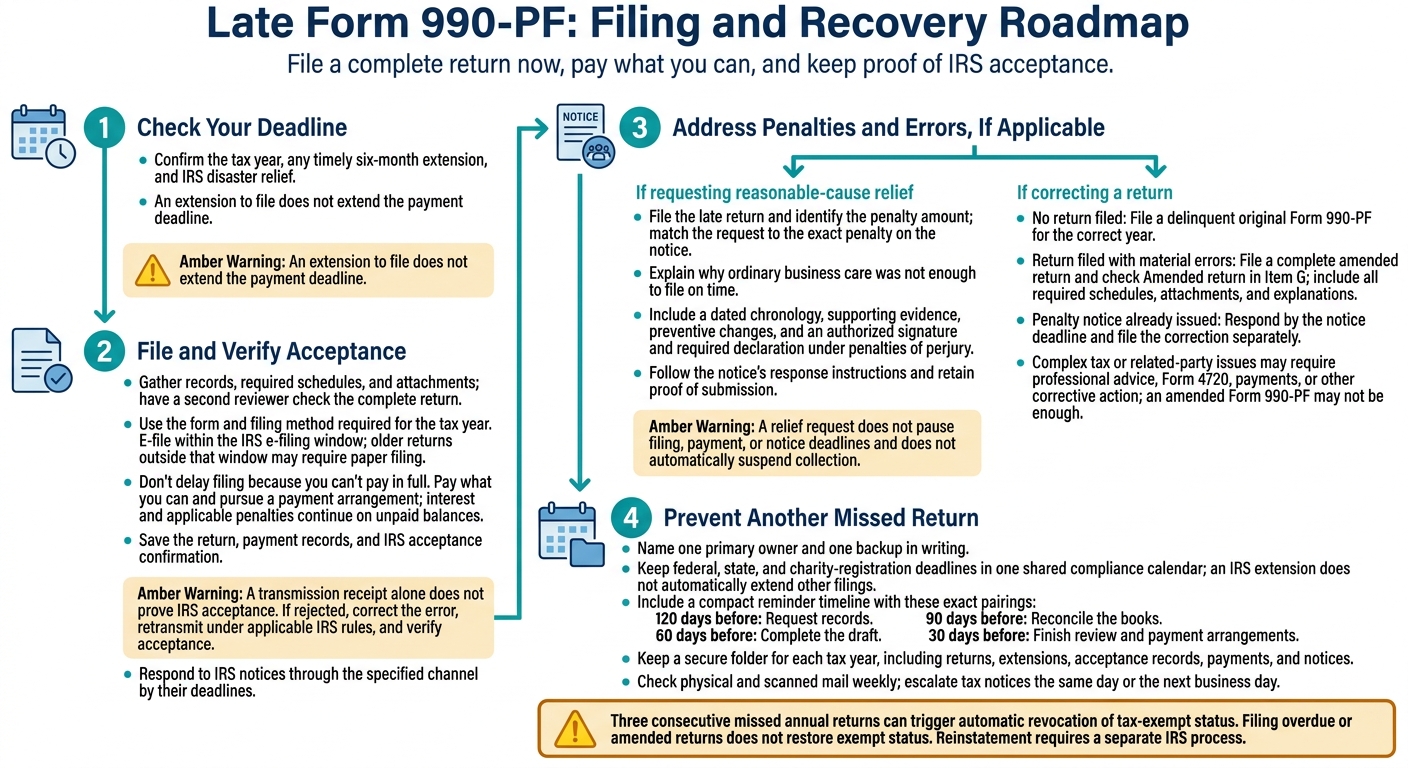
Late Form 990-PF: Filing and Recovery Roadmap
Prepare and File the Late Return
Once you understand the deadline and potential penalties, turn to the return itself. Confirm the foundation’s legal name, EIN, tax year-end, and filing status so you can file a complete return promptly. Determine whether this is an initial, short-period, or final return. Review prior returns, IRS notices, and acceptance records to check whether the return was already filed or rejected.
Gather Records and Required Attachments
Gather the general ledger, trial balance, bank and brokerage statements, prior-year Form 990-PF, governing documents, grant files, payroll and compensation records, and related-party documentation.
Review every applicable part of Form 990-PF and its required schedules, including Schedule B when applicable. You may also need supporting statements for grants, investments, excise-tax calculations, related organizations, excess business holdings, self-dealing, taxable expenditures, and minimum investment return calculations.
Do not submit an incomplete return just to get something filed. Have a second reviewer check balances, attachments, signatures, schedules, and tax calculations.
Submit the Return and Address Tax Due
Use the form and filing method required for the tax year you’re filing. File electronically for tax years within the IRS e-filing window. Older returns outside that window may need to be filed on paper.
Don’t delay filing because you can’t pay in full. Pay what you can through an IRS-approved method, save the confirmation, and pursue a payment arrangement. Interest and applicable penalties continue to accrue on unpaid balances. Document the payment shortfall and any payment attempts.
Save Filing Proof and Respond to IRS Notices
After filing, save your proof and promptly track any IRS follow-up. Keep the filed return, all schedules and attachments, signed authorizations, workpapers, and payment records. For an e-filed return, also keep the electronic transmission receipt and IRS acceptance confirmation.
A transmission receipt alone does not prove IRS acceptance. If the return is rejected, correct the stated error, retransmit it under the applicable IRS rules, and verify acceptance. A paper return stating that an electronic filing was rejected is not automatically treated as timely filed or processed as a timely return.
For each IRS notice, record the tax period, amount claimed, penalty or interest, required action, and deadline. Compare the notice with your acceptance and payment records. Respond through the specified channel by the deadline, even if a correction or reasonable-cause relief request is still pending. Send copies rather than originals, and keep your response and proof of delivery.
sbb-itb-ba0a4be
Request Penalty Relief for Reasonable Cause
Request reasonable-cause relief only if the foundation can show it used ordinary business care but still couldn’t file on time. After filing the late return and identifying the penalty amount, match the request to the exact penalty on the notice.
Write a Supported Reasonable-Cause Statement
Give the IRS the facts it needs to connect your explanation to the penalty. Identify the foundation, EIN, tax year, and penalty. Include a dated timeline covering the deadline, what caused the delay, efforts to fix the problem, when filing became possible, and when you filed. Name the event and explain exactly how it prevented timely filing. If you didn’t request an extension, explain why that same event prevented both actions.
Back up the timeline with records that support your explanation. These may include medical records or provider statements when appropriate, disaster notices, board minutes, transition or resignation records, and correspondence with preparers or vendors. Describe what you did to obtain records, find backup help, or resolve the filing problem.
Also explain the concrete changes made to prevent another late filing, such as appointing a backup officer and setting reminders 120, 90, 60, and 30 days before the deadline. Have a person authorized to act for the foundation sign and date the statement, and include the required declaration under penalties of perjury.
Follow the Penalty Relief Checklist
Before submitting, check that the request is complete and addresses the exact penalty:
- File the complete Form 990-PF promptly, and include a dated chronology in the relief package.
- Include the authorized signer’s signature, title, and date, along with the declaration under penalties of perjury.
- Include the statement with the e-filed return when allowed, or submit it according to the notice’s response instructions.
- Keep copies of the full relief request and proof of submission.
A relief request does not pause filing, payment, or notice deadlines. It also does not automatically suspend collection.
Correct Errors With an Amended Form 990-PF
If your filed return has an error, correct it now. Don’t wait for the IRS to find it.
Decide Whether to File or Amend
Choose the filing that matches your situation:
- No return filed: File a delinquent original Form 990-PF for the correct year.
- Return filed with errors: File a complete amended return and check Amended return in Item G.
- Penalty notice already issued: Respond by the notice deadline and file the correction separately.
Amend any material error involving income, expenses, assets, liabilities, grants, compensation, distributions, excise tax, or required disclosures. Submit all required schedules, attachments, and explanations, not just the corrected lines.
You don’t need to amend minor typos that leave the reported information unchanged. Keep records explaining that decision. If the amendment changes the tax due, reconcile amounts already paid, refunded, or credited. Also send any required copy or supplemental statement to the state that received the original filing.
Keep the original and amended returns together with all schedules, a line-by-line summary of changes, and supporting records. Document who found the error, when they found it, and who reviewed the correction.
Get professional review before filing if the correction affects tax exposure or related-party transactions.
Get Tax Advice for Complex Corrections
Work with a qualified CPA or exempt-organizations tax adviser on corrections involving excise tax, grantmaking, self-dealing, or related-party transactions. Keep contracts, invoices, board minutes, and conflict disclosures.
Have the adviser check whether you also need Form 4720, associated tax and interest payments, corrective action, or state disclosures. An amended Form 990-PF may not be enough: some errors require separate tax filings or board action.
If exemption was revoked after three consecutive years of nonfiling, follow the IRS reinstatement process. Filing overdue or amended returns does not restore exempt status.
After filing the correction, tighten your controls to prevent the same error next year.
Prevent Another Late Filing
Assign Filing Duties and Set Reminders
After a late filing, tighten your controls to prevent more delays and penalties. Name one primary owner and one backup in writing. Spell out who gathers records, reviews the draft, authorizes payment, submits the return, and confirms acceptance. Give the backup access to the records and filing systems.
Add every federal, state, and charity-registration deadline to one shared compliance calendar. File even if the foundation had no income or activity. An IRS extension does not automatically extend other filings.
Set reminders for 120, 90, 60, and 30 days before the deadline. Use them, in that order, to request records, reconcile the books, complete the draft, and finish the review and payment arrangements. The goal is to submit the return and pay before the deadline.
Once everyone knows their role, bring returns, notices, and filing proof together in one place.
Keep Records Together and Review Mail
Keep one secure folder for each tax year. Include returns, schedules, supporting records, extensions, acceptance records, payments, and reasonable-cause files.
Tax notices need prompt attention. Assign someone to check physical and scanned mail weekly and escalate tax notices the same day or the next business day. Log each notice’s receipt date, response deadline, owner, and resolution.
A virtual mailbox can help route IRS notices, but it does not replace a current IRS mailing address or your filing duties. Report address changes through the IRS process; mail forwarding alone is not enough.
Next Steps: File, Respond, and Plan Ahead
File the complete late return now and pay any balance due. Keep proof of both filing and payment, and respond to IRS notices by their deadlines.
If the IRS assesses a penalty, submit a dated reasonable-cause statement with supporting evidence.
Amend any material error immediately. Assign a primary filer and a backup now so each person knows who’s responsible.
Three consecutive missed returns can trigger automatic revocation of exempt status. Reinstatement is a separate process, so get tax advice before treating the issue as closed.
FAQs
How much could my late Form 990-PF penalty be?
The IRS uses your organization’s gross receipts to calculate penalties for filing Form 990-PF late:
- Under $1,000,000: $20 per day, up to $10,000 per return.
- Over $1,000,000: $100 per day, up to $50,000 per return.
Failing to file for three consecutive years also triggers automatic revocation of your organization’s tax-exempt status.
Can my preparer’s mistake qualify for penalty relief?
A tax preparer’s mistake usually won’t shield you from civil penalties. Tax authorities generally hold you responsible for compliance. They focus on whether a violation occurred, even if it stemmed from an unintentional error or oversight.
You may need professional help to fix the issue. If special circumstances caused the delay, you can consider submitting a formal request to waive the penalty.
Does amending Form 990-PF trigger additional penalties?
The provided sources do not indicate that filing an amended Form 990-PF itself triggers additional penalties. Correcting errors is generally encouraged and can help resolve existing compliance issues.
Penalties may still apply to inaccuracies or late filing. Addressing these issues promptly can help reduce the risk of further consequences, such as audits.