
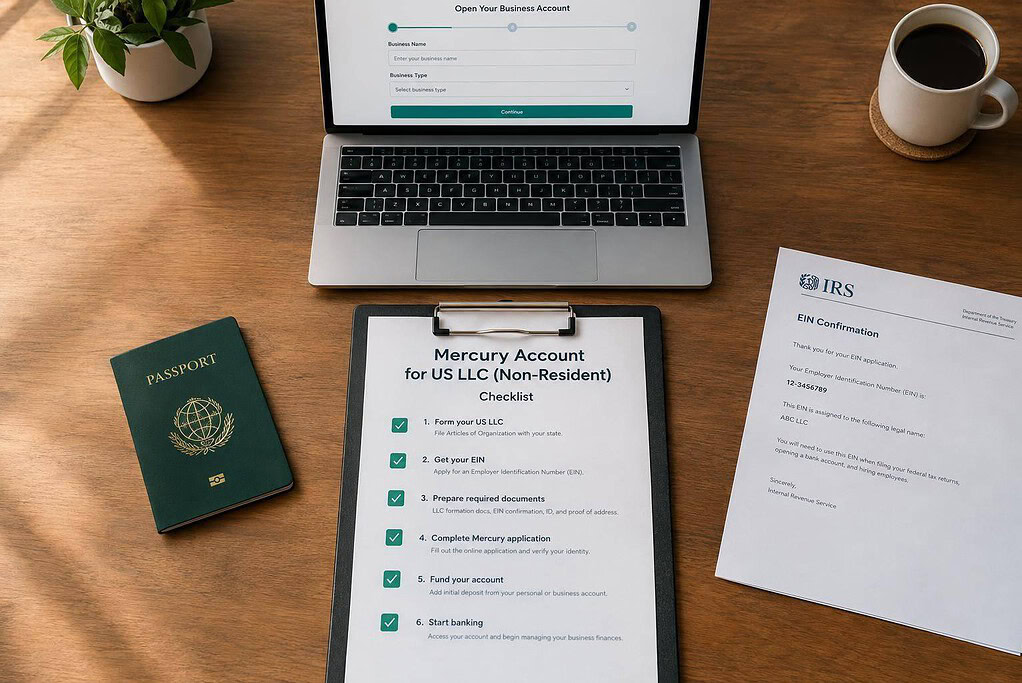
You can apply for a Mercury account online as a non-U.S. resident – without visiting the United States. I recommend checking your country of residence, business activity, and U.S. business plans before gathering documents. A U.S. LLC alone does not guarantee approval.
Here’s what I’d prepare:
- LLC records: State-filed formation documents and IRS-issued EIN proof.
- Owner details: ID for each owner with 25% or more ownership, plus at least one person who controls the business.
- Correct addresses: Your actual business and home addresses – not a registered-agent address or virtual mailbox as a substitute.
- Business details: What you sell, where customers are located, and which countries you expect payments to come from and go to.
<u>Approval is Mercury’s decision.</u> Check its current rules, keep your records consistent, and respond to verification requests. If approved, your LLC’s state and federal filing duties still apply.
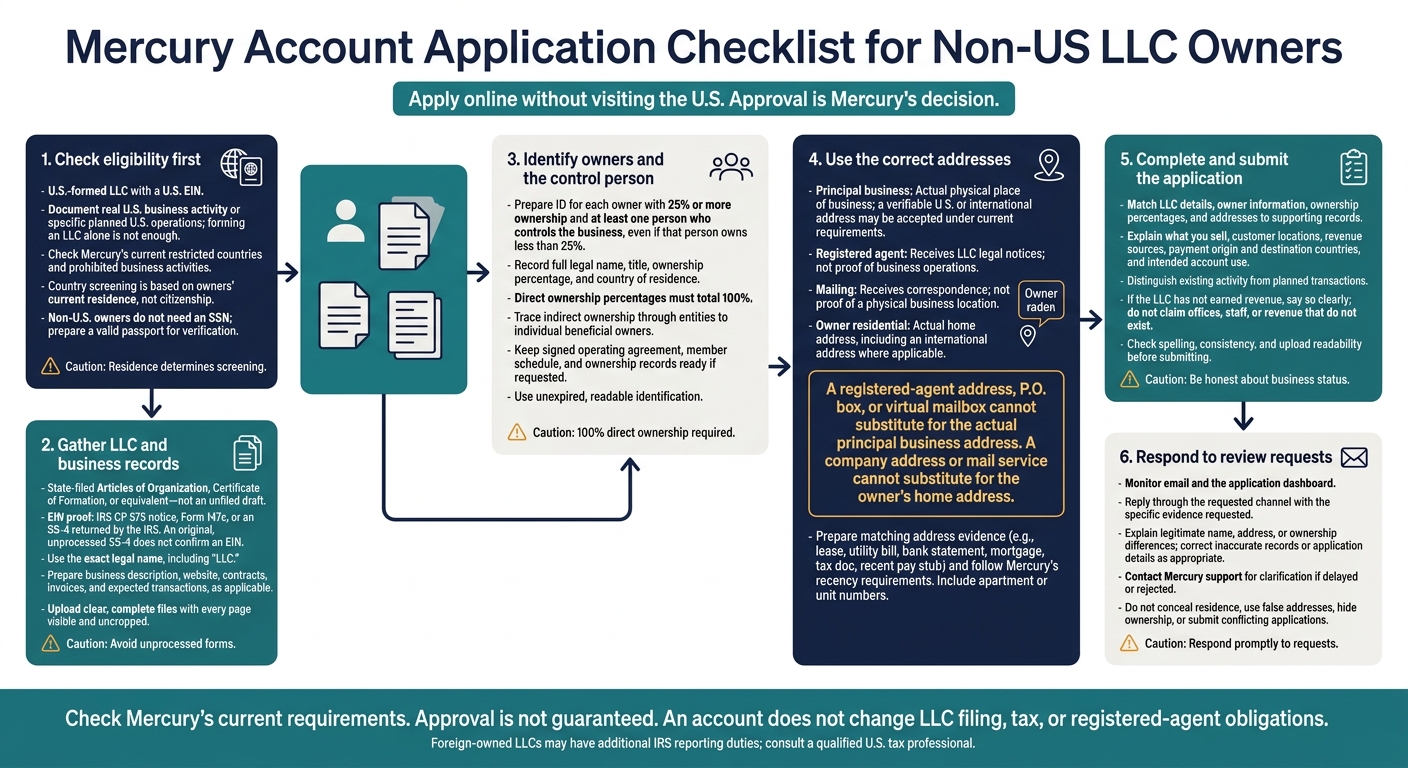
Mercury Account Application Checklist for Non-US LLC Owners
Check Your LLC and Owner Eligibility
U.S. Formation and Business Operations
Use the details above to check whether your LLC and its owners meet Mercury’s current eligibility rules. Your LLC must have a U.S. EIN and real U.S. business activity. Non-U.S. owners don’t need an SSN, but each owner must have a valid passport for identity verification.
Document current customers, signed contracts, or specific planned transactions. Forming an LLC alone isn’t enough.
Country and Business Activity Restrictions
Check the Mercury Help Center for the current prohibited industries and restricted countries. Mercury screens owners based on where they currently live, not their citizenship, so check each owner’s country of residence against the restrictions.
Compare your LLC’s activities with the latest rules before submitting your application. Be ready to share customer details, contracts, or a clear description of planned transactions.
Once you’ve checked eligibility, gather the documents and address details needed for the application.
sbb-itb-ba0a4be
Gather LLC Documents, Owner IDs, and Address Details
Gather the records Mercury needs to verify your LLC, its owners, and its addresses.
Formation Documents and EIN Proof
Save clear, complete files with every page visible and uncropped. Use the LLC’s exact legal name, including “LLC,” on the application and supporting records.
| Item | Who It Relates To | Why Mercury Requests It |
|---|---|---|
| State-filed Articles of Organization, Certificate of Formation, or equivalent – not an unfiled draft | The LLC | Confirms legal formation with the relevant state authority. Document names vary by state. |
| IRS CP 575 notice, Form 147c, or an SS-4 application returned by the IRS | The LLC | Verifies the assigned EIN. An original, unprocessed SS-4 does not confirm it. |
| Passport or other accepted government-issued photo ID | Controlling person and each owner with at least 25% ownership | Verifies identity. |
| Business description, website, contracts, invoices, and expected transactions | The LLC’s operations | Explains the business model, payment sources, and planned account use. |
The IRS issues EINs for free. Review the IRS EIN guidance for application requirements. If you’re missing your confirmation, request a replacement EIN notice from the IRS.
Owner IDs and Ownership Details
Prepare identification for everyone who owns at least 25% of the LLC and for at least one person who controls the business – even if that person owns less than 25%. For most non-U.S. applicants, an unexpired international passport is the primary ID. Make sure the name, photo, date of birth, identification number, and issue and expiration dates are readable.
Record each owner’s full legal name, title, ownership percentage, and country of residence. Direct ownership percentages must total 100%. Trace indirect ownership through any parent company, trust, or other entity until you reach the individual beneficial owners.
Keep the signed operating agreement, member schedule, and ownership records ready in case Mercury requests more verification. Explain legitimate name differences or ownership changes instead of submitting records that conflict.
Business, Mailing, and Residential Addresses
Each address field serves a different purpose. Use the address type it asks for.
| Address Type | What to Provide | What Not to Substitute |
|---|---|---|
| Principal business | The LLC’s actual principal place of business. Mercury may accept a verifiable U.S. or international physical address if its current requirements allow it. | A registered-agent address, P.O. box, or virtual mailbox. |
| Registered agent | The address used to receive legal notices for the LLC. | Proof that the business operates there. |
| Mailing | The address used to receive company correspondence, if Mercury asks for it. | Proof of a physical business location. |
| Owner residential | The owner’s actual home address, including an international address where applicable. | A company address or mail-receiving service. |
A registered-agent address or virtual mailbox cannot replace a principal business or residential address. Follow each application field’s label, and prepare matching address evidence. This may include a lease, utility bill, bank statement, mortgage statement, financial statement, tax document, or recent pay stub. Follow Mercury’s recency requirements for each document type.
Include apartment or unit numbers. If an address has changed, explain the change without altering the documents.
Submit Your Application and Handle Review Requests
Once you’ve confirmed eligibility and gathered your documents, submit your application and be ready for follow-up requests.
Enter LLC Details and Upload Documents
Match your application details to your records exactly. Enter the requested owner information, name at least one control person, and upload the documents gathered above.
Before you submit, check spelling, ownership percentages, and addresses for consistency. Make sure every upload is readable and complete.
Explain Your Business and Expected Transactions
After completing the core application fields, describe your business in plain language.
Explain what you sell, where your customers are located, and where your revenue comes from. Include the countries payments will come from and go to, plus how you plan to use the account. Mercury checks whether this description matches your LLC’s records, website, and transactions.
Describe your current activity and any documented expansion plans. Don’t claim offices, staff, or revenue you don’t have. If your LLC hasn’t earned revenue yet, say so clearly. Keep expected transactions separate from business activity that has already happened. Mercury’s eligibility information refers to existing or planned U.S. operations.
Handle Delays, Verification Requests, or Rejection
After submitting, check your email and dashboard for verification requests. Reply promptly through the requested channel and provide the specific evidence Mercury asks for.
Briefly explain any mismatch, such as a passport-name transliteration or different business and residential addresses. If a request isn’t clear, ask Mercury support which detail needs clarification. Submit corrected details when asked.
| Problem | Next action |
|---|---|
| Restricted country or region | Check Mercury’s current prohibited-country list before applying. Don’t hide your residence or use another person’s information. |
| Formation or EIN mismatch | Update the application to match official records. If the records are wrong, obtain corrected state or IRS documents. |
| Address evidence rejected | Submit proof of the actual address and explain why it appears on the application. |
| Unclear ownership | Provide consistent ownership percentages, operating agreement details, and controlling-person information. |
| Expired, blurry, or incomplete ID | Upload an unexpired, readable ID with all required details visible. |
| Unclear business activity | Explain your services, customers, payment countries, and revenue sources. Back up the explanation with relevant contracts, invoices, or a business plan. |
If the review is delayed or your application is rejected, contact Mercury support for clarification. Don’t submit conflicting applications, false addresses, or hidden ownership details. Mercury makes the final decision and may ask for more verification before approving the account.
Conclusion: Review Your Application Before Submitting
Before you submit, double-check country eligibility, U.S. formation, and U.S. operations. Make sure you have the required formation documents, EIN records, and ID records.
Use the correct address in each field, and check that it matches the supporting document. Your business description and expected payments should reflect your actual plans. If Mercury requests more information, respond promptly with the exact documents requested.
A Mercury account doesn’t change your LLC’s filing or registered-agent obligations. Keep state reports, fees, registered agent service, and federal tax filings current. A foreign-owned LLC may also have extra IRS reporting duties, depending on its tax classification and transactions. Consult a qualified U.S. tax professional about those requirements.
FAQs
Can I apply before my LLC has U.S. customers?
Yes. Mercury considers businesses that already serve U.S. customers or plan to within two years.
In your application, clearly explain what your business does, who you plan to serve, and your projected monthly volume. Banks use these details to assess risk, so be specific.
Can I use my overseas home as my business address?
Yes. When applying for a Mercury account, enter your actual overseas home address as your physical or operating address. Enter your LLC’s legal formation address in the business’s legal address field.
Do not use a registered agent address, P.O. box, or virtual office as your operating address. Doing so will result in automatic rejection.
What IRS filings might my foreign-owned LLC need?
Your filing requirements depend on your LLC’s structure and activity. To get an EIN, use Form SS-4. You may also need Form W-8BEN or W-8BEN-E to certify your status and claim potential tax exemptions.
Foreign-owned single-member LLCs often must file Form 5472 with a pro forma Form 1120.
You must file an FBAR (FinCEN Form 114) if your foreign account balances total more than $10,000 at any point during the year. Form 8938 may also apply, depending on your residency and the applicable income thresholds.