


Your LLC may still be valid without a written operating agreement – but state rules can decide terms you never chose. I’d start by checking your formation state’s law: New York requires a written agreement within 90 days after filing, or earlier; Delaware allows written, oral, or implied terms.
Here’s what I’d check next:
- Ownership and control: Document each member’s share, voting rights, contributions, and signing authority. A 50/50 split needs a plan for tied votes.
- Money and paperwork: Keep tax, banking, and property records consistent. Missing an agreement alone doesn’t change federal tax classification.
- Transfers and exits: Put approval rules, buyout prices, payment terms, and successor rights in writing.
- Adoption and updates: Get the required approvals, sign with accurate dates, and align company records. <u>Never backdate signatures.</u>
My takeaway: Don’t rely on a shared understanding or informal agreements. Put the terms in writing, have legal and tax advisers check them, and keep filing duties separate.
How State Default Rules Fill Gaps
No written agreement doesn’t mean no enforceable LLC terms. In Delaware, agreements can be written, oral, or implied. Emails, resolutions, contribution records, and consistent conduct may help prove those terms.
Default Rules for LLC Decisions and Payments
State default rules cover who manages the LLC, how votes count, and how profits, losses, and distributions are split. An ownership percentage doesn’t automatically determine every right. In New York, voting generally follows profit shares, while default profit-and-loss allocations can depend on documented contributions. Keep ownership, contribution, voting, and payment records separate and consistent.
Transfers and exits come with another distinction: selling a membership interest isn’t the same as admitting a new member. Before promising a transfer or buyout, check admission approvals, withdrawal restrictions, and dissolution triggers. In Delaware, a member’s death or departure doesn’t automatically dissolve the LLC unless the agreement says otherwise. Unclear terms can lead to disputes over who may vote, receive payouts, or sign for the company.
New York and Delaware: Agreement Requirements and Defaults
You’ll find the relevant provisions in the New York LLC Law and the Delaware LLC Act. Agreement requirements and the effects of missing terms are separate issues.
| Issue | New York | Delaware |
|---|---|---|
| Agreement requirement | Members must adopt a written operating agreement before formation, at formation, or within 90 days after filing the Articles of Organization. | The agreement may be written, oral, or implied; no separate written document is required. |
| Defaults | State defaults govern management, voting, and economic rights when the agreement is silent. | The Act supplies management, voting, and economic defaults unless the agreement changes them. |
| Missing documentation | Missing the required writing doesn’t automatically void the LLC, but leaves default rules and proof disputes to govern. | Without written terms, statutory defaults and provable oral or implied terms govern. |
These defaults can become a problem when records of ownership, control, or payouts are unclear. Incomplete records commonly lead to ownership and control disputes.
Some rules are mandatory, so check the statute before relying on a default.
sbb-itb-ba0a4be
Why Missing Ownership Records Lead to Disputes
Once default rules apply, the next question is proof: what did the owners actually agree to? Saying the members are equal owners isn’t a complete ownership record. If someone disputes those rights, membership ledgers, signed consents, tax filings, and bank statements help establish ownership and authority. A missing operating agreement alone doesn’t settle who owns what or who can act for the LLC.
Contributions, Ownership Shares, and Signing Authority
Hypothetical two-member LLC: Alex contributes $80,000 and Jordan contributes $20,000. That does not automatically create an 80/20 ownership split; the actual split depends on the terms the members approved.
Create a signed ownership schedule with each member’s name, admission date, equity, voting rights, and distribution rights. Track capital contributions, member loans, services, reimbursements, and signing authority separately.
Name authorized signers, set transaction limits, and require joint approval for major actions. Reconcile the records whenever contributions or membership interests change.
Deadlocks, Transfers, and Member Exits
For a 50/50 LLC, spell out which decisions are ordinary or major, how many votes each requires, and how to handle a deadlock. Set a process that starts with negotiation, moves to mediation, and then allows a buyout or another legal remedy.
Treat economic transfers separately from admitting new members. Document consent rules and transfer limits. Address death, disability, resignation, and removal, including notice, successor rights, purchase obligations, valuation, debt treatment, and payment terms.
Put these terms in writing. Informal understandings can fall apart when members disagree about authority or payout rights. Keep formation records, membership ledgers, signed consents, transfer documents, and amendments so a member’s exit doesn’t turn into an argument over what the owners approved. Banks, tax preparers, and closing agents also use this paper trail to verify authority.
Documentation Gaps in Taxes, Banking, and Real Estate
These disputes get harder to resolve when tax preparers, banks, and title companies ask for proof.
| Documentation gap | Practical risk | Records needed |
|---|---|---|
| Unclear ownership records | Delayed tax filings or financing review | Current ownership schedule, contribution ledger, capital-account records, and admission dates |
| Signing disputes | Delayed bank account opening or property closing | Management authority clauses, banking resolution, authorized-signer records, and written consent |
| Funding obligations | Disputes over required funding or repayment | Capital-call provisions, contribution notices, payment deadlines, and loan-or-capital classification |
| Distributions | Disputed payouts or incorrect tax reporting | Distribution provisions, written approvals, distribution records, and allocation records |
| Buyout and exit disputes | Disagreement over buyout price or sale proceeds | Buy-sell terms, valuation method, transfer restrictions, and updated ownership schedule |
LLC Tax Classification and Ownership Records
Your tax preparer needs records to check allocations and elections. Share the ownership schedule, contribution and distribution records, prior returns, and bookkeeping. Ask them to review allocations, capital accounts, return corrections, and choosing a business structure like an S-corp election.
You don’t need an operating agreement to get an EIN. Under IRS LLC guidance, federal tax treatment depends on member count and elections. Some LLCs can elect corporate treatment using Form 8832 or S corporation status using Form 2553.
Foreign ownership and S-corp eligibility follow separate rules. A nonresident alien generally cannot be an S corporation shareholder. Foreign-owned LLCs may still have reporting duties, depending on their structure and activities.
Banks usually need the same proof of authority.
Bank Account Requirements and Authorized Signers
Banks, lenders, payment processors, and investors set their own documentation requirements. Ask for the checklist before applying. Unresolved questions about ownership or authority can delay account opening or financing.
Put in writing who can open accounts, sign, borrow, and remove signers. Provide member or manager approvals and a banking resolution that covers access, limits, borrowing power, and signer removal. Keep these documents consistent with the bank’s signer records.
Real estate transactions require the same care: authority must match the closing file.
Property Approvals, Expenses, and Sale Proceeds
Document who has authority to buy, sell, mortgage, refinance, or lease each property. Set property-specific approval thresholds for repairs, improvements, and long-term leases. Assign responsibility for insurance, rent collection, reserves, and capital calls.
Before distributing sale proceeds, document debt repayment, expenses, member-loan treatment, and the approved payout formula.
Before signing, ask counsel or the closing team to check authority against lender, title, and recording requirements. An agreement does not transfer title, replace a deed, or provide insurance. Keep deeds, leases, policies, loan documents, and consents in one secure file.
How to Adopt an Agreement and Update Records
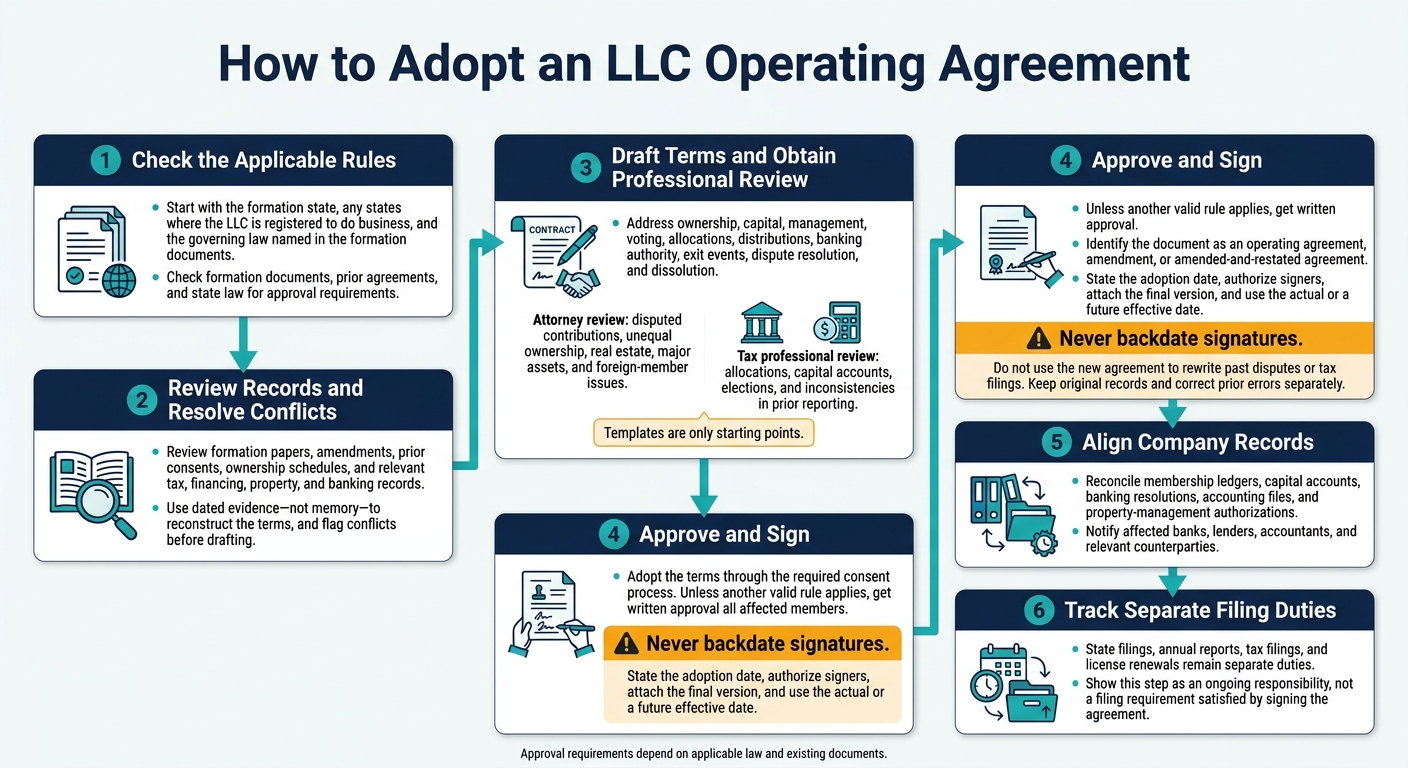
How to Adopt an LLC Operating Agreement
Once you’ve identified the gaps, put the missing terms into a signed agreement and update company records to match.
Start with the formation state, any states where the LLC is registered to do business, and the governing law named in the formation documents. Review formation papers, amendments, prior consents, ownership schedules, and relevant tax, financing, property, and banking records. Use dated evidence – not memory – to reconstruct the terms, and flag conflicts before drafting.
Draft and Approve the Missing Terms
Address ownership, capital, management, voting, allocations, distributions, banking authority, exit events, dispute resolution, and dissolution. These terms should close gaps in ownership, control, and payouts.
Ask an attorney to review disputed contributions, unequal ownership, real estate, major assets, and foreign-member issues. A tax professional should review allocations, capital accounts, elections, and inconsistencies in prior reporting. Templates are only starting points.
Next, adopt the terms through the required consent process. Check the formation documents, prior agreements, and state law for approval requirements. Unless another valid rule applies, get written approval and signatures from all affected members. Identify the document as an operating agreement, amendment, or amended-and-restated agreement. State the adoption date, authorize signers, attach the final version, and use the actual or a future effective date.
Never backdate signatures. Don’t use the new agreement to rewrite past disputes or tax filings. Keep the original records and correct prior errors separately.
Align Company Records and Track Filing Duties
After signing, bring internal records into line with the adopted agreement. Reconcile membership ledgers, capital accounts, banking resolutions, accounting files, and property-management authorizations. Notify affected banks, lenders, accountants, and relevant counterparties.
State filings, annual reports, tax filings, and license renewals remain separate duties.
Conclusion: Put LLC Terms in Writing Before Problems Arise
Review the records and adopt a valid agreement that follows the formation state’s law. Update the agreement after ownership or management changes.
FAQs
Could having no operating agreement put my personal assets at risk?
Yes. An operating agreement helps show that your LLC is legally separate from your personal affairs. Without one, courts or creditors may argue that the LLC is just your “alter ego.” That could allow them to pierce the corporate veil and hold you personally responsible for business debts, lawsuits, or other liabilities. An LLC’s limited liability protection is not automatic.
How can I resolve ownership disputes without an operating agreement?
Without an operating agreement, your LLC follows state default laws. Those laws often don’t spell out how to resolve ownership disputes, leaving you exposed to costly litigation.
Make drafting a formal operating agreement a priority. Include clear voting thresholds, mediation or arbitration requirements, tie-breaker mechanisms, and buy-sell provisions. These rules give your LLC a conflict-resolution process tailored to its needs and clarify each member’s responsibilities.
What if a member refuses to sign an operating agreement?
If a member refuses to sign an operating agreement, the LLC remains subject to the default rules in its formation state. Those rules may set rigid terms for management and profit sharing that don’t fit the members’ goals.
Without a signed agreement, members lack clear, tailored rules for making decisions, resolving disputes, and transferring ownership. That gap can lead to conflicts and inefficiencies. It may also weaken liability protections, potentially putting members’ personal assets at risk for business liabilities.