

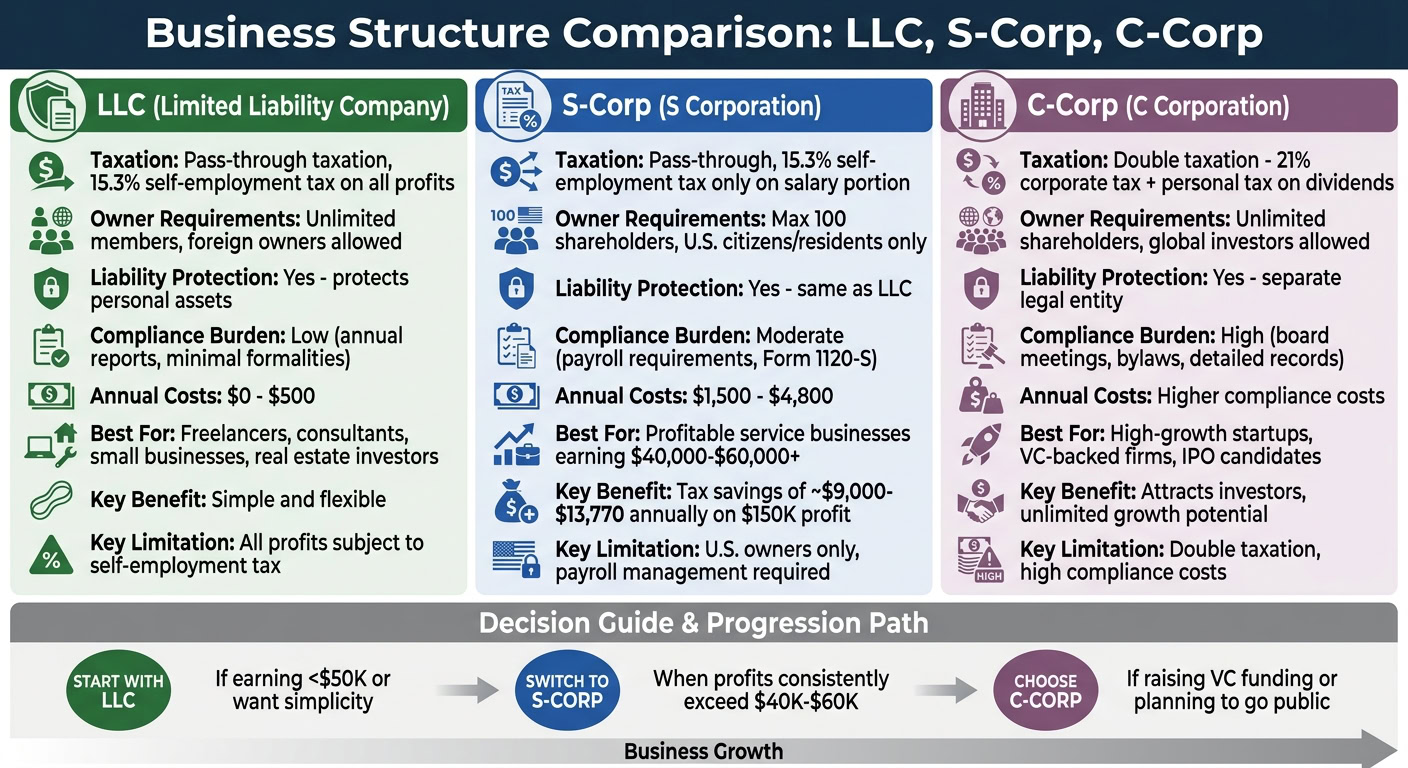
Choosing the right business structure – LLC, S-Corp, or C-Corp – can significantly impact your taxes, liability, and ability to grow. Here’s the quick breakdown:
- LLC: Simple setup, personal asset protection, and profits taxed on your personal return. Ideal for freelancers, consultants, and small businesses. However, all profits are subject to 15.3% self-employment tax.
- S-Corp: Tax-efficient option for profitable businesses. You can split income into salary (taxed) and distributions (not taxed for self-employment). Best for U.S.-based owners earning $40,000–$60,000+ annually. Requires more paperwork and payroll management.
- C-Corp: Separate legal entity with unlimited shareholders and designed for growth. Preferred by investors and venture capitalists. Comes with double taxation (corporate and dividend taxes) and higher compliance.
Quick Comparison:
| Entity | Taxes | Best For | Key Limitation |
|---|---|---|---|
| LLC | Pass-through; 15.3% self-employment tax | Freelancers, small businesses | All profits subject to self-employment tax |
| S-Corp | Split income (salary taxed, distributions not) | Profitable U.S. businesses | Limited to U.S. owners, 100 shareholders |
| C-Corp | Double taxation (21% corporate + dividends) | High-growth startups, VC-backed firms | Higher compliance costs |
Bottom line: Start with an LLC for simplicity. Switch to S-Corp when profits grow. Opt for a C-Corp if you need investors or plan to go public. Always consult a tax professional to tailor the choice to your goals.
What Each Structure Actually Means
Understanding the legal and tax implications of each structure is crucial. Let’s break it down further. While an S-Corp is not a separate legal entity – it’s simply a tax election made with the IRS – LLCs and C-Corps are distinct legal entities that you establish by filing with your state.
LLC Explained
A Limited Liability Company (LLC) is designed to shield your personal assets from business liabilities. It’s flexible when it comes to ownership and profit distribution, allowing for single or multiple members, including foreign nationals. Plus, the administrative requirements are pretty light – most states just ask for an annual report and small fees.
Because of this simplicity, LLCs are a go-to choice for freelancers, consultants, real estate investors, and small business owners who want liability protection without dealing with excessive red tape.
S-Corp Explained
An S-Corp isn’t a separate entity but rather a tax status you can apply to an existing LLC or corporation by filing Form 2553 with the IRS. The main perk? It allows you to split income: you pay yourself a reasonable salary (subject to payroll taxes) and take the rest as dividends, which aren’t hit with the 15.3% self-employment tax [1].
However, there’s a catch. The IRS keeps a close eye on S-Corps. If you underpay yourself to avoid payroll taxes, you could face an audit. Your salary needs to align with what someone in your role would typically earn. For instance, in 2026, the Social Security wage base is $184,500, meaning the 12.4% Social Security portion of payroll tax applies only up to that limit [4]. Many tax advisors recommend considering S-Corp status if your net business income consistently falls between $40,000 and $60,000 or more [3].
C-Corp Explained
A C-Corp, or C Corporation, operates as a completely separate legal and tax entity from its owners. It files its own tax return and pays a flat 21% federal corporate tax rate [4].
One drawback is double taxation: the corporation pays taxes on its profits, and shareholders also pay personal income tax on dividends [1]. Even so, C-Corps are often the structure of choice for venture-backed startups and companies aiming to go public. Why? They allow unlimited shareholders, can issue multiple classes of stock (like common and preferred), and are open to corporate and foreign investors.
C-Corps come with more administrative work – they require formal meetings and detailed record-keeping. While this adds to the cost, the structure provides better access to institutional funding and a straightforward path to an IPO. These distinctions lay the groundwork for comparing structures and figuring out which one aligns with your business goals.
sbb-itb-ba0a4be
Side-by-Side Comparison: LLC vs S-Corp vs C-Corp
Comparison Table
Here’s how these three business structures compare: Entity Type Taxation Owner Requirements Liability Protection Compliance Burden Ideal For
The 20% Qualified Business Income (QBI) deduction applies to both LLCs and S-Corps. However, with S-Corps, only your distributions – not your salary – qualify for the deduction [3]. This deduction was permanently established by the One Big Beautiful Bill Act of 2025, reshaping the financial landscape for pass-through entities [4].
This table highlights the key differences, but understanding the trade-offs requires a closer look.
The Main Trade-Offs
Each structure comes with its own advantages and challenges. LLCs are straightforward and flexible, but all profits are subject to self-employment tax. S-Corps, on the other hand, can help you cut taxes significantly. For example, a business making $150,000 in profit could save about $13,770 annually by switching to an S-Corp [2]. However, this comes with additional responsibilities like managing payroll and more complex tax filings. C-Corps, while appealing to investors, impose double taxation – first at the corporate level (21% flat rate) and then on dividends [4].
"Lower compliance means higher personal responsibility. Higher compliance means better protection."
– Dewey & LeBoeuf LLP [1]
As compliance requirements increase – from LLCs to S-Corps to C-Corps – so do the associated costs. LLCs typically cost between $0 and $500 annually to maintain [2]. S-Corps, with their payroll and tax preparation needs, can cost $1,500–$4,800 per year [3]. C-Corps demand even more, requiring formal board meetings, detailed records, and professional assistance for filings.
When to Switch Structures
Your business structure isn’t set in stone – it can evolve as your business grows.
Many entrepreneurs start with an LLC due to its simplicity and low cost. Once profits consistently exceed $40,000–$60,000, switching to an S-Corp often makes sense because the tax savings outweigh the added compliance costs [3]. Below that threshold, the savings may not justify the extra effort.
If your goal is to attract venture capital or prepare for an IPO, converting to a C-Corp becomes essential. Institutional investors prefer C-Corps because they allow multiple stock classes and unlimited shareholders [5]. Keep in mind, though, that changing your structure can have tax implications, so it’s wise to consult a tax professional.
State-specific rules can also influence your decision. For example, California imposes a 1.5% franchise tax on S-Corps with an $800 minimum, which can reduce or eliminate the federal tax benefits [2]. Always check your state’s regulations before making a move.
Each Structure Broken Down
LLC: Simple and Flexible
LLCs are a popular choice for freelancers, consultants, e-commerce sellers, and anyone looking for a straightforward business structure. They offer personal asset protection without the hassle of corporate formalities – no need for board meetings, shareholder minutes, or complex record-keeping [5]. Setting one up is affordable, with formation costs and annual compliance typically ranging from $0 to $500, depending on your state [2].
For non-U.S. residents, LLCs are particularly appealing. Unlike S-Corps, LLCs allow unlimited members from any country [1][5]. You can operate solo or bring in partners without worrying about citizenship restrictions. However, profits are fully subject to self-employment tax. For many small businesses, especially in the early stages, the simplicity of managing an LLC outweighs this drawback. This is particularly true when profits are modest, and your focus is on growing the business rather than navigating payroll complexities. This structure is especially attractive to international founders, as discussed further below. Understanding LLCs provides a foundation for comparing them with S-Corps.
S-Corp: Tax Savings with Restrictions
An S-Corp builds upon the LLC model, offering a tax strategy that can save money if your business is profitable. However, this option comes with strict requirements, making it suitable primarily for U.S.-based businesses. The key benefit lies in splitting your income into two parts: a "reasonable salary" (subject to payroll taxes) and distributions (which avoid the 15.3% self-employment tax). For example, a business earning $150,000 could save around $13,770 annually by allocating $60,000 as salary and taking the remainder as distributions. Keep in mind, though, that annual compliance costs – covering payroll services and professional tax preparation – typically fall between $1,500 and $4,500 [2][3].
"Choosing between an S-Corp and an LLC is the single most impactful tax decision most small business owners will make." – Tom Woolley, MBA, TodayCFO [2]
There are limitations: S-Corps can have no more than 100 shareholders, all of whom must be U.S. citizens or residents [1][5]. Additionally, you’ll need to manage payroll (even if you’re the only employee), file Form 1120-S annually, and document why your salary is "reasonable" using data from the Bureau of Labor Statistics [2][3]. Experts generally advise against electing S-Corp status unless your net profit consistently exceeds $40,000–$50,000, as the associated compliance costs can negate potential tax savings below this threshold [2][3]. For businesses aiming for substantial growth or investor funding, the C-Corp structure may be a better fit.
C-Corp: Built for Investors and Growth
If your goal is to scale quickly and attract investors, the C-Corp structure stands out. These entities are separate legal bodies that can issue multiple classes of stock – something venture capitalists and angel investors often require [1][5]. If you plan to raise outside capital within the next 2–3 years, it’s wise to establish a C-Corp from the start. Converting later can lead to costly restructuring and potential tax hurdles [1].
"The most successful founders we work with treat entity selection like any other strategic decision – they consider multiple scenarios and plan for growth." – Davy Deluge, COO, InCorp [5]
C-Corps do come with higher administrative demands and double taxation. The corporation pays a flat 21% federal tax on profits, while shareholders are taxed on dividends [4][5]. Compliance requirements include bylaws, board meetings, shareholder resolutions, detailed minutes, and meticulous record-keeping [1][5]. While these demands increase costs compared to LLCs or S-Corps, they signal professionalism and readiness to scale – qualities that attract institutional investors.
Each structure offers distinct advantages. Whether you value simplicity, tax efficiency, or scalability, understanding these options will help you make an informed decision about your business’s future.
The LLC + S-Corp Election Strategy
If you’re a business owner, there’s a way to combine the flexibility of an LLC with the tax advantages of an S-Corp. By electing S-Corp taxation for your existing LLC, you can potentially reduce your tax burden without needing to dissolve your LLC or create a new entity. All it takes is filing a specific form with the IRS to change how you’re taxed.
How to File for S-Corp Taxation
To make this election, you’ll need to file IRS Form 2553. Timing is critical: submit it by March 15 of the tax year you want the S-Corp status to take effect or within 75 days of forming your LLC[2]. If you miss the deadline, you might have to wait until the next year unless you qualify for late election relief by showing reasonable cause.
There are a few eligibility rules to keep in mind. All LLC members must be U.S. citizens or residents, and no foreign ownership is allowed[1]. Additionally, S-Corps are limited to 100 shareholders and can only issue one class of stock[1]. Once approved, you’ll need to establish a payroll system, issue yourself a W-2, and file Form 1120-S annually instead of using the simpler Schedule C[2].
With the filing process outlined, let’s dive into the potential rewards and responsibilities of this strategy.
Benefits and Drawbacks
The biggest draw of electing S-Corp taxation is the potential to save on self-employment taxes. Normally, LLC owners pay 15.3% in self-employment tax on all net profits. But with S-Corp status, this tax only applies to the salary portion of your income. The rest – distributed as profits – avoids self-employment tax[2].
That said, these savings come with added responsibilities. You’ll need to set up a payroll system, make quarterly tax payments, and likely hire a professional to handle the complexities, which can cost $1,500 to $4,500 annually[2]. The IRS also requires that you pay yourself a "reasonable salary" based on industry standards. Undervaluing your salary to avoid taxes is a red flag for audits. Many tax professionals suggest allocating 40–60% of your net income to salary and using reliable data to back up your decision.
One thing to consider: while distributions are exempt from self-employment tax, the salary portion doesn’t qualify for the 20% Qualified Business Income (QBI) deduction. This could slightly reduce your overall QBI deduction compared to a standard LLC. Still, in most cases, the tax savings from reduced self-employment taxes outweigh this downside.
Who Benefits from This Approach
This strategy is ideal for U.S.-based LLC owners whose net profits exceed $40,000–$60,000. Below that range, the added administrative costs might cancel out any tax savings. For example, in January 2026, SDO CPA analyzed a consulting business with $120,000 in net profit. As a standard LLC, the owner paid $18,378 in self-employment tax. By electing S-Corp status and setting a $60,000 reasonable salary, the employment tax dropped to $9,180, resulting in annual savings of about $9,198.
If your business is growing and you’re comfortable managing payroll, S-Corp taxation could save you a significant amount over time. However, this option isn’t available if any LLC member is a non-U.S. resident[1]. For international founders, sticking with standard LLC taxation might be the better choice.
Options for Non-U.S. Residents
If you’re an international entrepreneur looking to establish a business in the U.S., your options for structuring your company are more limited compared to U.S. citizens. However, there are still solid pathways available – you just need to know which ones are accessible and which are off the table.
Why S-Corps Aren’t an Option for Non-Residents
S-Corporations are off-limits for non-U.S. residents. The IRS has strict rules requiring all S-Corp shareholders to be either U.S. citizens or resident aliens[1][5]. This is a non-negotiable restriction, so if you’re not a U.S. resident, this structure is simply not an option.
Best Alternatives for Non-Residents
For most international entrepreneurs, an LLC is a great starting point. LLCs place no restrictions on the nationality or residency of their members, allowing for unlimited foreign ownership[1][5]. They are straightforward to set up, have fewer administrative requirements, and offer flexibility – perfect if you’re testing the waters in the U.S. market or running a lean operation.
That said, LLCs come with their own challenges, particularly when it comes to taxes. Since LLCs are pass-through entities by default, profits are reported on your personal tax return. This means you’ll likely need to file individual U.S. tax returns, which can get tricky and costly when navigating cross-border tax rules[1].
If you’re planning to raise venture capital or want to avoid dealing with U.S. personal tax filings, a C-Corporation is often a better choice. C-Corps allow unlimited global ownership, making them an attractive option for non-resident founders. They are also the preferred structure for institutional investors[1]. Unlike LLCs, C-Corps pay U.S. taxes at the corporate level, currently at a flat rate of 21%[4]. Shareholders are only taxed on dividends they actually receive, which can simplify your personal tax situation significantly.
"C-Corporations are often the cleanest option for international founders. The company pays US taxes, shareholders are taxed only on dividends, and global ownership is allowed." – Dewey & LeBoeuf LLP[1]
Choosing the right structure is just the first step. Next, you’ll need to understand how U.S. tax laws apply to your specific situation.
U.S. tax rules for non-residents
Once you’ve decided on a business structure, it’s crucial to get a handle on your tax obligations in the U.S. With an LLC, you’ll need to file a U.S. tax return for your business income, even if you never set foot in the country. On the other hand, a C-Corp files its own tax return and only taxes you personally on dividends[1]. Depending on your home country’s tax treaty with the U.S., you might also face double taxation unless you carefully plan your financial setup.
For C-Corps, the company pays the 21% corporate tax rate[4], and you only deal with U.S. taxes when you receive dividends. These dividends are typically taxed at qualified dividend rates of 15% or 20%, depending on your income level, though tax treaties can sometimes lower this rate[5]. Many international founders prefer this setup because it reduces their personal tax exposure in the U.S.
No matter which structure you choose, it’s essential to consult a cross-border tax professional before making any decisions. Tax laws vary widely depending on your country of residence, the type of income your business generates, and the existence of a tax treaty between your home country and the U.S.[1]. Getting expert advice early can save you a lot of money and headaches down the road.
How to Choose the Right Structure
Main Points to Remember
Picking the right business structure – whether an LLC, S-Corp, or C-Corp – depends on your goals and how you plan to grow. LLCs are ideal for solopreneurs, freelancers, or small teams who want simplicity and flexibility. They’re easy to manage, allow unlimited foreign ownership, and give you complete freedom over how profits are distributed.
S-Corps become attractive when your net income consistently surpasses $40,000–$50,000 [2][3]. Below that range, the annual compliance costs, which typically run between $1,500 and $4,800, can cancel out the savings on self-employment taxes. For example, if you’re a U.S.-based service business owner earning $150,000 annually, an S-Corp election could save you around $9,000–$13,000 in taxes [2][3]. However, this structure requires proper payroll management and timely filings, as discussed earlier.
C-Corps are designed for businesses aiming for significant growth or outside investment. If you plan to attract venture capital, institutional investors, or go public, starting with a C-Corp might save you from costly restructuring later. Many venture capitalists prefer this structure because it supports multiple stock classes and unlimited global ownership [1][5]. While the 21% flat corporate tax rate does mean double taxation on dividends, it also allows you to reinvest profits without triggering immediate personal taxes.
"Choosing the right business structure is not a cosmetic decision. It directly affects your taxes, personal liability, fundraising ability, compliance burden, and long-term exit options." – Dewey & LeBoeuf LLP [1]
For a deeper dive into the pros and cons of each option, refer to the earlier sections. With these essentials in mind, you can evaluate your current situation and pick the structure that aligns with your vision for the future.
What to Do Next
Now that you know the key differences, it’s time to take action. Think about your revenue, growth plans, and business needs:
- If you’re a solo consultant earning less than $50,000 annually, an LLC might be your best bet.
- Running a profitable service business with six-figure earnings? Crunch the numbers and consider filing IRS Form 2553 for the S-Corp election.
- Planning to scale rapidly or attract investors? A C-Corp could save you from future restructuring headaches.
Need help with the paperwork? Business Anywhere can make the process smoother, whether you’re forming an LLC, filing for S-Corp taxation, or setting up a C-Corp. They’ll ensure compliance and handle the details, so you can focus on growing your business instead of wrestling with IRS forms. Choosing wisely now can save you time, money, and stress down the road.
FAQs
How do I know what a “reasonable salary” is for an S-Corp?
A "reasonable salary" for an S-Corp owner-employee is essentially what someone in a comparable role, within the same industry and location, would typically earn. The IRS expects this figure to represent fair market value, helping to avoid potential audit issues. To determine this, take into account factors like the nature of the job duties, the owner’s level of experience, and prevailing industry standards.
Can I switch from an LLC to an S-Corp or C-Corp without big tax issues?
Yes, it’s possible to switch from an LLC to an S-Corp or C-Corp. If you’re considering an S-Corp, there are some tax factors to keep in mind. For instance, depending on your situation, you might need to account for gains or income during the transition.
To avoid potential tax complications, many small businesses ensure they file the necessary paperwork correctly – like Form 2553 for electing S-Corp status. It’s always a smart move to consult a tax professional to navigate the process, stay compliant, and reduce any risks.
What’s the best structure if I plan to raise money in 1–3 years?
If you’re looking to secure funding within the next 1–3 years, forming a C-Corp is usually the way to go. This structure works well for startups seeking venture capital or planning to go public. It makes it easier to attract investors and issue shares, which is why venture capitalists often favor this setup. Plus, it provides a straightforward system for distributing equity.