
Yes – you can open a US LLC from the UK without living in the US. In most cases, I’d expect the process to take about 2 to 6 weeks, and the main steps are simple: pick a state, hire a registered agent, file the LLC, get an EIN, set up a mailing address, open banking, and keep up with tax filings.
Here’s the short version:
- You do not need US citizenship, a visa, or a green card to own the LLC
- You do need a registered agent in the state where you form
- You can’t use LLC ownership to get US work or residence rights
- Single-member and multi-member LLCs have different tax filing rules
- Missing US filing rules can be expensive, with Form 5472 penalties starting at $25,000
- State costs can be low, but annual compliance still matters
If I were starting from the UK, I’d focus on these 3 choices first:
- Wyoming for a low-cost, privacy-friendly setup
- New Mexico for low state maintenance
- Delaware if I planned to seek VC funding
A fast way to think about it:
| State | Best fit | Upfront fee | Annual state cost |
|---|---|---|---|
| Wyoming | Online businesses, e-commerce, consulting | About $100–$150 | $60/year |
| New Mexico | Lowest state maintenance | About $50 | $0 |
| Delaware | Startups aiming for investors | $110 | $400/year |
Before filing, I’d get these ready:
- Proposed LLC name
- Passport or government ID
- UK home address and proof of address
- Owner details
- Business activity summary
- Ownership structure
Bottom line: if you line up your documents early and know your US and UK filing duties, opening a US LLC from the UK is pretty direct. The rest of the article walks through each step in order.
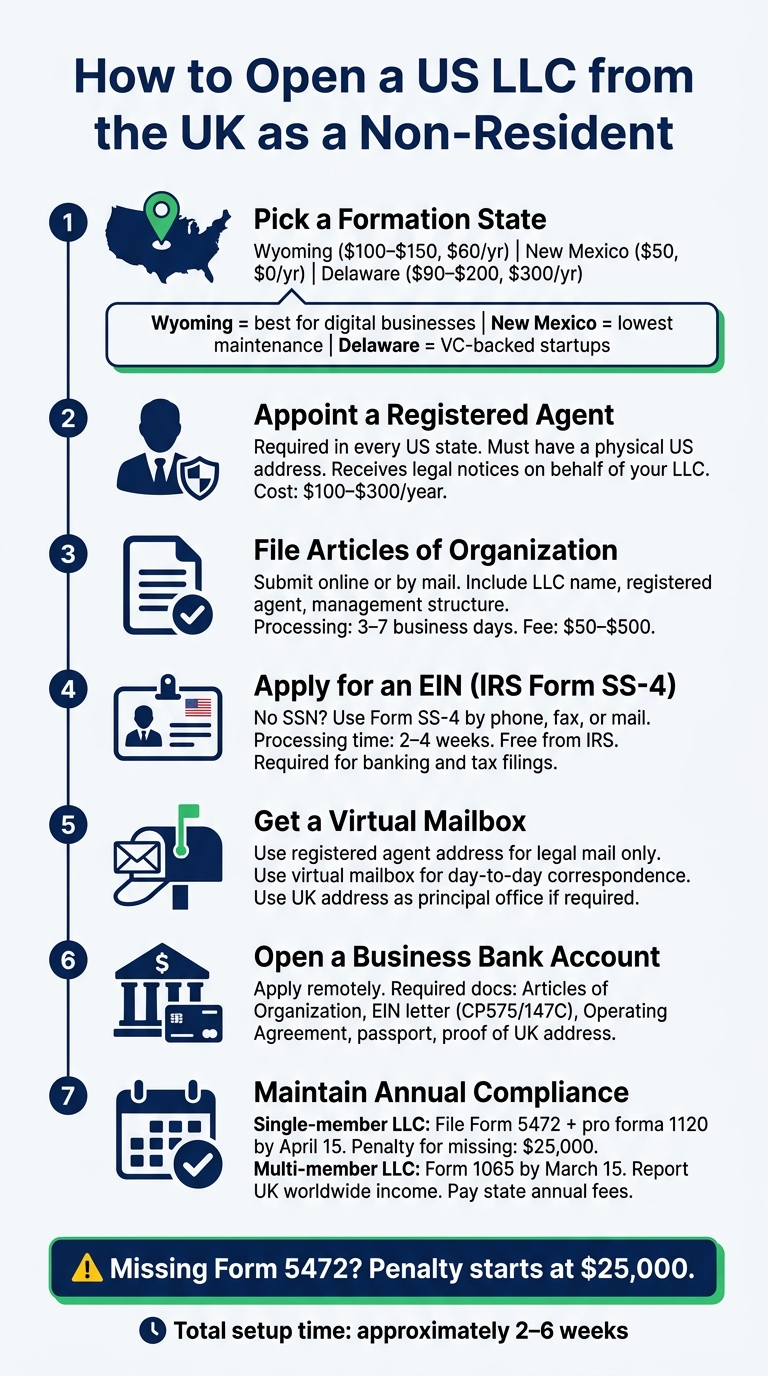
How to Open a US LLC from the UK: Step-by-Step Guide for Non-Residents
Choose the Right State and Appoint a Registered Agent
The state you choose affects filing fees, privacy, and what you’ll need to file each year. For UK-based non-residents with no physical presence in the US, the short list usually comes down to Wyoming, New Mexico, and Delaware.
If your LLC will actually do business from another US state, you’ll need to register there as well.
When Wyoming, New Mexico, or Delaware Makes Sense
For most UK founders running digital businesses, e-commerce stores, or consulting practices without a US physical footprint, Wyoming and New Mexico are usually the simplest fit. Delaware tends to make more sense if you plan to seek venture capital or want access to the Court of Chancery and its well-known business law system.
| Feature | Wyoming | New Mexico | Delaware |
|---|---|---|---|
| Formation Fee | ~$100–$150 | ~$50 | $110 |
| Recurring State Costs | $60/year (Annual Report) | $0 (No annual report) | $400/year (Franchise Tax) |
| Annual Filing | Required | Not required | Required |
| Privacy | High – member names are not public | High – member names are not public | High – no member names in certificate |
| Best Use Case | Digital businesses, e-commerce, privacy-focused founders | Founders who want the lowest ongoing maintenance | Startups seeking VC investment or complex legal needs |
This table helps narrow things down fast. Wyoming is the default pick for many remote founders. New Mexico is the low-maintenance option. Delaware fits companies with venture-backed goals.
Before you file, check each state’s official website for current fees. Filing costs can change.
Once you’ve picked the state, the next step is to appoint a registered agent.
What a Registered Agent Does and Does Not Do
This is the next required step before formation.
Every US LLC must have a registered agent. That can be a person or a company, but they must have a physical address in the state where you form the LLC and be available during normal business hours.
The job is simple: the registered agent receives legal papers for the LLC. That’s it. Using a professional service is often safer than using your home address for privacy reasons. It is not your mailing address, and it is not your banking address.
BusinessAnywhere registered agent service starts at $147/year.
sbb-itb-ba0a4be
File the LLC and Create the Core Company Records
After you pick a state and a registered agent, file the LLC online or by mail. If the state allows it, use the registered agent’s address on the public filing. Once the state approves the filing, you can move on to your federal tax registration and bank account setup.
How to Submit the Articles of Organization Correctly
Start by checking name availability in your chosen state’s business database. Your LLC name has to be different from other registered names and include "LLC", "L.L.C.", or "Limited Liability Company." Also, avoid restricted words like "Bank" or "Insurance" unless your business has the license to use them.
Most states ask for the same basic details:
- LLC name
- Registered agent
- Organizer
- Management structure
- Principal address
State filing fees usually fall between $50 and $500, depending on the state, and processing often takes 3 to 7 business days.
Why You Need an Operating Agreement Even If the State Does Not Require One
Even if your state doesn’t legally ask for an Operating Agreement, banks often do. And honestly, this is one of those documents that saves headaches later. It spells out ownership percentages, capital contributions, management authority, profit distributions, and exit or dissolution procedures.
In plain English, it shows how the LLC is supposed to run when money, control, or member changes come up.
Keep these core documents together, because banks and payment providers will ask for them.
| Document | Use |
|---|---|
| Articles of Organization | Legal proof the LLC exists; required for banking |
| Operating Agreement | Defines ownership and governance for the LLC |
| EIN Confirmation Letter | Federal tax ID; required for banking and tax reporting |
| Registered Agent Information | Ensures you receive state compliance and legal notices |
Keep your formation records easy to access. You’ll need them for the EIN application and when opening a bank account.
Get an EIN and Set Up a US Mailing Address
After you file the LLC, the next step is getting an EIN and setting up a mailing address that banks can verify. Those two pieces turn a filed LLC into something you can actually use from the UK.
How to Apply for an EIN as a Foreign-Owned LLC
You need an EIN for banking, payment processors, and tax filings. If you’re a UK-based owner without an SSN or ITIN, you can’t use the IRS online EIN portal. Instead, foreign-owned LLCs apply with IRS Form SS-4, usually by phone, fax, or mail.
The form asks for a responsible party. That means the person who ultimately controls the LLC, which is usually you as the owner. Have your passport or other government-issued ID ready when you fill out the application.
For international applicants, EIN processing usually takes about 2 to 4 weeks. Apply only after the state approves your LLC.
Once the EIN is issued, save the confirmation with your formation records. Banks and payment platforms often ask for that official document – usually the CP575 or 147C – when they verify the business.
After that, you can set up the mailing address banks and vendors expect to see.
Which Address to Use for Mail, Banking, and Compliance
A separate mailing address helps keep official mail in one place without making it look like you run the business from the US. That matters because banks, vendors, and state agencies all rely on a clear address setup.
Use the registered agent for legal notices only. For day-to-day mail, use a virtual mailbox. Don’t list a virtual mailbox as a physical office. If a principal office or management address is required, use your UK address .
With the EIN and mailing address in place, you’re ready for banking and tax registration.
Open a Bank Account, Handle Taxes, and Keep the LLC in Good Standing
What Documents Banks and Payment Platforms Will Ask For
Once you have your EIN and mailing address sorted, the last setup step is banking. For many non-resident owners, this part is easier than expected. A lot of US banks and payment platforms let you apply remotely, which means a trip to the US often isn’t needed.
It helps to gather your paperwork before you start. Most banks or payment providers will ask for some mix of the following:
- Certified copy of the Articles of Organization
- EIN confirmation letter (CP575 or 147C from the IRS)
- Operating Agreement
- Valid passport for each owner
- Proof of UK address, such as a utility bill or bank statement
- Business activity summary or business plan describing what the LLC does and where customers are located
- Registered agent details
- Financial evidence if requested, such as an initial deposit, bank reference letter, or financial statements
- ITIN or SSN, if applicable
One small thing that matters a lot: keep the business account separate from your personal money. It makes bookkeeping easier, keeps tax reporting cleaner, and helps show that the LLC is being run as its own business.
US and UK Tax and Filing Obligations You Need to Know
After the account is open, attention shifts to filings in the US and the UK. This is where many founders slow down a bit – and for good reason. The rules are manageable, but you don’t want to wing it.
A foreign-owned single-member LLC is usually treated as a disregarded entity for US federal tax purposes. That means the LLC itself usually does not file a standard income tax return. But that does not mean no filing is needed. If you have reportable transactions with the LLC, you must file Form 5472 with a pro forma Form 1120 each year. Miss that filing, and the penalty is $25,000.
If you set up a multi-member LLC, the filing rule is different. Form 1065 and Schedule K-1s are generally due March 15. For a single-member LLC, the Form 5472 and pro forma Form 1120 deadline is April 15.
On the UK side, residents are usually taxed on worldwide income. So if income is tied to the LLC, you may also need to report it in the UK. The US-UK Double Taxation Treaty may help reduce the chance of being taxed twice, but the way it works depends on your facts. That’s why it’s smart to get tax advice before you start taking distributions.
State filings are separate from federal tax filings, and that’s where people sometimes get tripped up. Most states want an annual or biennial report, a franchise tax payment, or both. You also need to keep a registered agent in the formation state. Wyoming charges $60 per year, while Delaware charges $400 in annual franchise tax. If you miss a state renewal, the LLC can lose good standing or even be administratively dissolved.
Here is a practical budget table:
| Category | Item | Frequency | Estimated Cost (USD) |
|---|---|---|---|
| One-Time Setup | State Filing Fee | Once | $50 – $500 |
| One-Time Setup | EIN Application | Once | $0 (IRS) or $97 (BusinessAnywhere service fee) |
| State Recurring | Annual Report / Franchise Tax | Annual | $60 – $350 |
| Recurring Compliance | Registered Agent Service | Annual | $100 – $300 |
| Recurring Federal | US LLC Tax Filing (Form 5472 / pro forma Form 1120) | Annual | $700 |
Set reminders for every filing deadline from day one. For single-member LLCs, federal filings are due April 15. For multi-member LLCs filing Form 1065, the deadline is March 15. State renewal dates vary, so check your state’s calendar as soon as the LLC is formed.
Conclusion: The Clearest Path to Launch and Run a US LLC From the UK
By this stage, the LLC is formed, funded, and set up for compliance. For UK founders, the path is pretty direct: choose the state, appoint a registered agent, file the formation documents, get the EIN, open the bank account, and stay on top of US and UK tax and state filings.
The easiest way to keep things smooth is to line up your addresses, finances, and filings from the start.
FAQs
Do I need to visit the U.S. to open and run the LLC?
No. You don’t need to visit the United States to open or run your LLC.
You can handle the full process from the UK, including filing your formation documents, getting an EIN, and opening a business bank account.
The one thing you do need is a registered agent with a physical street address in the state where you form your LLC. That person or service receives official legal and government documents on your behalf.
Aside from that, everything else can be managed remotely from the UK.
Will a US LLC change how I pay tax in the UK?
Forming a US LLC doesn’t automatically change your UK tax status. But it can create extra filing duties, and that’s where many people get caught off guard.
For a UK owner, a single-member LLC is usually treated as a disregarded entity for US tax purposes. In plain English, that means the LLC itself usually doesn’t pay federal income tax. Instead, the profits pass through to you personally.
If you don’t have US-sourced income or a physical presence in the United States, you may not owe US federal income tax. Even so, you may still have to file forms such as Form 5472 and Form 1120. That’s the part that surprises people: no tax bill doesn’t always mean no filing.
On the UK side, the rule stays simple. You must still report your worldwide income in the UK.
When does a foreign-owned LLC need to register in another U.S. state?
A foreign-owned LLC must register in another U.S. state – called foreign qualification – if it does business there.
This usually applies when your company has a physical location, hires employees, or keeps a clear business presence in that state.
Skip registration when it’s required, and you could run into legal and financial penalties. Once you register, you’ll usually need a registered agent in that state. You may also have to pay state fees, taxes, and file extra paperwork.