


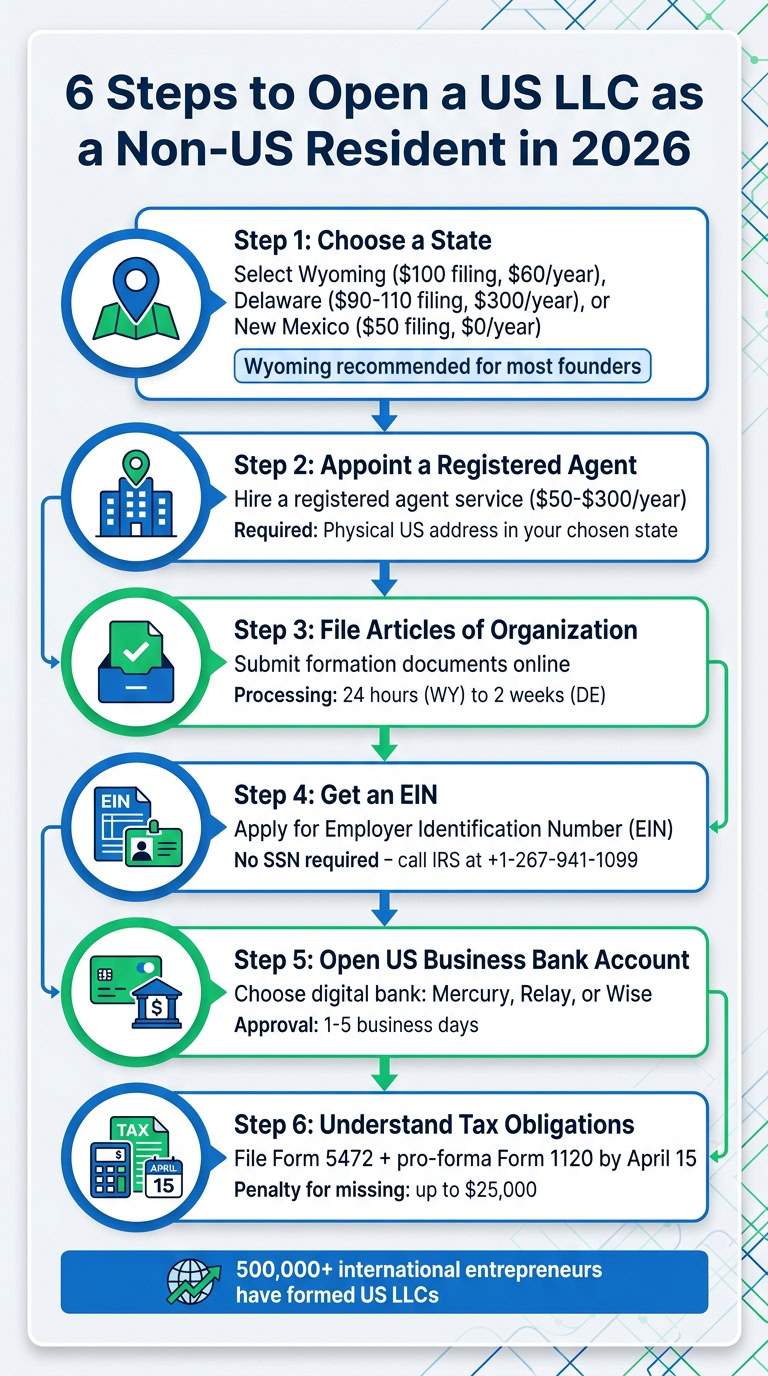
Non-US residents can legally form a US LLC without needing a visa, green card, or Social Security Number (SSN). Here’s how you can do it entirely online in 2026:
- Choose a State: Wyoming, Delaware, and New Mexico are top options. Wyoming offers low fees and strong privacy, Delaware is ideal for startups seeking investors, and New Mexico is the most cost-effective.
- Appoint a Registered Agent: Hire a service to meet the LLC’s legal requirement for a physical address in the chosen state.
- File Articles of Organization: Submit this document to legally establish your LLC. Fees range from $50 to $110, depending on the state.
- Get an EIN: Apply for an Employer Identification Number (EIN) through the IRS. Non-residents can do this by phone, fax, or mail without an SSN.
- Open a US Business Bank Account: Use digital banks like Mercury, Relay, or Wise to gain access to the US financial system.
- Understand Tax Obligations: File required forms, such as Form 5472, and ensure compliance with US tax laws. Non-residents may owe no federal taxes if income isn’t US-sourced.
Quick Comparison of States
| Feature | Wyoming | Delaware | New Mexico |
|---|---|---|---|
| Filing Fee | $100 | $110 | $50 |
| Annual Fee | $60 | $400 | $0 |
| Privacy | Excellent | Good | Good |
| State Income Tax | None | None | None |
Can Non-US Residents Legally Form a US LLC?
Yes, non-US residents can fully own a US LLC without needing a visa, green card, or Social Security Number (SSN). US law does not restrict LLC ownership based on citizenship or residency, and you don’t even need a personal US address to get started.
"There are no citizenship or residency requirements to form an LLC in any US state." – LLC.org Team
All 50 states allow foreign nationals to file Articles of Organization and establish an LLC. In fact, more than 500,000 international entrepreneurs have successfully taken advantage of this legal option to form US LLCs. The entire process can be completed remotely, so there’s no need to travel to the US.
The only address-related requirement involves the LLC itself, not you as the owner. Every LLC must designate a Registered Agent with a physical address in the state where the LLC is formed. This agent is responsible for receiving legal and official documents on behalf of the business. Using a Registered Agent service typically costs between $50 and $300 per year.
For tax purposes, you’ll need an Employer Identification Number (EIN) instead of an SSN. While the IRS online application requires an SSN, non-residents can still obtain an EIN by faxing Form SS-4, mailing it, or calling the IRS Business & Specialty Tax Line directly. This EIN is essential for opening business bank accounts, accepting payments, and running your LLC just like any US-based entrepreneur.
Up next, we’ll walk you through how to meet the address requirement by appointing a Registered Agent.
sbb-itb-ba0a4be
Step 1: Choose the Right State for Your LLC
After confirming that you can legally form a U.S. LLC, the next step is deciding where to register it. This decision impacts your setup costs, yearly fees, privacy, and even how smoothly you can open business bank accounts.
Here’s the good news: you don’t have to register your LLC in the state where you live – even if you’re not based in the U.S. You can pick from any of the 50 states, weighing factors like low costs, privacy protections, and business-friendly regulations. For non-resident LLC owners, Wyoming, Delaware, and New Mexico are the top three choices.
"Wyoming is the best overall choice for non-resident LLCs. It has no state income tax, strong privacy protections, low fees, and a business-friendly legal environment." – LLC.org Team
Wyoming is a standout option for solo entrepreneurs and digital nomads. The state charges a $100 filing fee and a $60 annual report fee. It also offers excellent privacy, as LLC members don’t have to appear in public records. On top of that, there’s no state income tax for non-residents.
Delaware is a favorite for businesses aiming to attract venture capital. More than 66% of Fortune 500 companies are registered there, thanks to its specialized Court of Chancery, which efficiently handles business disputes. However, Delaware’s $400 annual franchise tax is significantly higher than Wyoming’s fees.
New Mexico is the most budget-friendly choice. Its filing fee is just $50, and it doesn’t require annual reports or franchise taxes, keeping ongoing costs at zero. That said, some neobanks may process New Mexico LLCs more slowly or ask for additional documents compared to Wyoming or Delaware LLCs.
State Comparison: Wyoming vs. Delaware vs. New Mexico
| Feature | Wyoming | Delaware | New Mexico |
|---|---|---|---|
| Filing Fee | $100 | $110 | $50 |
| Annual Fee | $60 | $400 | $0 |
| Annual Report | Required | Required | Not Required |
| Privacy | Excellent (No public members) | Good (No public members) | Good (No public members) |
| State Income Tax | None | None (for non-residents) | None (for non-residents) |
| Best Use Case | Solo founders / Privacy-focused | Venture capital / Investor-backed | Budget-conscious founders |
If privacy, legal protection, and low maintenance costs are your priorities, Wyoming is the top pick. Delaware is better suited for startups looking to raise capital or go public. For those focused on minimizing expenses, New Mexico is a great option.
For most non-U.S. residents running online businesses, Wyoming is the recommended choice. It offers strong legal protections, low yearly costs, and smooth banking processes.
Once you’ve chosen the state that fits your needs, the next step is appointing a Registered Agent to fulfill the LLC’s address requirement. Choosing the best registered agent service ensures your business stays compliant with state laws.
Step 2: Appoint a Registered Agent
Once you’ve chosen your state, the next step is to appoint a registered agent for your LLC – a legal requirement across all U.S. states.
A registered agent is an individual or company designated to receive official documents on behalf of your LLC. These documents include lawsuits, tax notifications, annual report reminders, and other government correspondence. The agent must have a physical street address in the state where your LLC is formed and must be available during standard business hours to accept these deliveries. Keep in mind: P.O. Boxes won’t cut it.
If you’re a non-U.S. resident, hiring a commercial registered agent service is your only option since you won’t have a physical U.S. address. These services typically charge between $50 and $300 annually, with most falling in the $100–$150 range. For instance, BusinessAnywhere provides registered agent services starting at $147 per year, with the first year free if you form your LLC through their platform.
"If you let the registered agent lapse, the state can dissolve your entity. For non-residents with no US presence, a commercial registered agent is the only practical option."
– Jett Fu, Founder, Global Solo
Beyond fulfilling legal obligations, a registered agent helps protect your privacy by forming an anonymous LLC. Instead of your personal address being listed on public records, the agent’s address is used on state filings. Additionally, registered agent services often send compliance reminders to ensure you don’t miss important deadlines. Letting your service lapse can lead to serious issues, like losing good standing, frozen bank accounts, or even default judgments. To avoid this, set a digital reminder at least a month before your renewal date.
Step 3: File Articles of Organization
Once you’ve secured your registered agent, the next step is to file your Articles of Organization (sometimes called a Certificate of Formation). This is the official document that legally establishes your LLC.
The process is fairly simple and can usually be done online through your state’s business portal. Here’s what you’ll need to include:
- Your LLC’s unique name (it must include "LLC" or "Limited Liability Company").
- The name and physical address of your registered agent.
- Details about the organizer (the person filing the paperwork).
- A brief description of your business purpose.
- Whether your LLC will be member-managed (common for single-member LLCs) or manager-managed.
Before filing, make sure to check your state’s business database to confirm the name you want is available. Once verified, the actual filing can often be completed in just 15 to 45 minutes online. Fees for filing vary depending on the state: New Mexico charges $50, Wyoming $100, and Delaware charges $110. Processing times also differ, with Wyoming offering 24-hour processing, while Delaware might take one to two weeks. If you’re in a rush, many states provide expedited options for an additional fee.
One critical detail: ensure the name on your Articles of Organization matches exactly with the name you’ll use on your EIN application (Form SS-4). Even minor differences in spelling, punctuation, or capitalization can cause delays or rejections when applying for your EIN.
For added convenience, services like BusinessAnywhere can handle the filing for you. Starting at $0 plus state fees, they include perks like a free year of registered agent service, compliance reminders, and document management tools – all accessible through one online dashboard.
Once your Articles of Organization are filed, you’ll be ready to tackle the next step: obtaining your EIN without using an SSN.
Step 4: Get an EIN Without an SSN
Once your LLC is formed, the next step is to obtain an EIN (Employer Identification Number). Think of it as your LLC’s version of a Social Security Number – it’s a 9-digit tax ID used for tax purposes and other business activities. The good news? You don’t need a U.S. Social Security Number (SSN) to get one. As long as your Articles of Organization are filed, this step ensures your LLC is fully recognized by the IRS.
The IRS provides EINs at no cost, but non-residents can’t use the online application because it requires an SSN or an Individual Taxpayer Identification Number (ITIN). Instead, you’ll need to complete IRS Form SS-4 and submit it via phone, fax, or mail.
How to Apply for an EIN as a Non-Resident
For international applicants, calling is the quickest option. Dial the IRS at +1-267-941-1099 (available Monday through Friday from 6:00 a.m. to 11:00 p.m. Eastern Time). Before you call, make sure your Form SS-4 is fully completed. During the call, the IRS representative will verify the details and usually issue your EIN on the spot.
If calling isn’t convenient, you can fax your completed form to 304-707-9471. You’ll typically get a response within 4 business days. Mailing the form is also an option, but it takes longer – about 4 to 6 weeks.
Filling Out Form SS-4 Correctly
On Form SS-4, pay close attention to Line 7a, where you list the "Responsible Party" – this is the person who owns or controls the LLC (likely you, if it’s a single-member LLC). For Line 7b, where it asks for the responsible party’s SSN or ITIN, write “foreign” or “N/A.” The IRS accepts this for non-residents who aren’t eligible for a U.S. tax ID. Also, ensure the LLC name you enter matches exactly with the name on your Articles of Organization. Even minor discrepancies, like punctuation or capitalization errors, can lead to rejection.
"You do not need an ITIN to get an EIN. The EIN is for the entity; the ITIN is for you personally." – Jett Fu, Global Solo
Need Help? Consider a Service
If you’d rather not deal with the process yourself, services like BusinessAnywhere can handle it for you. For $97, they’ll prepare, submit, and follow up on your EIN application, saving you time and ensuring everything is done correctly.
With your EIN in hand, you’ll be ready for the next step: opening a U.S. business bank account as a non-resident.
Step 5: Open a US Business Bank Account as a Non-Resident
Once you’ve secured your EIN, you’re ready to take another important step: opening a US business bank account remotely. This is a game-changer for non-residents forming an LLC in the US, as it unlocks access to US financial services. While traditional banks like Chase, Bank of America, and Wells Fargo often require an in-person visit to a branch (which isn’t feasible for most non-residents), there are digital banking options tailored for remote business owners.
Some of the most popular choices include Mercury, Relay, and Wise Business:
- Mercury: A favorite among non-resident LLC founders, Mercury is built with tech startups and solo entrepreneurs in mind. It offers FDIC insurance through its partner banks and typically processes account approvals within 1 to 5 business days.
- Relay: Ideal for teams or those looking for banking tools focused on profit management, Relay provides robust solutions for collaborative financial management.
- Wise Business: Perfect for businesses dealing with multiple currencies, Wise supports over 50 currencies and processes applications in just 1 to 3 business days. However, keep in mind that Wise operates as an Electronic Money Institution, so it safeguards funds but doesn’t offer FDIC insurance.
To ensure a smooth application process, it’s crucial to meet banking compliance requirements. Banks follow strict KYC (Know Your Customer) and AML (Anti-Money Laundering) protocols, so your documentation must be accurate and complete. Here’s what you’ll need:
- Articles of Organization (such as those filed in Delaware)
- EIN Confirmation Letter (CP 575 or 147C)
- Signed Operating Agreement
- Passport
- Detailed Business Description
Make sure the information in your application matches your website and company records exactly. For instance, your business name on the EIN must align with your state filing. Also, ensure your website is operational and provides a clear description of your business to avoid unnecessary scrutiny.
"For many founders, banking access is the real reason they form the LLC." – Jett Fu, Founder
If tackling this process on your own feels overwhelming, services like BusinessAnywhere can help. They offer assistance with preparing your documentation and navigating the application process, so you can focus on growing your business instead of getting bogged down in paperwork.
Step 6: Understand Your Tax Obligations as a Non-Resident LLC Owner
Once your US LLC is officially formed and your bank account is open, it’s time to tackle your tax responsibilities. This step is crucial for maintaining your LLC’s compliance. Even if your LLC doesn’t generate US-sourced income, you’re still required to file certain forms. Ignoring these obligations could result in penalties of up to $25,000.
Here’s how it works: an LLC is treated as a pass-through entity, meaning its profits are passed directly to you. As a non-resident, you’ll report this income on Form 1040-NR. But not all income is treated the same. If your earnings qualify as Effectively Connected Income (ECI) – income tied to a US trade or business – they may be subject to federal tax. For example, running an online service business from abroad, without US employees, offices, or inventory, typically means your income won’t be classified as ECI and may not be taxed federally. However, passive income like US-sourced dividends, interest, or royalties (known as FDAP income) is taxed at a flat 30% unless a tax treaty lowers the rate.
Even if your LLC doesn’t generate income, foreign-owned LLCs (with 25% or more foreign ownership) must file Form 5472 and a pro-forma Form 1120 by April 15 each year. Missing these filings can result in hefty penalties of $25,000. While the IRS sometimes grants exceptions for small businesses with limited US involvement, you shouldn’t count on this leniency.
Tax treaties can be a major advantage. The US has agreements with over 65 countries, potentially exempting your income from federal taxes if you don’t have a permanent establishment (like an office or staff) in the US. But here’s the catch: not all states honor these treaties. States like California, New Jersey, and New York may still tax income that’s exempt at the federal level. Understanding these nuances is key to staying compliant and running your LLC smoothly.
For those investing in US real estate, you might want to explore the IRC Sec. 871(d) election, which can reduce taxes on net rental income.
"The gap between creating an entity and understanding what that entity requires of you hasn’t changed at all. Formation is maybe 20% of the work." – Jett Fu, Founder
If the thought of handling tax filings feels overwhelming, there are services that can help. BusinessAnywhere, for instance, offers a US LLC tax filing package for $700. This includes preparing and filing Form 5472 and a pro-forma Form 1120, plus a review call to explain your obligations. Need an EIN? They can handle that too for $97. For more tailored advice, their tax and residency consultation service ($535) provides a one-hour session to create a custom plan for your business and residency needs. Taking care of these filings ensures your LLC stays in compliance and operates without hiccups.
Conclusion
This guide has outlined how a non-resident can establish an LLC in the U.S. entirely remotely and within legal boundaries. As of 2026, you can access the robust U.S. financial system without needing a visa, green card, or SSN. By following the six steps detailed here – selecting the right state, appointing a registered agent, filing your Articles of Organization, obtaining an EIN, opening a U.S. business bank account, and understanding tax obligations – you can form a legitimate U.S. company.
Benefits include access to top-tier payment processors like Stripe and PayPal, personal asset protection through limited liability, tax efficiency via pass-through taxation, and enhanced global credibility for your business. Wyoming continues to stand out for its affordability and strong privacy protections.
"Starting a US business as a non-resident is not a ‘hack.’ It is a legitimate, legal path to accessing the world’s best financial infrastructure." – Foreign Founder Team
Keep in mind, forming your LLC is just the beginning. Staying compliant with ongoing requirements – such as filing Form 5472, meeting annual state filing deadlines, and submitting the Beneficial Ownership Information (BOI) report – is critical. Missing these deadlines can lead to penalties of up to $25,000. This highlights the importance of staying on top of your legal and administrative responsibilities.
For extra help, companies like BusinessAnywhere offer a variety of remote services, including US LLC tax filing, EIN application services, and tax and residency consultations.
Take the first step by choosing your state, securing a registered agent, and establishing your U.S. business presence. Over 500,000 international entrepreneurs have already taken this path – you can too.
FAQs
Do I need an ITIN to run my US LLC?
No, you don’t need an ITIN (Individual Taxpayer Identification Number) to operate a US LLC. Non-US residents can apply for an EIN (Employer Identification Number) directly from the IRS, even without an SSN or ITIN. The EIN is generally all you need for most business activities, including opening a bank account. An ITIN is only required if you have specific US tax reporting obligations, but it’s not a requirement for running or managing your LLC.
Will my non-US LLC income be taxed in the US?
Yes, income from your non-US LLC might be subject to US taxes if it is classified as effectively connected income (ECI) with a US trade or business. Your specific tax responsibilities will depend on factors such as the nature of the income, any relevant tax treaties, and US tax laws. It’s crucial to work with a tax professional to ensure you meet all US regulatory requirements.
Can I open a US bank account without visiting the US?
Yes, opening a U.S. bank account without traveling to the country is possible. Several banks and financial services offer options for non-residents to set up accounts remotely. Generally, you’ll need to provide proof of your LLC formation and a valid form of identification. Some services are designed specifically for international entrepreneurs, streamlining the process so you can complete it entirely online or without being physically present in the U.S.