
In Short: Seller’s Permit
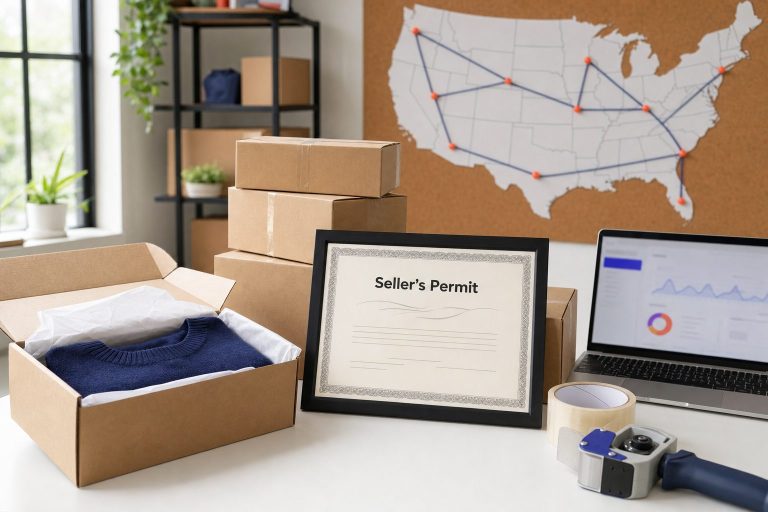
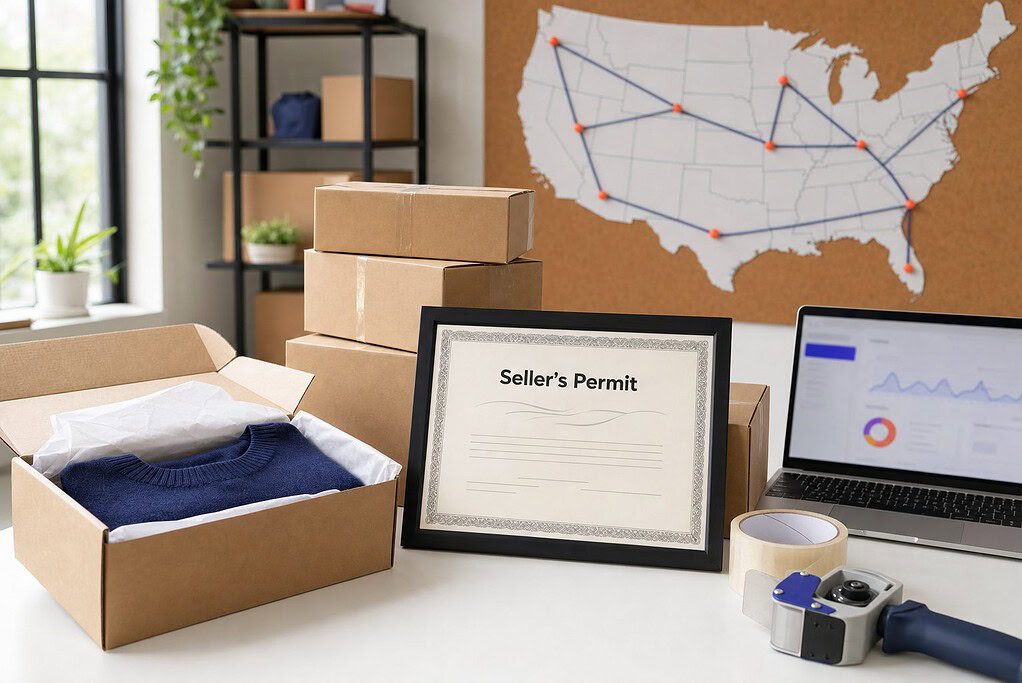
A seller’s permit is the state registration that lets a business collect sales tax from customers and send it to the state. “Seller’s permit” and “sales tax permit” are the same thing under different names: California and Wisconsin say seller’s permit, Texas says sales and use tax permit, New York says Certificate of Authority and Ohio says vendor’s license.
- Who needs one: any business that sells taxable goods or services in a state with a sales tax, through a physical presence there or by passing that state’s remote seller threshold.
- Where to get it: the state’s own tax agency, online. Every link in the table below goes to the official agency.
- Cost: free in most states. Fees run from $12 in Arizona to $100 in Connecticut.
- No sales tax: Alaska, Delaware, Montana, New Hampshire and Oregon have no statewide sales tax, so they issue no seller’s permit. Alaska towns can still levy local sales tax.
- What you need first: a legal business entity and, in most states, an EIN, because the application asks for the business’s federal tax ID.
You list your first products on Amazon or Shopify, or sign a US customer for a taxable service, and every guide tells you to “get a seller’s permit.” Then you search the state’s website and find a Certificate of Authority, a Transaction Privilege Tax License or a General Excise Tax License instead. This guide explains what a seller’s permit is, when you need one, how it differs from a resale certificate and a business license, and exactly where to apply in each of the 45 states and DC that charge sales tax.
What Is a Seller’s Permit?
A seller’s permit is a registration with a state tax agency that authorizes your business to collect sales tax on taxable sales in that state. Once you hold it, you charge the correct sales tax at checkout, file sales tax returns on the schedule the state assigns, and pay over the tax you collected. Selling taxable goods in a sales tax state without the permit means collecting tax you have no right to collect, or failing to collect tax you owe.
The permit is issued to the business, not to the owner personally. If you form an LLC, the LLC holds the permit under its legal name and federal tax ID. Each state issues its own permit, so a business that sells into ten states holds ten registrations.
Seller’s Permit vs Sales Tax Permit: Same Thing, Different Names
There is no difference between a seller’s permit and a sales tax permit. The two phrases describe the same registration, and each state picks its own official title. A few examples from the state agencies themselves:
- Seller’s Permit: California, Idaho and Wisconsin.
- Sales and Use Tax Permit or Sales Tax Permit: Texas, Arkansas, Connecticut, Iowa, Kentucky, Mississippi, Nebraska and Oklahoma.
- Sales Tax License: Alabama, Colorado, Michigan, South Dakota, Utah and Wyoming.
- Certificate of Registration: Florida, Georgia, Illinois, North Carolina, Tennessee and Virginia.
- Certificate of Authority: New York and New Jersey.
- Vendor’s License: Ohio. Retail License: South Carolina. Retailer Certificate: Maine.
- Gross receipts or excise registrations: Arizona’s Transaction Privilege Tax License, Hawaii’s General Excise Tax License and New Mexico’s Gross Receipts Tax registration do the same job for those states’ versions of a sales tax.
Seller’s Permit vs Resale Certificate vs Business License
These three documents are confused constantly, and they do different jobs:
- Seller’s permit: lets you collect sales tax from your customers and remit it to the state.
- Resale certificate: a document you give your supplier so you can buy inventory you will resell without paying sales tax on it. States issue or accept resale certificates only from businesses that hold a seller’s permit, so the permit comes first. Florida, for example, issues an Annual Resale Certificate to registered dealers that expires on December 31 each year.
- Business license: permission from a state, county or city to operate a business there. It has nothing to do with collecting sales tax, and many businesses need both. See our business license costs by state comparison for what each state charges.
Washington combines the two: its Business License application also completes your tax registration with the Department of Revenue.
Who Needs a Seller’s Permit?
You need a seller’s permit in a state when two things are true: you sell goods or services that the state taxes, and your business has nexus there, meaning a connection strong enough for the state to require you to collect its tax. Nexus comes in two forms.
Physical presence
An office, a store, employees, a warehouse or inventory stored in the state creates nexus. Inventory counts even when someone else holds it, which matters for sellers who use third-party fulfillment centers.
Economic nexus for remote sellers
Since the US Supreme Court decision in South Dakota v. Wayfair in 2018, states can require out-of-state sellers to collect sales tax once their sales into the state pass a threshold, even with no physical presence. South Dakota’s threshold is $100,000 in gross sales, according to its 2026 Sales and Use Tax Guide. Each state sets its own threshold, so check the state agency’s remote seller page before you pass it.
Selling through Amazon, Etsy, eBay or Walmart
States with marketplace facilitator laws make the marketplace itself collect and remit sales tax on the sales it processes. That covers many marketplace-only sellers, but not all of them, and it does not cover sales through your own website. If you also sell direct, or the state requires marketplace sellers to register anyway, you still need the permit. Our guide to the best state to form an LLC for Amazon FBA covers the entity side of that decision.
How to Get a Seller’s Permit in 5 Steps
- Form your business entity. The permit is issued to the legal business, so form the LLC or corporation first and use its exact legal name on the application.
- Get an EIN. State applications ask for the business’s federal Employer Identification Number. A non-resident owner without a Social Security number can still get one; see our EIN application guide for foreigners. Keep the IRS letter that confirms it, covered in our guide to the EIN confirmation letter (CP 575).
- Register with each state’s tax agency. Apply online through the official portal linked in the table below. Have ready the entity’s formation date, owners or officers, business address, a description of what you sell and your expected monthly sales.
- Apply before your first taxable sale. New York asks applicants to register at least 20 days before they start doing business, and New Jersey asks for at least 15 business days.
- Collect, file and pay. The state assigns a filing frequency, monthly, quarterly or annual, based on your expected sales. File every return on time, including zero returns, or the state can suspend or revoke the permit.
How Much Does a Seller’s Permit Cost?
Most states charge nothing. California, Texas, Illinois, Pennsylvania, Michigan, North Carolina and many others state on their own sites that registration is free. Where a fee applies, it is small: Arizona $12 per location plus city fees, Colorado $16 plus a $50 refundable deposit, Indiana $25 per location, Arkansas and South Carolina $50, Ohio $50, Wyoming $60 and Connecticut $100.
Some states also hold a security deposit or bond for higher-risk or high-volume sellers. California, Nevada, Texas and Mississippi all state that a deposit or bond can apply. Renewal rules vary too: Connecticut and Wisconsin renew every two years, Pennsylvania every five years, Michigan and Rhode Island every year, and Idaho, Nevada and South Carolina permits do not expire while the business stays active.
Seller’s Permit Requirements by State
The table lists the official name of the registration, the agency that issues it, the state fee as published by that agency, and a link to the agency’s own registration page. “No fee listed” means the agency’s published pages do not state a fee; confirm on the application before you submit.
| State | Name of the permit | Where to apply | State fee |
|---|---|---|---|
| Alabama | Sales Tax License | Alabama Department of Revenue | No fee listed; renewal is free |
| Arizona | Transaction Privilege Tax (TPT) License | Arizona Department of Revenue | $12 per location, plus city fees |
| Arkansas | Sales and Use Tax Permit | Arkansas Department of Finance and Administration | $50 |
| California | Seller’s Permit | California Department of Tax and Fee Administration | Free (a security deposit can apply) |
| Colorado | Sales Tax License | Colorado Department of Revenue | $16 plus a $50 refundable deposit |
| Connecticut | Sales and Use Tax Permit | Connecticut Department of Revenue Services | $100 |
| District of Columbia | Certificate of Registration | DC Office of Tax and Revenue | Free |
| Florida | Certificate of Registration (sales and use tax) | Florida Department of Revenue | No fee listed |
| Georgia | Sales and Use Tax Certificate of Registration | Georgia Department of Revenue | No fee listed |
| Hawaii | General Excise Tax (GET) License | Hawaii Department of Taxation | $20 one time |
| Idaho | Seller’s Permit | Idaho State Tax Commission | Free |
| Illinois | Certificate of Registration | Illinois Department of Revenue | Free |
| Indiana | Registered Retail Merchant Certificate | Indiana Department of Revenue | $25 per location |
| Iowa | Sales and Use Tax Permit | Iowa Department of Revenue | Free |
| Kansas | Sales Tax Registration Certificate | Kansas Department of Revenue | Free |
| Kentucky | Sales and Use Tax Permit | Kentucky Department of Revenue | No fee listed |
| Louisiana | Sales Tax Certificate | Louisiana Department of Revenue | No fee listed |
| Maine | Retailer Certificate | Maine Revenue Services | Free |
| Maryland | Sales and Use Tax License | Comptroller of Maryland | No fee listed |
| Massachusetts | Sales and Use Tax Registration Certificate | Massachusetts Department of Revenue | No fee listed |
| Michigan | Sales Tax License | Michigan Department of Treasury | Free |
| Minnesota | Sales and Use Tax account (confirmation letter) | Minnesota Department of Revenue | No fee listed |
| Mississippi | Sales Tax Permit | Mississippi Department of Revenue | Free (a bond can apply) |
| Missouri | Retail Sales Tax License | Missouri Department of Revenue | No fee listed |
| Nebraska | Sales Tax Permit | Nebraska Department of Revenue | Free |
| Nevada | Sales/Use Tax Permit | Nevada Department of Taxation | $15 per location plus a security deposit |
| New Jersey | Certificate of Authority | New Jersey Division of Taxation | Free |
| New Mexico | Gross Receipts Tax registration (NMBTIN) | New Mexico Taxation and Revenue Department | Free |
| New York | Certificate of Authority | New York State Department of Taxation and Finance | No fee listed |
| North Carolina | Certificate of Registration | North Carolina Department of Revenue | Free |
| North Dakota | Sales and Use Tax Permit | North Dakota Office of State Tax Commissioner | No fee listed |
| Ohio | Vendor’s License | Ohio Department of Taxation | $50 (out-of-state sellers register free) |
| Oklahoma | Sales Tax Permit | Oklahoma Tax Commission | $20 plus a handling fee |
| Pennsylvania | Sales, Use and Hotel Occupancy Tax License | Pennsylvania Department of Revenue | Free |
| Rhode Island | Permit to Make Sales at Retail | Rhode Island Division of Taxation | Free |
| South Carolina | Retail License | South Carolina Department of Revenue | $50 |
| South Dakota | Sales Tax License | South Dakota Department of Revenue | Free |
| Tennessee | Certificate of Registration | Tennessee Department of Revenue | Free |
| Texas | Sales and Use Tax Permit | Texas Comptroller of Public Accounts | Free (a security bond can apply) |
| Utah | Sales Tax License | Utah State Tax Commission | No fee listed |
| Vermont | Sales and Use Tax License | Vermont Department of Taxes | Free |
| Virginia | Sales Tax Certificate of Registration | Virginia Department of Taxation | No fee listed |
| Washington | Business License with tax registration | Washington State Department of Revenue | $50 application fee, endorsements extra |
| West Virginia | Business Registration Certificate | West Virginia Tax Division | $30 |
| Wisconsin | Seller’s Permit | Wisconsin Department of Revenue | $20, then $10 every two years |
| Wyoming | Sales Tax License | Wyoming Department of Revenue | $60 |
States With No Sales Tax
Alaska, Delaware, Montana, New Hampshire and Oregon have no statewide sales tax, so they issue no seller’s permit. Two caveats apply. Alaska lets municipalities levy local sales taxes, and remote sellers collecting those local taxes register through the Alaska Remote Seller Sales Tax Commission. Delaware charges a gross receipts tax on the seller instead of a sales tax on the buyer. A business formed in one of these states still needs a seller’s permit in every sales tax state where it has nexus.
Seller’s Permits for Non-Resident and Foreign-Owned LLCs
A US LLC owned by someone who lives abroad registers for a seller’s permit the same way a US-owned LLC does. Where you live does not change the rule. What triggers the requirement is the LLC’s nexus in each state: inventory in a fulfillment center, sales above a remote seller threshold, or an office or employees. Two practical points for non-resident owners:
- Get the EIN first. State applications ask for it, and a foreign owner without an SSN applies by fax, mail or the IRS international phone line rather than online.
- Use a US business address you control. State tax agencies mail notices, assigned filing frequencies and certificates. A registered agent or business address that forwards and scans mail keeps those notices from going missing.
Common Seller’s Permit Mistakes
- Paying a third-party site for a free permit. The Nebraska Department of Revenue publishes a warning about websites that sell sales tax certificates. Apply directly with the state agency in the table.
- Confusing the permit with a resale certificate. The resale certificate lets you buy inventory tax-free; it does not let you collect tax from customers.
- Registering in only your home state. A non-resident owner’s LLC formed in Wyoming or Delaware sells into other states, and the permit follows the sales, not the formation state.
- Skipping zero returns. A state that assigns you a filing frequency expects a return every period, even with no sales.
- Ignoring local taxes. Arizona cities, Colorado home-rule cities and Louisiana parishes add their own licensing or collection on top of the state.
Set Up Your LLC and EIN With BusinessAnywhere
Every seller’s permit application starts with the same two things: a properly formed business and an EIN issued to it. BusinessAnywhere forms your US LLC for $0 plus the state filing fee, includes a free first year of registered agent service, and gets the EIN for non-residents without a Social Security number for $97.
Frequently Asked Questions
Is a seller’s permit the same as a sales tax permit?
Yes. Both phrases describe the state registration that lets a business collect and remit sales tax. Each state uses its own official name, such as Seller’s Permit in California, Sales and Use Tax Permit in Texas and Certificate of Authority in New York.
How much does a seller’s permit cost?
Most states charge nothing. Where a fee applies it is small: $12 in Arizona, $25 in Indiana, $50 in Arkansas, Ohio and South Carolina, $60 in Wyoming and $100 in Connecticut. Some states also hold a security deposit or bond.
Do I need a seller’s permit if I sell only on Amazon?
Not in every case. States with marketplace facilitator laws make Amazon collect and remit the tax on its sales, but some states still require marketplace sellers to register, and any sales through your own website need a permit where you have nexus.
Is a resale certificate the same as a seller’s permit?
No. A seller’s permit lets you collect sales tax from customers. A resale certificate lets you buy inventory for resale without paying sales tax, and states issue or accept it only from businesses that already hold a seller’s permit.
Which states do not require a seller’s permit?
Alaska, Delaware, Montana, New Hampshire and Oregon have no statewide sales tax, so they issue no seller’s permit. Alaska municipalities can still levy local sales tax, collected for remote sellers through the Alaska Remote Seller Sales Tax Commission.
Can a non-resident LLC owner get a seller’s permit?
Yes. The permit is issued to the LLC, not the owner, and the owner’s residence does not change the rule. The LLC needs its EIN first, because state applications ask for the business’s federal tax ID.
This guide summarizes information published by each state’s tax agency as of October 2026. It is general information, not tax or legal advice. Fees, thresholds and forms change, so confirm the requirements on the agency’s site before you apply.