

Short answer: Wyoming is better for most small businesses, solo owners and non-US residents: it costs $100 to form and $60 minimum a year, has no state income tax and keeps member names off the public record. Delaware is better for companies raising venture capital or planning an IPO: it costs $110 to form and $400 a year, and its Court of Chancery gives investors predictable business law. Here’s how they compare:
- Wyoming: Best for small businesses, solopreneurs, and privacy-focused owners. It offers low fees ($60 annually), no state income tax, and strong privacy protections (no public member disclosures). Ideal for freelancers, e-commerce stores, and international founders. Many non-US citizens start a US LLC to access the American market remotely.
- Delaware: Preferred by startups seeking venture capital or planning IPOs. Its $400 annual franchise tax provides access to the specialized Court of Chancery and a legal system trusted by investors. Great for high-growth tech companies and businesses with complex legal needs.
Quick Comparison
| Factor | Wyoming LLC | Delaware LLC |
|---|---|---|
| Annual Fee | $60 | $400 |
| Privacy | No public member disclosure | Limited; details may surface |
| Legal System | Standard state courts | Specialized Court of Chancery |
| Best For | Small businesses, privacy | VC-backed startups, IPO plans |
Bottom Line: Pick Wyoming for simplicity, low costs, and privacy. Choose Delaware if you need investor credibility or legal predictability for complex operations.
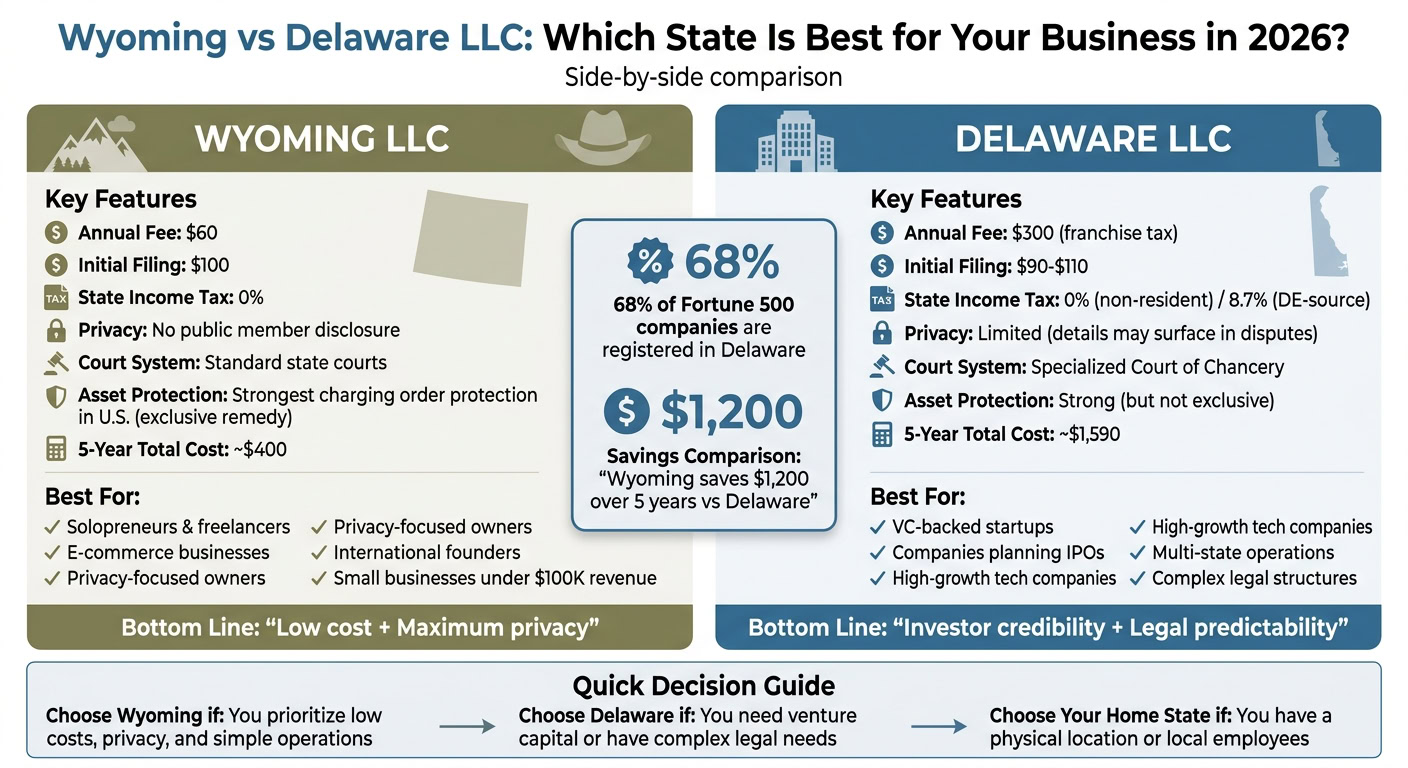
Wyoming vs Delaware LLC: Key Comparison Factors
When deciding between Wyoming and Delaware for forming an LLC, four main factors stand out: cost, legal infrastructure, privacy, and asset protection. Wyoming’s financial advantage is clear, with a $60 annual report fee compared to Delaware’s fixed $400 annual franchise tax – saving LLC owners around $1,200 over five years.
Delaware’s Court of Chancery is a major draw for businesses seeking a specialized legal system. This court, with over 200 years of corporate case law, is staffed by expert judges who handle complex disputes involving governance, mergers, and shareholder rights. Wyoming’s standard courts, while sufficient for small businesses, lack Delaware’s depth of corporate legal precedent, which is often a key consideration for institutional investors.
When it comes to privacy, Wyoming takes the lead. It doesn’t require LLC members or managers to be listed in public records, whether in the Articles of Organization or annual reports. Delaware offers some initial privacy, but ownership details may surface in legal disputes. Wyoming also boasts the strongest charging order protection in the U.S., ensuring creditors can’t force the sale of LLC assets to settle a member’s personal debts. The charging order remains the sole remedy in such cases.
Neither state imposes income tax on non-residents without local operations. However, Delaware’s $400 franchise tax applies regardless of earnings, whether you make $0 or $1 million. As the USLLCGlobal Team noted:
“Delaware’s reputation is built on C-Corporation law, not LLC law. For a single-member LLC, you are paying $240 more per year for zero practical advantage.”
Side-by-Side Comparison Table
| Factor | Wyoming LLC | Delaware LLC |
|---|---|---|
| Initial Filing Fee | $100 | $110 |
| Annual Fee | $60 (Annual Report) | $400 (Franchise Tax) |
| State Income Tax | 0% | 0% (non-resident) / 8.7% (DE-source) |
| Public Member Disclosure | None required | None initially; accessible in disputes |
| Court System | Standard state courts | Court of Chancery (judges only) |
| Charging Order Protection | Exclusive remedy (strongest in U.S.) | Strong, but not exclusive |
| Late Filing Penalty | Dissolution (no late fee) | $200 + 1.5% interest |
| Best For | Solopreneurs, e-commerce, privacy-focused | VC-backed startups, large corporations |
Legal and Court System Differences
The legal systems in Wyoming and Delaware significantly influence the risks and benefits of forming an LLC in each state.
Delaware’s Court of Chancery is a key reason why 68% of Fortune 500 companies incorporate there. This court exclusively handles business disputes, with judges who specialize in corporate law and rely on an extensive body of case law. For startups raising millions in venture capital, this predictability is crucial, as most VC agreements are structured around Delaware law.
Wyoming, on the other hand, uses standard state courts, which often involve juries and have less corporate case law to reference. For small businesses like consulting firms or online stores, this difference may not matter much. Wyoming’s simpler legal framework can even be an advantage for straightforward operations.
“Wyoming is for privacy-focused founders who want low overhead. Delaware is for startups that need investor credibility and a predictable legal system for complex deals.” – TaxSym
Privacy and Asset Protection
Privacy and asset protection are two areas where Wyoming and Delaware diverge sharply.
Wyoming provides “anonymity by default”, as it doesn’t require member or manager names in public filings. Delaware offers privacy in initial filings, but ownership details can become accessible during legal proceedings.
For asset protection, Wyoming stands out with the most robust charging order protection in the country. If a creditor wins a judgment against an LLC member personally, they cannot force the sale of the LLC or its assets. The charging order remains the sole remedy. This protection extends to single-member LLCs, a feature Wyoming pioneered. Delaware’s laws are strong but are not always considered as comprehensive as Wyoming’s in this regard.
“Wyoming was the first state to give [charging order] protection to single-member LLCs, and their laws are still among the strongest in the country.” – Isabella Jones, Fynloapps
For non-resident founders, Wyoming’s superior privacy and asset protection are significant advantages. However, if your goal is to attract institutional investors or prepare for an IPO, Delaware’s transparency and legal predictability make it the better choice.
sbb-itb-ba0a4be
When Wyoming Is the Better Choice
Here’s why Wyoming stands out as a strong option for certain business owners in 2026.
Wyoming is a top pick for those who prioritize affordability, privacy, and simplicity – especially if you’re not relying on Delaware’s specialized court system or its reputation with investors. If you’re running a lean operation, selling digital goods, or building an e-commerce brand without seeking venture capital, Wyoming’s low costs, strong privacy protections, and zero state taxes make it a practical choice.
Cost-Sensitive Entrepreneurs and Solopreneurs
For freelancers, consultants, and small business owners, Wyoming’s low fees are a game-changer. The state charges just $100 to file your LLC and $60 annually for reports. Compare that to Delaware, where franchise taxes alone can add up to $1,500 over five years. Wyoming also doesn’t impose corporate income tax, personal income tax, or gross receipts tax, letting you keep more of your earnings to grow your business.
“Wyoming is widely regarded as the most business-friendly state due to its low costs, minimal regulations, and strong privacy protections.” – NCH
Wyoming also makes the LLC formation process straightforward. There’s no legal requirement for an operating agreement, and you can file everything online in just 1–3 business days. For solo entrepreneurs, this simplicity is a big plus. And the financial savings? They come with added privacy perks.
Privacy-Focused Business Owners
Wyoming’s legal framework is designed to protect your anonymity and assets. The state doesn’t require LLC members or managers to list their names in public records or the Articles of Organization, offering “anonymity by default.” This shields your personal information from competitors, data miners, or potential legal issues.
By contrast, Delaware provides some privacy through registered agents, but ownership details can surface during legal or investor-related processes.
“Wyoming’s legal structure offers a true corporate veil, making it the top choice for founders who prioritize keeping their ownership details private.” – Taxsym
For business owners who prioritize discretion, Wyoming’s privacy protections are unmatched, especially for those operating remotely or internationally.
Non-Resident and International Founders
Wyoming is also a welcoming option for international entrepreneurs. The state doesn’t require U.S. citizenship or residency to form an LLC – no visa, green card, or Social Security number is needed. Plus, Wyoming’s zero state income tax and its compatibility with U.S. digital banking platforms like Mercury and Wise make it an accessible gateway for global founders entering the U.S. market.
The $60 annual report fee applies to LLCs with less than $300,000 in Wyoming-based assets, making it a great fit for businesses without a physical presence in the state. Non-residents will, however, need to secure an Employer Identification Number (EIN) from the IRS and appoint a registered agent with a Wyoming address.
“Wyoming is the best state for most LLC owners, especially non-residents.” – USLLCGlobal Team
When Delaware Is the Better Choice
Delaware stands out as a preferred option for businesses aiming to attract outside investors, grow rapidly, or navigate complex legal landscapes. While Wyoming emphasizes cost savings and privacy, Delaware focuses on providing a solid legal foundation for companies facing high growth or intricate legal needs.
VC-Backed Startups and Large Corporations
If you’re planning to raise venture capital or go public, Delaware is the go-to choice. It’s the preferred jurisdiction for over 68% of Fortune 500 companies and home to more than 1.8 million business entities. U.S. venture capitalists and institutional investors often structure their legal documents – like term sheets and shareholder agreements – based on Delaware law.
“VCs are so comfortable with Delaware’s corporate laws that it’s just the path of least resistance if you’re aiming for an IPO or a big funding round.” – TaxSym
Delaware’s appeal lies in its predictable legal environment, supported by the specialized Court of Chancery and a deep body of corporate case law. If you’re looking to raise a Series A or beyond, investors will likely require you to incorporate in Delaware. The $400 annual franchise tax is a small expense compared to the benefits of accessing institutional capital. This legal stability is invaluable not just for startups but also for companies expecting complex ownership or M&A scenarios.
Businesses Expecting Complex Legal Disputes
Delaware’s Court of Chancery is unmatched when it comes to resolving business disputes. This court focuses exclusively on corporate matters and relies on expert judges (Chancellors) rather than juries, ensuring faster and more predictable outcomes. Its decisions are thorough and well-reasoned, creating a consistent legal framework.
“For many experienced lawyers throughout the world, the principal reasons to recommend organizing in Delaware are the Delaware courts and the body of case law developed by those courts.” – State of Delaware
Appeals are handled efficiently, helping businesses avoid prolonged legal battles. For companies dealing with intricate ownership structures, shareholder agreements, or potential M&A activity, Delaware’s legal system offers a level of reliability that Wyoming’s general court system cannot match.
Established Companies with Multi-State Operations
Delaware’s legal framework also benefits businesses with operations spanning multiple states. The state does not impose corporate income tax on earnings generated outside Delaware, making it an effective “home base” for holding companies and multi-state corporations.
However, if your Delaware LLC has a physical presence, employees, or significant activity in another state, you must register as a “foreign LLC” in that state and pay the associated fees and taxes. For instance, Connecticut collected $1.3 million from businesses that failed to register properly as foreign entities. Delaware works best as a legal domicile for companies operating across states – not as a loophole to avoid paying taxes where your business actually operates.
Other States to Consider: New Mexico and Nevada
When weighing options beyond the Wyoming vs. Delaware LLC debate, New Mexico and Nevada emerge as alternatives with distinct advantages. New Mexico stands out for its affordability and privacy, while Nevada is often promoted for asset protection, though its appeal can be overstated for out-of-state owners.
New Mexico: High Privacy, Low Costs
If keeping costs low and maintaining privacy are priorities, New Mexico is worth a closer look. The state charges a $50 filing fee with no annual fees, making it a budget-friendly choice. Over a five-year period, a New Mexico LLC costs only $50 in state fees, compared to $300 in Wyoming and $2,000 in Delaware.
New Mexico also sets itself apart with its lack of annual reporting requirements. This means LLC member information doesn’t appear in public records beyond the initial filing.
“New Mexico is the state that most LLC guides either ignore or mention only briefly. It deserves more attention, particularly for non-residents who want the lowest possible ongoing costs.” – USLLCGlobal Team
However, New Mexico does impose a state income tax ranging from 4.8% to 5.9% on income sourced within the state. If you’re a non-resident with no in-state operations, this won’t apply to you. Additionally, the state processes LLC formations quickly, often within 1-2 business days.
For solopreneurs, freelancers, or international founders prioritizing low costs and privacy over institutional credibility, New Mexico is an ideal choice. But if asset protection is a bigger concern, Nevada might be more appealing.
Nevada: Asset Protection and No State Taxes
Nevada markets itself as a business-friendly state with no state income tax and robust asset protection laws, including charging order protection to shield LLC ownership interests from creditors. While these features are attractive, Nevada’s costs are considerably higher than Wyoming’s, despite offering similar benefits.
The initial formation costs in Nevada total $425, which includes the $75 Articles of Organization fee, the $150 initial list and the $200 state business license. Ongoing annual fees are $350: the $150 annual list and the $200 business license renewal. By comparison, Wyoming’s annual fee is just $60, making Nevada nearly six times more expensive.
“Nevada is overrated for LLCs. Despite having no state income tax, it charges a $200 annual business license fee and $150 annual list filing – $350/year in mandatory fees. Wyoming offers the same tax benefits at $60/year.” – USLLCGlobal Team
Nevada is best suited for businesses physically operating within the state, such as those in gambling, hospitality, or real estate, or for high-income individuals who need its specific asset protection laws. For most out-of-state businesses – like freelancers, e-commerce ventures, or holding companies – Wyoming offers nearly identical benefits at a fraction of the cost. Without a compelling operational or legal reason, Nevada’s higher fees may not be worth it in 2026.
5 Real Scenarios: Picking the Right State for Your Business
Choosing the best state for your LLC depends heavily on your business model and future plans. Here’s a look at how different business types can benefit from the unique perks offered by Wyoming and Delaware.
Freelancer Earning Under $100K Annually
Go with: Wyoming (or your home state if you have a physical office in the U.S.)
If you’re a freelancer – whether you’re designing, writing, or consulting – and your income is under $100,000 a year, Wyoming is the better option. Why? Wyoming’s $60 annual fee is significantly lower than Delaware’s $400 franchise tax. Over five years, you’d spend around $400 in Wyoming compared to $1,590 in Delaware. That’s a savings of nearly $1,200 – money that matters when you’re just starting out.
“For a single-member LLC selling digital products or services, the Court of Chancery is irrelevant. You will never use it.” – USLLCGlobal Team
Another bonus: Wyoming keeps LLC member and manager names off public records, offering more privacy than Delaware.
On the other hand, tech startups looking for venture capital have different needs.
Tech Startup Seeking Venture Capital
Go with: Delaware
If you’re building a tech company or SaaS platform and plan to attract venture capital, Delaware is the clear winner. With 68% of Fortune 500 companies registered there, Delaware is a favorite among institutional investors. Its Court of Chancery specializes in corporate law, offering clarity on equity disputes, preferred stock arrangements, and governance structures.
This legal predictability reassures investors, making Delaware’s $400 franchise tax a worthwhile expense for startups aiming to secure funding.
For international entrepreneurs, though, the choice leans in another direction.
International Founder with No U.S. Residency
Go with: Wyoming
If you’re an international founder running an online business – whether in SaaS, e-commerce, or consulting – Wyoming offers the best deal. It’s more cost-effective, saving you roughly $1,200 over five years compared to Delaware. Plus, Wyoming is one of the states with no state income tax, and its LLCs are widely supported by U.S. neobanks like Mercury, Relay, and Wise.
“Wyoming is the best state for most LLC owners, especially non-residents. Delaware is better only if you plan to raise venture capital from US investors.” – USLLCGlobal Team
Keep in mind, both states require you to hire the best registered agent service, which typically costs between $100 and $300 annually. Federal tax obligations remain the same regardless of your LLC’s state of formation.
For those prioritizing privacy, Wyoming stands out even more.
Privacy-Focused E-Commerce Business
Go with: Wyoming
If you run an e-commerce business – dropshipping, Amazon FBA, or a Shopify store – and want to keep your identity private, Wyoming is your best bet. Unlike Delaware, Wyoming doesn’t require LLC member or manager names to be listed publicly. You can even use nominee services through your registered agent for added protection. Delaware, while offering standard privacy, doesn’t shield ownership details as effectively in legal situations.
Wyoming also provides charging order protection, which prevents personal creditors from forcing the sale of LLC assets to settle individual debts. And with Wyoming’s lower annual fees, you can reinvest more into growing your business.
For businesses with more intricate operations, Delaware remains a strong contender.
Scaling Business with Complex Operations
Go with: Delaware
If your business spans multiple states, involves complex partnerships, or is gearing up for an acquisition or IPO, Delaware’s legal framework is hard to beat. The state’s Court of Chancery has over 200 years of business case law, making it ideal for handling complex equity arrangements, fiduciary duties, and multi-member governance issues.
Delaware is home to over 1.8 million registered business entities, offering a wealth of legal expertise and precedents. Its $400 franchise tax might seem steep, but it’s a small price for the stability and legal clarity it provides.
Conclusion: Making the Best Choice for Your LLC
Choosing the right state for forming your LLC depends entirely on your business model, funding plans, and operational needs. There’s no single “best” state for every business in 2026. Instead, the ideal choice varies based on your unique circumstances. For example, Wyoming stands out for solopreneurs and international founders without local operations, thanks to its low $60 annual fee and strong privacy protections. On the other hand, Delaware is a go-to for tech startups seeking U.S. venture capital, offering a trusted legal framework and investor familiarity, even with its $400 annual franchise tax.
For most small businesses, forming an LLC in your home state is often the simplest and most cost-effective route. This avoids the hassle of additional fees and paperwork tied to registering a foreign LLC. If your business has a physical location or employees, sticking to your home state is usually the best move.
Recommendation Matrix: Wyoming vs. Delaware LLC
Here’s a quick reference to help match your business model with the right state:
| Your Situation | Best State | Why |
|---|---|---|
| Non-resident running an online business | Wyoming | $60/year vs. $400/year; strong privacy protections |
| VC-backed tech startup | Delaware | 68% of Fortune 500 companies registered there; trusted by investors |
| Physical storefront or local employees | Your home state | Avoids extra fees and foreign LLC registration paperwork |
| Privacy-focused e-commerce | Wyoming | No public member listing; excellent charging order protection |
| Budget-conscious founder | New Mexico | $50 filing fee and no annual report fees |
| Complex multi-state operations | Delaware | Specialized legal system and dedicated Court of Chancery for resolving disputes |
Final Thoughts on State Selection
While Delaware offers clear benefits for specific businesses, its advantages cater to a narrow group of founders. For many entrepreneurs, particularly those without a physical presence, Wyoming provides better long-term value through lower costs and enhanced privacy. Your choice should ultimately reflect your business operations and growth strategy.
Ask yourself: Do I have a physical presence in a specific state? If yes, forming in your home state is likely the most practical option. If not, Wyoming is often a strong default – unless venture capital is a key part of your plan, in which case Delaware may be the better fit.
Platforms like Business Anywhere simplify the process of forming your LLC in Wyoming, Delaware, or your home state. Selecting the right state is a critical first step in setting your business up for success in 2026.
FAQs
Is a Wyoming LLC cheaper to run than a Delaware LLC?
Yes, and the gap is not small. Wyoming charges an annual fee of about $60 against Delaware’s $400, so on the recurring cost alone Wyoming is the lighter option year after year. Treat both figures as the amounts to confirm with each state before you file, since fee schedules get revised.
Cost is not the only difference that follows the cheaper choice, though. Wyoming gives you simplicity and privacy; Delaware buys investor credibility and legal predictability. If neither of those two things is on your roadmap, you are paying the higher fee for something you will not use.
Which state gives an LLC more privacy, Wyoming or Delaware?
Wyoming, clearly. It offers anonymity by default, because it does not require member or manager names in public filings. Delaware gives you privacy in the initial filings, but ownership details can become accessible during legal proceedings.
Wyoming also holds the stronger asset protection position. It has the most robust charging order protection in the country, meaning a creditor who wins a personal judgment against an LLC member cannot force the sale of the LLC or its assets, and the charging order remains the sole remedy. Wyoming was the first state to extend that protection to single-member LLCs. Delaware’s laws are strong, but not generally regarded as comprehensive as Wyoming’s on this point.
Do I need a Delaware LLC to raise venture capital?
You do not strictly need one, but Delaware is the path of least resistance if raising venture capital or going public is the plan. It is the preferred jurisdiction for more than 68% of Fortune 500 companies and home to over 1.8 million business entities, and U.S. venture capitalists and institutional investors routinely draft term sheets and shareholder agreements against Delaware law.
Delaware also has the specialised Court of Chancery rather than standard state courts, which is what makes outcomes more predictable in complex disputes. If you are a freelancer or a small operator with no funding round in sight, none of that applies to you, and Wyoming is the more sensible home.