

If you’re a non-resident looking to form a US LLC, having a US address is a must. It’s required for legal filings, banking, and maintaining a professional image. Here’s what you need to know:
- You’ll need two addresses: A registered agent address (specific to the state of formation) and a principal business address.
- Avoid common mistakes: Using a registered agent address for banking often leads to rejection.
- Address options:
- Registered Agent Address: For legal documents only.
- Virtual Mailbox: Affordable and flexible, but may face banking limitations.
- Coworking Space: Offers a professional image but can be costly.
- Physical Lease: Best for traditional banking but more expensive.
- Costs: Virtual mailboxes start at Virtual mailboxes start at $20/month, physical leases at $200/month, and registered agent services at $100–$300/year.
- Privacy matters: Using your home address can expose it publicly. Virtual mailboxes and physical leases protect your personal information.
Choose an address based on your banking needs, privacy concerns, and budget. For fintech banks, virtual mailboxes often work. For traditional banks, a physical lease is usually required. Always verify your address type before committing.
The 4 Types of US Addresses for Your LLC
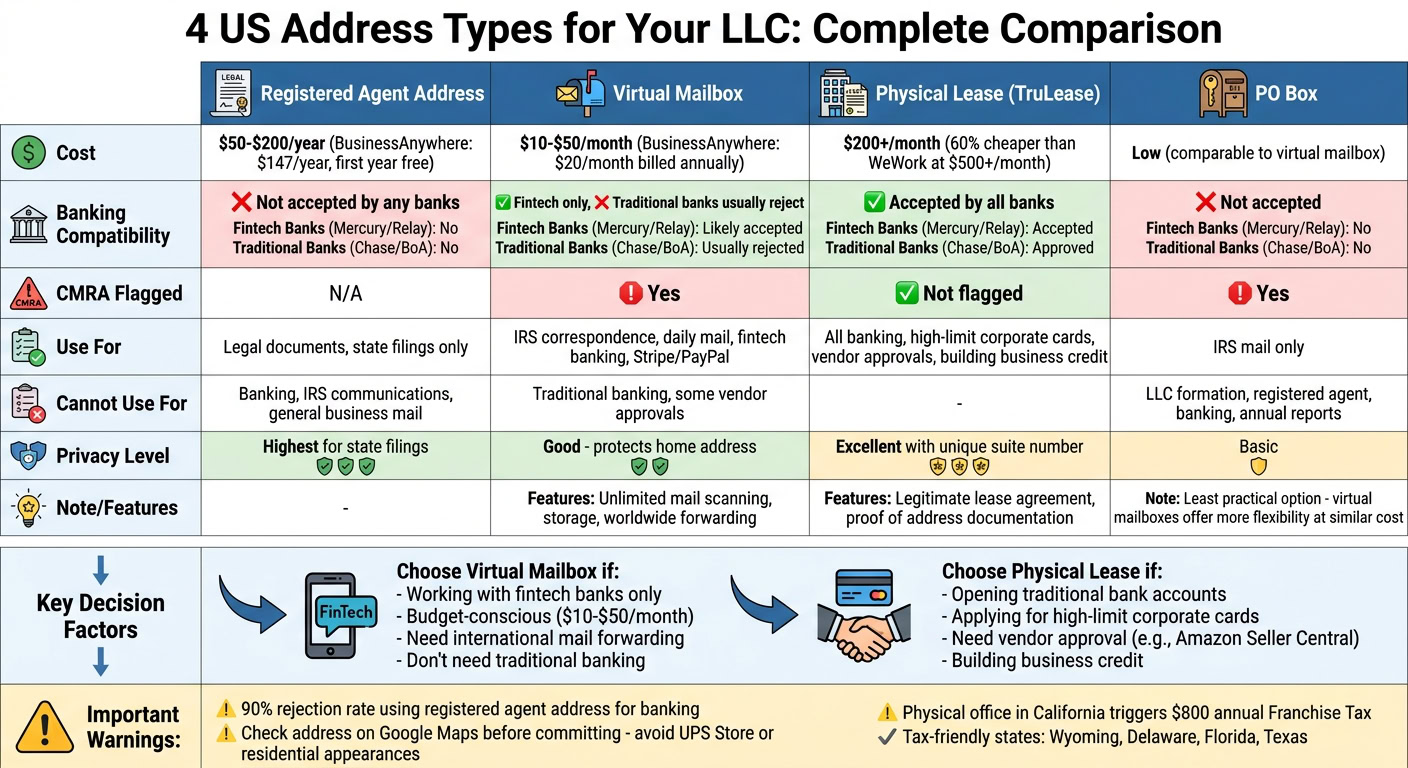
When setting up an LLC, choosing the right address is more than just an administrative step – it affects compliance, banking, and how clients perceive your business. Let’s break down the four main address types and what they mean for your LLC.
Registered Agent Address
Every LLC is legally required to have a registered agent with a physical address in the state where the business is formed. This address is crucial for receiving official government correspondence and legal notices. As Shelly Garcia from Nolo explains:
"Registered agents typically limit their responsibilities to accepting official documents, not packages and other types of correspondence." [1]
It’s important to note that this address is strictly for official documents. You can’t use your registered agent’s address for banking, IRS communications (outside of state filings), or general business mail[2]. Professional registered agent services typically cost between $100 and $300 annually[3]. For example, BusinessAnywhere offers this service starting at $147 per year, with the first year free if you form your LLC through their platform.
Virtual Mailbox Services
A virtual mailbox provides a physical street address where your mail is received, scanned, and uploaded to an online platform for easy access[1]. By completing USPS Form 1583, your virtual mailbox provider is registered as a Commercial Mail Receiving Agency (CMRA) in the USPS database[2]. However, keep in mind that traditional banks like Chase or Bank of America often reject applications using CMRA addresses, though fintech banks such as Mercury and Relay are generally more flexible[2].
Virtual mailbox services typically range from $10 to $50 per month. BusinessAnywhere, for instance, offers plans starting at $20 per month (billed annually), which include unlimited mail scanning, storage, and worldwide forwarding.
Coworking Space Addresses
Coworking spaces go a step further than virtual mailboxes by offering a physical address alongside access to amenities like meeting rooms and reception services. This option is great for maintaining a professional image, especially for LLC founders who occasionally visit the U.S.[1]. However, some states may not accept a coworking space address as your "principal place of business" because these addresses are often considered temporary[1].
Memberships for coworking spaces can cost $500 or more per month[2]. While they provide a professional setting, their suitability as a permanent business address depends on state and institutional requirements.
PO Box Addresses
PO boxes are the least practical option for LLC owners. Most states won’t allow a PO box to be used for LLC formation since it doesn’t qualify as a physical street address[1]. Additionally, you can’t use a PO box as your registered agent address[2]. Considering the limited functionality of a PO box, virtual mailboxes offer much more flexibility at a comparable cost.
What You Can and Cannot Use Each Address Type For
Understanding how to use different types of U.S. addresses can save you from compliance headaches and unnecessary rejections. Each address type has specific purposes, and knowing these distinctions is crucial.
State Filings and IRS Correspondence
Registered agent addresses are essential for forming an LLC, but their use is strictly limited to that purpose. You can’t use a registered agent address for tasks like opening a bank account, general business mail, or most IRS correspondence. As the Foreign Founder Team puts it:
"The bank knows that address belongs to a law firm, not your shoe store." [4]
Virtual mailboxes are more versatile. They can handle regular IRS communications and be listed on your EIN application. If your business address changes, file Form 8822-B with the IRS, which typically processes the update within 4–6 weeks [2]. However, PO boxes have limitations – they can receive IRS mail but cannot be used for LLC formation or annual reports, as states require a physical street address.
Physical addresses – whether through a dedicated lease (often called a "TruLease") or coworking spaces – are generally accepted for state filings and IRS correspondence. Dedicated leases are a safe bet, but coworking spaces may also work depending on your state’s requirements, so it’s wise to double-check.
Bank Accounts and Payment Processors
Choosing the right address is critical when dealing with banks and payment processors. Traditional banks like Chase and Bank of America use the USPS database to verify addresses. If your address is flagged as a CMRA (common for virtual mailboxes), it could lead to rejection or additional manual reviews [2]. As the Foreign Founder Team explains:
"Banks like Chase and Bank of America subscribe to the USPS database. When you enter your address, their system runs an instant check… If it’s a CMRA? YES. Flag for Manual Review or Auto-Reject." [2]
Fintech banks such as Mercury and Relay are typically more lenient and often accept virtual mailbox addresses. Similarly, Stripe and PayPal usually allow virtual mailbox addresses for account setup but may require an ITIN or SSN to lift certain account limits.
For traditional banks or high-limit corporate credit cards, a physical lease address is your best bet. These addresses come with a unique suite number and a legitimate commercial lease agreement, avoiding the CMRA flag. They usually cost around $200 or more per month [2]. Before signing up for any address service, check the address on Google Maps Street View. If it looks like a UPS Store or a residential property, banks are likely to reject it [2].
| Address Type | Fintech Banks (Mercury/Relay) | Traditional Banks (Chase/BoA) | Stripe/PayPal |
|---|---|---|---|
| Registered Agent | No | No | No |
| Virtual Mailbox | Likely | Usually Rejected | Yes |
| Physical Lease | Accepted | Approved | Yes |
| PO Box | No | No | No |
Client Communications and Vendor Approvals
For client and vendor communications, virtual mailboxes work well. They provide a professional U.S. street address that looks polished on business cards and websites.
Coworking spaces offer additional perks, such as reception services and meeting rooms, which can enhance credibility if you need to host clients or vendors. However, platforms like Amazon Seller Central may require proof of address through a utility bill, which only a physical lease or office can provide [2].
Registered agent addresses, while necessary for legal filings, aren’t suitable for client communications. Since these addresses are public and tied to legal services, they can harm your business’s professional image.
Be cautious about establishing a physical office in high-tax states like California, as this could trigger extra tax obligations, such as the $800 annual Franchise Tax. To minimize costs, consider using physical addresses in tax-friendly states like Wyoming, Delaware, Florida, or Texas [2].
With these practical guidelines in mind, you’ll be better equipped to choose the right address for your non-resident LLC.
How to Choose the Right US Address for Your LLC
Picking the best US address for your LLC boils down to three key factors: state requirements, banking compatibility, and privacy concerns. Many non-residents go for the cheapest option, only to face issues like banking rejections later.
State Requirements for Registered Agents and Physical Addresses
Every state requires a registered agent with a physical address in the state where your LLC is formed. This address is used to receive legal documents and is listed in public records.
In addition to a registered agent, you’ll need a principal business address. While most states accept virtual mailboxes for this, some impose stricter rules. States like Wyoming, Delaware, and New Mexico are more lenient, allowing virtual addresses for your principal office while also offering strong privacy protections. For example, Wyoming charges just $60 annually, and Delaware’s franchise tax is $400 [4].
If you’re considering a physical office or coworking space, be cautious. Setting up a physical presence in California, for instance, could trigger the state’s $800 annual Franchise Tax – even if your business operates remotely [2]. To avoid such costs, consider tax-friendly states like Wyoming, Delaware, Florida, or Texas if a physical address is necessary.
Privacy Levels for Each Address Type
Since your LLC’s address becomes public, privacy is a major concern. Shelly Garcia from Nolo explains:
"If you use your home address to register your LLC or other business entity type, your home address becomes public record. Your personal address will be accessible to junk mailers, irate customers, and pushy vendors." [1]
Here’s how different address options stack up in terms of privacy:
- Registered agent addresses: These provide the highest level of privacy for state filings, keeping your personal address off public records. However, they can’t be used for banking or general business mail.
- Virtual mailboxes: These give you a professional US street address, protecting your home address. But banks often identify these as CMRAs (Commercial Mail Receiving Agencies) through USPS databases, which can result in account rejections [2].
- Physical lease addresses: Sometimes called "TruLeases", these offer excellent privacy and are widely accepted by banks. They come with a unique suite number and a legitimate lease agreement, making them ideal for traditional banking and building business credit as a non-resident. Avoid residential addresses due to privacy and compliance risks [2].
Cost Comparison and International Mail Forwarding
Budget plays a big role in choosing the right address. Here’s a breakdown of common costs:
- Registered agent services: These cost between $100 and $300 annually. If you form your LLC through BusinessAnywhere, the first year of registered agent service is free, with subsequent years costing $147.
- Virtual mailboxes: Prices range from $10 to $50 per month for basic plans. BusinessAnywhere offers a plan starting at $20 per month (billed annually), which includes unlimited mail scanning, storage, and worldwide forwarding – great for non-residents needing mail sent to Europe, Asia, or Latin America. Tier 2 virtual mailboxes work well for fintech banks like Mercury or Relay [2].
- Physical lease services: These start at $200 per month and are essential if you plan to open accounts with banks like Chase, Bank of America, or need high-limit corporate credit cards. They’re about 60% cheaper than renting a WeWork office, which typically costs $500+ per month [2].
Before committing to any service, check the address on Google Maps Street View. If it looks like a UPS Store or a residential home, traditional banks are likely to reject it [2]. Also, ensure the provider offers international mail forwarding – some charge extra or have restrictions on shipping to certain countries.
When upgrading from a virtual mailbox to a physical lease, remember to file Form 8822-B with the IRS to update your business address. This process takes 4–6 weeks, so plan accordingly [2].
This breakdown should help you weigh your options and choose the right US address for your LLC. Up next, we’ll walk through the step-by-step process of setting up your chosen address.
sbb-itb-ba0a4be
Setting Up Your US Address: Step-by-Step Process
Getting the right US business address is crucial for legal compliance, banking, and building credibility. Here’s a simple guide to help you set it up.
Step 1: Choose the Right Address Type
First, decide on the type of address that fits your banking needs:
- Tier 2 Virtual Mailbox: Ideal for fintech banks like Mercury or Relay. Costs range from $10–$50 per month.
- Tier 3 Physical Lease: Necessary if you’re working with traditional banks or need high-limit corporate cards. Prices start around $200 per month.
Before committing, check the address on Google Maps to ensure it doesn’t appear as a UPS Store or a residential property. Avoid using your registered agent’s address for banking purposes.
If you’re using BusinessAnywhere to form your LLC, you’ll get the first year of registered agent service free, with subsequent years costing $147. Their virtual mailbox service starts at $20 per month (billed annually) and includes unlimited mail scanning, storage, and worldwide forwarding.
Once you’ve chosen the right address type, don’t forget to set up mail forwarding.
Step 2: Set Up Mail Forwarding
After selecting your address service, complete USPS Form 1583 to authorize mail receipt. You’ll need to have this form notarized, which can be done remotely through services like Notarize.com or Safedocs. If you’re a non-resident, you can complete the notarization via webcam using a valid passport – no need to visit a U.S. embassy. Make sure you have two forms of ID, such as your passport and a secondary document like a driver’s license or utility bill.
Once your account is active, you’ll gain access to a digital dashboard where you can manage your mail. Options include shredding, scanning, or forwarding mail to your international address. BusinessAnywhere’s virtual mailbox service even offers worldwide forwarding at no extra cost, which is especially convenient for those in Europe, Asia, or Latin America.
With mail forwarding set up, you’re ready to update your records.
Step 3: Update Your Address with Agencies and Institutions
Now that your US address is active, it’s time to update it with the necessary government agencies and financial institutions:
- IRS: File IRS Form 8822-B to notify federal authorities of your new business address. Processing typically takes 4–6 weeks.
- State Agencies: Update your address with your state’s Secretary of State.
- Banks and Payment Processors: Inform them of your new address to avoid issues with verification.
Keep documentation of your new address ready. Banks often require proof, such as a lease agreement or utility bill, which is typically provided by Tier 3 physical lease services.
Conclusion: Getting the Right US Address for Your Non-Resident LLC
Choosing the right US address for your non-resident LLC is about more than just receiving mail – it’s key to staying compliant, accessing banking services, and protecting your privacy. Each address type has its own role: a registered agent address handles legal and state documents, a virtual mailbox is ideal for daily correspondence and fintech banking, a coworking space provides a professional image, and a PO box offers basic mail services. Knowing how these options differ helps you make the right choice for your business needs.
One major pitfall non-residents face is using their registered agent address for banking applications. This often leads to rejection, with a 90% failure rate in many cases [2]. For fintech banks like Mercury or Relay, a virtual mailbox – costing between $20 and $50 per month – usually works well. But if you’re aiming for traditional banks like Chase or Bank of America, or applying for high-limit corporate credit cards, you’ll likely need a physical lease (Tier 3). These leases start at about $200 per month and help you avoid the CMRA flag that disqualifies most virtual addresses [2].
"A US business address is more than just a place to receive mail. For the IRS, it’s where your business physically exists. For banks, it’s a fraud prevention tool. For customers, it’s a trust signal." – Foreign Founder Team [2]
Before finalizing your address, double-check that it meets the requirements outlined earlier. Also, be mindful of state-specific tax rules – for example, a California address could result in an $800 annual Franchise Tax, even if your business operates remotely [2]. Your checklist should include matching the address tier to your banking needs, completing USPS Form 1583, and updating the IRS when necessary.
Start with the most basic tier that fits your needs, and upgrade only as your business grows. The best US business address for your LLC depends on your banking goals, privacy considerations, and budget.
FAQs
Which US address should I use on my EIN application?
For your EIN application, make sure to use a U.S. address that’s appropriate for IRS correspondence and legal matters. A registered agent address can work for state filings and certain IRS communications, but it might not satisfy all banking requirements. Another option is a virtual mailbox service, which is often accepted by both the IRS and banks. It’s always a good idea to double-check with the IRS or your bank to confirm the address type meets their criteria.
How can I avoid banks rejecting my address as a CMRA?
To ensure your bank doesn’t classify your address as a CMRA (Commercial Mail Receiving Agency), opt for a virtual mailbox service that offers a verified physical street address. Steer clear of P.O. boxes or addresses flagged as CMRA. Also, avoid using a registered agent address specifically for banking purposes. Whenever possible, consider coworking spaces or actual physical locations, as banks are more likely to accept them.
What proof of address will banks or Amazon require?
Banks and Amazon typically ask for proof of address to verify a valid, physical location. Accepted documents often include utility bills, bank or credit card statements, rental or mortgage agreements, or official letters from government agencies. Keep in mind that virtual mailboxes or PO boxes usually don’t meet the criteria unless linked to a physical address. Make sure the documents are recent, official, and clearly show your name alongside your physical address.