

Want to expand your business across state lines? Foreign qualification is the legal process that lets your LLC or corporation operate in states beyond where it was formed. Online filing has made this process faster and simpler, cutting down processing times and reducing paperwork headaches.
Here’s what you need to know:
- What It Is: Foreign qualification registers your business in a new state to comply with local laws.
- When You Need It: If you hit $100,000 in sales, 200 transactions, hire employees, or open offices in another state.
- Online Filing Benefits: Faster processing (1-3 days with expedited options), electronic payments, and instant access to documents.
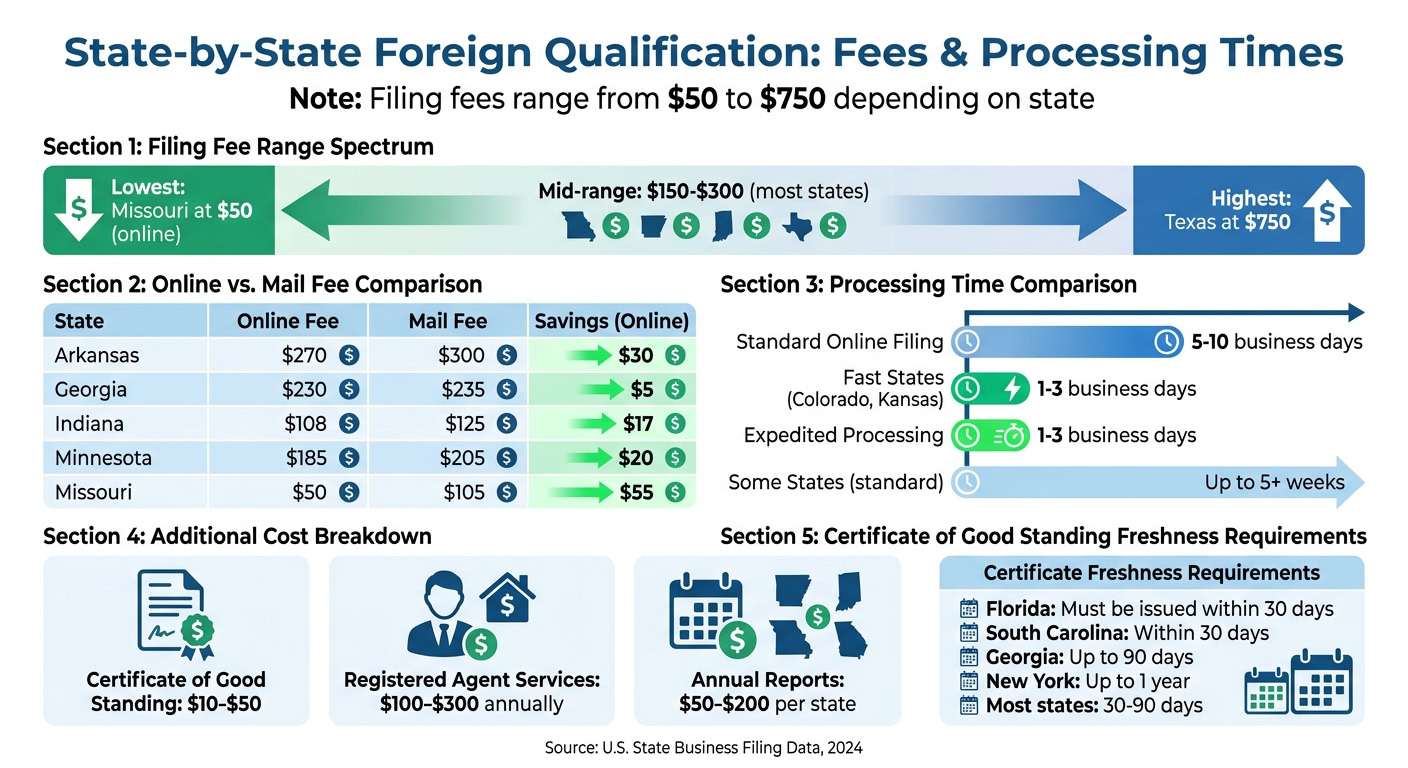
- Costs: Filing fees range from $50 to $750, with additional costs for Certificates of Good Standing ($10-$50) and registered agent services ($100-$300 annually).
- Key Documents: Certificate of Good Standing, Articles of Organization/Incorporation, and a registered agent consent form.
Why it matters: Failing to register can lead to penalties, back taxes, and the inability to enforce contracts in that state. Online filing helps avoid these risks while saving time and effort.
Let’s break down the steps, requirements, and common mistakes to ensure a smooth filing process.
How Online Filing Works for Foreign Qualification
What Foreign Qualification Means and When You Need It
Foreign qualification allows your LLC or corporation to legally conduct business in states outside of its formation state.
You’ll typically need to file for foreign qualification once your business crosses certain thresholds. One of the most common triggers is economic nexus, which generally applies when you reach $100,000 in sales or 200 transactions within a 12-month period. Other situations that might require registration include hiring employees in another state, opening a physical office or warehouse, or maintaining a consistent presence through contracts or ongoing projects.
Steps to Complete Your Online Filing
Filing online for foreign qualification is a fairly straightforward process. Start by creating an account on the business filing portal of the state where you want to register. Then, complete the foreign qualification application. You’ll need to provide key details such as your business name, formation date, registered agent information, and principal office address.
Once the form is filled out, upload any required documents, particularly your Certificate of Good Standing. Most states accept PDFs, but some may have specific file size or naming requirements. After reviewing your application, submit your payment electronically – most states accept credit cards or electronic checks. Filing fees range widely, from $50 to $750, though many states fall between $150 and $300.
After submission, make sure to save your confirmation number so you can track the status of your application. Standard processing times are usually 5–10 business days, but many states offer expedited options that can reduce the turnaround to 1–3 days. Keep in mind that while the general process is similar across states, some states may have additional steps or requirements.
How Filing Requirements Differ by State
Filing requirements can vary greatly depending on the state. For example, states like Delaware and Wyoming offer fully digital systems, allowing you to handle everything online, including receiving your Certificate of Authority electronically. On the other hand, some states use a hybrid system where you can file online but may need to mail in certain original documents. A few states still rely heavily on mail-based processes.
Processing times also differ significantly. While some states can process standard filings in as little as 5 business days, others may take over 5 weeks. Filing fees range widely too – Texas charges $750, while states like Colorado and Florida typically charge around $70. Additionally, annual report fees vary by state, generally falling between $100 and $300, with due dates that depend on the specific state.
Before starting the filing process, it’s crucial to check the specific requirements of the state where you plan to register, especially if your business operates in multiple locations. Each state has its own set of rules, and understanding them in advance can save you time and effort.
Documents You Need for Online Foreign Qualification
Certificate of Good Standing from Your Home State
Once you start your online filing, you’ll need to gather specific documents to meet state requirements. One key document is the Certificate of Good Standing, which proves your business is legally registered and compliant in its home state. This certificate shows you’ve filed all necessary reports and paid any required fees. Most states require it as part of the foreign qualification process.
You can request this certificate from your home state’s Secretary of State office, either online or by mail. The cost usually falls between $10 and $50 per certificate. Processing times can vary – some states will issue the certificate within 1–2 business days, while others may take up to two weeks.
Important to Know: Some states have specific rules about how recent your Certificate of Good Standing must be. For example, Florida requires it to be issued within 30 days of filing, while New York allows certificates up to one year old. Most states fall somewhere in the middle, typically requiring certificates issued within 30, 60, or 90 days. Be sure to check the specific "freshness" requirements of the state where you’re filing to avoid issues with an expired document.
While many states accept electronic PDFs for online filing, a few may still require a hard copy with a raised seal. Double-check the format requirements of your target state before ordering your certificate to avoid unnecessary delays.
Additional Required Documents
You’ll also need to include documents like your Articles of Organization (for LLCs) or Articles of Incorporation (for corporations), along with a signed registered agent consent form. Every state requires your registered agent to have a physical street address in that state – P.O. Boxes are not accepted. If you’re using a professional registered agent service, they typically provide the consent form during the onboarding process.
Some states may have extra requirements. For instance, New York, Arizona, and Nebraska mandate that you publish a notice of your application or authority in a local newspaper after filing. Additionally, you might need to confirm your business name is available in the new state, which often involves checking if the business name is taken. In New York, this search costs $5 per name.
Make sure all your documents meet the digital format and upload standards required by the state where you’re filing.
File Format and Upload Requirements
Most state portals prefer PDF files, though some may also accept TIFF or JPEG formats. PDFs are the safest choice since they’re widely accepted.
Pay attention to file size limits, which are typically between 5MB and 10MB, and follow naming conventions. Use only alphanumeric characters in file names, avoiding special symbols like #, %, or &.
To avoid delays, request your Certificate of Good Standing only when you’re ready to file. This ensures the document stays valid within the required freshness window (usually 30–90 days) by the time you upload it. Proper timing will save you from having to reorder an expired certificate and slow down your application process.
Processing Times, Fees, and Advantages of Online Filing
How Long Processing Takes: Online vs. Mail
Filing online is much quicker than mailing your documents. For most states, standard processing for foreign qualification takes about 5–10 business days, but states like Colorado and Kansas handle online submissions in just 1–3 business days.
Many states also offer expedited processing options. These can shorten the timeline to 1–3 business days, with some states even providing same-day processing.
"Foreign qualification typically takes 5-10 business days (or 1-3 days with expedited processing) and costs $50-$500 depending on the state."
– Jack Nicholaisen, Founder, Businessinitiative.org
If you’re filing online, submitting your paperwork early in the week – on a Monday or Tuesday – can help ensure faster processing.
While speed is a big advantage, filing fees and associated costs are also important to consider.
Filing Fees and Additional Costs
The cost of filing varies significantly depending on the state, with fees ranging from $50 to $750. For example, Missouri has one of the lowest online filing fees at $50, while Texas tops the chart with a fee of $750.
Several states offer lower fees for online submissions compared to mail. Here are a few examples:
- Arkansas: $270 online vs. $300 by mail
- Georgia: $230 online vs. $235 by mail
- Indiana: $108 online vs. $125 by mail
- Minnesota: $185 online vs. $205 by mail
- Missouri: $50 online vs. $105 by mail
In addition to the filing fee, you’ll need to budget for a Certificate of Good Standing, which usually costs between $10 and $50, and registered agent fees, which can range from $100 to $300 per year. Keep in mind that some states add extra fees for online processing. For instance, Washington charges a convenience fee on top of its $180 base filing fee.
While costs are a factor, the ease and efficiency of online filing often outweigh the additional expenses.
Why Online Filing Is Better
Filing online offers several perks that make it a better option than mailing your documents. One major benefit is the ability to track your application in real time through state portals, so there’s no need to make phone calls or wait for updates via mail.
Online submissions also eliminate the hassle of printing and mailing, which can introduce delays or the risk of lost documents. Plus, expedited processing options – like same-day or 1–3 day turnaround – are often exclusive to online filings.
Another advantage? You’ll get immediate confirmation when your documents are received and accepted. If there’s an issue or missing information, you’ll know right away and can fix it without waiting weeks to hear back. Additionally, receiving your Certificate of Authority digitally means you can start operating your business sooner, skipping the delays of physical mail.
sbb-itb-ba0a4be
Common Filing Mistakes and How to Avoid Them
Business Name Errors and Missing Signatures
Even the smallest mistake in your business name can derail your filing process. Your business name must match exactly what’s registered in your home state. Something as minor as using "LLC" instead of "L.L.C." or leaving out punctuation could result in your application being rejected. To avoid this, check the target state’s Secretary of State database to confirm the name’s availability. If the name you want is already taken, consider filing under a fictitious name (DBA).
Signature mistakes are another frequent issue. Many states require the signer to include their title – such as "CEO" or "Manager" – on the form. Some states, like South Carolina, even require an attorney’s signature for corporation filings. Using the wrong signer or omitting the required title can cause your application to be rejected. Double-check these details before submitting your paperwork.
Incomplete Applications and Expired Documents
Using outdated forms is a common misstep that can lead to immediate rejection. Always download the most current forms directly from the state’s official website instead of relying on older versions saved on your computer.
Another issue to watch for is expired documents. For example, a Certificate of Good Standing must meet specific state timelines. South Carolina requires it to be issued within 30 days, while Georgia allows up to 90 days. Make sure you obtain this certificate within the required timeframe to avoid it expiring during the filing process.
State-Specific Compliance Mistakes
Each state has its own filing rules, and overlooking these can be costly. In Georgia, for instance, you must file your annual registration between January 1 and April 1 to maintain your Certificate of Authority. Some states also require original "wet" signatures or notarization, even when online filing is an option.
Another common oversight is failing to request a certified copy of your filed documents at the time of submission. Without this request (and the associated fee), many states will only provide a basic filing receipt. If you need a certified copy later, it can take weeks to process. Save time by requesting it upfront when you submit your application.
What to Do After Your Application Is Approved
Getting Your Certificate of Authority
Once your application is approved, your first step should be to download and secure your Certificate of Authority. This document is your legal proof that your business is authorized to operate in the state where you’ve registered. You’ll need it for critical tasks like opening bank accounts, applying for local business licenses, or signing contracts with vendors and clients.
Make sure to save both a digital and a physical copy. Storing a digital version in a cloud-based system is a smart move – it ensures you’ll always have access when you need it, whether for audits, loan applications, or legal matters. This complements the convenience of the online filing process mentioned earlier.
Staying Compliant After Approval
Getting approval is just the first step. To keep your business in good standing, you’ll need to maintain a state-registered agent and meet all periodic filing requirements. If your registered agent resigns or becomes unavailable, it’s crucial to appoint a replacement promptly. Failing to do so could result in losing your authority to operate.
Most states require businesses to file updates periodically to ensure their information is current. Missing these deadlines can lead to big problems. As The Discern Team explains:
Missing any compliance deadline triggers escalating consequences: loss of good standing, contract enforcement difficulties, administrative revocation, and potential personal liability exposure for company obligations.
To avoid these issues, consider creating a compliance calendar. Track deadlines, fees, and required documents, and set reminders 30 to 60 days in advance of each deadline. Also, remember to file updates for any changes to your business, such as new officers, address changes, or a name change, in both your home state and every state where you’re registered. Staying on top of these details is essential to sidestep legal and financial troubles.
How BusinessAnywhere Helps with Compliance
BusinessAnywhere simplifies the entire compliance process by centralizing registration tasks and offering automated reminders for deadlines. Instead of managing multiple state portals and juggling various requirements, you can handle everything from one dashboard. This includes annual filings, franchise taxes and deadlines, and receiving important legal documents.
The platform also provides registered agent services, starting at $147 per year, to help ensure your business stays in good standing. By handling these responsibilities for you, BusinessAnywhere not only speeds up the initial filing process but also ensures ongoing compliance as your company grows and operates in multiple states.
Conclusion
Filing for foreign qualification online makes what was once a complicated process much more manageable. With processing times typically reduced to 5–10 business days – compared to weeks with paper filings – it’s a much quicker option. Plus, the digital format minimizes errors like missing signatures, expired documents, or inconsistent business name entries, which are common pitfalls of traditional methods.
Compliance isn’t just about convenience – it’s about protecting your business. Operating in a state without proper registration can lead to fines, penalties, back taxes, and even issues with contract enforcement. Managing compliance across multiple states can be overwhelming, with each state having its own portals, deadlines, and rules. Filing fees alone range from $50 to $750 per state, and you’ll also need to budget for registered agent services (typically $100–$300 annually per state) and annual reports (around $50–$200 per state). Missing deadlines can quickly result in escalating penalties, underscoring the need for a streamlined solution.
That’s where BusinessAnywhere comes in. This platform simplifies the entire process by consolidating everything – initial filings, compliance tracking, and more – into one easy-to-use dashboard. With registered agent services starting at $147 per year and automated reminders for deadlines, you can stay focused on growing your business while ensuring compliance. By keeping your business in good standing across all states, the platform helps you avoid disruptions and positions you for opportunities like expansion or fundraising.
Whether you’re filing in one state or several, precision and consistency are key. Using a dedicated platform removes the guesswork, ensuring your business stays properly registered and compliant. This efficient approach not only saves time but also supports your business’s long-term growth and stability.
FAQs
How do I know if I’m “doing business” in a state?
If your company meets specific criteria in a state – like having a physical location, hiring employees, or frequently engaging in transactions – you’re likely considered to be "doing business" there. In such cases, you may need to register for foreign qualification to ensure compliance with that state’s regulations.
What if my LLC or corporation name is already taken in the new state?
If the name of your LLC or corporation is already in use in the new state, you’ll need to choose a different name that follows the state’s naming regulations. Make sure the new name meets all local guidelines and isn’t already registered before moving forward with your paperwork.
Can I file online without hiring a registered agent?
Yes, many states let you file for foreign qualification online without needing to hire a registered agent. This process is usually handled through official state websites. Just make sure to review your specific state’s requirements carefully to ensure you follow their procedures correctly.