
If I were starting a new LLC today, I’d narrow it down fast: QuickBooks Online for accountant-ready reports, Xero for shared cloud access, FreshBooks for service invoicing, Wave for a $0 start, and Zoho Books for automation at a low monthly cost.
Most new LLCs need just 4 things from day one:
- Profit and loss
- Balance sheet
- Cash flow reports
- Clean records for tax filing and an accountant
That’s the core decision. If I only need simple books, I’d look at Wave. If I send client invoices all day, I’d lean toward FreshBooks. If I want stronger reports as the business grows, I’d put QuickBooks Online near the top. If my team works in different places, Xero makes more sense. And if I want built-in automation and a free tier for revenue under $50,000, I’d check Zoho Books.
Before I sign up, I’d keep these ready:
- EIN confirmation letter
- LLC formation documents
- Operating Agreement
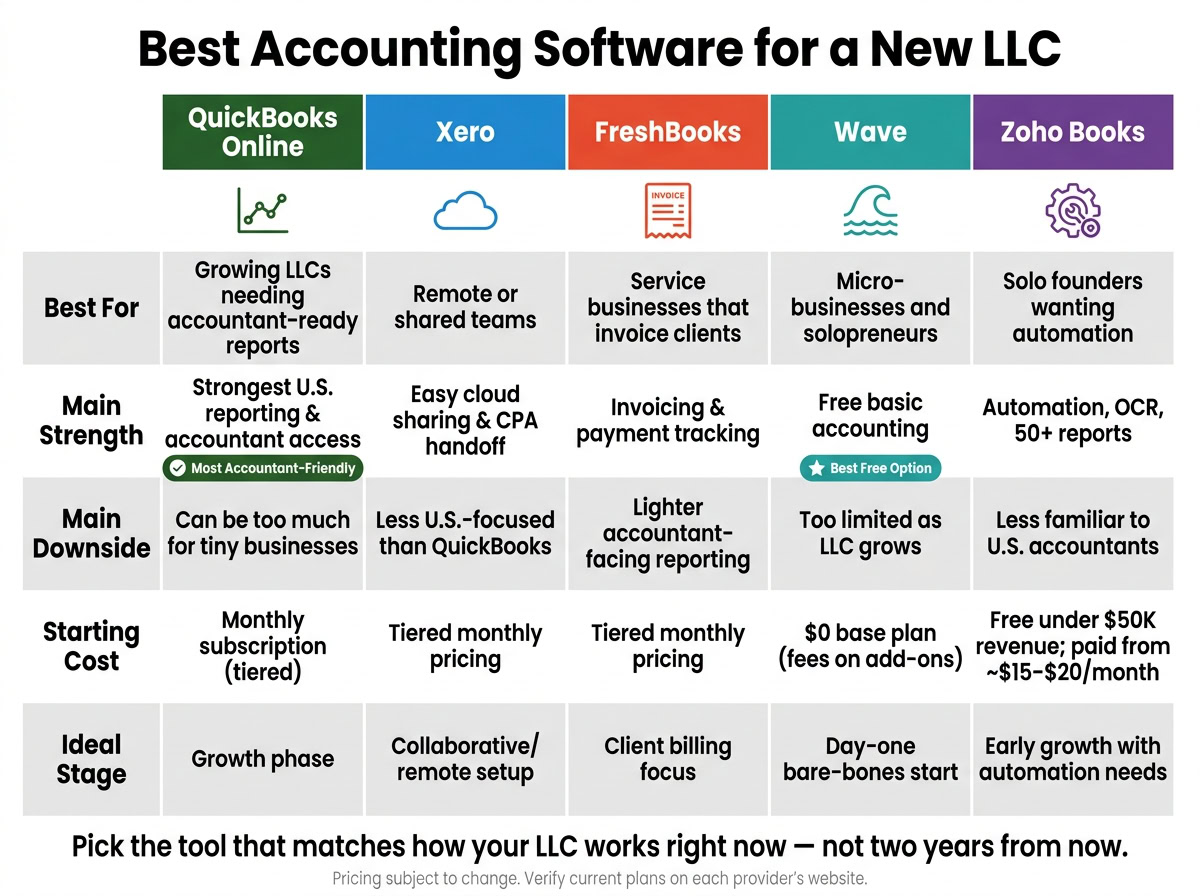
Best Accounting Software for a New LLC: Side-by-Side Comparison
Quick Comparison
| Software | Best for | Main strength | Main downside | Starting cost |
|---|---|---|---|---|
| QuickBooks Online | Growing LLCs | Strong reports and accountant access | Can feel like too much for a tiny business | Monthly subscription |
| Xero | Remote or shared teams | Cloud access and easy handoff | Less U.S.-focused than QuickBooks | Tiered monthly pricing |
| FreshBooks | Service businesses | Invoicing and payment tracking | Lighter reporting for accountants | Tiered monthly pricing |
| Wave | Micro-businesses | Free basic accounting | Limited as the LLC gets bigger | $0 base plan, plus fees/add-ons |
| Zoho Books | Solo founders and small teams | Automation, OCR, and 50+ reports | Less common with some U.S. accountants | Free under $50,000 revenue; paid plans from about $15–$20/month |
My short take: pick the tool that matches how your LLC works right now, not what you might need two years from now. That usually means Wave for bare-bones books, FreshBooks for client billing, QuickBooks for deeper reporting, Xero for team access, or Zoho Books for low-cost automation.
1. QuickBooks Online
QuickBooks Online is a top pick for U.S. LLCs. It tends to make the most sense when a new LLC wants books that are ready for an accountant from the start. For many owners, that’s the big draw: reporting.
Bookkeeping and Reports
QuickBooks is well known for accountant-friendly reporting. That matters a lot if a CPA or bookkeeper is going to check the books on a regular basis. Instead of cleaning things up later, you can start with a setup that makes handoff easier.
Invoicing and Expense Tracking
QuickBooks covers invoicing and expense tracking, but it can feel a bit heavy if that’s all you need. If your main goal is simple billing, this may be more than your LLC needs right now. In that case, the next option deserves a closer look.
Payroll and Tax Support
QuickBooks also includes sales tax tracking and tax-ready records, which can help with compliance. That’s a big plus if you want fewer headaches when tax time rolls around.
Pricing and Growth Fit
QuickBooks uses monthly subscription pricing, so look at the full cost before you commit. That includes the base plan, payment-processing fees, and any paid add-ons.
It’s usually a better fit once your LLC needs:
- cleaner reporting
- contractor tracking
- accountant access
If you want a lighter cloud setup that feels easier to share with others, compare it with Xero next.
2. Xero
If QuickBooks feels like more than your LLC needs, Xero is the lighter cloud pick. It works well for owners who want shared access to the books, clean exports, and an easy handoff to a CPA.
Bookkeeping and Reports
Xero keeps your books tidy and gives you reports that accountants can use as-is. That means less cleanup, less reformatting, and fewer back-and-forth emails when it’s time to share records.
Invoicing and Expenses
Xero handles invoicing and expense capture in one workspace. So your billing and cost tracking stay connected, instead of bouncing between separate tools.
Payroll and Tax Support
If you don’t have employees, payroll can wait. The main job early on is keeping tax-ready records organized from day one.
Pricing and Growth Fit
Start with the plan that fits how your LLC works right now, then move up later if transaction volume grows. Xero uses tiered pricing, so you don’t have to pay for features you won’t use yet.
If invoicing matters more to you than deeper bookkeeping tools, FreshBooks is the next one to look at.
3. FreshBooks
FreshBooks is a good match for service-based LLCs that want strong invoicing and simple bookkeeping. If you’re running a new client-based LLC and sending bills straight to clients, FreshBooks usually makes more sense than a broader accounting platform.
Bookkeeping and Reports
FreshBooks includes basic reports, but it doesn’t go as deep as QuickBooks for accountant-facing reporting. In plain English: your accountant may need to clean things up before working with the numbers. If your accountant likes QuickBooks, check compatibility before you commit.
Invoicing and Expenses
This is where FreshBooks stands out. It puts invoicing front and center, and expense tracking stays simple for client-based businesses. That setup works well if your day-to-day looks like sending invoices, tracking payments, and keeping tabs on business spending.
Payroll and Tax Support
FreshBooks can track sales tax, which covers a common need for small businesses. But if your LLC has more involved tax workflows, it may feel a bit limited.
Pricing and Growth Fit
FreshBooks uses tiered pricing, so the starting price isn’t always the full story. Add-ons and payment-processing fees can push up the monthly cost, and that becomes more noticeable as you add features or bring on a small team.
If keeping costs low matters more than having deeper invoicing tools, Wave is the leaner pick.
sbb-itb-ba0a4be
4. Wave
Wave makes the most sense at the very start of an LLC’s life: simple books, low transaction volume, and not much overhead. The main trade-off is pretty clear: does Wave’s low price make up for its lighter feature set?
Bookkeeping and Reports
Wave handles basic bookkeeping, standard reports, and data exports. That’s enough for a very small LLC that just needs to keep the books in order. But once the business starts growing, the reporting can feel a bit thin.
Invoicing and Expenses
For simple invoicing and expense tracking, Wave does the job well. It works best when your setup is straightforward and you don’t need a lot of extra layers.
Payroll and Tax Support
Wave includes sales tax support and offers payroll as a paid add-on. That setup can work fine early on. Still, it’s a weaker fit for LLCs with more involved payroll or tax needs.
Pricing and Growth Fit
Wave is best known for its free accounting plan. But “free” doesn’t always mean $0 in practice. Payment processing fees and paid add-ons can push the total cost up, so new LLC owners should look at the full picture before leaning too hard on the free label.
For a very small LLC, Wave can work well right now. Once the business gets larger or more involved, it may start to feel cramped. If your LLC needs deeper features and more integrations, Zoho Books is the next option to compare.
5. Zoho Books
If your LLC has outgrown bare-bones bookkeeping, Zoho Books gives you more automation without turning things into a headache. It’s a good fit for solo founders and small remote teams that want more than the basics but don’t need a heavy system.
Bookkeeping and Reports
Zoho Books uses double-entry accounting, along with automated bank feeds and transaction matching. It also includes 50+ reports, such as profit and loss, balance sheet, and cash flow.
Invoicing and Expenses
On the invoicing side, Zoho Books supports custom invoices, recurring billing, payment reminders, and a client portal. It also includes AutoScan, which uses OCR to pull receipt data in automatically. That can save a lot of manual entry.
Payroll and Tax Support
Zoho Books connects directly with Zoho Payroll in most states. It also integrates with Avalara for sales tax rates and compliance.
Pricing and Growth Fit
Zoho Books has a free tier for businesses under $50,000 in annual revenue. Paid plans start at about $15 to $20 per month for Standard and about $40 to $50 per month for Professional.
That pricing makes it a strong option for very small LLCs that plan to grow into more users, invoices, or integrations. Next, weigh these strengths against the trade-offs.
Pros and Cons of Each Option
Here’s a quick side-by-side look to help narrow the field:
| Software | Best For a New LLC | Key Trade-Off | Best For |
|---|---|---|---|
| QuickBooks Online | Most familiar to U.S. accountants; strongest reporting | More than a tiny business needs at the start | LLCs planning for growth with accountant-ready records |
| Xero | Clean cloud access; easy accountant handoff | Lighter feature set than QuickBooks for U.S.-specific needs | Remote teams needing shared book access |
| FreshBooks | Best for invoicing-heavy service work | Limited for complex accounting needs | Solo service providers and consultants |
| Wave | Free for basic accounting and invoicing | Too limited for growing LLCs with more reporting or tax needs | Solopreneurs and micro-businesses with minimal transactions |
| Zoho Books | Strong automation and reporting at a low starting cost | Smaller U.S. accountant familiarity than QuickBooks | Solo founders and small remote teams planning to scale |
A simple pattern shows up fast. Some tools are better if you want deeper reports. Others make more sense if sending invoices is your main job. And some are all about keeping costs down while you get the business off the ground.
If your LLC is small today but you expect it to grow, QuickBooks Online or Zoho Books may fit better. If you mostly bill clients for service work, FreshBooks can feel like the simpler path. If you just need the basics and want to spend $0 to start, Wave is hard to ignore. And if your team works from different places, Xero stands out for shared access.
The next section cuts through the trade-offs and points to the best overall pick for most new LLCs.
Final Verdict: Which Software Should Your LLC Use?
The best choice comes down to where your LLC is right now and the one thing you care about most: reporting, invoicing, price, or automation.
Here’s the simple version:
- QuickBooks Online is the go-to option for accountant-ready reporting.
- Xero works well for teams that need shared access.
- FreshBooks is a strong pick for service businesses that bill clients.
- Wave makes sense for the smallest LLCs with basic needs.
- Zoho Books fits founders who want automation from day one.
Pick the software that lines up with your current reporting, invoicing, and tax needs. The right tool should keep your books clean, fit your budget, and support your tax workflow as your LLC grows.
FAQs
How do I choose the right accounting software for my LLC?
Start by looking at what you need help with: bookkeeping, invoicing, tax prep, and how many people will use the software. A good place to start is with software that connects to your business bank account and credit card, so it can pull in transactions on its own and cut down on manual entry mistakes.
It also helps to think a step ahead. Wave is often a good fit for freelancers and solopreneurs. FreshBooks tends to work well for service-based businesses. QuickBooks is usually better for businesses with more moving parts.
Make sure the software supports your business entity and your location. And bring in a tax pro or accountant early – it can save you a lot of cleanup later.
When should I switch from basic accounting software to a more advanced option?
Consider switching when your business has outgrown your current software.
A few signs tend to show up fast. Maybe you need tools your current setup just doesn’t offer, like complex inventory management, automated payroll, or advanced reporting. At that point, patching things together can start to feel like duct-taping a leaky pipe.
It can also be time to move to a new platform when the business itself gets more complicated. That might mean managing multiple projects, adding more people to your team, or needing a closer look at your numbers through deeper financial analysis.
And here’s one more signal that matters: if your accountant wants you on a more advanced platform for reporting and tax prep, pay attention. That’s often a pretty strong clue that your current software is starting to hold you back.
What features matter most for a brand-new LLC?
For a brand-new LLC, focus on features that take the busywork out of day-to-day bookkeeping and make tax season less of a scramble.
Key features include:
- Direct bank account syncing
- Automatic expense categorization
- Invoicing and expense tracking
- Tax-ready reports, such as profit and loss statements
- Integrations with payroll or tax-filing tools