


Short answer: I’d form an LLC for liability separation, not for tax savings. For most landlords, a single-member LLC does not change federal income tax treatment. The rent, expenses, and depreciation still usually go on Schedule E of Form 1040. But an LLC can help keep a tenant claim from reaching my personal cash and other assets if insurance falls short.
Here’s the article in plain English:
- Liability: Owning in my own name means a lawsuit is against me. Owning through an LLC can help keep the claim tied to the property and LLC assets.
- Taxes: A single-member LLC is usually ignored for federal tax purposes. A multi-member LLC usually files Form 1065 and sends K-1s to owners.
- Insurance still comes first: Many landlord policies carry about $100,000 to $300,000 per occurrence. Umbrella coverage can add $1 million to $10 million, often for about $200 to $500 per $1 million of coverage each year.
- Cost: Forming an LLC often costs about $50 to $500 up front. Annual state fees and filings can run about $200 to $1,000+ per year, and some states cost much more.
- Paperwork: To keep the shield in place, I’d need a separate bank account, clean records, contracts in the LLC’s name, and current state filings.
- Setup choice: One LLC for all rentals is simpler, but one claim can put all properties in that LLC at risk. One LLC per property gives more separation, but costs more.
My bottom line: if I have meaningful assets, higher-risk rentals, or partners, an LLC often makes sense. If I own one small rental, have strong insurance, and live in a high-fee state, the extra cost may not be worth it.
Quick Comparison
| Option | Liability | Federal tax filing | Work involved | Best fit |
|---|---|---|---|---|
| Personal ownership | No legal split between me and the property | Schedule E on Form 1040 | Low | Very small, low-risk setup |
| Single-member LLC | Claim is usually limited to LLC assets if I keep things separate | Usually still Schedule E on Form 1040 | Medium | Solo owner who wants liability separation |
| Multi-member LLC | Same LLC shield for property claims | Form 1065, K-1s, then Schedule E | High | Rentals with 2+ owners |
If I were making this call, I’d compare state fees, insurance limits, property risk, and how much personal wealth I’m trying to shield before filing anything.
The core problem: personal exposure, tax confusion, and added costs
Many landlords think about LLCs for two big reasons: liability protection and tax savings. In most cases, only one of those stands up. The real question isn’t whether an LLC sounds safer. It’s whether that legal separation is worth the extra cost and paperwork.
Owning rentals personally can put more than the property at risk
When you own a rental in your own name, you and the property are the same legal owner. If something goes wrong, you are the defendant, not a separate business entity.
Say a tenant falls on a poorly lit staircase or in another unsafe common area. If the claim goes beyond your insurance limits, the unpaid amount may reach your savings, brokerage accounts, and, depending on your state’s laws, equity in other real estate you own. In plain English: the lawsuit is against you, not only the property.
That’s the core risk of personal ownership once you’ve built assets you want to shield.
Most landlords overestimate the tax benefits of an LLC
This is where a lot of people get tripped up. A single-member rental LLC is usually disregarded for federal tax purposes, which means the income and expenses still go on Schedule E. So an LLC is mostly a liability tool, not a federal tax shortcut.
Put another way: forming an LLC usually doesn’t create a new tax win by itself. The better question is what, if anything, it changes on your return.
State fees and annual filings can offset the protection benefit
An LLC can help, but it isn’t free. Formation often runs $50 to $500, and annual filings plus related fees can add $200 to $1,000+ per year. In some states, the bill can be much higher.
That tradeoff matters most when you compare LLC ownership with owning rentals personally. Side by side, the difference gets a lot easier to see.
Personal ownership vs. LLC ownership: liability, taxes, and paperwork
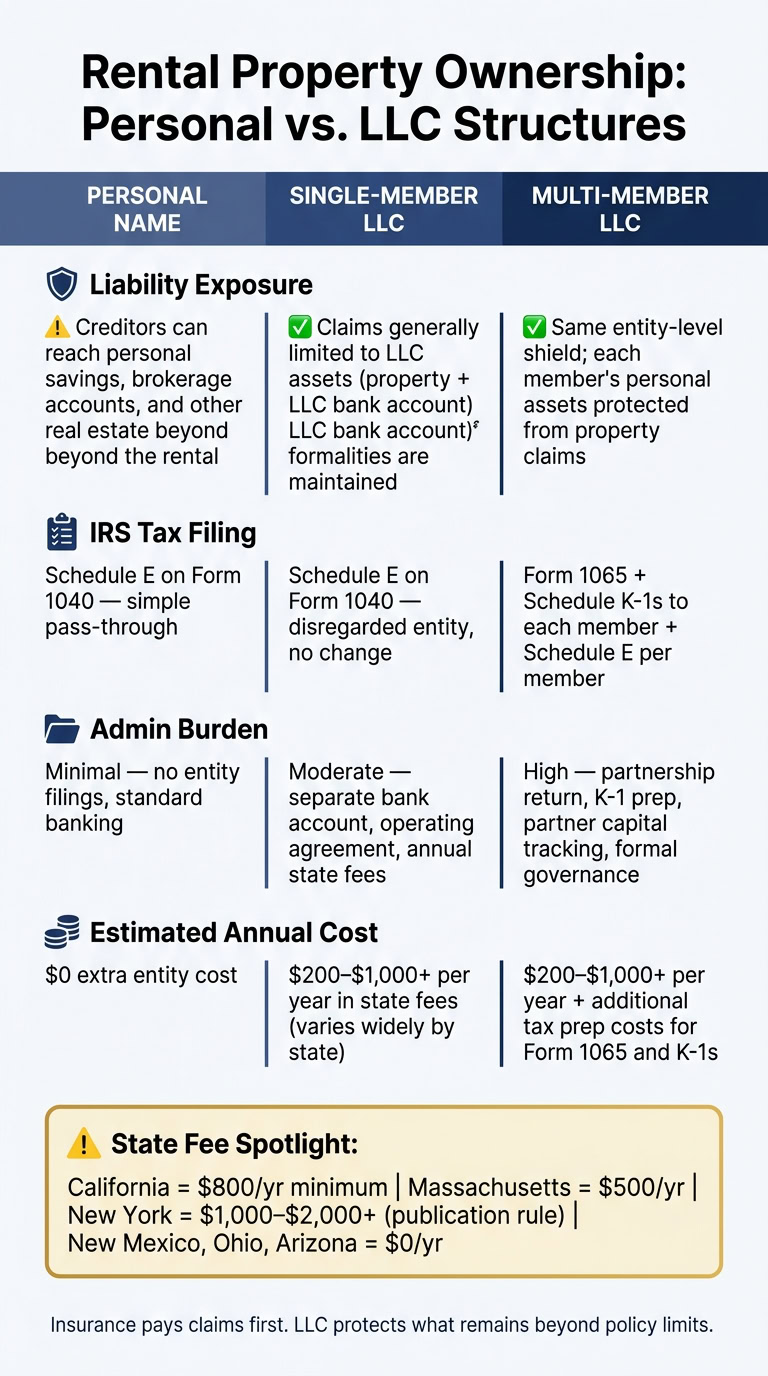
LLC vs Personal Ownership for Rental Property: Liability, Taxes & Costs
Owning a rental in your own name and owning it through an LLC can lead to the same property income. But the legal risk, tax filing, and admin work can look very different.
The clearest way to see the tradeoff is to look at liability, tax treatment, and paperwork side by side.
How liability exposure shifts when property is held inside an LLC
If a rental is in your personal name, a tenant lawsuit is aimed at you. In legal terms, the property and your personal assets are not separated. So if a court judgment goes past your insurance limits, creditors may go after your personal assets too.
A properly maintained single-member LLC changes that setup. Claims tied to the rental can usually reach only what the LLC owns, such as the property itself and any cash in the LLC bank account. Your personal savings are generally protected, but only if you keep the LLC’s money and records separate from your own.
A multi-member LLC works in much the same way. Property-related claims are usually limited to the LLC’s assets, and each member’s personal assets are protected from that lawsuit. That said, a member can still be sued personally for their own direct negligence.
What changes on your tax return and what does not
For federal tax purposes, a single-member LLC usually changes almost nothing. The IRS treats a single-member rental LLC as a disregarded entity. That means the rental’s income and expenses still go on Schedule E of Form 1040.
So what stays the same?
- The depreciation rules
- Passive loss treatment
- Rental deductions
- No separate federal return for the LLC
A multi-member LLC is different. By default, the IRS treats it as a partnership. That means the LLC files Form 1065 each year and sends a Schedule K-1 to each member. Then each member reports their share on Schedule E of their own return.
So the income still passes through to the owners, with no federal tax at the entity level. But the filing work is heavier. There’s just more moving parts.
The side-by-side view makes the differences easier to spot.
| Personal Name | Single-Member LLC | Multi-Member LLC | |
|---|---|---|---|
| Liability exposure | Creditors can reach personal assets beyond the rental | Claims generally limited to LLC assets if formalities are maintained | Same entity-level shield; each member’s personal assets are protected |
| IRS filing | Schedule E, Form 1040 | Schedule E, Form 1040 (disregarded entity) | Form 1065 + Schedule K-1s + Schedule E per member |
| Admin burden | Minimal – no entity filings, simpler banking | Moderate – separate bank account, operating agreement, state annual fees | High – partnership return, K-1 prep, partner capital tracking, formal governance |
Those differences only matter if the LLC is set up and maintained the right way, and backed by insurance.
sbb-itb-ba0a4be
How LLC liability protection works in practice
The paperwork matters a lot less than what happens when someone actually files a claim.
Insurance is still your first line of defense
Insurance is what pays legal defense costs and claims. The LLC’s job is different: it can limit which assets a judgment can reach. A standard landlord policy will often include $100,000–$300,000 in liability coverage per occurrence, and an umbrella policy can add another $1 million–$10 million for about $200–$500 per year for each $1 million of coverage.
Here’s the plain-English version. If a tenant slips on an icy walkway, suffers a major injury, and sues, the insurance policy usually steps in first to cover the defense and any payout up to the policy limit. If the damages go past that limit, the rental property itself and cash held by the LLC may still be at risk. But your personal assets are generally more protected.
One easy mistake: forgetting to update the policy after moving ownership into an LLC. A personal umbrella policy does not automatically cover the LLC.
Insurance pays first. The LLC helps only if you’ve kept the business separate from your personal life.
Protection can fail if you skip LLC formalities
Setting up an LLC is the easy part. Running it like a real business is what keeps the shield in place.
Courts can ignore an LLC if the owner treats it like a personal checking account. That’s called veil piercing. It can happen when rent gets deposited into a personal bank account, personal bills get paid from the LLC, or LLC money gets used for household expenses. Once that line gets blurry, personal assets can become part of the target in a lawsuit.
The good news is that the fix is pretty simple:
- Use a bank account just for the LLC
- Pay property expenses from that account
- Sign leases and contracts in the LLC’s name
- Keep a written operating agreement
- Stay current on annual state reports and any franchise tax filings
A court cares less about whether you filed the LLC paperwork and more about how you actually run the company.
How you divide properties inside that setup matters too.
One LLC for all properties vs. one LLC per property
If one LLC owns several rentals, it’s easier to manage. Fewer filings. Fewer accounts. Less admin work. The downside is pretty clear: if one property triggers a big claim, the other properties in that same LLC can also be on the table.
Using a separate LLC for each property gives you more separation. If one rental gets hit with a lawsuit, the equity in the others is less likely to be pulled in. Of course, that extra separation comes with more paperwork, more annual fees, more bank accounts, and more bookkeeping every year.
There’s also a middle-ground option in some states: the series LLC. It can create separate liability buckets under one umbrella LLC, which may cut down on duplicate filings compared with setting up a brand-new LLC for every property. The catch is that series LLC rules depend on the state, and not every state treats them the same way.
| Structure | Liability Isolation | Compliance Burden | Best Fit |
|---|---|---|---|
| One LLC for all properties | Low – a claim against one property can reach all others in the LLC | Low | Small portfolios or lower-value properties |
| Separate LLC per property | High – liability stays confined to the specific property involved | High – separate filings, bank accounts, and fees for each | High-value assets or portfolios with meaningful equity |
| Series LLC | High – each series can be isolated under one umbrella entity | Moderate – simplified filing, but strict internal accounting required | Investors in series-friendly states with multiple properties |
Once the liability setup makes sense, the next step is figuring out whether the tax treatment and admin cost are worth it.
Tax treatment, compliance costs, and how to decide
Once liability is clear, the next step is pretty simple: does the tax treatment and the added cost make this setup worth it?
Default tax treatment for rental LLCs
For most rental owners, an LLC does not change the basic federal tax result. In most cases, taxation stays pass-through, so the main issue is whether the extra filing work and yearly fees are worth the liability protection.
A single-member LLC is treated as transparent for federal tax purposes. That means rental income and expenses still flow through to Schedule E, just as they would if you owned the property in your own name. And for most landlords, rental income is still passive income, so it is not subject to self-employment tax.
So the tax side usually stays about the same. The decision often comes down to fees, filings, and risk.
When forming an LLC makes sense and when it may not
That leads to the practical test: is the liability shield worth the annual cost?
An LLC tends to make more sense when there is more on the line. If you have a lot of personal assets – home equity, savings, or investments – you have more to lose if a tenant wins a judgment that goes past your insurance limits. The same goes for owners with partners, since a multi-member LLC gives you a cleaner ownership setup. And some properties simply carry more lawsuit risk, such as short-term rentals with a steady flow of guests or units with features like pools.
On the other hand, for a small portfolio, state fees and filing costs can eat up a lot of the upside. Some states make an LLC much more expensive to keep. California charges an $800 minimum franchise tax per LLC each year. Massachusetts charges $500 annually. New York also has a publication rule that can cost $1,000–$2,000+ in some counties. By contrast, states like New Mexico, Ohio, and Arizona charge $0 in annual LLC fees.
That difference matters. If your risk is fairly low and your insurance is strong, those yearly costs may not pencil out. If your risk is higher, the LLC starts to look a lot easier to justify.
Conclusion: base the decision on risk, cost, and insurance limits
The key point is simple: form an LLC for liability protection, not for tax savings.
An LLC can put a legal wall between your rental activity and your personal finances. But that wall only works if you treat the LLC like a real business entity. You need to keep money separate, stay up to date on state filings, and handle the paperwork the right way. Insurance still pays claims first. The LLC matters if a judgment goes beyond your coverage and a claimant tries to reach more than the policy pays.
Before you form one, run the numbers for your state. Look at filing fees, franchise taxes, registered agent costs, and any extra tax prep. Then compare that total with your actual liability risk. If the cost is modest and the exposure is high, an LLC can be a sensible tool.
FAQs
Do I need an LLC if I already have landlord and umbrella insurance?
Not necessarily. Umbrella insurance can help cover large claims and settlements, but it doesn’t offer the same legal shield as an LLC.
Here’s the simple way to think about it: insurance helps pay for losses. An LLC sets up a legal barrier that can help protect your personal assets if someone sues over your rental business.
For small landlords with limited assets, insurance may be enough. But as your portfolio grows – or your personal wealth starts to add up – many owners decide to use both.
Should I put each rental property in its own LLC?
It depends on your portfolio size, risk tolerance, and budget.
A separate LLC for each property gives you the strongest liability separation. If one property gets hit with a lawsuit, the equity in your other properties usually isn’t on the line.
The downside is cost and paperwork. You’ll need separate filings, annual reports, and bank accounts for each LLC. That can add up fast.
For larger portfolios, a Series LLC may be a better fit where it’s allowed. If you own just one or two properties with low equity, the extra cost and admin work may not be worth it.
Will transferring a rental property into an LLC trigger taxes or affect my mortgage?
Usually, not for federal taxes if it’s a single-member LLC. The IRS generally treats a single-member LLC as a disregarded entity, so your tax basis, depreciation, and rental income reporting will typically stay the same. That said, state recording fees or deed transfer taxes may still apply.
It can affect your mortgage. An ownership change may trigger a due-on-sale clause, so contact your lender first and get written permission to avoid possible loan acceleration.