


Setting up an LLC for real estate comes with legal and tax advantages – but only if you stay compliant with filing rules. Here’s what landlords need to know:
- BOI Reporting (Beneficial Ownership Information): As of March 26, 2025, domestic LLCs in the U.S. are exempt from federal BOI reporting. However, foreign-formed LLCs operating in the U.S. must file BOI reports, with strict deadlines and penalties for non-compliance.
- State Filings: Every LLC must file initial formation documents (like Articles of Organization) and appoint a registered agent. Many states also require annual or biennial reports to update LLC details and maintain good standing.
- Annual Reports: Filing these reports ensures your LLC remains legally recognized. Deadlines and fees vary by state, with penalties for missed filings that can lead to administrative dissolution.
- Tax Filings: Most LLCs use pass-through taxation, reporting rental income on personal tax returns. Multi-member LLCs file Form 1065, while single-member LLCs use Schedule E. S-Corp election can reduce tax bills for high-income landlords.
Missing deadlines can result in fines, loss of liability protection, and even LLC dissolution. Tools like BusinessAnywhere help landlords track deadlines, file reports, and stay compliant across multiple states.
BOI Reporting Requirements for LLCs
Which LLCs Must File BOI Reports
Starting March 26, 2025, domestic LLCs are not required to file federal BOI reports. However, foreign LLCs registered to do business in the U.S. must comply. This applies to entities formed under the laws of another country but registered in any U.S. state or tribal jurisdiction. For instance, if your LLC was established in the Cayman Islands but operates rental properties in Nevada, you are obligated to submit a BOI report.
Here’s a quick breakdown of the filing requirements and deadlines:
| Entity Type | BOI Reporting Requirement | Filing Deadline |
|---|---|---|
| Domestic LLC (formed in the U.S.) | Exempt | N/A |
| Foreign LLC (registered in the U.S. before March 26, 2025) | Required | April 25, 2025 |
| Foreign LLC (registered in the U.S. on/after March 26, 2025) | Required | 30 days after receiving notice |
Once you’ve determined if your LLC needs to file, the next step is to gather all the necessary details.
Required Information for BOI Reports
Only foreign-formed LLCs need to prepare and submit this information. These entities must provide details about the company, its beneficial owners, and, if applicable, the company applicant. A beneficial owner is defined as anyone who owns or controls at least 25% of the LLC or has significant influence over its operations.
The report should include the following:
- Your LLC’s legal name, any DBAs or trade names, U.S. business address, jurisdiction of formation, and Taxpayer Identification Number.
- For each beneficial owner, list their full legal name, date of birth, residential address, and a government-issued ID number, along with an image of the document.
If your foreign LLC was formed on or after January 1, 2024, you’ll also need to provide information about the company applicant – the person who filed or directed the filing of the formation documents.
BOI Filing Deadlines and How to Submit
Foreign LLCs registered before March 26, 2025, must file their initial BOI report by April 25, 2025. For those registered on or after March 26, 2025, the report is due within 30 days of receiving the registration notice. Be sure to update any changes or correct errors within 30 days.
You can file your report using FinCEN’s free electronic system. The process is simple, but accuracy is key – ensure all names, dates, and ID numbers match the information on your government-issued documents to avoid delays. If you’d like assistance, BusinessAnywhere offers a BOIR filing service for $37.
Be cautious of scams. FinCEN does not charge a fee for electronic filing. If you receive any correspondence requesting payment, verify its authenticity before taking action.
State Formation and Compliance Filings
How to File Articles of Organization
The first step in setting up your landlord LLC is filing your Articles of Organization or, in some states like Delaware, a Certificate of Formation. This document officially establishes your LLC and is a requirement in every state. While the name of the form may vary, the process is largely similar across the country.
Start by selecting a unique business name that complies with your state’s naming rules. Most states require the name to include "LLC" or "Limited Liability Company" at the end. To ensure your chosen name is available, use your state’s business entity search tool before filing.
Many states now streamline the process by offering online submissions. For instance, California requires you to file Articles of Organization online, with a $70 filing fee. The form will ask for details like your LLC’s legal name, principal business address, registered agent information, management structure, and the organizer’s signature.
| Filing Step | What You Need | Typical Cost |
|---|---|---|
| Name Search | Check state database for availability | $0 (free online search) |
| File Articles | Submit formation document to Secretary of State | $70 in California (varies by state) |
| Get Certificate of Status | Proof of good standing for bank accounts | $50–$175 in Delaware |
Once you’ve filed your Articles, it’s smart to order a Certificate of Status (sometimes called a Good Standing certificate). Many banks require this document to open a business account. In Delaware, for example, the short-form certificate costs $50, while the long-form version is $175. After filing, your next step is appointing a registered agent to handle legal and state correspondence.
Appointing a Registered Agent
Every LLC is required to have a registered agent who will act as the official point of contact for legal documents and state-related filings. The agent must have a physical address (not a P.O. box) in the state where the LLC is formed. Their role includes receiving service of process, legal notices, and state reminders during regular business hours.
"Delaware law requires that every business entity have and maintain a Registered Agent in the State of Delaware who may be either an individual resident or business entity that is authorized to do business in the State of Delaware."
– Delaware Division of Corporations
You can serve as your own registered agent if you live in the state where your LLC is based, but the LLC itself cannot act as its own agent. For landlords managing properties across multiple states or those who want to keep their home address private, considering the pros and cons of hiring a professional registered agent is a great option. These services ensure you don’t miss important legal documents and help protect your privacy.
Some platforms, like BusinessAnywhere, offer a free registered agent service for the first year when you form your LLC through them. After that, the service costs $147 per year. Once you’ve set up your registered agent, the next step is to obtain your EIN and fulfill any additional state-specific requirements.
Getting an EIN and Meeting State-Specific Requirements
After forming your LLC and appointing a registered agent, you’ll need to get an Employer Identification Number (EIN) from the IRS. This nine-digit number acts as your business’s identifier, similar to a Social Security number for individuals. It’s required for opening a business bank account, hiring employees, and filing federal taxes. The application is free and can be completed online through the IRS website or by mail.
Some states also have additional requirements for LLCs. For example, New York mandates that newly formed LLCs publish a notice of their formation in local newspapers. In Delaware, while you won’t need to file annual reports, there’s a $300 annual LLC tax. California requires LLCs to file a Statement of Information every two years, which costs $20.
Once you’ve secured your EIN, prioritize opening a dedicated business bank account. Keeping your business finances separate from personal funds is critical for maintaining your LLC’s liability protection. By completing these steps, you’ll establish a solid foundation for your LLC and ensure it stays compliant with state and federal regulations.
Annual Reports and Ongoing State Compliance
Filing your reports on time isn’t just a box to check – it’s a key step in safeguarding your personal assets. Once your LLC is up and running, you’ll need to stay on top of annual (or in some cases, biennial) reports to keep your business in good standing. These reports ensure the state has updated information about your LLC, such as its name, address, registered agent, and management contacts.
Most states make the process simple with online filing portals. Depending on the state, this filing might be called something else – like "Statement of Information" in California or "Annual Registration" in Georgia. For landlords, staying compliant is particularly important, as it helps maintain the legal protections that separate your personal assets from your business liabilities.
What to Include in Annual Reports
The information required in annual reports is fairly basic. You’ll typically need to include:
- Your LLC’s legal name
- The principal office address
- The registered agent’s name and address
- Names and business addresses of managers or members
It’s a straightforward process that doesn’t require extensive detail.
Annual Report Fees and Deadlines by State
The fees and deadlines for filing vary depending on where your LLC is registered. Some states use a fixed calendar date for all businesses, while others tie the deadline to your LLC’s formation anniversary. Here’s a quick look at some common states for landlords:
| State | Report Frequency | Deadline | Filing Fee |
|---|---|---|---|
| California | Every 2 years | Last day of anniversary month | $20 |
| Florida | Annual | May 1 | $138.75 |
| Texas | Annual | May 15 | $0 |
| New York | Every 2 years | Last day of anniversary month | $9 |
| Delaware | Annual (Tax only) | June 1 | $300 |
| Illinois | Annual | Anniversary month | $75 |
| Nevada | Annual | Anniversary month | $350 ($150 + $200 license) |
Keep in mind, not every state requires annual reports. For example, Alabama, Arizona, Arkansas, Delaware, Missouri, New Mexico, Ohio, and South Carolina generally don’t mandate regular filings with the Secretary of State. However, other tax obligations might still apply. Pennsylvania is another outlier, requiring a decennial report only once every 10 years in years ending in "1" (e.g., 2031, 2041).
If you own property in multiple states, you’ll likely need to file reports in both your home state and any state where your LLC is registered as a foreign entity. Many states no longer send reminders, so it’s smart to track these deadlines yourself.
Penalties for Missing Filing Deadlines
Filing on time isn’t just about avoiding late fees – missing deadlines can have serious consequences.
Failing to file an annual report results in an immediate loss of good standing status, which can block your ability to secure loans, sign contracts, or expand your business. Continued non-compliance may even lead to administrative dissolution, effectively stripping your LLC of its legal status and putting your personal assets at risk.
"A dissolved LLC can only conduct business necessary to wind up its affairs. If it conducts its regular business, the people conducting that business could lose their limited liability protection." – Laura Schmidt, Senior Customer Service Representative, Wolters Kluwer
The financial penalties can be steep. In Florida, for instance, a $400 late fee is added to the $138.75 filing fee, and if you miss the filing by the third Friday in September, the state will dissolve your LLC on the fourth Friday of that month. Delaware imposes a $200 penalty plus 1.5% monthly interest on the $300 annual tax.
Beyond fines, operating a dissolved LLC can leave you vulnerable. Some states won’t allow you to pursue legal action – like suing a tenant for unpaid rent – if your LLC isn’t in good standing. To reinstate a dissolved LLC, you’ll need to file a reinstatement application and pay all outstanding fees, penalties, and taxes.
Avoid these headaches by setting up digital reminders tied to your LLC’s formation anniversary. File as soon as the reporting window opens, even if nothing has changed, to ensure your LLC stays active and protected.
sbb-itb-ba0a4be
Tax Filings and Reporting for Landlord LLCs
Accurate tax reporting is a critical part of maintaining the benefits of your LLC. For most rental property LLCs, pass-through taxation is the norm. This means the LLC itself doesn’t pay federal income taxes. Instead, the income flows directly to the owner’s personal tax return.
How you report this income depends on your LLC’s structure. If you have a single-member LLC, it’s treated as a "disregarded entity." This means you’ll report all rental income and expenses on Schedule E (Supplemental Income and Loss), which is attached to your personal Form 1040. On the other hand, multi-member LLCs are treated as partnerships. They must file Form 1065, an informational return, and each member will receive a Schedule K-1. The K-1 details each member’s share of the income, deductions, and credits, which they then report on their personal tax returns.
For both types of LLCs, rental income, expenses, and deductions are passed through to the owners based on their ownership percentages. Even if your single-member LLC is disregarded for federal tax purposes, you may still need a separate EIN if you have employees or if your state requires one. Additionally, some states impose their own LLC-specific filing requirements or annual fees.
How Pass-Through Taxation Works for LLCs
For landlords with higher incomes and active involvement in property management, there’s another option to consider: S-Corp election, which could lead to substantial tax savings.
S-Corp Election for Potential Tax Savings
If your rental business generates significant income and you’re actively managing it, electing S-Corp status can help reduce your tax bill. The key advantage is splitting your income into two parts: a reasonable salary (subject to the 15.3% self-employment tax) and distributions, which are not.
Here’s an example: Let’s say your LLC earns $200,000 annually. Without an S-Corp election, you’d owe about $27,637 in self-employment taxes on the entire amount. By electing S-Corp status and paying yourself a reasonable salary of $80,000, with the remaining $120,000 taken as distributions, your self-employment tax liability could drop to roughly $12,240. That’s over $15,000 in savings.
"By drawing a reasonable salary and classifying excess profits as distributions, you can significantly reduce exposure to self-employment taxes." – Lauterbach, Borschow & Co.
However, the IRS requires that the salary you pay yourself be reasonable. It should reflect what someone in a similar role would earn. Setting your salary too low could trigger audits and penalties. Many tax professionals suggest S-Corp status becomes worthwhile once your net income exceeds $40,000 to $50,000 annually, as the tax savings should outweigh the extra costs of running payroll.
To elect S-Corp status, you’ll need to file Form 2553 with the IRS. This must be done no later than 2 months and 15 days after the start of the tax year when you want the election to take effect. Services like BusinessAnywhere can handle this filing for you for a fee of $97, saving you the hassle. Keep in mind, though, that S-Corps come with certain restrictions: they’re limited to 100 shareholders, who must be U.S. citizens or residents, and distributions must align with ownership percentages.
How to Simplify Compliance with BusinessAnywhere

Keeping up with filing deadlines can feel like a full-time job, but BusinessAnywhere makes compliance management much easier. By offering a centralized platform, it helps landlords stay on top of deadlines and paperwork without the usual stress.
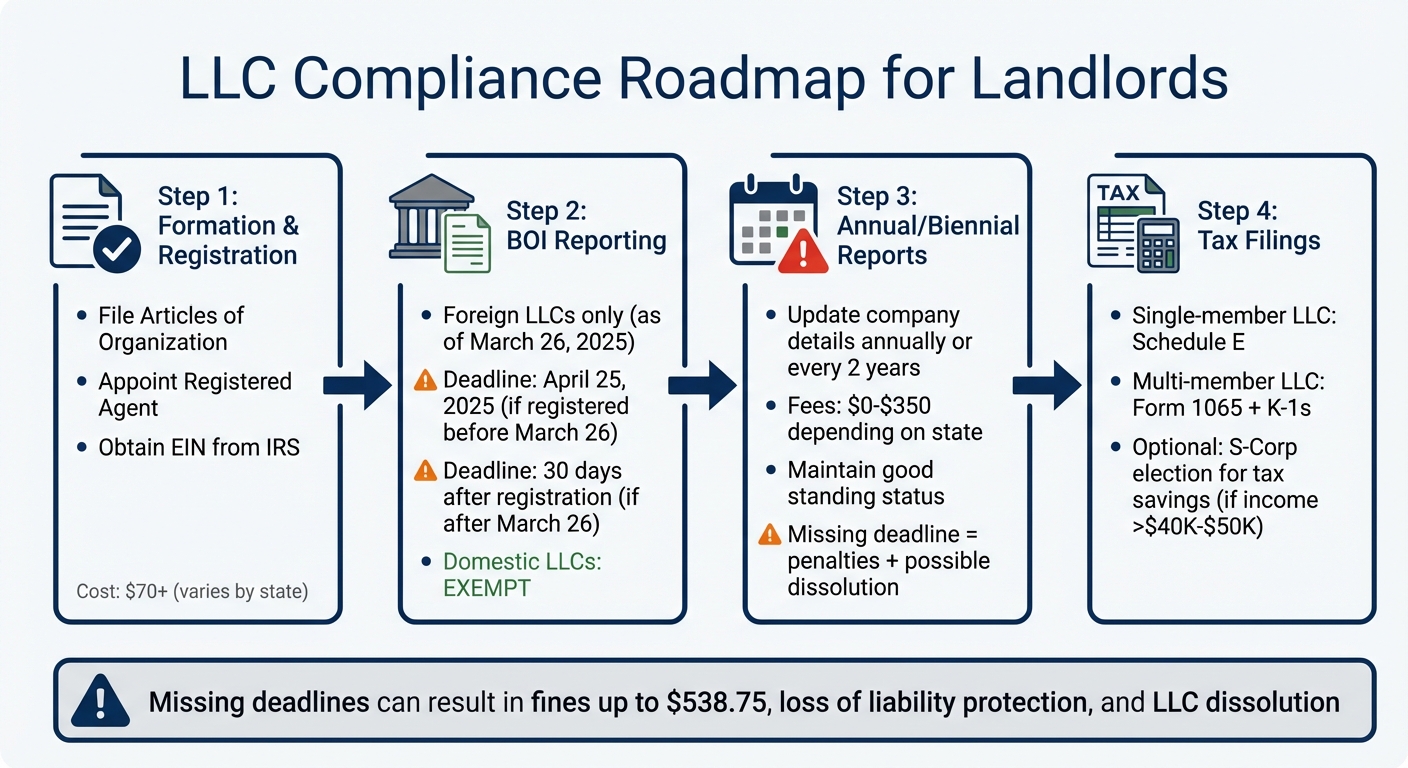
4-Step Compliance Process for Landlords
BusinessAnywhere’s dashboard simplifies compliance into four clear steps:
- Step 1: Register your LLC by filing Articles of Organization and obtaining an EIN.
- Step 2: File your BOI (Beneficial Ownership Information) report if your LLC is foreign-formed and registered in the U.S. (domestic LLCs are exempt until March 26, 2025).
- Step 3: Submit annual or biennial reports with updated company details as required by your state.
- Step 4: Manage tax filings using forms like Schedule E or Form 1065.
This streamlined process helps landlords meet every deadline without missing a step. BusinessAnywhere’s platform also tracks state-specific deadlines, sends reminders before due dates, and keeps all filed documents in one secure location. For example, missing Florida’s annual report deadline could result in a hefty $538.75 late fee, but the platform’s alerts help avoid such costly mistakes.
BusinessAnywhere Services for Landlord LLCs
Beyond filing assistance, BusinessAnywhere provides additional services tailored to landlords:
- Registered Agent Service: For $147 per year (free for the first year with new LLC registrations), this service ensures you never miss important legal notices or state correspondence.
- Virtual Mailbox: Starting at $20 per month, this feature gives you remote access to your business mail – perfect for landlords managing properties in multiple states or living abroad.
- BOI Reporting: The platform handles BOI filings for $37 per report.
- S-Corp Election Filings: Available for $97 per filing.
Whether you’re choosing between an LLC vs sole proprietorship for a single rental property or managing an extensive portfolio, BusinessAnywhere’s dashboard provides 24/7 access to track compliance, update business details, and maintain your LLC’s good standing across all jurisdictions. It’s a one-stop solution for landlords looking to simplify the complexities of compliance.
Conclusion
Operating a rental property through an LLC comes with its share of responsibilities, particularly when it comes to meeting filing deadlines throughout the year. To remain in good standing with your state, you’ll need to file annual or biennial reports, keep your registered agent details updated, and manage tax filings based on your LLC’s structure. While domestic LLCs are now exempt from BOI reporting starting March 26, 2025, landlords using foreign-formed entities must still adhere to federal reporting requirements.
Missing these deadlines can lead to serious consequences. Late filings may result in hefty financial penalties, and administrative dissolution could strip away your LLC’s limited liability protection, leaving your personal assets vulnerable to business liabilities. As Laura Schmidt, Senior Customer Service Representative at Wolters Kluwer, explains:
"Until the filing is made, your company will not be in good standing with the state. This can jeopardize your business’s ability to secure a loan, close contracts, or expand operations."
The good news? Staying compliant doesn’t have to be a headache. Platforms like BusinessAnywhere simplify the process by centralizing filings, tracking deadlines, and sending timely reminders. From initial LLC registration and BOI reports to annual filings and S-Corp elections, their services let you focus on managing your properties while they handle the paperwork.
A reliable compliance system is essential to safeguarding the benefits of your LLC. Whether you’re managing a single rental unit or a portfolio spanning multiple states, keeping your LLC in good standing protects both your business and your personal finances. BusinessAnywhere offers landlords across the country the tools to stay on top of compliance with ease.
FAQs
What happens if I miss the BOI reporting deadline for my foreign LLC?
Missing the BOI (Beneficial Ownership Information) reporting deadline can lead to hefty penalties. The Financial Crimes Enforcement Network (FinCEN) has the authority to issue civil fines of up to $500 per day for every day the report is overdue. On top of that, intentional non-compliance could result in criminal charges, including large fines and even imprisonment, as stated in the Corporate Transparency Act (CTA).
These penalties also extend to foreign-registered LLCs that are required to submit BOI reports. Keeping up with these obligations is crucial to avoid financial setbacks and to ensure your LLC maintains its good standing.
What are the tax benefits of choosing S-Corp status for landlords with high rental income?
Electing S-Corp taxation for your LLC can be a smart move for landlords with substantial rental income looking to lower their tax bill. By filing Form 2553, the LLC’s profits flow directly to the owners, but there’s a catch: owners must take a reasonable salary, which is subject to payroll taxes like Social Security and Medicare. The good news? Any remaining profit can be distributed as dividends, which aren’t hit with self-employment tax. This setup often trims the overall tax burden since only the salary portion is subject to the 15.3% self-employment tax.
On top of that, S-Corp status opens the door to deducting ordinary business expenses – think health insurance premiums, retirement contributions, and salaries – right from the LLC’s income. This further reduces taxable profits. And don’t worry, the LLC’s legal structure stays the same, so owners still get liability protection while reaping the tax benefits. For landlords raking in high rental profits, this election can make a big difference in after-tax cash flow and lighten the tax load.
What are the consequences of missing an LLC’s annual report deadline?
If an LLC misses the deadline for filing its annual report, the state may label it as not in good standing. This can trigger serious issues, such as the LLC being administratively dissolved, terminated, or having its registration canceled altogether.
To resume operations, the LLC would usually need to complete a reinstatement process, which can be both costly and time-intensive. On top of that, the business might incur penalties, late fees, or even face restrictions on conducting its activities until it meets compliance requirements. Keeping track of filing deadlines is essential to avoid these setbacks.