


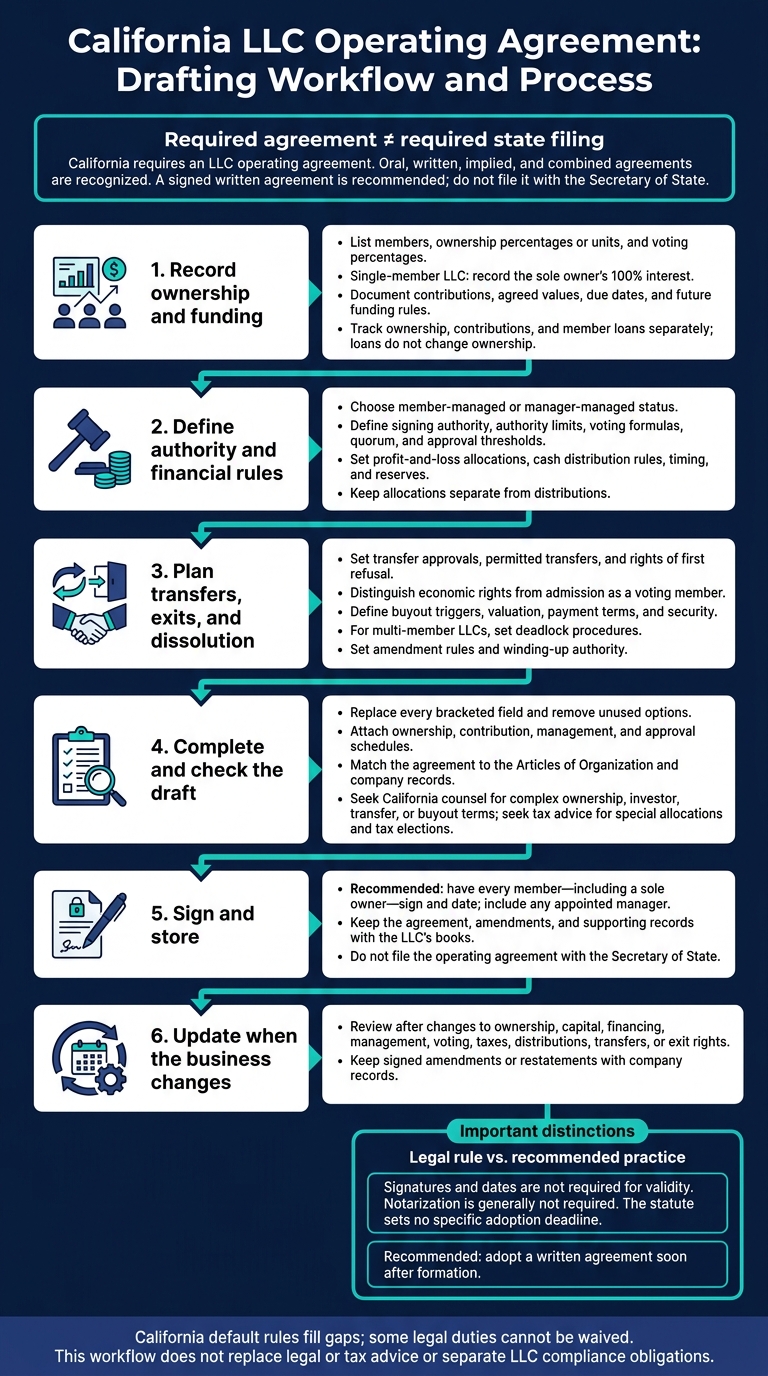
California requires an LLC operating agreement, but it does not have to be written or filed with the state. A written agreement signed by every member – including a sole owner – is the clearest way to record ownership, authority, and financial terms.
The free, editable template below covers single-member and multi-member LLCs, including contributions, management, voting, distributions, transfers, buyouts, and dissolution. California’s default rules fill gaps, and some legal duties cannot be waived.
Complete the fields, remove unused options, and check the draft against the LLC’s formation documents. Then sign it, keep it with company records, and update it when the business changes. Get legal advice or understand your LLC tax obligations for complex ownership, tax, or exit terms.
California LLC Operating Agreement: Draft, Sign, and Maintain
How to Start an LLC in California: Step-by-Step Guide (2026)
sbb-itb-ba0a4be
California LLC Operating Agreement Requirements
Under California Corporations Code Section 17701.10, an operating agreement sets the rules for members, managers, LLC activities, and amendments. California’s default rules apply when the agreement does not address an issue. The agreement cannot waive the duty of loyalty or good faith and fair dealing, or unreasonably reduce the duty of care.
Use the requirements below as a drafting checklist for ownership, management, voting, distributions, transfers, and exits.
Written Agreements, Signatures, and Filing Rules
California recognizes oral, written, implied, and combined operating agreements under Section 17701.02. A written agreement puts the terms in one place so members don’t have to rely on memory.
| Topic | Legal minimum or rule | Recommended practice |
|---|---|---|
| Written form | California recognizes oral, written, implied, and combined agreements. | Put all terms in writing rather than relying on oral understandings. |
| Signatures | Signatures and dates are not required for validity. | Have every member and any appointed manager sign and date the agreement. |
| Notarization | Generally not required for validity. | Consider notarization when identity verification or a transaction calls for it. |
| State filing and records | Do not file the agreement with the Secretary of State. | Keep the signed original, amendments, and ownership records with the LLC’s books. |
| Adoption and updates | The statute sets no specific adoption deadline. | Adopt the agreement soon after formation, before large capital contributions, major contracts, or distributions. Update it after changes to ownership, management, financing, taxes, or how the business runs. |
Single-Member vs. Multi-Member Agreements
Even a single-member LLC should document authority, succession, and financial rights. With multiple members, the agreement also needs a clear voting formula and approval thresholds. Here’s how drafting needs differ.
| Single-member LLC | Multi-member LLC |
|---|---|
| Ownership: Record the sole owner’s 100% membership interest. | Ownership: Keep a current ownership schedule showing each member’s percentage or units. |
| Management: State whether the sole member manages the LLC or appoints a manager. | Management: State whether members manage together or appointed managers have authority. |
| Voting: Record major decisions through written consents. | Voting: Set voting weights and approval thresholds. |
| Distributions: Set reserves and authorize distributions subject to solvency and tax considerations. | Distributions: Define allocation and cash distribution rules, including whether they follow ownership percentages or another agreed formula. |
| Transfers: Address transfers to a trust, estate, buyer, or successor. Separate economic rights from full membership rights. | Transfers: Set rights of first refusal, approval requirements, permitted transfers, buyout procedures, and admission rules. |
| Deadlock: Not applicable, but address successor or manager disputes. | Deadlock: Set mediation, tie-breaking, or buy-sell procedures. |
| Amendments: Approve amendments in a dated written consent. | Amendments: Set ordinary, supermajority, or unanimous approval requirements. |
Management Structure and Other Compliance Duties
Choose a member-managed or manager-managed structure that matches the Articles of Organization and how the LLC runs. Name who can sign contracts, open bank accounts, hire employees, and borrow money. Set limits on that authority, explain how managers are appointed and removed, and identify decisions that only members can approve. The California Secretary of State’s entity guidance separates these management options from formation requirements.
The agreement governs internal matters. It does not replace the Articles of Organization, the agent for service of process, required Statements of Information, taxes, or licenses. File the initial Statement of Information within 90 days, then every two years. The template below follows these baseline rules.
Free, Editable California LLC Operating Agreement Template
The clauses below turn the requirements above into editable operating agreement language for ownership, capital, management, voting, distributions, transfers, and dissolution.
Drafting instructions – not contract language: Use this template for drafting only. It is not legal or tax advice. Replace every bracketed field, remove unused options, and enter current dates and dollar amounts that match the final agreement. Check the agreement against the Articles of Organization, current California law, and federal tax rules. Get legal and tax review for complex ownership, allocation, or buyout terms. Complete the blanks to reflect your ownership, management, and tax setup.
Company Details, Ownership, and Contributions
Contract language – Formation and ownership. This Operating Agreement of [LLC NAME], a California limited liability company, takes effect on [EFFECTIVE DATE]. The Company’s principal office is [PRINCIPAL OFFICE ADDRESS], its purpose is [BUSINESS PURPOSE], and it continues until dissolved. [Single-member option:] [MEMBER NAME] owns 100% of the membership interests. [Multi-member option:] Attached Schedule A lists each [MEMBER NAME], [MEMBER ADDRESS], [OWNERSHIP PERCENTAGE], [VOTING PERCENTAGE], and [NUMBER OF UNITS AND CLASS, IF USED].
Contract language – Contributions. Schedule A lists each contribution’s description, agreed value, due date, and ownership received, including cash, property, and expressly agreed services. Future contributions require [APPROVAL THRESHOLD] approval and are [MANDATORY / OPTIONAL]. Failure to make a required contribution is subject to [REMEDY]. Member loans require separate written terms stating the principal, interest, maturity, repayment priority, and security. Loans do not change ownership.
Management, Voting, Distributions, and Records
Contract language – Management and voting. The Company is [MEMBER-MANAGED / MANAGER-MANAGED]. [AUTHORIZED PERSONS] manage ordinary operations within [AUTHORITY LIMITS]. Borrowing above $[AMOUNT], substantial asset sales, new interests, member admissions, related-party transactions, and tax-classification changes require [APPROVAL THRESHOLD]. Votes follow [VOTING FORMULA]. Quorum is [QUORUM], and ordinary member decisions require [APPROVAL THRESHOLD]. Meetings may take place remotely. Written consents take effect when approved by the required threshold, signed or electronically approved, and kept with company records.
Contract language – Distributions and finances. Profits and losses follow [ALLOCATION FORMULA]. Distributions follow [DISTRIBUTION FORMULA] at [INTERVAL], subject to approval and lawful limits. Distributable cash is the cash remaining after expenses, debt service, taxes, and required reserves. [Optional tax distributions:] Payments use an assumed [TAX RATE]% rate on allocated taxable income and offset later distributions. The fiscal year is [YEAR-END], the accounting method is [METHOD], the tax classification is [CLASSIFICATION], and the tax representative is [NAME, IF APPLICABLE]. Company funds stay in separate accounts with [AUTHORIZED SIGNERS].
Contract language – Records and indemnification. Records are kept at [LOCATION]. Financial reports are delivered within [NUMBER] days after each quarter. Indemnification and expense advances apply only to the extent California law allows.
Transfers, Member Exits, Dissolution, and Signatures
Use these clauses to set the terms for transfers, member exits, and buyouts.
Contract language – Transfers. Transfers require [APPROVAL THRESHOLD], except for [DEFINED PERMITTED TRANSFERS] after written notice. For third-party offers, the Company has [COMPANY PURCHASE WINDOW] days to purchase on the disclosed terms, followed by the remaining members, who have [MEMBER PURCHASE WINDOW] days. Closing must occur within [NUMBER] days after acceptance. Transferees receive economic rights only until their admission receives [APPROVAL THRESHOLD] approval and they sign a joinder.
Contract language – Exits and buyouts. Death, incapacity, bankruptcy, voluntary withdrawal, or lawful expulsion may trigger [BUYOUT RIGHT OR OBLIGATION], subject to applicable law. Buyouts use an independent appraisal as of [VALUATION DATE], with [DISCOUNT RULE], [APPRAISER-SELECTION PROCESS], and payment through [DOWN PAYMENT, INSTALLMENTS, INTEREST, AND SECURITY]. [Multi-member option:] Deadlock after [NUMBER] failed votes proceeds to negotiation, then mediation within [NUMBER] days, followed by [SELECTED REMEDY]. [Single-member option:] [SUCCESSOR] is designated to seek admission and continue operations following death or incapacity, subject to applicable law.
Contract language – Amendments. Written amendments require [APPROVAL THRESHOLD]. Each affected member must also consent to increased personal obligations or adverse changes to ownership, voting, or distribution rights.
Contract language – Dissolution. Dissolution follows [SPECIFIED EVENTS], the required member vote, or mandatory law. [AUTHORIZED WINDING-UP PERSON] collects assets, pays creditors, sets aside reserves for contingent claims, and distributes remaining assets under [LAWFUL DISTRIBUTION FORMULA].
Member signature block – repeat for every member:
[MEMBER NAME]
[TITLE, IF APPLICABLE]
Signature: __________________
Date: [DATE]
Manager acknowledgment, if applicable:
[MANAGER NAME]
Signature: __________________
Date: [DATE]
How to Customize Your Agreement
Use the template above to set the core terms, then adjust the choices below to match how your LLC will work.
Set these terms before completing the agreement. Delete unused options and attach schedules for ownership, contributions, managers, and approval thresholds. Check those schedules against contribution records, bank statements, promissory notes, and the accounting ledger.
| Topic | Decisions members must make |
|---|---|
| Ownership | List legal names, addresses, ownership percentages, and membership classes. |
| Contributions | Specify cash, property, services, or future funding, including amounts, due dates, valuations, and consequences for nonpayment. |
| Management | Choose member-managed or manager-managed status. Define manager powers and signing authority. |
| Voting | Set voting denominators and approval thresholds for ordinary and major decisions. |
| Allocations | Choose an ownership-based formula or a special allocation reviewed by a tax professional. |
| Distributions | Set the formula, timing, and required reserves for taxes, debt service, and operations. |
| Transfers | Define notice requirements, consent, right of first refusal, permitted transfers, and admission requirements. |
| Buyouts | Choose triggers, valuation methods, discounts, payment terms, and security. |
| Amendments | Set approval thresholds, written-consent procedures, and effective dates. |
| Dissolution | Define triggers, winding-up authority, creditor payments, tax filings, and distributions of remaining assets. |
Above all, keep ownership, contributions, and distributions consistent with the company’s books.
Align Ownership, Contributions, and Distributions
Track ownership, contributions, and loans separately. If ownership percentages differ from contribution values, explain why, including any ownership earned through services.
Label each member advance as either a contribution or a loan. For a loan, state the principal amount, interest rate, maturity date, repayment priority, and default terms. A loan should not automatically increase ownership.
Decide what happens when a member misses a contribution. Options include dilution, funding through member loans, suspension of voting rights where legally permitted, or a buyout. Keep allocations separate from distributions, and have a tax professional review any special allocation.
Example: A real estate LLC may reserve cash for debt service, repairs, and reserves before making distributions.
If lender covenants limit distributions, state that those limits control.
Set Decision-Making and Exit Rules
List the reserved matters that require member approval. These may include major borrowing, asset sales, related-party transactions, new members, tax-classification changes, amendments, or dissolution. For each matter, state the voting denominator and approval threshold.
For transfers, set notice periods, consent thresholds, permitted transfers, and right-of-first-refusal deadlines. Distinguish a transfer of economic rights from admission as a voting member.
For buyouts, choose trigger events, valuation dates and methods, discount rules, who pays appraisal costs, payment terms, and security. Explain how members will resolve valuation disputes.
A deadlock clause should lay out a sequence, such as discussion, mediation, and then a tie-breaker or buy-sell remedy.
Know When to Get Legal and Tax Advice
Use California counsel for real estate holdings, outside investors, multiple classes, transfer restrictions, deadlock, or complex buyouts. Legal review is especially helpful when loan documents, investor rights, securities issues, indemnification, or property-management terms must match the agreement. Counsel should also check that the agreement does not conflict with the articles of organization, financing documents, or mandatory California rules.
Use a CPA or tax attorney for special allocations, guaranteed payments, tax distributions, debt basis, and LLC tax elections. Foreign ownership can trigger additional federal reporting and withholding duties.
Conclusion: Sign, Store, and Update Your Agreement
California recognizes oral, implied, and written operating agreements, but a signed written agreement provides the clearest record of the LLC’s terms. Do not file it with the Secretary of State.
Once you complete the template above, have every member – including a sole member – sign and date it. Keep it with amendments and supporting company records at the principal office or in a secure digital file that authorized members and managers can access.
If a bank, lender, or payment processor needs proof of who can bind the LLC, share only the signing-authority clause or an approved resolution to protect confidential details.
Review and update the agreement and related resolutions whenever ownership, capital, financing, management, voting, allocations, distributions, taxes, business activities, membership, transfers, or dissolution rights change. Keep signed amendments or restatements with the company records.
FAQs
What happens if my California LLC has no operating agreement?
Without an operating agreement, California’s default rules govern how your LLC splits profits and losses, handles votes and member exits, and transfers membership interests. Those rules may not match how you want to run the business.
California requires an operating agreement, but it can be written, oral, or implied – not just written. A written agreement puts the terms on paper. You don’t file it with the state; keep a signed copy in your LLC’s records.
Can my operating agreement override my Articles of Organization?
No. Your operating agreement cannot conflict with your Articles of Organization. The Articles of Organization is a public document filed with the state to establish your LLC. Your operating agreement is a private contract that sets out how the business runs.
Any management structure or details about how the business runs in your operating agreement must match what you stated in your Articles of Organization.
Can I use this template if my LLC elects S corporation taxation?
Yes, but update the agreement to document your tax election. S corporation status comes from filing IRS Form 2553, not from the operating agreement.
To reflect the S corporation’s one-class-of-stock restriction, state that profits and losses are allocated in proportion to ownership percentages. Also include tax distribution clauses to help members cover personal tax liabilities on pass-through income.