

Texas generally does not require a written LLC operating agreement – but putting the rules in writing helps prevent disputes. Known as a company agreement under Texas law, it sets ownership, management, money, and exit rules. Keep the signed agreement with company records; do not file it with the state.
This guide includes a free, editable template for single-member and multi-member LLCs, plus a checklist covering:
- Company details, ownership totaling 100%, and member contributions.
- Management authority, voting, taxes, and distributions.
- Transfers, buyouts, succession, disputes, and closure.
Before signing, complete every field, match the management structure to the certificate of formation, and seek legal and tax review for custom terms. The agreement does not replace state filings or tax duties.
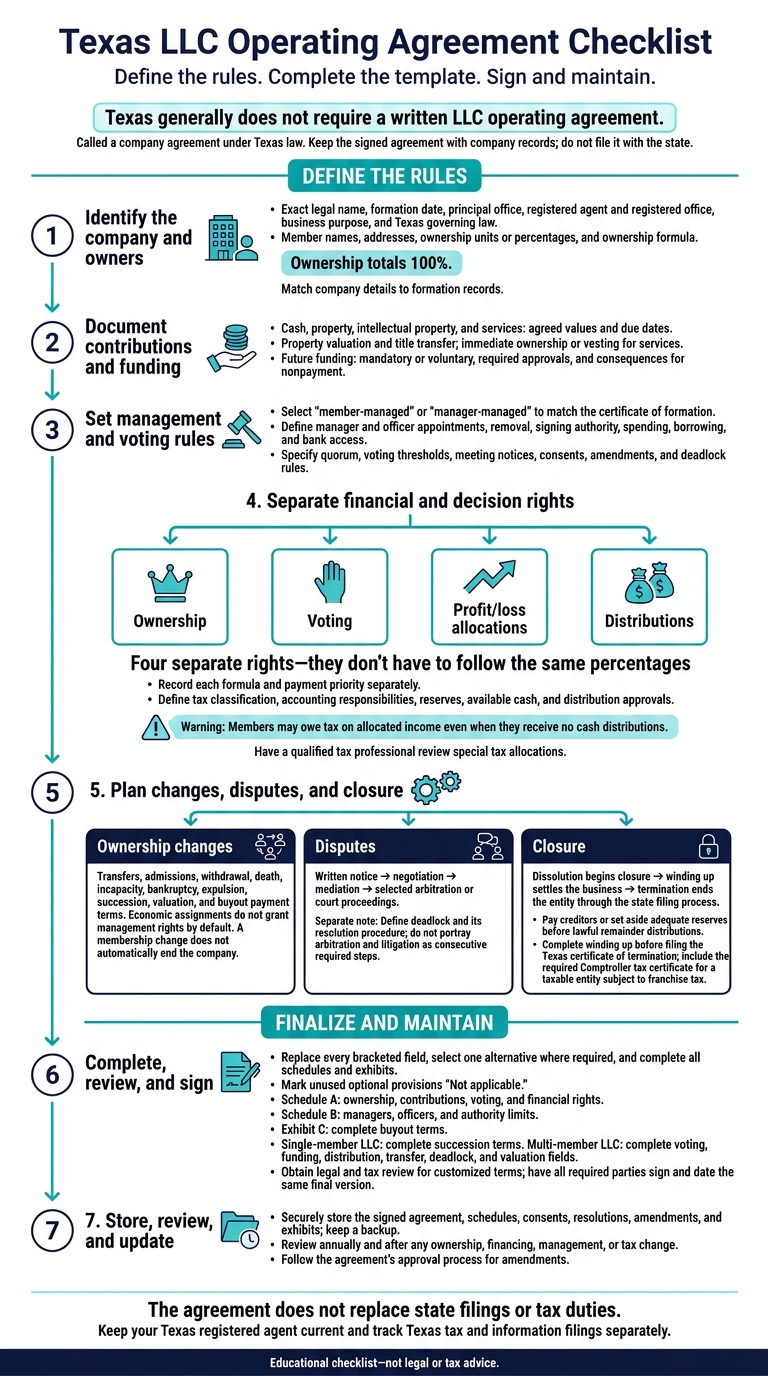
Texas LLC Operating Agreement Checklist
What to Include in a Texas LLC Operating Agreement
Company Details, Ownership, and Member Contributions
Start with the company’s exact legal name, formation date, principal office, registered agent and registered office, business purpose, and Texas governing law. Attach a member schedule listing names, addresses, ownership units or percentages, and the formula used to determine ownership. Keep these details consistent with formation records.
Next, spell out what each member contributes and how it affects ownership. List cash, property, intellectual property, and services separately, with agreed values and due dates. Explain how property is valued and when title transfers. For services, state whether ownership is earned immediately or through vesting.
Make clear whether future funding is mandatory or voluntary and who approves funding requests. Also explain what happens if a member doesn’t pay. Possible consequences include dilution, suspended voting rights, a member loan, interest, or a buyout.
Management Authority and Voting
Choose member-managed or manager-managed control that matches the certificate of formation. Name managers and officers, explain how they’re appointed and removed, and define their authority to sign documents, spend money, borrow, and access bank accounts.
Set rules for conflict disclosures, records access, meeting notices, quorum, voting thresholds, written or electronic consents, and amendments. Identify decisions that require member approval and explain how to resolve deadlocks. Include an order-of-precedence clause that addresses conflicts with the certificate of formation, company records, and Texas law. Keep reimbursement, indemnification, and liability protections within what Texas law allows.
Treat voting rights separately from the rules for profits, losses, and distributions.
Profit and Loss Allocations, Taxes, and Distributions
Ownership, voting, allocations, and distributions are four separate rights. They don’t have to follow the same percentages. Record each formula, preferred return, and payment priority in the member schedule, and have a qualified tax professional review any special tax allocations.
Identify the tax year, accounting method, bookkeeper, return preparer, reporting deadlines, and intended tax classification. If the LLC is taxed as a partnership, designate its partnership representative and define that person’s audit authority and duties to notify members. File any federal tax election separately with the IRS.
Define available cash after reserves for payroll, operating expenses, debt, taxes, contingencies, and planned capital expenditures. Set the payment frequency, required approvals, withholding rules, and process for handling mistaken payments.
Members may owe tax on allocated income even when they receive no cash distributions. State whether tax distributions are required, how they’re calculated, and whether they reduce later distributions. Prohibit payments that would leave the company unable to pay its debts as they become due.
sbb-itb-ba0a4be
Ownership Changes, Disputes, and Dissolution
Decision Rights, Member Admissions, and Buyouts
Set transfer, exit, and buyout rules before ownership changes. Cover sales, gifts, pledges, and permitted transfers to family members or trusts. Keep economic rights separate from voting and management rights: a transferee does not receive voting or management rights by default.
Require written notice, the required company or member approval, signed transfer documents, a joinder, and updated ownership schedules. Define any right of first refusal, along with the valuation method and payment schedule. Treat the thresholds below as drafting choices, and align them with the agreement’s voting structure.
| Decision | Authorized decision-maker | Selected approval threshold | Agreement article |
|---|---|---|---|
| New member admission | Existing members | Unanimous written consent | Article 7 |
| Interest transfer | Transferring member and approving members | Right of first refusal plus majority or unanimous consent | Article 8 |
| Withdrawal, death, or incapacity buyout | Remaining members or designated buyer | Majority or unanimous approval by remaining members | Article 8 |
| Expulsion | Nonaffected members | Supermajority or unanimous approval by nonaffected members | Article 8 |
Address withdrawal, death, incapacity, bankruptcy, and expulsion separately. Include notice and due-process protections for each. Set the buyout valuation date, appraisal method or formula, treatment of debt and valuation discounts, buyer, payment deadline, installment interest, and security.
Explain the estate’s economic rights and the requirements for admission after a member’s death. For a single-member LLC, also address succession. A membership change does not automatically end the company.
Dispute Resolution and Deadlocks
If a transfer, admission, or buyout stalls, this section sets out what happens next.
Require written notice that explains the dispute and requested remedy. Follow that with negotiation and mediation under stated deadlines. Then choose arbitration or court proceedings, specifying Texas governing law, venue, fee allocation, confidentiality limits, and exceptions for emergency relief.
Define deadlock as a failed vote or blocked decision. Require another meeting, followed by mediation and a buy-sell process with valuation and funding deadlines. Choose the forum deliberately – no single method fits every LLC.
| Method | Decision-maker | Privacy limits | Enforceability | Costs | Appeal rights |
|---|---|---|---|---|---|
| Mediation | Neutral mediator helps the parties reach a settlement | Generally private, subject to legal and contractual limits | Settlement is enforceable if documented properly | Mediator and attorney fees | No ruling to appeal |
| Arbitration | Arbitrator decides | Confidentiality is not automatic | Award is enforceable under applicable law | Filing, arbitrator, hearing, and attorney fees | Narrow grounds for review |
| Litigation | Judge, sometimes jury | Generally public; sealing rules apply | Court judgment is enforceable | Court, discovery, and attorney costs | Broader appellate review |
Dissolution, Winding Up, and State Termination
If the company cannot continue, the agreement should explain how to dissolve an LLC in Texas, from the first vote through state termination.
List the events that trigger closure: required member approval, expiration, completion of purpose, a court decree, and other contractual or statutory events. Address what happens when the last member leaves, including any applicable continuation rules.
Dissolution begins closure, winding up settles the business, and termination ends the entity through the state filing process. Name the person responsible for collecting receivables, ending contracts, selling assets, giving required creditor notices, paying debts, and reserving funds for unresolved claims.
Require final tax returns. Allow lawful distributions only after creditors have been paid or adequate funds have been set aside for them. Keep financial, tax, ownership, consent, and closure records for the applicable retention period.
Complete winding up before filing the Texas certificate of termination. For a taxable entity subject to franchise tax, include the required Comptroller tax certificate. Follow the Texas Secretary of State’s termination instructions.
Removing an LLC Member? Here’s What Most Businesses Get Wrong?
Free Editable Texas LLC Operating Agreement Template
Use the clauses below to turn the checklist above into a signed Texas LLC company agreement.
Copy and edit this template in your own document. It does not include legal or tax review. Before signing, replace every bracketed field, choose one alternative in each selection, and complete all schedules. Keep the drafting instructions outside the signed agreement. Get Texas legal and tax review if your LLC has multiple owners, special allocations, outside investors, regulated services, or large real estate holdings.
Drafting instructions – keep outside the agreement:
- Single-member LLC: Delete the multi-member alternatives and complete the succession terms before signing.
- Multi-member LLC: Delete the sole-member alternative. Complete every voting, funding, distribution, transfer, deadlock, and valuation field before signing.
- Sign in each applicable capacity. Have counsel draft any special allocations, arbitration, fee-shifting, or expanded liability protections.
- Keep the signed agreement and its schedules private. Texas does not accept company agreements for filing.
Articles 1–4: Formation, Ownership, Contributions, and Management
Texas LLC Company Agreement (Operating Agreement)
Article 1 – Formation. [Legal name], Texas file number [number], formed [date], adopts this company agreement effective [date]. Principal office: [address]. Registered agent and Texas registered office: [name; street address]. The company may conduct any lawful business permitted for a Texas LLC. Its duration is perpetual unless terminated under this agreement.
Article 2 – Ownership. The company is a [single-member LLC: the sole member owns 100% and exercises all member decision rights / multi-member LLC: ownership and voting rights follow Schedule A].
Article 3 – Contributions. Schedule A lists contributions, delivery dates, agreed values for noncash contributions, and whether each contribution is equity or a loan. No member must make additional contributions without that member’s written agreement. New funding requires approval under Article 5. Loans require signed repayment terms. Funding alone does not change ownership.
Article 4 – Management. The company is [member-managed / manager-managed], consistent with its certificate of formation. Schedule B lists authorized managers and officers, their titles and terms, and procedures for appointment and removal. They direct ordinary business activities within Schedule B’s spending limits. Reserved actions require Article 5 approval. Company records remain available for lawful member inspection. Related-party transactions require disclosure and approval by disinterested members. Reimbursable expenses and indemnification are limited by Texas law.
Articles 5–8: Voting, Finances, Transfers, and Member Departures
Article 5 – Approvals. Voting follows Schedule A. Quorum requires [percentage]% of all voting interests. Ordinary decisions require [percentage]%; borrowing above $[amount] and major actions, including asset sales, mergers, and tax elections, require [percentage]%. New members, amendments that reduce economic rights, and new contribution duties require unanimous written consent. Meetings require [days] days’ notice. Remote participation and signed electronic consents are permitted. Keep minutes and consents.
Article 6 – Finances. Schedule A lists profit, loss, and distribution percentages separately. Tax classification: [disregarded entity / partnership / corporation]. Accounting method: [method]; fiscal year: [year]. Tax administrator: [name]; partnership representative, if applicable: [name]. Maintain separate bank accounts and reserves for debts, taxes, and business activities. Approved distributions are payable within [days] days, subject to available cash, creditor obligations, and applicable law. Tax distributions follow [formula and schedule].
Article 7 – Transfers. Transfers require written notice and compliance with this agreement. Permitted estate-planning transfers: [terms]. The company, followed by the remaining members, each receives [days] days to match a documented third-party offer. Economic assignments do not grant management rights. Admission requires Article 5 approval, a signed joinder, and updated schedules.
Article 8 – Departures. Withdrawal requires [days] days’ notice. Death, disability as defined in [exhibit], bankruptcy, and other events listed in this agreement trigger [purchase option / mandatory purchase], subject to applicable law. Attached Exhibit C governs the buyer, exercise deadline, valuation date, appraiser selection, debt treatment, discounts, down payment, installments, interest, security, and funding shortfalls. Remaining members continue the business where legally permitted. Successor or personal representative: [name; authority and admission procedure].
Articles 9–11: Disputes, Dissolution, Final Terms, and Signatures
Article 9 – Disputes. Written notice starts a [days]-day negotiation period, followed by mediation within [days] days in [county], Texas. Unresolved disputes proceed exclusively through [select one: Texas courts in the selected county / binding arbitration under attached rules, arbitrator-selection procedure, and cost terms]. Fees: [allocation]; confidentiality: [terms]. Emergency court relief remains available. Deadlock means [definition] and triggers another meeting, then mediation, then [attached buy-sell procedure / court remedy].
Article 10 – Closure. Dissolution occurs upon [percentage]% member approval, expiration, or another required event. [Name/title] handles winding up, collects assets, pays creditors or sets aside reserves for them, files final tax returns, distributes the lawful remainder under Schedule A, and completes required termination filings.
Article 11 – Final Terms. Amendments require [threshold], subject to Article 5’s unanimous-consent protections. Notices go to Schedule A addresses by [delivery method] and take effect [timing]. Texas law and the certificate of formation control conflicting terms. Otherwise, this agreement and its schedules control. Invalid provisions are severable. This document and its attachments constitute the entire agreement. Texas law governs. Electronic signatures and counterparts are valid.
Member signatures: [Each member’s signature, printed legal name, capacity, ownership percentage, date].
Manager acceptance: [Each applicable manager’s signature, printed name, title, date].
Schedule A: [Each member’s address, ownership, units, voting weight, profit/loss percentages, distribution percentage, contribution, value, classification, and delivery date].
Schedule B: [Managers, officers, appointment/removal terms, authority limits, bank controls].
Exhibit C: [Complete buyout terms].
Amendment log: [Amendment date, affected article, approval, effective date].
Conclusion: Sign, Store, and Update Your Agreement
Before signing, check the completed template against your LLC’s details: formation, ownership, management, voting, finances, transfers, disputes, and dissolution terms.
Fill in every bracketed field and make every required selection. This includes the effective date, principal office, registered agent, member details, ownership, contributions, voting, tax election, distribution schedule, notice method, governing law, and signatures. Confirm that ownership percentages total 100%, and mark unused optional provisions as Not applicable. Have a Texas attorney and tax professional review any customized terms.
Have all required parties sign and date the same final version. Store it in a secure folder with its schedules, consents, resolutions, amendments, and exhibits, and keep a backup copy. Review the agreement annually and after any ownership, financing, management, or tax change. Follow its approval process when making amendments.
The agreement does not replace your compliance obligations. After signing, keep your Texas registered agent current and track Texas tax and information filings separately.
FAQs
What happens if my Texas LLC has no operating agreement?
Without an operating agreement, your Texas LLC follows the default rules in the Texas Business Organizations Code – even if those rules don’t fit your business goals. Who manages the business, how members vote, and how disputes get resolved may also be unclear.
Without a written agreement, you may have less evidence that your LLC operates as a separate legal entity. Banks and investors may also ask for one to confirm how your LLC is governed.
Does my Texas LLC operating agreement need notarization?
No. Texas does not require you to notarize your LLC operating agreement. It’s an internal document, so you don’t file it with the state. Still, notarization is recommended to help verify signatures and support the agreement if its validity is challenged.
If you choose to notarize it, a remote online notary service lets members complete identity verification and notarization online from different locations, subject to the service’s requirements.
Can I create an operating agreement after forming my LLC?
Yes, you can create an operating agreement after forming your LLC. It’s best to draft it within the first few weeks, but many owners put one in place later.
The agreement stays private – you don’t need to file it with the state. Creating one is strongly recommended to help strengthen liability protection, spell out how decisions are made, and let you run your business under your own rules rather than state default laws.