


A manager-managed LLC is a business structure where members (owners) delegate the authority to manage daily operations to one or more designated managers. These managers handle tasks like signing contracts, hiring employees, and making financial decisions, while members retain ownership but take on a more passive role. This setup is ideal for:
- Passive investors who prefer to provide funding without managing operations.
- Large groups of owners where decision-making by all members would be inefficient.
- Owners with limited time or experience who want skilled professionals to handle management.
- Family businesses where some members manage operations while others focus on ownership.
The difference between manager-managed and member-managed LLCs lies in decision-making authority. In a manager-managed LLC, only appointed managers can make binding decisions, while members oversee major changes like replacing managers or amending the operating agreement. This structure offers faster decision-making, privacy for members, and access to professional management but requires a clear operating agreement and may involve higher costs.
Quick Overview:
- Who manages? Appointed managers.
- Who benefits? Members retain ownership and vote on major decisions.
- Best for: Passive investors, large groups, or businesses needing professional management.
- Setup: Specify "manager-managed" in state filings and outline roles in an operating agreement.
This structure works well for businesses seeking operational efficiency and clarity in roles while maintaining member oversight for major decisions.
Manager-Managed LLC vs Member-Managed LLC
Main Differences Between the Two Structures
Expanding on the earlier explanation of a manager-managed LLC, let’s now compare it directly with a member-managed LLC to highlight the key distinctions.
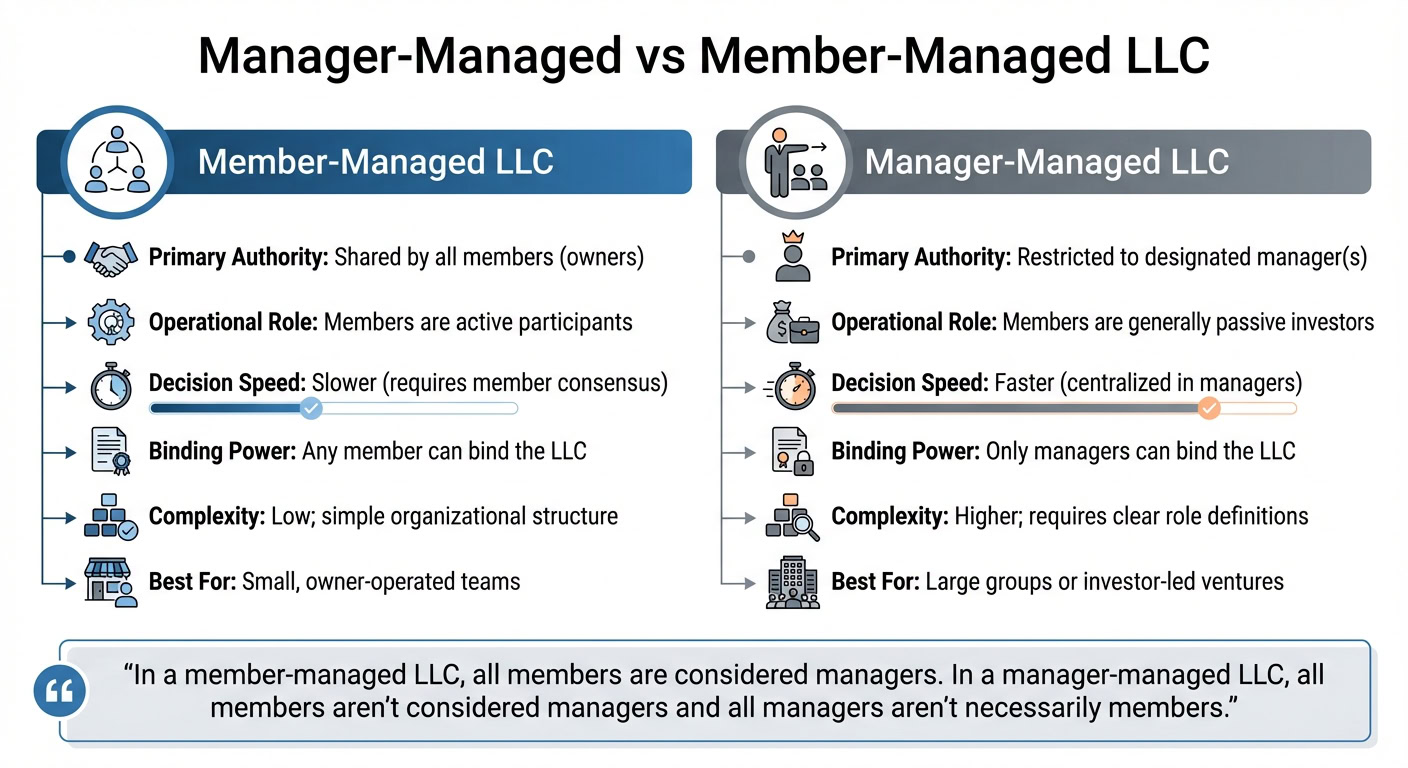
The primary difference lies in who has the authority to make decisions and bind the company. In a member-managed LLC, all owners (or members) share this authority equally. This means every member can make decisions and legally commit the company. However, this shared power often requires a majority – or even unanimous – vote for key decisions, which can slow things down but ensures everyone has a say.
In contrast, a manager-managed LLC centralizes decision-making. Here, only the appointed managers have the legal authority to run day-to-day operations or make binding decisions. This setup allows for quicker, more streamlined decision-making since managers don’t need to consult all members for every operational choice. Members in this structure often take a more passive role, stepping back from daily operations but retaining the right to influence major changes, like removing managers, amending the operating agreement, or dissolving the LLC.
"In a member-managed LLC, all members are considered managers. In a manager-managed LLC, all members aren’t considered managers and all managers aren’t necessarily members", explains attorney David M. Steingold.
The table below provides a clear side-by-side comparison of these two structures.
Comparison Table
| Feature | Member-Managed LLC | Manager-Managed LLC |
|---|---|---|
| Primary Authority | Shared by all members (owners) | Restricted to designated manager(s) |
| Operational Role | Members are active participants | Members are generally passive investors |
| Decision Speed | Slower (requires member consensus) | Faster (centralized in managers) |
| Binding Power | Any member can bind the LLC | Only managers can bind the LLC |
| Complexity | Low; simple organizational structure | Higher; requires clear role definitions |
| Best For | Small, owner-operated teams | Large groups or investor-led ventures |
sbb-itb-ba0a4be
Roles and Responsibilities in a Manager-Managed LLC
Manager Responsibilities
In a manager-managed LLC, managers wield considerable operational authority. They act as the business’s legal agents, meaning they can enter into contracts and agreements on behalf of the LLC without needing member approval for routine decisions. Their responsibilities span the full spectrum of daily operations: hiring and firing employees, managing independent contractors, and steering the company’s strategic direction. Managers also oversee financial activities like opening and managing bank accounts, securing loans, and obtaining financing. Additionally, they are authorized to buy, sell, or lease real estate and other property for the business.
"In a manager-managed LLC, only managers are authorized to make management decisions", explains attorney Bethany K. Laurence.
Beyond their operational duties, managers carry a fiduciary duty to act in the company’s best interest. To shield managers from personal liability when acting within their authority, many LLC operating agreements include indemnification clauses. These provisions ensure the LLC covers debts or legal fees incurred by managers while performing their duties.
While managers handle the day-to-day operations, members retain oversight of the LLC’s broader strategic direction.
Member Responsibilities
Members in a manager-managed LLC take on a more passive role. They provide the capital to fund the business and receive profit distributions but do not engage in daily operations or have the authority to bind the LLC to contracts. Their role is similar to that of shareholders in a corporation.
However, members retain significant control over major decisions through their voting rights. They vote on critical matters like amending the operating agreement, selling most of the company’s assets, or dissolving the LLC. Members also have the authority to remove or replace managers if needed and can even vote to shift the management structure back to a member-managed model if they are dissatisfied with current practices.
"While it sounds like the Manager(s) has a lot of power, the LLC Members have the ultimate power and authority. They can remove or replace the Manager(s) at any time", notes Matt Horwitz, Founder & Educator at LLC University.
To balance efficiency with oversight, members often use the operating agreement to set limits on managerial authority. For example, they might require member approval for purchases over $10,000 or for hiring key personnel. This structure allows managers to operate effectively while ensuring members maintain control over decisions that could have a significant impact on the company’s finances or overall direction.
How to Set Up a Manager-Managed LLC
Specifying in Articles of Organization
When forming your LLC, you’ll need to decide on its management structure, and this starts with your formation documents. Most states require you to specify whether your LLC will be "Member-Managed" or "Manager-Managed." Typically, this is done by checking a box or completing a section in the filing document. This decision determines who has the authority to make binding decisions for the company from the start.
The specific name of this document varies by state – it might be called the Articles of Organization, Certificate of Organization, or Certificate of Formation. While some states, like Maryland, allow you to make this designation in your Operating Agreement, most require it to be stated in the formation document. Additionally, some states mandate that you include the names and addresses of the initial managers in the Articles of Organization, making this information publicly accessible.
"In most states, LLCs are member-managed by default under state law. So, if you don’t designate a management structure for your LLC either in your formation documents or operating agreement, then it’ll be considered a member-managed organization." – Attorney David M. Steingold
For clarity and legal consistency, ensure your formation documents align with the details outlined in your Operating Agreement. This avoids potential disputes over who has the authority to act on behalf of the LLC.
Once this is done, the next step involves creating an Operating Agreement to define internal roles and responsibilities.
Creating the Operating Agreement
The Operating Agreement is your LLC’s internal guidebook. It lays out how the business will run and clarifies the authority and responsibilities of managers. Unlike the formation documents, this agreement isn’t filed with the state but is kept with your business records. While most states don’t require an Operating Agreement, having one is crucial to prevent misunderstandings and conflicts.
The details in your Articles of Organization set the groundwork for the Operating Agreement. This document specifies the scope of authority managers have – what they can decide on their own and what requires member approval. For instance, managers might handle routine operations independently but need member consent for major decisions like large purchases or significant contracts.
"The operating agreement should provide that management decisions will be made by the managers, and it should specify the vote required to make management decisions (such as a majority of managers or a unanimous vote of all managers)." – Attorney Bethany K. Laurence
Here are some key elements to include in your Operating Agreement:
- Names and addresses of all members and appointed managers.
- Clear definitions of duties, compensation, and limits on authority.
- Voting procedures for member decisions, including quorum requirements.
- Guidelines for removing or replacing managers.
- Indemnification clauses to protect managers acting in good faith.
- Succession planning, especially for single-member LLCs.
Once all members and managers sign the Operating Agreement, it becomes legally binding, even without notarization.
Electing and Changing Managers
The Operating Agreement should also outline the process for electing and replacing managers. During the LLC’s formation, members typically elect the initial managers. The agreement should specify how many managers will serve, any qualifications they must meet, and the voting threshold required for their appointment. Managers can be members of the LLC or external professionals brought in for their expertise.
If changes are needed, members must follow the voting procedures detailed in the Operating Agreement. After a vote, update the agreement to reflect the change. For states that require manager information to be part of public records, you’ll also need to file an amendment to the Articles of Organization or update the details in your next Annual Report.
If your business needs evolve, your management structure can be adjusted. Members can vote to switch from a manager-managed setup to a member-managed one (or vice versa) by amending the Operating Agreement and filing any required updates with the state.
Advantages and Disadvantages of Manager-Managed LLCs
Pros and Cons Table
Opting for a manager-managed LLC structure comes with its own set of trade-offs. Weighing the benefits against the drawbacks can help determine if this setup aligns with your business objectives.
| Advantages | Disadvantages |
|---|---|
| Operational Efficiency: Decision-making is centralized, enabling faster actions. | Reduced Member Control: Non-managing members have little to no say in decisions. |
| Attracts Passive Investors: Ideal for investors who want to contribute capital but avoid involvement in daily operations. | Increased Costs: Paying salaries to professional managers can strain the budget, especially for startups or smaller businesses. |
| Access to Expertise: Allows hiring managers with industry-specific skills or experience that members might lack. | Legal Complexity: Requires a detailed operating agreement that clearly defines managerial authority and removal procedures. |
| Enhanced Privacy: Public records list "Manager" instead of "Member", offering more privacy regarding ownership. | Trust Challenges: Managers must be carefully chosen, as external managers may not align with the founders’ values or long-term goals. |
| Strategic Control: Useful for family businesses where founders retain management while transferring ownership to heirs. | Securities Compliance Issues: Passive investor interests may be classified as securities, potentially triggering regulatory oversight. |
"Membership interests in a manager-managed LLC are sometimes classified as securities because non-managing members… are likely investing their money in a business in which they’re not actively participating." – Attorney Bethany K. Laurence
The choice of a manager-managed LLC structure often depends on how these advantages and disadvantages align with the needs of the business.
Important to note: While managers handle day-to-day decisions, members usually retain the right to vote on removing or replacing them, as outlined in the operating agreement. This safeguard ensures accountability and flexibility if management falls short of expectations.
Common Use Cases for Manager-Managed LLCs
The trade-offs of a manager-managed LLC make it particularly suited for specific business scenarios. Here are some common examples:
- Real Estate Portfolios: Passive investors fund the business while professional managers handle property maintenance, lease negotiations, and tenant relations. This setup allows investors to enjoy returns without dealing with operational responsibilities.
- Family Businesses: Older generations can transfer ownership to younger family members while maintaining management control, ensuring a smooth transition without immediately giving up decision-making authority.
- Large Investment Groups: When numerous investors are involved, centralized decision-making prevents inefficiencies that arise from seeking consensus among all members.
- Remote Operations: An owner in one state can appoint a local manager in another state to oversee tasks such as contractor meetings and property inspections, simplifying the management of distant operations.
- Professional Management: Businesses needing specialized expertise can delegate daily management to experienced professionals, allowing capital-rich members to focus on other priorities.
- Succession Planning in Single-Member LLCs: An operating agreement can designate a successor manager to ensure the business continues if the owner becomes incapacitated or passes away.
- Lender Requirements: Lenders may require an independent manager to oversee the business as a condition for providing funding.
Each of these scenarios highlights how the manager-managed structure can address specific operational or strategic needs, making it a versatile option for many businesses.
Legal Requirements and Compliance
Liability and Legal Protections
LLCs provide a layer of protection for both members and managers, shielding their personal assets from the company’s debts. In this structure, only managers – acting as the business’s agents – hold the authority to bind the LLC to contracts or obligations. Managers also carry a fiduciary duty, meaning they are legally required to act in the best interest of the LLC.
Non-managing members are essentially passive investors. Like corporate shareholders, they generally lack the authority to make binding decisions for the LLC. As Nevada law explains: "In a Manager-managed LLC, no Member has the power to bind the LLC (just as no shareholder of a corporation can bind the corporation); only a Manager or authorized officer of the LLC can take binding actions".
To extend the same liability protection to managers as members, it’s critical to include specific language in your operating agreement. This document should make it clear that managers are not personally responsible for the company’s debts. Attorney Bethany K. Laurence from UC Law San Francisco advises: "A manager-managed operating agreement should state that managers aren’t liable for the debts or liabilities of the business – assuming you want to extend the LLC’s limited liability to the managers – and an ‘indemnification provision’". An indemnification clause ensures that the LLC will cover debts or legal fees a manager incurs while acting on behalf of the company.
Another perk for passive members: if they don’t actively participate in the business, they may avoid self-employment taxes. Managers, however, are typically required to pay these taxes.
These liability guidelines set the stage for the state-specific rules outlined below.
State-Specific Rules
When forming a manager-managed LLC, understanding state-specific regulations is essential. Most states assume an LLC will operate under a member-managed structure unless stated otherwise. To avoid confusion, you must explicitly indicate the management structure in your Articles of Organization when filing with the Secretary of State. If this step is skipped, the LLC will default to member-managed, even if your internal operating agreement specifies otherwise. This misstep can create uncertainty about who has the authority to act on behalf of the business.
State laws also define who can serve as a manager. In most cases, individuals, other LLCs, or corporations can fill this role. Delaware, in particular, offers a high degree of flexibility. Under the Delaware LLC Act, operating agreements can override most statutory requirements, giving you more control over how management roles are defined.
If your LLC includes passive investors, be aware that membership interests might be classified as "securities" under state and federal law. Attorney Bethany K. Laurence explains: "Membership interests in a manager-managed LLC are sometimes classified as securities because non-managing members (owners who don’t manage the company) are likely investing their money in a business in which they’re not actively participating". While many small LLCs qualify for "private offering" or "intrastate" exemptions from SEC registration, consulting with a legal expert is crucial to ensure compliance.
Filing and Compliance Requirements
Adhering to filing and compliance rules is key to keeping your LLC in good standing. For manager-managed LLCs, it’s important to clearly state the management structure in your Articles of Organization when registering with the state. This public filing informs third parties about who has the authority to act on the LLC’s behalf, while the operating agreement governs internal operations.
A strong operating agreement is essential. It should address critical details like manager removal, succession planning, voting procedures, and indemnification. For single-member LLCs, it’s wise to include a provision appointing a successor manager to avoid business disruptions in case of the owner’s death or incapacity.
If you decide to change the management structure later, you’ll need to update both your operating agreement and your state filings, such as the Articles of Organization or Annual Report. Neglecting to update these records can lead to legal disputes over who has the authority to act on behalf of the business.
Ongoing compliance includes maintaining accurate records of members and managers, tracking capital contributions, and keeping detailed tax and financial records. Most states also require annual reports and franchise tax payments to ensure your LLC remains in good standing. Services like BusinessAnywhere can help by providing compliance alerts to keep you on track with deadlines.
To preserve the LLC’s liability protections, it’s critical to maintain a clear division between personal and business finances. Mixing these finances can result in "piercing the corporate veil", where courts may hold managers personally liable for the company’s debts.
Conclusion
A manager-managed LLC separates the roles of ownership and daily management, making it an ideal choice for businesses with passive investors, a large number of owners, or a need for professional management expertise. Unlike member-managed LLCs – where every owner has the authority to bind the company to contracts – this structure grants that power exclusively to designated managers. This clear division of responsibilities streamlines decision-making and enhances operational efficiency.
This setup also offers flexibility and control. While managers handle the day-to-day operations, members retain the ultimate authority to remove or replace them if needed. Additionally, it provides a layer of privacy, as being listed as a "Manager" in public records does not automatically disclose ownership details. For businesses with complex structures or passive investors, this model closely resembles corporate management while maintaining the adaptability of an LLC.
To ensure success, draft a detailed operating agreement that outlines the authority of managers, voting procedures, and removal protocols. It’s also crucial to specify the manager-managed structure in your Articles of Organization, as most states default to member-managed LLCs if this is not explicitly stated.
Proper documentation and ongoing compliance are key to maintaining this structure. Services like BusinessAnywhere can simplify this process, offering $0 LLC formation (plus state fees), a free first-year registered agent service, and compliance alerts to help keep your business on track.
Whether you’re a digital nomad, running a family business, or managing a venture with multiple investors, understanding the manager-managed LLC model can help you make informed decisions. With the right management framework, you can protect personal assets, clarify authority, and set your business up for growth. Take time to review and refine your operating agreement to ensure it aligns with these principles and supports your long-term goals.
FAQs
What are the advantages of a manager-managed LLC compared to a member-managed LLC?
A manager-managed LLC comes with several benefits, especially for businesses where the owners prefer to hand off daily operations. In this setup, members appoint a manager – or a team of managers – to oversee decision-making and handle the day-to-day running of the business. This allows the owners to focus on other priorities or take on a more passive role, which is particularly helpful for those who lack the time or expertise to manage the business themselves.
One major perk is the clear division of roles, which can help prevent internal conflicts. When decision-making authority is spelled out in the operating agreement, it reduces the chances of disputes among members. Another plus? Increased privacy. The manager listed in public records doesn’t need to be one of the owners, meaning member details can stay out of public filings.
This structure works particularly well for larger LLCs, businesses with multiple members, or those looking to attract outside investors. It simplifies governance, speeds up decision-making, and shows potential investors that skilled managers are at the helm – an appealing factor for businesses aiming to grow.
How does a manager-managed LLC help protect members’ personal assets?
A manager-managed LLC offers a layer of protection for its members’ personal assets by drawing a clear line between ownership and the business’s daily operations. This structure minimizes the risk of courts "piercing the corporate veil", a situation where members could be held personally responsible for the LLC’s debts or legal troubles.
In this arrangement, members usually don’t engage in the company’s day-to-day activities, which helps shield their personal assets – like homes, savings, or other property – from the LLC’s financial liabilities or legal challenges.
What are the steps to set up a manager-managed LLC?
To establish a manager-managed LLC, here’s what you need to do:
- Pick a name for your LLC: Make sure the name is unique and adheres to your state’s naming guidelines. A quick search in your state’s business registry can confirm availability.
- Appoint one or more managers: Decide who will oversee daily operations. These managers can be members of the LLC or outside professionals, depending on your needs.
- File the Articles of Organization: Submit this essential document to your state’s Secretary of State, clearly indicating that your LLC will be manager-managed.
- Create an Operating Agreement: This document lays out the roles and responsibilities of both managers and members, as well as how profits, losses, and decisions will be managed.
- Get an EIN (Employer Identification Number): Apply for this federal tax ID through the IRS. It’s necessary for setting up a business bank account, hiring employees, and filing taxes.
By following these steps, you can set up a manager-managed LLC that complies with state and federal laws. Don’t forget to check your state’s specific requirements for any additional steps or details.