

If I only need a business name, I’d file a DBA. If I need liability protection, I’d form an LLC. That’s the whole decision for most side hustles.
Here’s the short version:
-
A DBA lets me use a business name instead of my personal name.
-
An LLC creates a separate business entity under state law.
-
A DBA does not protect my personal assets.
-
An LLC usually does, as long as I keep business and personal finances separate.
-
A DBA often costs about $10 to $100.
-
An LLC often costs about $35 to $500 to form, plus state fees and reports later.
-
Taxes usually don’t decide this. A DBA changes nothing for federal taxes, and a single-member LLC is usually taxed the same by default.
If I’m freelancing, tutoring, or testing a low-risk idea, a DBA may be enough. If I’m selling products, working in client homes, or taking on contracts where something could go wrong, I’d lean toward an LLC. And if I want liability protection and a different public-facing brand, I can use an LLC plus a DBA.
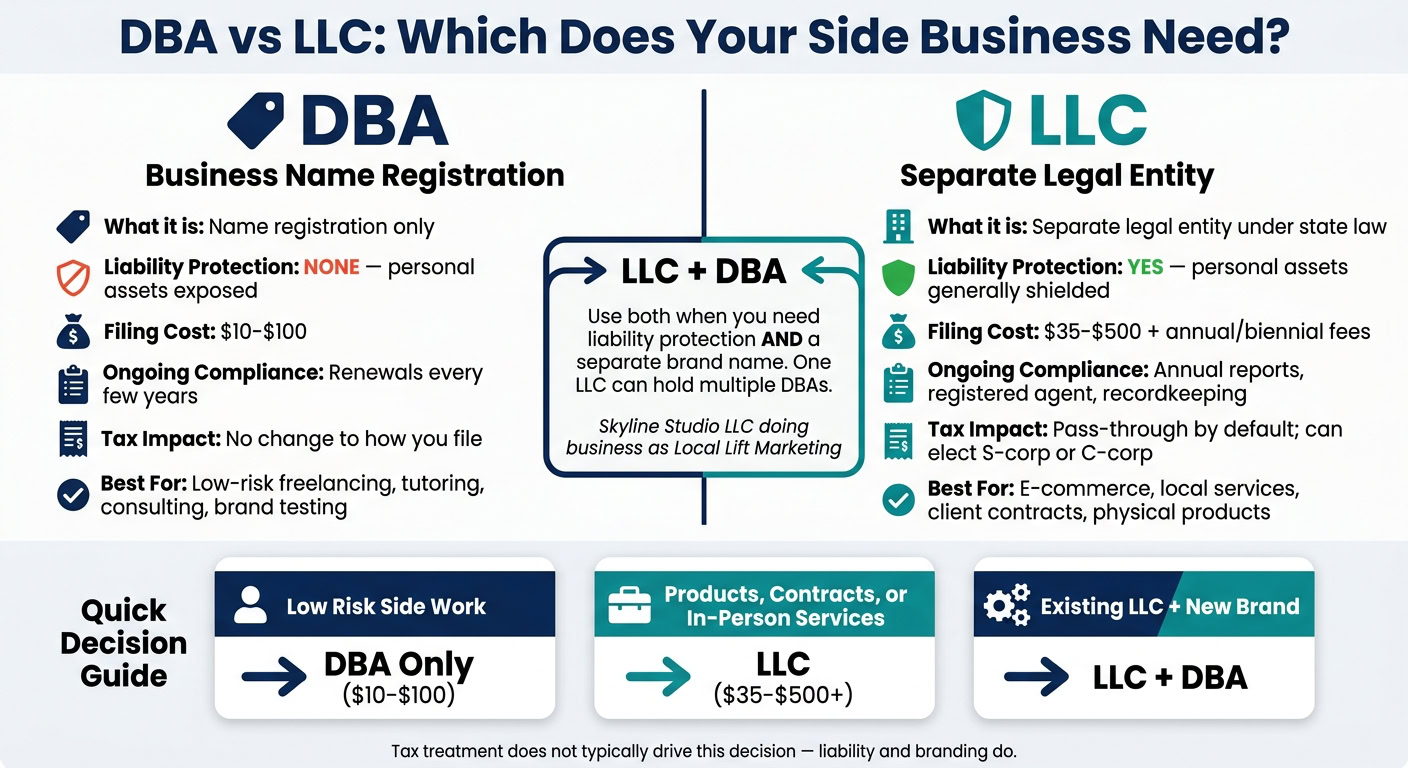
DBA vs LLC: Side Business Structure Comparison
Quick Comparison
|
Criteria |
DBA |
LLC |
|---|---|---|
|
What it is |
Business name filing |
Separate legal entity |
|
Main use |
Branding |
Liability protection |
|
Personal asset protection |
No |
Usually yes |
|
Tax change |
No |
Usually no by default |
|
Filing cost |
About $10–$100 |
About $35–$500 |
|
Extra filings later |
Renewal in many places |
|
|
Best for |
Higher-risk side work |
My rule of thumb: if the risk is low, keep it simple. If the risk touches products, property, contracts, or in-person services, pay for the LLC.
This guide breaks down when each option fits, what it costs, and when using both makes sense.
DBA vs. LLC: Core Differences at a Glance
Here’s the practical difference in one view.
|
Feature |
DBA |
LLC |
|---|---|---|
|
Entity status |
Name registration only |
Separate legal entity created under state law |
|
Liability protection |
None – personal assets remain exposed |
Limited liability – personal assets are generally shielded |
|
Filing level |
State, county, or city depending on jurisdiction |
State level via Articles of Organization |
|
Tax treatment |
Does not change how you file taxes |
Usually pass-through taxation by default |
|
Naming use |
Lets you operate under a trade or brand name |
Legal entity name registered with the state; can also add DBAs |
|
Startup cost |
Often under $100 in many jurisdictions [9] |
|
|
Ongoing compliance |
Renewals required; some states require newspaper publication [7][5] |
Annual or biennial reports, registered agent, ongoing fees [9][10] |
What a DBA Does and Does Not Do
For many side businesses, the first question is simple: do you just need a business name?
A DBA, also called an assumed name or trade name, lets you operate under a brand name instead of your legal name [12][6][5]. So if you want customers to see a business name instead of Jane Smith, a DBA can do that.
But that’s the main job. A DBA does not create a separate business entity. It does not separate you from the business. And it does not change how you file taxes.
The rules can also shift depending on where you live. DBA filings may happen at the state, county, or city level, and many registrations have to be renewed every few years to stay active [7][5].
What an LLC Does and When It Matters
If branding is one piece of the puzzle but risk is the bigger issue, an LLC starts to make more sense.
An LLC creates legal separation between you and the business. You form it by filing Articles of Organization with your state’s Secretary of State office and paying a filing fee [4][8]. Once formed, the LLC can own assets, sign contracts, and be sued separately from you [13][15].
That split matters more than many people think. If your side business signs contracts, sells physical products, performs local services, or hires contractors, an LLC can help keep those business risks from spilling into your personal finances [14][15][2].
There’s a trade-off, of course. An LLC usually costs more to start, and it comes with more paperwork. Filing fees, publication rules, and annual reports vary by state. Most states also expect annual or biennial reports, a registered agent, and basic recordkeeping to keep the liability shield in place [9][10].
How to Choose Based on Risk, Cost, Taxes, and Branding
The real decision comes down to this: do you just need a business name, or do you need a business name and liability protection? Once you’ve got the basic structures straight, the next step is matching the option to your risk level and your budget.
Costs, Filings, and Ongoing Compliance in the U.S.
A DBA is usually the lower-cost option. Filing fees often range from $10 to $100, and renewals tend to come every few years at about the same price.[20][25][9] An LLC costs more to set up. State formation fees usually fall between $50 and $500, and there are added recurring costs like annual or biennial reports, registered agent fees, and, in some states, franchise taxes.[9][27][29]
There’s also a cost people sometimes miss with a DBA: some states require newspaper publication, which can push the actual price past the filing fee alone.[17][18][19]
On the federal tax side, a DBA changes nothing. A single-member LLC is also disregarded by default. Tax treatment only shifts if you elect S corp or C corp status.[26][28]
When Branding Needs and Liability Needs Are Separate
Once cost and taxes are out of the way, the main issue is risk. If the work carries little legal exposure, a DBA may be enough.
For example, a freelance graphic designer billing as “Bright Pixel Studio” or a tutor working as “Main Street Math Tutoring” can use a DBA and keep costs low.[20][2] Legally and for tax purposes, the business is still a sole proprietorship vs. LLC comparison case. The DBA simply gives it a public-facing name.
That changes when the business starts taking on more risk. Client contracts, physical products, or work done on someone else’s property can all bring exposure. A home organizer or mobile repair technician entering clients’ homes has a real chance of facing claims tied to property damage or injury. In that situation, branding and liability protection stop being separate issues.
An LLC using the brand name – such as “Greenpath Yard Care LLC” – can cover both at the same time.[3][26] And there’s another plus: one LLC can register multiple DBAs, so a single legal entity can operate several brands.[22][23][24] That gives you room to test different names or service lines without setting up a separate LLC for each one.
Best Fit for Common Side-Business Scenarios
The risk and branding trade-offs above are easier to sort out when you tie them to the kind of work you do every day. Here’s the quick snapshot first, then the notes below break down why each setup tends to fit.
|
Scenario |
Risk Level |
Main Need |
Recommended Setup |
|---|---|---|---|
|
Freelancing |
Low |
Professional name for invoicing and banking |
DBA only |
|
Consulting |
Low |
Brand credibility, simple contracts |
DBA only; consider an LLC as income or contract size grows |
|
E-commerce (with inventory) |
Moderate–High |
Product liability protection |
LLC (+ DBA for branding if needed) |
|
Local services (at client homes or job sites) |
High |
Property damage and injury protection |
LLC + liability insurance |
|
Testing a brand |
Low |
Validate demand before committing |
DBA only; consider LLC once revenue is consistent |
|
Existing LLC, new brand |
Varies |
Separate customer-facing identity |
LLC + DBA |
When a DBA Only Is Usually Enough
For low-risk, service-based work, a DBA is often the fastest and least expensive path. It fits solo copywriters, part-time tutors, and remote marketing consultants well. You register a DBA, then open a business checking account under that trade name. The income still goes on your personal tax return, but your proposals and invoices can carry a business name instead of your own. That gives you a more polished front without the cost or paperwork of setting up a new entity.[1][21]
That said, a DBA protects the name, not you. It does not create liability protection. For many low-revenue, low-risk side businesses, professional liability insurance can help cover day-to-day risks. But that’s a separate step, and you have to add it on purpose.
When an LLC Is the Safer Move
Once your work comes with real risk, the legal shield matters more than the name on the door. E-commerce, home-repair, lawn care, cleaning, and pet services all bring enough exposure that an LLC often makes more sense.[16][21][31]
Here’s the plain-English version: if a product hurts someone, or a customer says your work damaged their property, the claim goes to the LLC instead of you personally – if you’ve kept business and personal finances separate and handled the basic recordkeeping properly.[21][31] That separation is the whole point. If you blur the lines, the shield can weaken fast. Maintaining this separation is also the first step to building business credit for your new entity.
When Using Both a DBA and an LLC Makes Sense
Sometimes you already have an LLC, but you want to sell under a different brand name. That’s where a DBA comes in handy. One LLC can operate more than one brand through separate DBAs, so you don’t need to start a second entity just to test a new offer or speak to a different market.
For example, a web designer running Skyline Studio LLC might register Local Lift Marketing as a DBA of that same LLC to sell SEO services under a different brand.[13][30][22] In that setup, contracts still name the LLC as the legal party – usually written as “Skyline Studio LLC doing business as Local Lift Marketing” – while the liability shield applies to work done under both names. That can save time, money, and extra admin compared with forming another LLC.[22][32][33]
Conclusion: Pick the Simplest Option That Covers Your Real Risk
Pick the setup that fits the risk you actually have. If you only need a business name, use a DBA. If you need liability protection, form an LLC. If you need both, use both. In most cases, taxes aren’t what make this call. Liability and branding are.
Here’s the practical breakdown.
Quick Summary: Which Option Fits Your Situation
Most side-business choices come down to four things: risk, branding, cost, and compliance.
|
Factor |
DBA Only |
LLC Only |
LLC + DBA |
|---|---|---|---|
|
Risk level |
Low |
Moderate to high |
Moderate to high |
|
Branding need |
One professional name |
One business name |
Multiple brands or a name different from the LLC |
|
Budget |
Tight ($10–$100 to file)[37] |
Moderate ($35–$500 to form, plus annual or biennial fees)[11][34] |
Higher (formation plus DBA filing costs) |
|
Compliance burden |
Minimal |
Basic (annual reports, separate banking) |
Highest compliance burden |
State rules matter too, because filing and renewal steps change depending on where you are. In many states, DBA filings happen at the county level, while other states handle them at the state level[36][37]. California is a good example of how specific these rules can get: many DBA filers must register the fictitious business name with the county clerk and publish the statement once a week for four consecutive weeks after filing[38].
LLCs work differently. They’re formed at the state level, usually by filing Articles of Organization with the Secretary of State or a similar office. Most states also require annual or biennial reports to keep the LLC in good standing[35].
The most common slip-ups aren’t hard to avoid:
-
Don’t mix personal and business funds.
-
Renew your DBA before it expires.
-
File your LLC’s annual or biennial report on time[35].
Start with the setup that fits your current risk. Add the other piece later if the business calls for it.
FAQs
Can I start with a DBA and switch to an LLC later?
Yes. A lot of business owners start with a DBA as a sole proprietor. It’s a simple way to test an idea or operate under a business name without setting up an LLC right away.
Then, later on, they make the switch.
As your side business grows, brings in steady income, or starts taking on more risk, moving to an LLC can help shield your personal assets. To make that change, you’ll file formation documents with your state.
Do I need a separate business bank account for a DBA or LLC?
Yes. You should open a separate business bank account whether you use a DBA or an LLC.
With a DBA, a separate account gives you a clean financial paper trail, makes tax time easier, and helps your business look more professional.
With an LLC, keeping business and personal money apart matters for protecting your liability shield. In both cases, a separate account helps prevent commingling funds.
Will an LLC protect me if I make a mistake or get sued?
An LLC will usually separate your personal assets from your business. That can help shield things like your home, car, and savings if the business runs into debt or gets sued.
That said, the shield isn’t absolute.
If you’re personally responsible for negligence, malpractice, or illegal conduct, your personal assets may still be on the line. The same goes if you blur the line between personal and business money. For cases like these, business insurance is a smart backup.