
Most U.S. businesses do not need a DUNS number. You usually need one only if a lender, supplier, or large company asks for it for business credit, vendor setup, or net-30 terms.
Here’s the short answer:
- A DUNS number is a 9-digit ID from Dun & Bradstreet
- It links your business to a D&B credit file
- It is not the federal ID for grants or contracts anymore
- Since April 4, 2022, federal systems use the UEI through SAM.gov
- If you only need tax filing, payroll, or state registration, your EIN and state records are usually enough
That’s why the question isn’t just “What is a DUNS number?” The better question is: “Will anyone I work with ask for it?”
Here’s where it tends to matter most:
- Supplier credit
- Building business credit
- Enterprise vendor onboarding
- Equipment financing
- Large buyer procurement systems
And here’s where it usually does not matter:
- Freelance work
- Local service businesses
- Federal awards through SAM.gov
- Day-to-day tax or legal filing
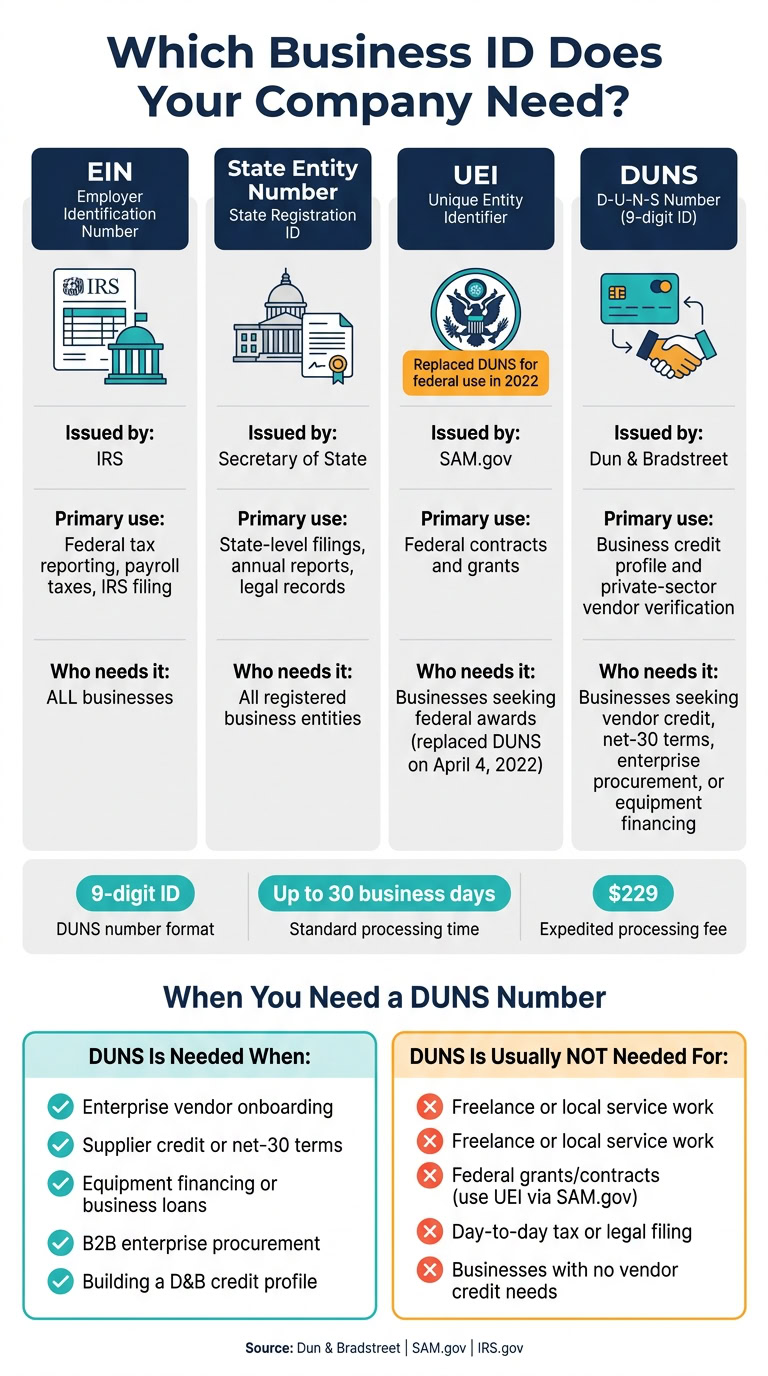
A few facts stand out:
- DUNS numbers are location-based, so different branches may have different records
- Standard setup can take up to 30 business days
- Expedited processing may cost $229
- Small errors in your business name, address, or phone can delay setup
If I want the simplest way to think about it, it’s this: DUNS is mostly for private-sector credit and vendor checks, not for running a business or dealing with federal tax rules.
| ID | What it’s for | Who issues it |
|---|---|---|
| EIN | Taxes, payroll, IRS filing | IRS |
| State entity number | State registration and reports | State office |
| UEI | Federal grants and contracts | SAM.gov |
| DUNS | D&B credit file and vendor review | Dun & Bradstreet |
So before I apply, I’d ask one simple question: Is a bank, supplier, or buyer asking for it? If the answer is no, I may not need it at all.
What a DUNS Number Does for Business Identity and Credit
A DUNS number is the ID that ties your company to its Dun & Bradstreet business credit file. Lenders, suppliers, and purchasing teams often use that file to review your D&B profile and payment history. This tends to matter most when a vendor or lender wants to see a credit file before offering terms.
How DUNS Tracks a Business Record
D&B connects a business’s legal name, physical address, contact details, and parent, subsidiary, and branch relationships to each DUNS record. Trade lines, loans, and vendor payment terms may also be linked to the file, and those details help shape scores such as PAYDEX.
DUNS is also location-specific. So if separate locations operate and borrow on their own, they may each have their own DUNS number. For businesses with more than one location, that means checking which entities or locations should keep separate records, especially if they sign leases, hold vendor accounts, or apply for credit.
DUNS vs. EIN, State Entity Number, and UEI
Each identifier has its own job:
| Identifier | Issued By | Primary Purpose |
|---|---|---|
| EIN | IRS | Federal tax reporting, payroll taxes, and information reporting |
| State Entity Number | Secretary of State | State-level filings, annual reports, and legal records |
| UEI | SAM.gov | Federal contracts and grants |
| DUNS | Dun & Bradstreet | Business credit profile and private-sector vendor verification |
Your EIN is for tax matters. Your state entity number shows that your business is registered with your state. Your UEI is now the ID federal agencies use for awards and contracts. And your DUNS number is the one private-sector creditors and vendors may use when reviewing your business credit file.
At that point, the issue isn’t just what a DUNS number is. It’s when a business needs one.
Why DUNS Can Matter for Trade Credit and Business Credibility
When a supplier offers net-30 terms, it is taking a risk by sending goods before getting paid. To judge that risk, many lenders and suppliers check a D&B report for payment history, credit scores, and risk signals before setting terms or credit limits. If you don’t have a DUNS number and a useful D&B file, you may be more likely to start with cash-on-delivery or smaller opening limits until you build some payment history.
For remote or online-only businesses, a DUNS number can help establish a credit record when there is no storefront or local trade history to point to. As more positive trade history is added to the file, it may help the business qualify for better credit terms without leaning on the owner’s personal credit.
That’s when DUNS stops being nice to have and starts feeling like something you may need.
sbb-itb-ba0a4be
When Your Business Needs a DUNS Number and When It Does Not
Once you know what DUNS is for, the next step is simple: figure out whether your business needs one at all. And that comes down to the situation.
Here’s the short version.
| Scenario | DUNS Status | Primary Reason |
|---|---|---|
| Enterprise vendor onboarding | Required | Enterprise buyers use D&B records to verify business identity during supplier review |
| Older grant or procurement forms still referencing DUNS | Required | Some forms still haven’t switched to UEI |
| Commercial vendor credit and enterprise buyers | Recommended | Vendors and lenders use D&B reports to set payment terms and credit limits |
| Equipment financing or business loans | Recommended | A D&B file helps establish business credit independent of personal credit |
| Federal contracts or grants (SAM.gov) | Not Needed | Federal systems now use UEI instead |
| Freelancing or local service work | Usually Unnecessary | EIN and state registration cover legal and tax needs |
| No vendor credit or large-buyer relationships | Usually Unnecessary | DUNS has no role in day-to-day operations without commercial credit or procurement activity |
When a DUNS Number Is Effectively Required
The clearest case is when the other side asks for it in their onboarding process. Large corporations, especially retailers, wholesalers, and institutional buyers, often include a DUNS number field in their vendor registration systems. If that field is required, you’ll need the number to finish the form.
The second case is older paperwork. Some forms still ask for DUNS even though many systems have moved to UEI. If you see that, check whether the document just hasn’t been updated yet. And if a non-federal institution is asking, contact them directly and confirm which identifier they want before you apply.
When a DUNS Number Is Recommended but Optional
For businesses moving into larger commercial deals, getting a DUNS number early can make life easier. Think of setting up an LLC to pitch big-box retailers, a B2B service company going after enterprise procurement, or a contractor looking for equipment financing.
In those cases, having a D&B file in place before someone asks for it can save time.
A DUNS file may also help lenders and vendors review your business without leaning only on personal credit. That doesn’t mean automatic approval. It just means a smoother review process and cleaner onboarding.
When a DUNS Number Is Usually Unnecessary
If none of those situations fit, DUNS is usually optional. A local plumber, a freelance graphic designer, or a one-person tutoring business does not need a DUNS number to operate legally, pay taxes, or get paid.
If your business isn’t seeking vendor credit, institutional procurement, or deals with large commercial buyers, a DUNS number likely won’t affect your day-to-day work.
Next, the application process shows how to get a DUNS record only when there’s a clear business reason for it.
How to Apply for a DUNS Number and Avoid Common Setup Problems
Information to Gather Before Applying
Before you apply, get your business details in one place. You’ll need your legal business name, physical street address, mailing address, main business phone number, business entity type, start date, employee count, and the name of an owner or other authorized contact. D&B uses this information to match your company to its credit file. A P.O. box usually can’t be used as the primary address.
This part sounds simple, but it’s where a lot of people get tripped up. Your details should match your state filings, IRS records, and bank records exactly. Even tiny differences in spelling, punctuation, or address format can slow things down or send your application into manual review.
What the Application Process Looks Like
The first step is to search D&B’s database and see whether your business already has a DUNS number. That’s more common than people think. If you submit a duplicate application, you can end up splitting your credit file and making verification harder than it needs to be.
If no DUNS record exists, move forward with a clean first application through D&B’s website using the information you gathered earlier. Standard free processing can take up to 30 business days. If you’re on a tight timeline, expedited processing may be available for $229, which can shorten the wait to about eight business days.
After you submit, D&B may contact you by phone or email to verify your information. If you take too long to respond, approval can be delayed.
How to Keep Your DUNS Profile Accurate After Approval
Once your DUNS number is active, keep the profile current. Update your D&B record whenever your address, phone number, ownership structure, executive contact, or branch/location information changes.
Why does this matter? Because mismatched records can cause friction fast. An old address can slow vendor onboarding. A business name that doesn’t line up with your other records can trigger extra review for net-30 terms. Keeping your D&B file aligned with your state, IRS, and banking records helps you avoid those slowdowns. That’s what makes a DUNS number work smoothly with your other business identifiers.
How DUNS Fits Into a Broader U.S. Business Setup
Once your business is legally formed, DUNS usually comes into play only if you need commercial credit or vendor onboarding. In most cases, businesses handle the basics first: form the entity, get an EIN, set up a stable address, and open a business bank account for your LLC before applying for DUNS.
Here’s the simple reason: D&B builds your file using your legal name, address, and entity details. If those records are steady and match across documents, vendors can verify your business with fewer hiccups. That’s why it makes sense to check your D&B profile details before you apply.
At this stage, DUNS works as an extra identifier for businesses that need vendor onboarding or private-sector credit.
If you sell to private companies, DUNS is the identifier that matters. If your goal is supplier credit, corporate vendor approval, or building a formal business credit profile through Dun & Bradstreet, DUNS is the one to use.
A consistent business mailing address also helps D&B match your records cleanly from the start.
FAQs
How do I know if my business already has a DUNS number?
Check the Dun & Bradstreet website first to see if your business already has a record. The easiest way is to use its official search tool or application portal.
Be careful with the details you enter. Use your exact legal business name, address, and phone number the same way they appear in your state registration. Even small differences can lead to a mismatch.
Can I get a DUNS number without a physical business address?
Usually, no. In most cases, you can’t get a D-U-N-S number without giving a business address.
The application asks for your business address and phone number, and those details should line up with your credit records. If you don’t have a storefront, you’ll often need to use a verified address instead of a P.O. Box.
What happens if your DUNS record has the wrong business information?
If your DUNS record has wrong information, fix it as soon as you can. Reach out to Dun & Bradstreet, file a formal dispute, and send proof such as bank statements, invoices, or official registration records.
It also helps to keep your business name, address, and phone number the same across credit bureaus and official records. Even small mismatches can cause issues with your credit profile.