


If I clear less than $50,000 in yearly business profit, S-Corp status usually does not pay off. Once profit gets into the $60,000 to $80,000 range, I need to run the numbers. At $100,000+, the tax savings often beat the extra costs.
Here’s the short version:
- With a sole proprietorship or default single-member LLC, most or all net profit gets hit with 15.3% self-employment tax
- With an S-Corp, I pay that tax on salary only, not on distributions
- The trade-off is extra work and added costs like:
- payroll
- Form 1120-S
- W-2s
- state fees
- added tax prep
- A rough yearly cost for S-Corp upkeep is often $1,500 to $2,500
- Filing too early can wipe out the savings
If I want a fast rule, it’s this:
- Under $50,000: usually too soon
- $60,000 to $80,000: math test
- $100,000 or more: often worth a close look
Quick Comparison
| Profit range | S-Corp fit | Main reason |
|---|---|---|
| Under $50,000 | Usually no | Savings are often too small after payroll and tax prep |
| $60,000 to $80,000 | Maybe | It depends on salary level, state fees, and admin costs |
| $100,000+ | Often yes | Distribution savings can outpace fixed yearly costs |
One more thing: the IRS does not give a set income cutoff. So I would not base choosing S-Corp or C-Corp for taxes on profit alone. I would look at my pay level, my state costs, and how much extra filing work I’m willing to take on.
sbb-itb-ba0a4be
How Sole Proprietorship, LLC, and S-Corp Taxation Differ
The tax gap between these setups comes down to one thing: how much of your profit gets hit with self-employment tax. Once you get that part, the income threshold discussion starts to make sense.
Default Taxation: Self-Employment Tax on Most Business Profit
If you run a sole proprietorship or a single-member LLC with no special tax election, the IRS will usually tax that single-member LLC the same way it taxes a sole proprietorship. Your net profit passes straight through to your personal Form 1040 on Schedule C, and the full amount is subject to self-employment tax.
That self-employment tax rate is 15.3%. It includes 12.4% for Social Security and 2.9% for Medicare. It applies to almost all net earnings up to the Social Security wage base, which is $184,500 for 2026. As the owner, you don’t get a W-2. You take draws from the business, but the IRS taxes the profit whether you pulled the money out or left it in the business.
S-Corp Taxation: Salary Plus Distributions
Choosing S-Corp tax status by filing IRS Form 2553 does not change your business entity. It changes the way the IRS taxes it. After the election takes effect, you become a shareholder-employee. That means you need to run payroll, pay yourself a W-2 salary, and then take any leftover profit as a shareholder distribution.
Only your W-2 salary is subject to payroll taxes. Distributions are not. That’s where the tax savings can come from. But there’s a catch: the IRS says your pay must reflect "reasonable compensation" for the work you do. If you set your salary too low just to shift more money into distributions, that can draw audit attention.
Here’s the side-by-side view:
| Feature | Sole Proprietorship / Default LLC | LLC Taxed as S-Corp |
|---|---|---|
| Tax Treatment | Pass-through; all profit taxed as personal income | Pass-through; profit split between salary and distributions |
| Self-Employment Tax | 15.3% on nearly all net profit | 15.3% on salary only; none on distributions |
| Owner Pay | Owner draws (no payroll required) | W-2 salary + shareholder distributions |
| Forms Filed | Form 1040 (Schedule C) | Form 1120S, Schedule K-1, and W-2 |
| Compliance Burden | Low; no payroll required | Higher; requires quarterly payroll and tax filings |
| IRS Scrutiny | Standard | Elevated, especially around reasonable salary |
Those extra forms and payroll steps are why the next section gets into break-even math.
The Income Threshold: When to Start Considering S-Corp Status
The break-even point comes down to three things: your profit, your reasonable salary, and your yearly compliance costs. The tax play with an S-Corp is pretty simple. You pay payroll tax on salary, but distributions aren’t hit the same way. So the key question is: when do the tax savings beat the added cost?
Here’s the rough range where that starts to shift:
| Annual Net Profit | Recommendation | Reasoning |
|---|---|---|
| Under $50,000 | Usually Too Early | Compliance costs for payroll ($600–$1,200/year) and extra accounting ($800+) often exceed the tax savings on a small distribution amount. |
| $60,000–$80,000 | Break-Even Zone | Tax savings start to outweigh the $1,500–$2,500 in added annual costs, especially in states with low filing fees. |
| $100,000 or More | Clear Benefit | Tax savings, often $4,000+, make fixed compliance costs a smaller share of total profit. |
Under $50,000 in Annual Profit: Usually Too Early
At this level, the fixed costs usually take a big bite out of the savings. The distribution portion is often too small to make much of a tax difference after you factor in payroll processing, extra accounting, and any state-level fees.
Payroll often costs $50–$100 per month, or $600–$1,200 per year, and S-Corp tax return prep can add about $800 in accounting fees. Put that together, and the added costs can wipe out the tax savings.
$60,000 to $80,000 in Annual Profit: The Break-Even Zone
This is where the math starts to get interesting. You can start to see savings in this range, but they’re not automatic. Once payroll costs and tax prep are added in, the edge can shrink fast.
That’s why this range is best seen as a decision zone, not a sure win. In states with low filing fees, the setup may make sense sooner. In higher-cost states, the numbers may still feel tight.
$100,000 or More in Annual Profit: Often a Clear Benefit
Once profit gets past $100,000, the case for S-Corp status is often much easier to make. A reasonable salary can still leave enough profit available as distribution to create meaningful tax savings.
At that point, the self-employment tax avoided on the distribution can reach $4,000 or more per year. Since the fixed compliance costs stay about the same, they take up a much smaller slice of total profit.
How to Calculate Your S-Corp Break-Even Point
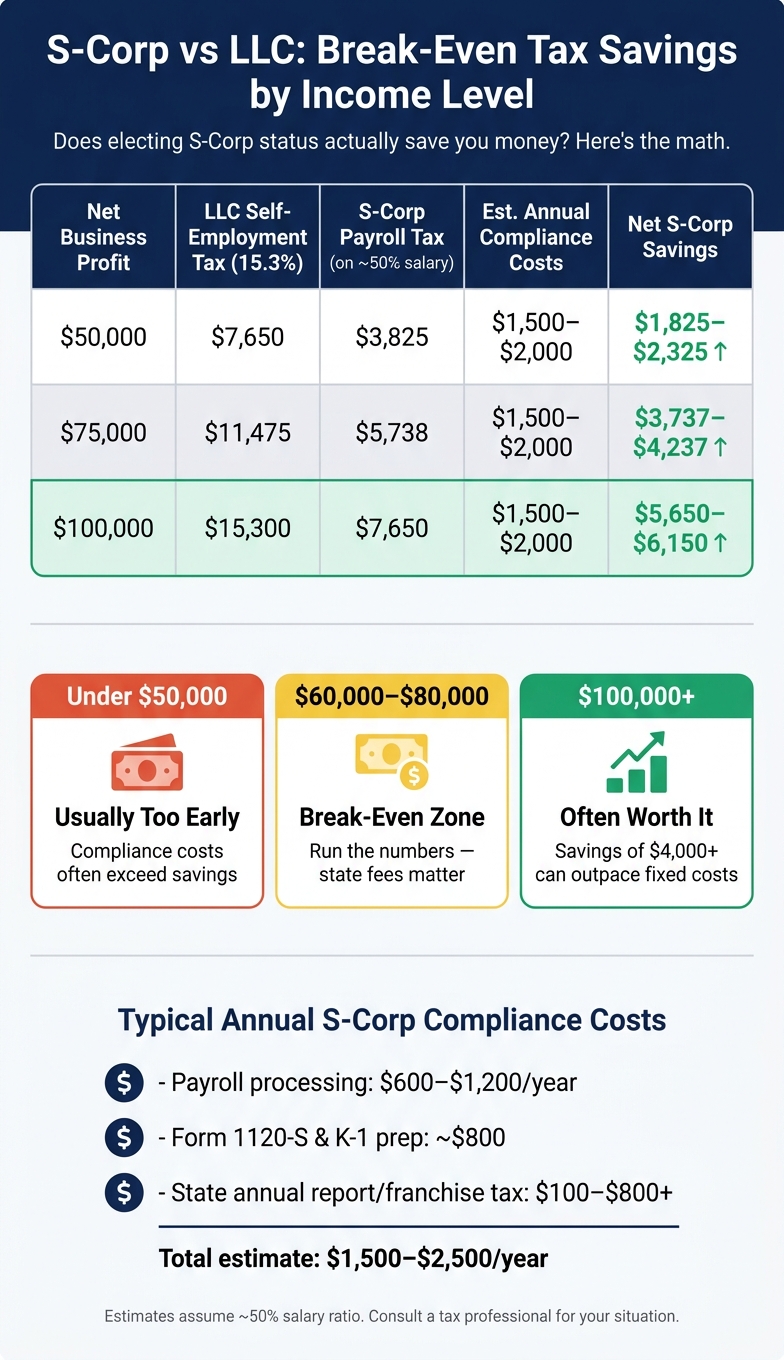
S-Corp vs LLC Tax Savings by Income Level: Break-Even Calculator
This break-even test helps you figure out if your profit is high enough to cover the extra cost of running an S-Corp. The idea is pretty simple: compare what you’d pay in self-employment tax as a sole proprietor or default LLC with what you’d pay in S-Corp payroll tax, then subtract your yearly S-Corp costs. What’s left tells you whether the election puts money back in your pocket.
Step 1: Estimate Your Self-Employment Tax as a Sole Proprietor or Default LLC
If you’re taxed as a sole proprietor or default LLC, use 15.3% of net profit as your baseline self-employment tax estimate.
So, if your net profit is $80,000, your self-employment tax baseline is $12,240.
Step 2: Estimate Payroll Tax and Distributions Under an S-Corp
With an S-Corp, you pay yourself a reasonable salary based on what someone would earn for doing the same job. For many service businesses, that often lands around 40% to 60% of net income. The rest can be taken as distributions, and those distributions are not subject to self-employment tax.
Using $80,000 in profit and a $40,000 salary, your payroll tax would be $6,120. That creates $6,120 in gross tax savings.
Step 3: Subtract Real Annual S-Corp Costs
Here’s where people sometimes get tripped up: gross savings are not the same as net savings. You still have to pay for the extra admin work that comes with an S-Corp.
Typical annual costs include:
- Payroll processing: $600–$1,200 per year
- Form 1120-S and K-1 prep: about $800
- State annual report or franchise tax: $100–$300 in most states; $800 minimum in California
- Reasonable-compensation documentation: wage data and job-duty support
At $80,000 in net profit, those added costs often come out to about $1,500 to $2,000. Take that away from the $6,120 in gross savings, and your net annual benefit is about $4,120 to $4,620.
The same math changes as profit goes up:
| Net Business Profit | LLC Self-Employment Tax (15.3%) | S-Corp Salary (Est. 50%) | S-Corp Payroll Tax | Est. Annual Compliance Costs | Net S-Corp Savings |
|---|---|---|---|---|---|
| $50,000 | $7,650 | $25,000 | $3,825 | $1,500–$2,000 | $1,825–$2,325 |
| $75,000 | $11,475 | $37,500 | $5,738 | $1,500–$2,000 | $3,737–$4,237 |
| $100,000 | $15,300 | $50,000 | $7,650 | $1,500–$2,000 | $5,650–$6,150 |
Estimates include payroll services, tax prep, and state fees.
When to File and How to Handle the Added Compliance
Once the numbers show a net gain, timing matters because it decides when those tax savings can start.
When to File Form 2553
For an existing business, file by March 15 of the tax year you want the election to take effect. For a newly formed entity, you have 75 days from the date of formation to apply it to that same year.
After the election kicks in, the tax savings only hold up if payroll and reporting stay on track. That means you’ll need to handle a few extra tasks on a regular basis:
- Pay yourself a reasonable salary
- Run payroll and make payroll tax deposits
- File quarterly payroll tax returns, including Form 941
- Issue annual W-2s
- File Form 1120S each year
This added admin is a big reason S-Corp status tends to make sense only once profit gets high enough. Miss one of these steps, and penalties can eat into your savings fast – or wipe them out altogether.
BusinessAnywhere Services That Support the Switch
These services can cut down the setup work and the recurring compliance load, which both affect your break-even point.
BusinessAnywhere offers help with the election and the work that comes after it. The S-Corp Tax Election filing service handles Form 2553 for $97. If you’re still forming an LLC, Business Registration starts at $0 plus state fees, and the EIN Application Service costs $97. For ongoing state compliance, Registered Agent Service starts at $147/year.
Conclusion: A Simple Rule for Deciding
If your profit is above the break-even point, file on time and plan for payroll plus annual returns.
FAQs
How do I choose a reasonable salary?
Choose a salary based on what an unrelated employer would pay for your role, duties, experience, and hours. The IRS doesn’t give a fixed formula, so your pay needs to be backed by records like job duties, credentials, hours worked, and local market rates.
For many service businesses, 40%–70% of net profit can serve as a starting point. But the main thing is fair market value. Run that pay through W-2 payroll before taking distributions, and don’t set the salary artificially low.
Do state taxes change the S-Corp break-even point?
Yes. State taxes can directly change the S-Corp break-even point because extra costs, like franchise taxes or yearly entity fees, can eat into federal self-employment tax savings.
Take California as an example. The state’s 1.5% franchise tax and $800 minimum annual fee push the income level higher before an S-Corp starts to pay off.
When you work out your break-even point, include:
- State-specific taxes and fees
- Federal payroll costs
- Administrative expenses
If you skip those state-level costs, the math can look better than it is.
Can I switch to S-Corp status later if my profit grows?
Yes. You can elect S-Corp status later as your business grows because it’s a tax election, not a change to your core business entity.
A lot of owners start with a standard LLC and make the switch once annual net profit stays around $60,000 to $80,000. At that point, the tax savings may be more than the added payroll and compliance costs.
To make the change, file IRS Form 2553.