

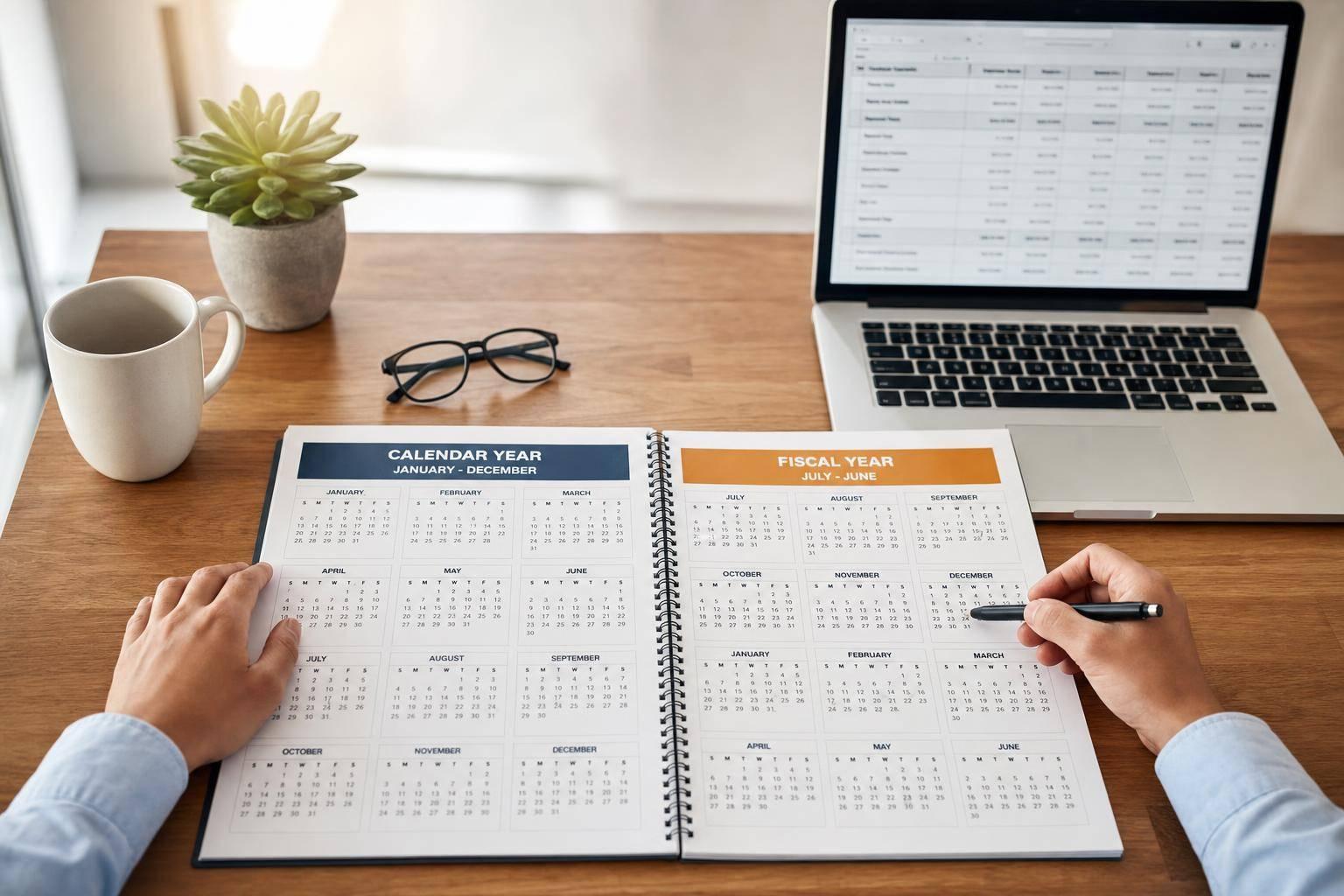
Your business year changes more than your close date. It affects when I file taxes, when I close the books, how payroll forms line up, and whether I may need IRS approval to use or change a tax year.
Here’s the short answer:
- A calendar year runs January 1–December 31
- A fiscal year is any other 12-month period ending on the last day of a different month
- Sole proprietors, single-member LLCs, and many S corps often use a calendar year
- A fiscal year can fit better if sales peak near year-end or business is seasonal
- Changing years can mean IRS filings, a short-year return, and shifted due dates
- W-2s and 1099s still follow the calendar year, even if the business books do not
In many cases, the simplest choice is the one that matches how the business runs and what the IRS allows. If I have a busy holiday season, for example, a July 1–June 30 year may make year-end less hectic than closing on December 31.
Quick Comparison
| Item | Calendar Year | Fiscal Year |
|---|---|---|
| Date range | Jan. 1–Dec. 31 | Any other 12-month period |
| Year-end | Dec. 31 | Last day of another month |
| Best fit | Many small pass-through businesses | Seasonal firms or companies with a non-December cycle |
| IRS limits | Usually the default | Often more rules to use or switch |
| Tax timing | Standard by entity type | Due dates move based on year-end |
| Payroll forms | Matches W-2/1099 timing | Adds a second timeline to track |
If I’m choosing between the two, I’d look at tax rules, filing dates, peak season timing, and admin work before making a change.
Fiscal Year vs Calendar Year: Key Differences for Business Taxes
Fiscal year vs. calendar year: definitions and core differences
The main difference comes down to when the 12-month period begins and ends.
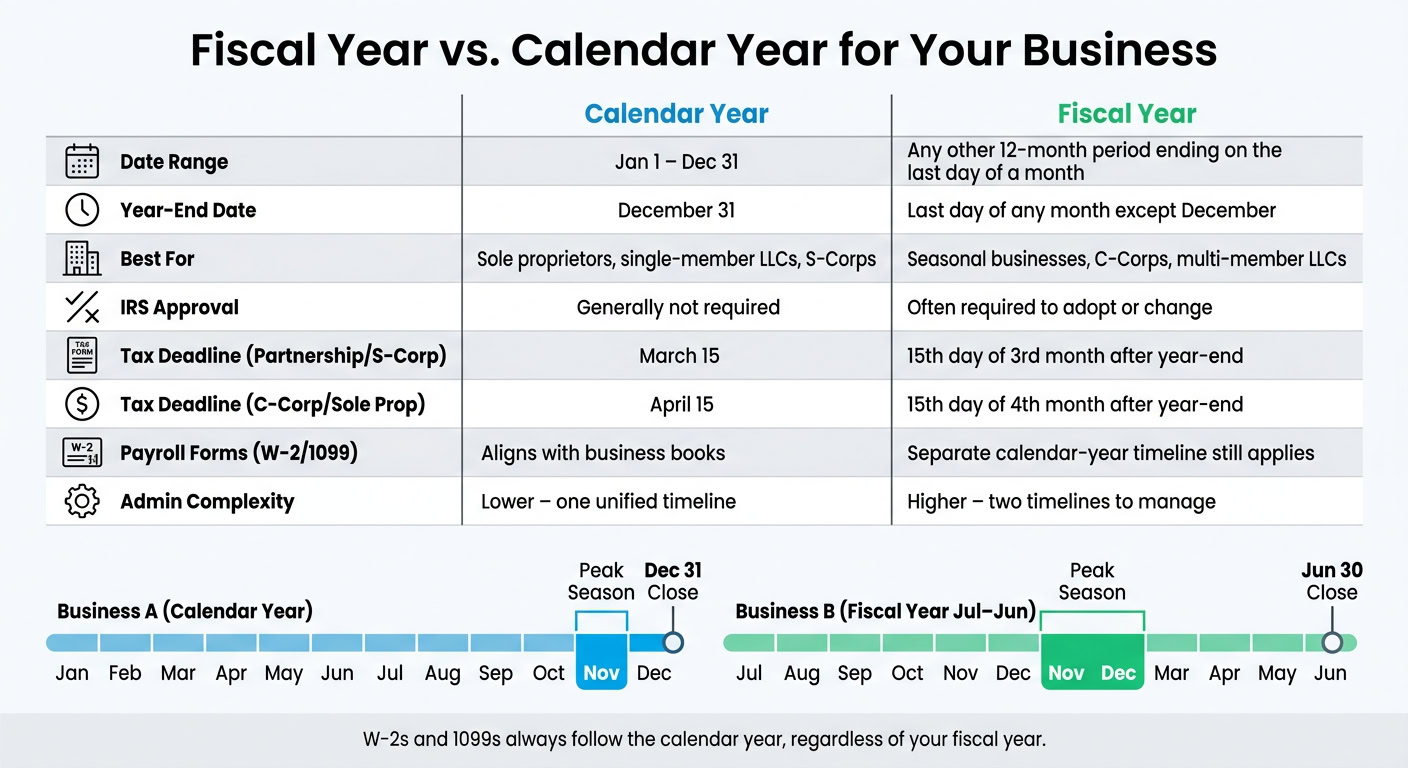
A calendar year runs from January 1 through December 31. A fiscal year is any 12-month period that ends on the last day of a month other than December. So if a business uses a July–June fiscal year, it closes its books on June 30, not December 31.
| Feature | Calendar Year | Fiscal Year |
|---|---|---|
| Duration | 12 consecutive months | 12 consecutive months |
| Start date | January 1 | First day of any month except January |
| End date | December 31 | Last day of any month except December |
| Common users | Sole proprietors, S-Corps, small LLCs | Seasonal businesses, large corporations |
| IRS approval needed | Generally not required for new businesses | Often required for sole props and S-Corps to deviate |
| Tax deadline timing | Fixed dates based on entity type | Deadlines shift based on the chosen year-end date |
Here’s what that looks like in day-to-day business use.
What a calendar year means for a business
For many U.S. businesses, the calendar year is the default. Sole proprietors, single-member LLCs taxed as sole proprietorships, and S-Corps usually use it. The big draw is simple: your business books and your personal tax return line up on the same year-end.
Single-member LLCs taxed as sole proprietorships generally use a calendar year unless they qualify for a different tax year. That makes recordkeeping a little less messy and tax season easier to track.
What a fiscal year means for a business
A fiscal year still covers 12 months. It just follows a different schedule. A business could run from July 1 to June 30 or from October 1 to September 30.
This setup tends to make more sense when a company’s busy season doesn’t line up with December. Multi-member LLCs taxed as partnerships may have more room to choose a different year, but switching to a fiscal year usually still needs IRS approval.
Put simply, a fiscal year gives a business room to line up reporting with how it actually operates.
Side-by-side example: January–December vs. July–June
A quick example makes the timing easier to see.
Business A uses a calendar year, from January through December. Its busiest season is November and December, so its peak sales hit right at year-end. That means the owner is trying to close the books and get tax records ready during the post-holiday scramble.
Business B uses a July–June fiscal year. It has the same busy season in November and December, but those months land in the middle of its fiscal year instead of at the end. By the time June 30 arrives, revenue has leveled out, and the close is less chaotic. The owner gets to wrap up the books after the rush, not during it.
That shift affects more than timing on paper. It changes when the books close, when taxes come due, and when reporting feels easiest. And that flows straight into bookkeeping, tax filing, and planning.
How your accounting year affects bookkeeping, tax filing, and reporting
Bookkeeping and year-end close
Your year-end date is the point everything ties back to. It drives reconciliations, final journal entries, and your year-end financial statements.
Here’s a simple tip that can save you a headache: set a calendar reminder at least 30 days before your year-end. That buffer gives you time to track down missing receipts, reconcile bank accounts, and get your records in order before things turn into a last-minute rush.
That same date also controls your tax filing schedule.
Tax filing deadlines and IRS rules
Your year-end affects when your tax return is due, and those due dates depend on your entity type. Tax deadlines vary by entity type:
| Entity Type | Tax Form | Calendar Year Deadline | Fiscal Year Deadline |
|---|---|---|---|
| Partnership | Form 1065 | March 15 | 15th day of 3rd month after year-end |
| S-Corp | Form 1120S | March 15 | 15th day of 3rd month after year-end |
| C-Corp | Form 1120 | April 15 | 15th day of 4th month after year-end |
| Sole Prop / Single-Member LLC | Schedule C (Form 1040) | April 15 | 15th day of 4th month after year-end |
Miss the deadline, and the IRS can assess penalties. If you’re thinking about changing your tax year, talk with a CPA first. It’s not the kind of switch you want to make on the fly.
Those filing dates also affect how easy it is to line up one year’s results against the next.
Financial reporting and business planning
When your year-end lines up with how your business actually runs, planning tends to make more sense. Your numbers are easier to review, and performance trends are easier to spot.
For seasonal businesses, there’s another upside. Picking a year-end close to your slow season can make the close process and inventory counts less disruptive. If your busiest period is all hands on deck, you probably don’t want year-end tasks landing right in the middle of it.
sbb-itb-ba0a4be
When to use a fiscal year and when a calendar year is simpler
Businesses that often benefit from a fiscal year
If your year-end should match how the business actually runs, not just the date on the calendar, a fiscal year can make reporting easier. It tends to work well for businesses with a natural business cycle that doesn’t line up with December 31. Seasonal companies often go this route so the year-end comes after peak sales and reflects one full operating cycle.
Multi-member LLCs and C-Corps often have more room here, but there’s a catch: changing an established year still usually needs IRS approval.
Businesses that often do better with a calendar year
For sole proprietors and most single-member LLCs, a calendar year is usually the simpler path. In many cases, the IRS expects it unless you can show a valid business reason for using a different fiscal year. S-Corps run into similar limits. They’re usually tied to a calendar year unless they qualify for narrow IRS exceptions.
There’s also a day-to-day reason to stick with January through December: it keeps your business taxes lined up with your personal taxes. When you use a fiscal year, the admin side can get messier because pass-through income still ends up on a calendar-year Form 1040.
W-2s and 1099s follow the calendar year too, no matter what fiscal year your business uses. So if payroll runs January through December but your books run July through June, you’re dealing with two timelines at once. That can turn a simple filing season into extra cleanup work.
The right pick usually comes down to your entity rules, tax timing, and how much extra coordination your records can handle.
Questions to ask before choosing or changing your year
These questions can help you sort out which option fits your business.
| Question | Why It Matters |
|---|---|
| Does your entity type allow a fiscal year? | S-Corps and single-member LLCs face strict IRS limits |
| When does your busiest season end? | It can help line up reporting with your operating cycle |
| Will a fiscal year complicate your personal tax return? | Pass-through income flows to a calendar-year Form 1040 |
| Are you operating in multiple states? | A fiscal year change can shift state filing deadlines and franchise tax obligations |
Changing your tax year isn’t just a box to check. It can mean IRS filings, and sometimes state filings too, plus a short-year return to cover the gap between the old year and the new one.
Conclusion: Pick the year that fits your business and compliance needs
The right choice depends on fit: how your business runs, what your entity type is allowed to use, and how much compliance work you can realistically handle.
Some businesses have room to choose. Others don’t. So before you move ahead with the year you want, check the rules that apply to your entity.
A change to your accounting year can affect filing deadlines, state requirements, and the IRS forms you may need to submit. Keep your bookkeeping steady, and before you file under a new year setup, confirm the IRS and state rules that apply to your business.
Choose the year that lines up best with your day-to-day operations and compliance rules.
FAQs
How do I know if my business can use a fiscal year?
It mostly comes down to your business structure and tax status.
A single-member LLC taxed as a sole proprietorship usually has to use a calendar year. The main exception is if it can show a valid business purpose for using a different tax year.
A multi-member LLC often has more room to choose. That said, switching to a fiscal year may still need IRS approval.
If your business is taxed as an S corporation, the rule is usually the same: use a calendar year unless you meet certain IRS requirements.
What happens if you change your business tax year?
You can change your business tax year, but it’s a formal process that usually requires IRS approval and comes with specific limits.
That change can affect your tax filing deadlines, your estimated tax payment schedule, and your state filing rules. In many cases, you’ll also need to file specific forms with the IRS and, depending on your state, your state tax agency.
Can I use a fiscal year if my payroll runs on a calendar year?
Yes. You can use a fiscal year for your business and still run payroll on a calendar year.
Here’s the simple version: payroll tax forms like Form 941 and Form W-2 usually follow calendar-year IRS reporting rules. Your fiscal year, on the other hand, sets the due date for your annual income tax return.
That split is normal. One system handles payroll reporting. The other handles your business tax year.
Still, don’t assume every rule lines up the same way at the state level. Some states require calendar-year reporting for all business activities, not just payroll. So it’s smart to check your state’s rules before you lock anything in.