

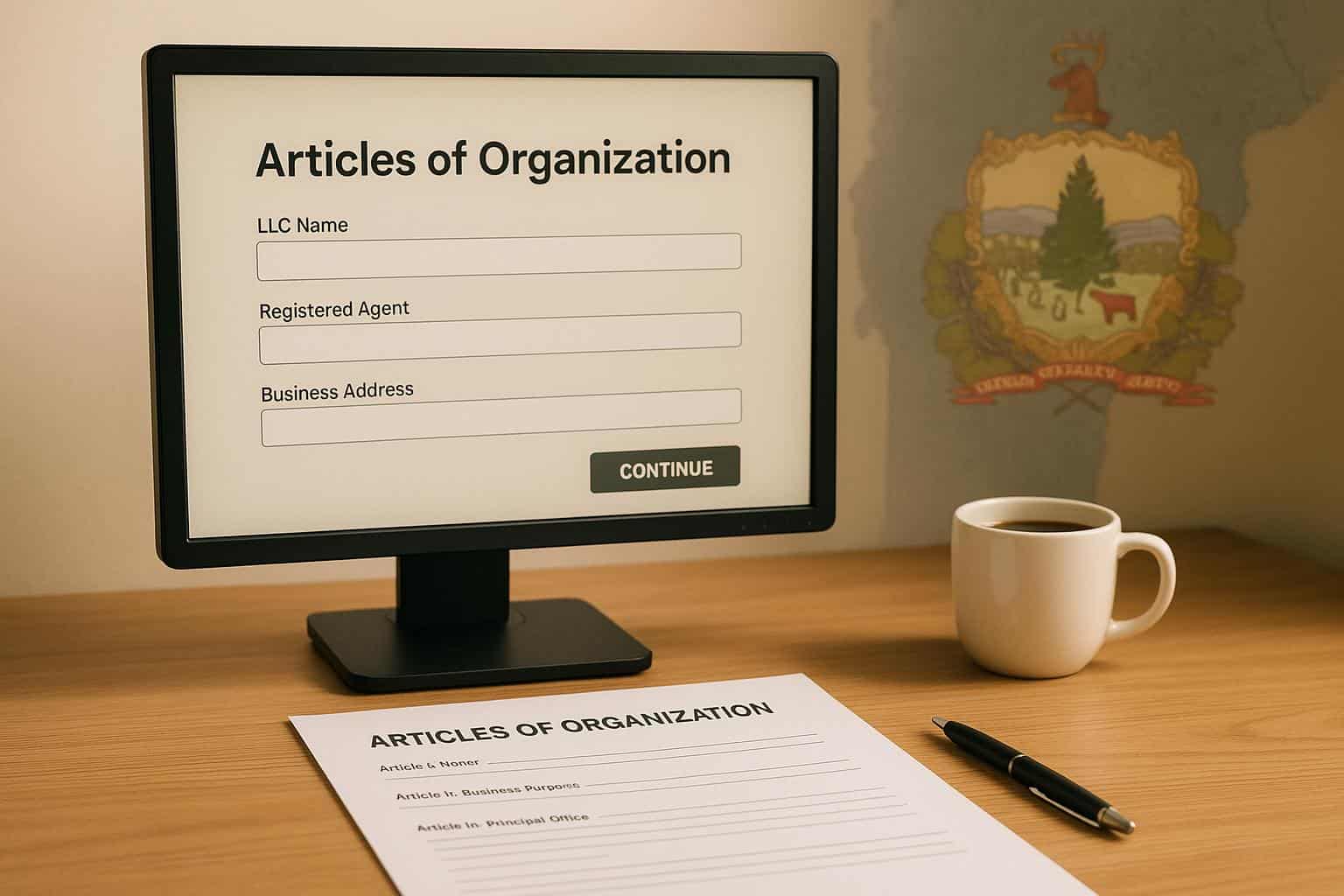
Filing Articles of Organization is the first step to officially forming an LLC in Vermont. This document legally establishes your business and provides benefits like liability protection and tax flexibility. Here’s what you need to know:
- What You Need: LLC name (with "LLC" or similar), principal office address, registered agent (with a Vermont address), organizer’s details, and business activity (NAICS code).
- Cost: $155 filing fee.
- How to File: Submit online through Vermont’s Business Portal for faster approval (usually 1-2 business days) or by mail (longer processing time).
- Next Steps: After approval, get an EIN, open a business bank account, and draft an Operating Agreement.
Filing online is faster and more convenient, but mail filing works for those preferring paper submissions. Both methods require accurate details to avoid delays. Once approved, ensure compliance by filing Vermont’s annual report by March 15 each year.
Requirements for Vermont LLC Formation
Before you file your Articles of Organization, it’s essential to make sure your LLC meets Vermont’s legal requirements. Taking care of these details upfront can save you from delays or rejected applications. Let’s break down the key steps, starting with naming rules and registered agent requirements.
Choosing an LLC Name That Meets Vermont’s Standards
Your LLC’s name must include a designator like "Limited Liability Company", "Limited Company", or an abbreviation such as "LLC." Vermont also allows abbreviations like "Ltd." for "limited" and "Co." for "company." Beyond the legal requirements, your name must be unique. Use the Vermont business entity search tool on the Secretary of State’s website to confirm availability and avoid conflicts with existing businesses.
Watch out for restricted words like "bank", "insurance", or "engineer", which may require extra licensing or approvals. Once you’ve confirmed compliance, think about choosing a name that’s easy to remember and check if matching domain names and social media handles are available. For extra precaution, search the USPTO trademark database to ensure your name doesn’t infringe on existing trademarks.
If you’re not quite ready to file your Articles of Organization but want to secure your chosen name, Vermont allows you to reserve it temporarily by submitting a name reservation form and paying a fee.
Once your name is sorted, the next step is to designate a registered agent.
Registered Agent Requirements in Vermont
Every Vermont LLC must appoint a registered agent. This person or entity acts as your company’s official point of contact for receiving government notices, tax forms, legal documents, and service of process. The registered agent must have a physical street address in Vermont – P.O. boxes aren’t allowed – and be available during regular business hours.
Your registered agent options include:
- A Vermont resident, such as a member or manager of your LLC
- A business entity authorized to provide registered agent services in Vermont
- Yourself, if you meet the requirements and don’t mind your address being public
Many LLC owners prefer hiring a professional registered agent service. This ensures a reliable Vermont address, timely handling of important documents, and added privacy by keeping your personal address off public records.
Keep in mind, your registered agent must provide written consent to serve in this role before you file your Articles of Organization. If your agent resigns without notifying the Secretary of State, your LLC’s charter could be revoked. If you need to switch agents later, you’ll have to file an amendment with the Vermont Online Business Service Center and pay a $25 fee.
With a registered agent in place, it’s time to organize the remaining details for your filing.
Preparing to File Your Articles of Organization
With your LLC name and registered agent sorted, finalize your management structure and gather the necessary details for filing.
First, decide how your LLC will be managed. You can choose between:
- Member-managed: All members handle daily operations, ideal for smaller LLCs where everyone wants to be actively involved.
- Manager-managed: One or more managers (who may or may not be members) oversee operations, while other members act as passive investors.
Document this decision clearly – it must be included in your Articles of Organization and further detailed in your Operating Agreement.
Before filing, make sure you’ve compiled the following information:
- Your LLC’s legal name, including the required designator
- The principal office address where your business will operate
- The name and physical Vermont address of your registered agent
- The name and address of at least one organizer (the person responsible for submitting the filing)
- A NAICS code that describes your LLC’s primary business activity
If your LLC has a specific start date or a fixed duration, confirm these details with all members before filing. Being prepared can help you avoid errors or the need for costly amendments down the line.
While not mandatory, drafting an Operating Agreement is highly recommended. This document outlines key details like ownership percentages, profit and loss sharing, voting rights, and procedures for member buyouts or exits. A solid Operating Agreement helps prevent disputes and reinforces your LLC’s legitimacy as a separate business entity.
Here’s a quick pre-filing checklist to help you stay organized:
- Verify your business idea and brainstorm potential names
- Confirm name availability using Vermont’s business entity search
- Choose a final name that meets legal requirements and doesn’t use restricted words without approval
- Decide on your management structure
- Obtain written consent from your registered agent
- Gather your principal office address, NAICS code, and organizer details
- Draft an Operating Agreement, even if it’s a basic one
How to File Vermont Articles of Organization
In Vermont, you can file your Articles of Organization either online via the state’s Business Portal or by mail. Both methods require a $155 filing fee, though online submissions are typically processed faster.
Filing Online Through Vermont’s Business Portal
For a quicker process, use Vermont’s Online Business Filing System. Before you begin, gather all necessary details, including your LLC name, registered agent information, NAICS code, principal office address, and organizer details. Accuracy is key, as errors can delay approval. Online filings are often processed within one business day.
Important Update: Vermont introduced a new online filing system in 2025. If you had an account on the previous platform, you’ll need to create a new one, as old login credentials are no longer valid.
Here’s how to file online:
- Create an account and log in: Head to the Vermont Secretary of State Business Services website to access the Online Business Filing System. Set up your account if you don’t already have one.
- Select the LLC formation option: Once logged in, choose the option to form a new domestic LLC. The system will guide you step-by-step.
- Enter your LLC name: Type your business name without the "LLC" designator. The system will prompt you to select the appropriate designator (e.g., LLC).
- Provide required details: Fill in information such as your NAICS code, registered agent details, principal office address, management structure (member-managed or manager-managed), and organizer information.
- Review and submit: Double-check all entries for accuracy. The system will calculate your filing fee.
- Pay the filing fee: Payments can be made using a credit or debit card. Click "Pay Now" to finalize your submission.
- Save your confirmation: After payment, a confirmation screen with your filing number or receipt will appear. Save or print this for your records, and look out for an email confirmation shortly.
Typically, you’ll receive an email with your approved Articles of Organization within one to two business days. Download and save these documents, as they are essential for tasks like opening a business bank account or verifying your LLC’s formation.
Prefer a paper option? Read on for instructions on filing by mail.
Filing by Mail
If you’d rather file your Articles of Organization by mail, or if your submission includes additional documentation, this option is available. However, it takes longer due to postal transit and manual processing.
Here’s how to file by mail:
- Get the form: Download the Articles of Organization form from the Vermont Secretary of State’s website or request a mailed copy.
- Fill out the form: Provide the same details required for online filing, including your LLC name (with the correct designator), registered agent information with a Vermont street address, principal office address, management structure, and organizer details.
- Prepare your submission: Include one signed original and one duplicate copy of the form.
- Payment: Attach a check or money order for $155, payable to "Vermont Secretary of State."
- Self-addressed stamped envelope: Include this so the state can return your approved documents.
- Mail your package: Send your completed submission to the Vermont Secretary of State – Corporations Division at the address listed on the form. Hand delivery is also an option if you prefer.
After submission, allow extra time for processing. Approved Articles of Organization will be mailed back to you.
What to Do After Submission
Once your filing is complete, take the following steps to finalize your LLC:
- Monitor email updates (for online filers): Respond promptly if the state requests corrections or additional information.
- Draft an Operating Agreement: While Vermont doesn’t require this document, it’s a good idea to create one. An Operating Agreement outlines ownership percentages, management responsibilities, profit-sharing, and procedures for adding or removing members.
- Save your approved documents: Once approved, you’ll receive a stamped copy of your Articles of Organization. Online filers typically get these via email, while mail filers receive paper copies. Store these documents securely, both digitally and physically, as they’ll be needed for tasks like opening a business bank account or applying for certain licenses.
- Apply for an EIN: Use your approved Articles to request an Employer Identification Number (EIN) from the IRS.
- Open a business bank account: This ensures your LLC’s finances are separate from personal accounts.
- Register for licenses: Depending on your business type, you may need Vermont state or local licenses. Check requirements to ensure compliance.
Lastly, avoid common mistakes by ensuring your LLC name is unique, your registered agent has a Vermont street address and has consented to the role, all fields are completed accurately, the correct fee is paid, and required signatures are included. A thorough review before submission can save time and avoid delays.
Filing Fees and Required Information
Before submitting your Vermont Articles of Organization, it’s important to gather all necessary details about your LLC and understand the associated costs. Vermont law requires specific information, while other details are optional and based on your preferences.
Required and Optional Information
Here’s what you’ll need to include:
- Required: Your LLC’s name (including a designator like “LLC”), a registered agent with a Vermont street address, the principal office address, the organizer’s name, a NAICS code, and the LLC’s management structure.
- Optional: You can also add details like the business purpose, names and addresses of members or managers, or set a delayed effective date.
Some business owners choose to include extra details for transparency with lenders or investors. However, many prefer to keep sensitive information private and include it in an internal operating agreement instead.
Filing Fees and Payment Methods
The one-time filing fee for forming an LLC in Vermont is $155. This fee covers the initial formation process but doesn’t include annual report fees or other recurring costs. Since fees can change, it’s a good idea to double-check the Vermont Secretary of State’s website before filing.
- Online Filing: You can pay with a credit or debit card. Payment is processed immediately, and you’ll receive electronic confirmation along with your approved documents.
- Mail Filing: Payments must be made via check or money order (drawn on a U.S. bank in U.S. dollars) payable to "Vermont Secretary of State." Be sure to include one signed original, a duplicate copy, and a self-addressed stamped envelope with your submission.
Comparison: Online vs. Mail Filing
When deciding between online and mail filing, consider how quickly you need your LLC approved and your preferred method of submission. Here’s a quick breakdown:
| Aspect | Online Filing | Mail Filing |
|---|---|---|
| Filing Method | Submit via Vermont’s Business Filing System | Mail a completed paper form to the Secretary of State |
| Fee | $155 | $155 |
| Processing Time | Often same-day or within 1 business day | Several business days or longer due to postal transit |
| Submission Process | Create an account, enter details, pay by card, and get instant confirmation | Mail a signed form with two copies, payment, and a self-addressed stamped envelope |
| Payment Methods | Credit or debit card | Check or money order |
| Pros | Fast processing, easy access to documents, guided workflow | Ideal for those who prefer paper records |
| Cons | Requires an online account and card payment | Slower due to mail transit and manual handling |
For most, online filing is the quicker and more convenient option. It allows you to get your Articles of Organization approved faster, which can help you open bank accounts, secure an EIN, and start operations sooner. That said, mail filing remains a reliable choice if you prefer a paper trail or don’t want to file online. Both methods cost the same, so the decision ultimately comes down to your timeline and comfort with digital tools.
sbb-itb-ba0a4be
What to Do After Forming Your Vermont LLC
Once your Vermont LLC is officially approved, there are a few important steps to take before you can start operating. These include setting up internal governance, obtaining a federal tax ID, opening a business bank account, and staying on top of compliance requirements. Following these steps ensures your business stays legally protected and in good standing with both state and federal authorities.
Creating an Operating Agreement
Although Vermont law doesn’t require an operating agreement, legal and business experts highly recommend drafting one as soon as your Articles of Organization are approved. This document serves as an internal guide for how your LLC will function and is typically kept private rather than filed with the Secretary of State.
An operating agreement outlines key details like ownership percentages, management structure (whether member-managed or manager-managed), voting processes, profit and loss distribution, and procedures for major decisions such as adding new members or dissolving the company. Having this agreement in place not only helps prevent internal disputes but also reinforces the LLC’s status as a separate legal entity. This can be particularly valuable when dealing with banks, investors, or potential buyers.
Store your operating agreement securely – whether in a digital folder or a physical binder – and ensure all members sign it. Update it whenever significant changes occur, such as shifts in ownership, management, or profit-sharing arrangements. If your LLC has multiple members or complex provisions, consulting a business attorney or tax advisor is a smart move.
For a streamlined process, BusinessAnywhere offers a service to prepare essential corporate documents, including operating agreements. This can make it easier to open bank accounts, sign contracts, and manage your business from day one.
Next, you’ll want to secure your EIN to establish your business’s financial independence.
Obtaining an EIN
An EIN, or Employer Identification Number, is a federal tax ID issued by the IRS that your business will use for tax and reporting purposes. While it’s mandatory for LLCs with multiple members, those hiring employees, or those electing corporate tax treatment, even single-member LLCs often apply for an EIN to avoid using a personal Social Security number on official documents.
Having an EIN is essential for opening a business bank account, running payroll, issuing W-2 forms, filing tax returns, and applying for licenses or permits. Most Vermont LLCs apply for an EIN after their Articles of Organization are approved. This can be done directly through the IRS website, where you’ll receive your EIN immediately, or by submitting Form SS-4 via mail or fax.
The application process requires basic information, including your LLC’s name, address, formation state, the responsible party’s details, and the reason for applying (e.g., starting a new business or hiring employees). If handling this paperwork feels overwhelming, BusinessAnywhere’s EIN application service can take care of it for you. For a one-time fee of $97, they’ll handle the submission, respond to any IRS inquiries, and deliver your EIN confirmation letter. This service is available to both U.S. and non-U.S. residents.
Once you have your EIN, use it consistently across all business accounts and filings to maintain a clear separation between personal and business finances. Provide your EIN to payroll providers, vendors, and payment processors to ensure tax reporting is properly tied to your business. Additionally, register for any Vermont state tax accounts – such as sales and use tax or employer withholding – using your EIN.
With your EIN in hand, your next priority is staying compliant with Vermont’s annual requirements.
Annual Reporting and Compliance
To maintain good standing, every Vermont LLC must file an annual report with the Vermont Secretary of State by March 15. This report, which costs $35 to file, updates or confirms details like your LLC’s principal office address, registered agent, and management structure. Filing late results in a $25 penalty, and continued noncompliance could lead to administrative dissolution, which can disrupt banking, contracts, and legal protections.
To avoid missing the deadline, set a recurring reminder 30 to 60 days before March 15. You can also use tools like accounting software or entity-management platforms to track filings and store important documents. If you find managing filings burdensome, hiring a registered agent or compliance service can be a practical solution.
In addition to the annual report, keep your LLC’s internal records up to date, promptly notify the Secretary of State of changes to your registered agent or principal office, and renew any required licenses or permits. Don’t forget to stay current with federal and state tax filings, renew any assumed business names, and maintain liability insurance to protect your business.
For ongoing support, BusinessAnywhere’s Existing Company Maintenance service can handle annual reports, filings, and other updates to keep your business compliant. Their Registered Agent Service – free for the first year with business registration and $147 annually thereafter – ensures you receive important government documents and legal notices on time.
Conclusion
Filing your Articles of Organization in Vermont can be a straightforward process if you take it step by step. Start by ensuring your LLC name complies with Vermont’s naming rules and appointing a Vermont-based registered agent. From there, you can file your Articles of Organization either online or by mail for a $155 fee. Once approved, don’t forget the next steps: drafting an operating agreement, obtaining an EIN, opening a business bank account, and registering for any necessary state taxes. For more help, check out our resources on Vermont business entity searches and registered agents.
Once your Articles of Organization are filed, you can fully enjoy the perks of running a Vermont LLC. These include limited liability protection, flexible management structures, and favorable tax treatment. Vermont’s online filing system is especially convenient, often processing submissions within one to two business days and providing instant confirmation. If you choose to file by mail, expect a longer wait. After approval, make sure to update your registered agent information as needed and file your annual report on time to maintain compliance.
If handling paperwork and staying on top of compliance feels overwhelming, services like BusinessAnywhere can make things easier. They’ll handle the preparation and submission of your Articles of Organization, provide registered agent services (free for the first year, then $147 annually), assist with obtaining an EIN, and even send reminders for annual reports and other important deadlines – all through an easy-to-use dashboard.
Whether you manage the process yourself or use a service like BusinessAnywhere, Vermont’s clear requirements make forming an LLC accessible for most entrepreneurs. By following these steps, you’ll set your business up for compliance and growth, giving you the confidence to focus on what matters most: building your business.
FAQs
What mistakes should I avoid when filing Articles of Organization in Vermont?
When you’re filing Articles of Organization in Vermont, steering clear of common errors can save you from unnecessary delays or even rejection. Here are a few pitfalls to watch out for:
- Providing incorrect or incomplete information: Make sure every detail is accurate and complete. This includes your LLC name, registered agent details, and business address. Even small mistakes or missing information can slow down the process.
- Using a non-compliant LLC name: Vermont has specific naming rules. Your LLC name must include "LLC" or "Limited Liability Company" and steer clear of restricted or prohibited terms. Double-check to ensure your chosen name meets these requirements.
- Not paying the correct filing fee: Confirm the current fee and pay it in the proper format. An incorrect payment can lead to delays in processing your application.
Taking a few extra moments to review your application thoroughly can make all the difference. It’s a simple step that helps you avoid unnecessary hiccups and keeps the filing process smooth.
What’s the difference between member-managed and manager-managed LLCs in Vermont?
The decision between a member-managed and manager-managed LLC in Vermont plays a key role in determining who will oversee daily operations and make business decisions. In a member-managed LLC, all members (the owners) are actively involved in running the business and share responsibility for decision-making. This structure works well for smaller businesses or situations where all members want to take an active role.
On the other hand, a manager-managed LLC places the responsibility for operations and decision-making in the hands of designated managers. These managers can be members of the LLC or external individuals. This setup is often better suited for larger businesses or when some members prefer to step back and take on a more passive role. The choice between these structures should align with your business’s size, how involved members want to be, and your long-term objectives.
Why should I create an Operating Agreement for my Vermont LLC if it’s not legally required?
Creating an Operating Agreement for your Vermont LLC is a smart move, even though it’s not legally required. This document spells out the ownership structure, member roles, and how your business operates, which can help avoid conflicts or confusion down the road.
Beyond keeping everyone on the same page, an Operating Agreement boosts your LLC’s credibility by showing that your business is well-organized and professional. It’s also a key tool for resolving disagreements, safeguarding your limited liability protection, and outlining financial arrangements. While it’s optional, having one in place can provide clarity and support your business’s long-term stability.