
Want to scale your business globally from India? Setting up a US LLC might be your best move. Here’s why:
- Global Payments Made Simple: Platforms like Stripe and PayPal are easier to access with a US LLC, solving the payment challenges many Indian entrepreneurs face.
- Credibility with Clients: A US-based business boosts your reputation with international customers.
- Tax Efficiency: Pass-through taxation means profits are taxed only at the owner level, avoiding double taxation.
- 100% Remote Setup: Indian citizens can fully own and manage a US LLC without visiting the US or needing a visa.
Key Steps to Start:
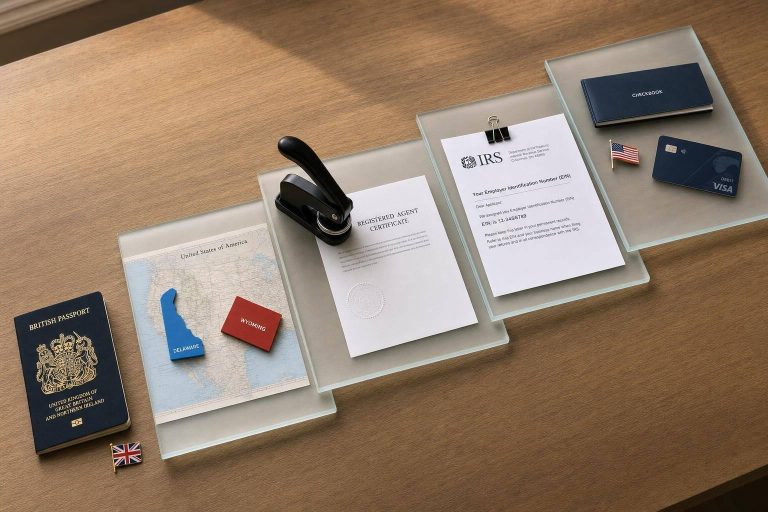
- Pick a state: Wyoming or Delaware is ideal depending on your needs: Wyoming for low costs and privacy, or Delaware for startups seeking funding.
- File formation documents: Secure a registered agent and file Articles of Organization online.
- Get an EIN: Use the IRS phone or fax method to obtain your Employer Identification Number.
- Open a US bank account: Platforms like Mercury, Relay, or Wise allow remote banking access.
- Stay compliant: File annual forms like 5472, report ownership in India, and follow RBI and FEMA rules for profit repatriation.
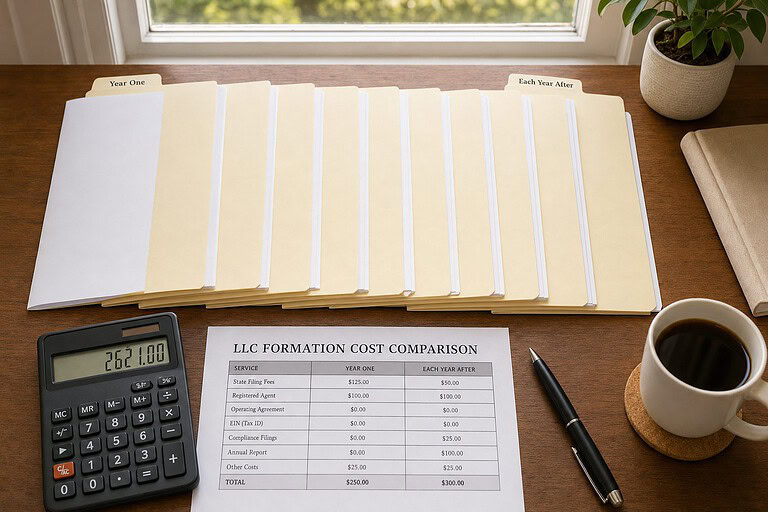
First-Year Costs: Expect $1,300–$3,100 for setup and maintenance.
Whether you’re a freelancer, SaaS founder, or consultant, this guide walks you through forming and running a US LLC from India – step by step.
Can Indian Citizens Own a US LLC?
Yes, Indian citizens can own 100% of a US LLC without needing US citizenship, residency, or even a Social Security Number. The entire process – right from incorporation to setting up a business bank account – can be handled remotely. Whether you’re in Bangalore, Mumbai, or anywhere else in India, you can manage everything without stepping foot in the United States [4].
"Indians can legally own 100% of a U.S. company, even without visiting the U.S." – USAIndiaCFO [4]
However, there’s a key point to remember: owning a US LLC doesn’t grant you the right to work in the US physically. If you plan to visit the US and work on-site, you’ll need to secure the appropriate visa [4]. What the LLC does offer is the ability to operate in the US market, collect payments from US clients, and access platforms like Stripe and Mercury. Knowing these boundaries is essential for complying with both US and Indian regulations.
Regulatory Requirements in India
Under Indian law, forming a US LLC falls under Overseas Direct Investment (ODI), which is governed by the Reserve Bank of India (RBI) under the Foreign Exchange Management Act (FEMA) [1]. This means:
- Initial investments must go through an Authorized Dealer (AD) bank.
- You’ll need to file Form FC with the RBI [1].
- Ownership of the foreign entity must be disclosed in Schedule FA of your Indian income tax return, even if no funds were transferred from India [1].
Compliance in the US
On the US side, every year you must file Form 5472 along with a pro forma Form 1120, even if your LLC didn’t earn any income or have any activity. Missing this filing can lead to a hefty penalty of $25,000 [1]. The good news is that with proper planning and professional help, meeting these compliance requirements can be straightforward.
Choosing the Right State for Your US LLC
For Indian founders looking to save money, maintain privacy, and benefit from state-level tax perks, Wyoming is the top pick for forming a US LLC. This is especially true if you’re running a SaaS business, freelancing, or launching a bootstrapped startup. Wyoming stands out because it imposes no corporate income tax, no franchise tax, and no gross receipts tax [5]. In short, you won’t owe any state-level taxes, which can significantly cut down on annual expenses compared to other states.
"Wyoming: A top choice for startups and small businesses due to its low annual fees, no state corporate or personal income tax, and strong privacy protections." – Braj Aggarwal, CPA, Braj Aggarwal CPA P.C. [6]
Wyoming also keeps costs low. The initial filing fee is just $100, and the annual report fee is $60 for businesses with assets under $250,000. Over three years, this adds up to savings of about $600–$700 when compared to Delaware, which charges a $300 annual franchise tax [7][8][9].
Another major plus? Privacy protection. Wyoming doesn’t require public disclosure of member or manager names in its formation documents. This means your personal details stay off public records – an important factor for Indian founders who prioritize privacy [7][9]. Additionally, Wyoming offers "charging order protection" for single-member LLCs, making it harder for creditors to seize LLC assets over personal debts [5].
That said, Delaware might be a better option if you’re planning to raise venture capital. U.S. investors often prefer Delaware for its clean shareholding structure and its specialized Court of Chancery, which has attracted over 66% of Fortune 500 companies [9][4]. However, for Indian freelancers and early-stage SaaS founders, Wyoming’s affordability and privacy advantages make it the better choice [4][1].
Up next, we’ll guide you through the non-resident LLC formation process from India, helping you leverage the benefits Wyoming or Delaware has to offer.
Step-by-Step Guide to Forming a US LLC from India
Forming a US LLC while based in India is completely remote – you can handle the entire process without stepping foot in the United States [2]. Here’s a clear breakdown of the steps involved:
Choosing an LLC Name and a Registered Agent
Start by selecting a unique name for your LLC. The name must be distinct within your chosen state and should include "Limited Liability Company", "LLC", or "L.L.C." at the end. To confirm availability, use your state’s Secretary of State website. For instance, Wyoming’s website allows you to check name availability instantly.
Next, you’ll need to appoint a registered agent. This is a mandatory requirement for all US LLCs. A registered agent is responsible for receiving legal notices, tax documents, and other official correspondence on your behalf. The agent must have a physical address in the state where you’re forming your LLC [3][4]. Since you’re based in India, you cannot serve as your own registered agent. Many professional services offer this, with fees ranging from $100 to $300 per year [3]. For example, BusinessAnywhere provides registered agent services starting at $147/year, and they even offer the first year free if you bundle it with their business formation services.
Once your LLC name and registered agent are secured, you’re ready to file your formation documents.
Preparing and Filing the Articles of Organization
The next step is filing your Articles of Organization with the Secretary of State in your chosen state. This document officially creates your LLC [4]. It generally includes:
- The LLC’s name
- Registered agent details
- Business address
- Management structure (whether member-managed or manager-managed)
Most states allow online filing. For example, Wyoming charges a $100 filing fee, while Delaware’s fee is $90 [3]. Once your filing is approved – usually within a few business days – you’ll receive a certificate of formation, officially establishing your LLC.
Documents Required and Costs for Non-Residents in 2026
As an Indian entrepreneur, you’ll need the following documents:
- A valid Indian passport for KYC verification
- Proof of your Indian residential address (such as a utility bill or bank statement) [4]
Having these ready can make the filing process and subsequent steps, like opening a US bank account, much smoother.
To illustrate, Priyansh Kothari, an Indian entrepreneur, successfully formed a Wyoming LLC in March 2023. He secured an EIN (Employer Identification Number) within 10 days and opened a Mercury bank account within 24 hours, using his Indian passport and LLC documents [10].
The total first-year cost of forming and maintaining a US LLC generally falls between $1,300 and $3,100. This estimate includes formation fees, registered agent services, compliance filings, and basic bookkeeping expenses [3]. BusinessAnywhere offers business registration starting at $0 plus state fees, with optional services like EIN application for $97 and operating agreement templates for $97.
One critical compliance task for foreign-owned US LLCs is filing Beneficial Ownership Information (BOI) with FinCEN. This federal report is mandatory starting in 2024 [2][4]. Additionally, single-member LLCs owned by foreign individuals must file Form 5472 annually. Missing these filings can result in hefty penalties – up to $25,000 per year [1][3].
"Every foreign-owned US LLC files Form 5472. Miss it: $25,000 per form per year." – Global Solo [3]
Getting an EIN from India: The Phone and Fax Method
After forming your LLC, the next critical step is securing an Employer Identification Number (EIN) from the IRS. This nine-digit number is key for tasks like opening U.S. bank accounts, setting up payment processors (e.g., Stripe or PayPal), filing taxes, and hiring contractors. The good news? You don’t need a U.S. Social Security Number (SSN) or an Individual Taxpayer Identification Number (ITIN) to apply for an EIN.
"You can apply for an EIN without a Social Security Number (SSN) or Individual Taxpayer Identification Number (ITIN)." – Braj Aggarwal, CPA [6]
Since the IRS online application is limited to U.S. residents with an SSN or ITIN, Indian entrepreneurs must rely on either the phone or fax method. The phone method is generally quicker. To apply, ensure you have the following documents and details ready:
- LLC formation documents
- Indian passport
- Indian residential address
- U.S. business address
An IRS representative will guide you through Form SS-4 over the phone, and you’ll receive your EIN immediately. If calling isn’t an option, faxing Form SS-4 is another route. However, fax processing takes several days, while mailing the form can extend the process to 4–6 weeks. For speed, the phone application is the better choice.
Before applying, confirm that your LLC formation has been approved. The IRS requires proof of acceptance of your Articles of Organization, and you must list yourself as the "responsible party" for tax purposes.
The entire process – from forming your LLC to obtaining an EIN – typically takes 3 to 8 weeks [1]. Once you’ve secured your EIN, you’ll be ready to open a U.S. business bank account from India.
You can apply for an EIN directly with the IRS for free. Alternatively, services like BusinessAnywhere offer assistance for $97.
Opening a US Business Bank Account from India
Once you’ve secured your EIN, the next step is opening a US business bank account. The good news? You can do this entirely from India – no US visa, citizenship, residency, or Social Security Number (SSN) required[4]. While traditional US banks typically demand an in-person visit, digital banking platforms have made it possible to bypass that hurdle.
Platforms like Mercury, Relay, and Wise are popular choices for Indian-owned LLCs. However, starting in 2025, these platforms have tightened their approval processes for non-resident founders[3]. For instance, Mercury has implemented stricter criteria, and Relay has become more selective about onboarding international businesses[3].
"Mercury tightened approvals in 2025. Wise works but isn’t a bank. Relay is selective." – Global Solo[3]
Before you apply, make sure you have all the necessary documents ready, as outlined in the earlier formation steps. Additionally, you’ll need to provide a brief business description and a link to your company’s website or LinkedIn profile.
It’s critical to use your business account exclusively for company transactions. This not only protects your corporate veil but also ensures compliance with India’s Schedule FA requirements. Indian tax law mandates that you disclose your US bank account in Schedule FA of your income tax return to avoid penalties under the Black Money Act[1].
Comparison of Mercury, Relay, and Wise for Indian-Owned LLCs
Each platform has its strengths, catering to different business needs. Here’s a breakdown:
- Mercury: Best suited for tech startups and SaaS businesses, Mercury offers FDIC insurance coverage of up to $5,000,000 through sweep networks. It charges no monthly fees and has a $5 fee for wire transfers. However, since 2025, non-resident founders face a more rigorous approval process, so having a solid business plan and clear revenue model can improve your chances[3].
- Relay: With FDIC insurance of up to $3,000,000, Relay is ideal for businesses requiring operational banking solutions, such as managing teams or creating multiple sub-accounts. Like Mercury, it offers a $0 monthly fee on its basic plan but has become more selective about working with international businesses[3].
- Wise Business: This isn’t a bank but a money transmitter, so it doesn’t provide FDIC insurance. Instead, funds are held in safeguarded accounts. Wise excels in multi-currency management, supporting transactions in over 50 currencies and offering currency conversion at approximately 0.57% – far lower than the roughly 2% markup common with other options[3].
Here’s a quick comparison to help you decide:
| Feature | Mercury | Relay | Wise Business |
|---|---|---|---|
| Account Type | Neobank (Fintech) | Neobank (Fintech) | Money Transmitter |
| FDIC Insurance | $5M[3] | $3M[3] | None (safeguarded accounts) |
| Monthly Fee | $0[3] | $0 (Basic)[3] | $0 |
| Wire Fees | $5[3] | Varies by plan | Low, transparent fees |
| Best For | Tech startups & high balances | Operational banking & teams | Multi-currency & low FX fees |
| Indian Support | High (stricter in 2025)[3] | Selective[3] | High[3] |
All three platforms integrate with key payment processors like Stripe, PayPal, and Shopify[4]. Interestingly, Stripe India transitioned to an invite-only model in 2024, prompting many Indian entrepreneurs to set up US-based Stripe accounts through their LLCs[3]. Once your account is approved, you’ll receive US account and routing numbers, enabling you to accept payments from US clients while leveraging a global payment network.
Up next, we’ll dive into the India-US tax treaty and how to repatriate profits to finalize your US business setup.
sbb-itb-ba0a4be
India-US Tax Treaty: LLC Taxation Explained
Double taxation is a common concern for Indian founders with US-based LLCs. Fortunately, the India-US Double Taxation Avoidance Agreement (DTAA) is designed to address this issue. A clear understanding of how it works can help you navigate potential tax complications.
Here’s the key: a US LLC is typically considered a pass-through entity. This means that instead of being taxed at the corporate level in the US, the profits flow directly to you, the owner, and are taxed at your personal income level. However, whether or not the US government taxes this income depends on whether your LLC generates Effectively Connected Income (ECI). If your business doesn’t have operations like employees, office space, or warehouses within the US, your income likely won’t be considered “effectively connected” to a US trade or business. In such cases, your income might not be taxable in the US at all, making the DTAA a critical tool to avoid double taxation [1][11].
"The good news is that the US and India have a tax treaty that prevents most forms of double taxation. If your US LLC earns income that’s not considered ‘effectively connected’ to US business activities, it may not be taxable in the US." – Vincenzo Villamena, CPA and CEO at Entity Inc. [1]
As an Indian tax resident (based on the 182-day rule), you’re required to pay taxes on your global income, which includes every dollar your US LLC earns [1][3]. To avoid paying taxes twice on the same income, the DTAA allows you to claim a Foreign Tax Credit (FTC) in India. This is done by filing Form 67, ensuring that your tax obligations are streamlined and fair [1].
Repatriating Profits to India: RBI and FEMA Regulations
Repatriating profits from a US LLC to India involves navigating a strict regulatory framework. In India, establishing a business abroad is classified as an Overseas Direct Investment (ODI) and falls under the purview of the Reserve Bank of India (RBI) as regulated by the Foreign Exchange Management Act (FEMA) [1]. Violating these regulations can result in penalties of up to three times the amount of the infraction [3].
If you initially funded your US business with capital from India, you have specific reporting obligations as the owner of a foreign entity. Once compliance with formation requirements is in place, repatriating profits becomes the next step, requiring adherence to additional regulations.
To transfer profits, you can use either a Non-Resident External (NRE) account or a Non-Resident Ordinary (NRO) account. NRE accounts allow you to repatriate funds fully, with interest earned being tax-free in India. On the other hand, NRO accounts impose repatriation limits – typically around $1 million annually – and are subject to Indian tax laws [1]. Additionally, under the Liberalised Remittance Scheme (LRS), outward remittances are capped at $250,000 per financial year [3]. These account options operate within the larger regulatory framework governing profit transfers.
"A common mistake is transferring business income directly into a personal account without supporting records. This not only creates compliance risks but also defeats the purpose of having a separate business structure." – Entity Inc. [1]
You must also report your US LLC ownership in Schedule FA of your Indian income tax return (ITR-2 or ITR-3), along with details of all foreign bank accounts. If your total foreign assets exceed ₹50 lakh, additional disclosures are required under the Black Money Act [1]. Every distribution and remittance must be documented thoroughly, as both the RBI and Indian tax authorities demand a clear audit trail. Like the formation and banking processes, maintaining meticulous records is crucial for a smooth profit repatriation strategy.
To avoid penalties and ensure compliance, consult with an Authorized Dealer bank and an experienced Indian Chartered Accountant (CA) familiar with ODI regulations.
Indian Tax Implications for a US LLC: FIRMS vs GST
Let’s break down how Indian tax rules apply to the profits of your US LLC, focusing on income tax and GST regulations.
If you’re an Indian tax resident, you must report all US LLC profits as global income in your Indian tax return. Since LLC profits are considered pass-through income, they’re taxed at your individual income tax rate in India. You’ll need to file this information using ITR-2 or ITR-3, while also disclosing your US LLC ownership and any associated bank details under Schedule FA.
Here’s an important point: income earned by your US LLC from international clients is typically not subject to Indian GST. This is because the business operates as a separate legal entity outside India. Your LLC invoices clients, receives payments in the US, and conducts its activities independently, which doesn’t trigger GST obligations in India [1][4].
However, if you’re providing services from India to your US LLC – like software development or consulting – this falls under the category of Export of Services. Under Indian tax law, this is considered a zero-rated supply, meaning the GST rate is 0%. While you won’t pay GST, you’ll need proper documentation and may have to register and file GST returns to claim the zero-rated status [1].
To avoid double taxation on your US LLC income, you can claim a Foreign Tax Credit (FTC) when filing your Indian tax return. Use Form 67 to claim this credit, ensuring you benefit from the US tax treaties [1].
It’s also crucial to maintain compliance with Indian tax laws. Work with a Chartered Accountant who specializes in cross-border taxation. They can help you claim treaty benefits, keep accurate records, and comply with the Income Tax Department and RBI requirements. Be cautious about commingling personal and business funds, and make sure to disclose all foreign assets, especially if their combined value exceeds ₹50 lakh. This will help you avoid scrutiny under the Black Money Act [1].
Tools and Services for Indian Founders Running US LLCs
Once you’ve set up your US LLC, the next step is ensuring smooth operations with the right tools and services. Managing non-resident LLC formation, compliance, banking, and daily tasks from India requires a well-chosen suite of resources. Here’s a breakdown of the essentials.
For formation and compliance, popular platforms include Doola ($297 for formation + $199/year), Firstbase ($399 for formation + $349/year), and Stripe Atlas (approximately $4,400 over three years). These services cover key needs like choosing the best registered agent service, EIN applications, and Form 5472 filings [3]. However, note that Stripe Atlas became invite-only for Indian founders in 2024, making access more limited [3]. For founders seeking India-specific support, USAIndiaCFO is a strong option, offering ITIN assistance, virtual CFO services, and tax compliance tailored to the India-US business corridor [4].
When it comes to banking and payments, integration with your formation service is key. Reliable banking options include Mercury (offering up to $5M FDIC insurance), Relay (up to $3M FDIC insurance), and Wise Business (with a 0.57% FX fee for transferring funds to India) [3]. Keep in mind that Mercury tightened its approval process for non-residents in 2025, while Relay remains selective [3]. For payment processing, Stripe, PayPal, and Paddle are excellent choices, providing greater credibility compared to Indian payment links.
Strong tax and bookkeeping practices are equally important. Specialized CPAs typically charge between $650 and $1,200 for filing Form 5472 and pro-forma 1120 [3]. Services like USAIndiaCFO and Entity Inc. can handle both US compliance and Indian reporting needs, including Schedule FA and FEMA/ODI filings. Additionally, since 2024, Beneficial Ownership Information (BOI) reporting to FinCEN has become mandatory [4].
For state-specific costs, Wyoming charges $60 annually, while Delaware imposes a $300 annual franchise tax [3]. For cost-conscious founders, Wyoming or New Mexico are more budget-friendly options. If you need to repatriate funds to India, Wise remains a cost-efficient solution [3].
Conclusion
Setting up and managing a US LLC from India is entirely possible. Indian citizens can fully own a US LLC remotely, tap into US payment gateways like Stripe, and enhance their credibility with American clients. Picking the right state is crucial – Wyoming stands out with its $60 annual fee and no state taxes, making it a budget-friendly choice for entrepreneurs starting out [3]. Once your LLC is formed, you’ll need an EIN, which can be obtained via phone or fax, and a business bank account through platforms like Mercury, Relay, or Wise.
However, forming the LLC is just the starting point. Long-term success requires strict compliance. Vincenzo Villamena, CPA & CEO of Entity Inc., stresses that compliance from day one is non-negotiable [1]. Missing Form 5472 can cost you a minimum of $25,000, and failing to adhere to FEMA rules can lead to fines up to three times the violation amount [3]. Additionally, starting in 2024, Beneficial Ownership Information (BOI) reporting to FinCEN is mandatory [4].
First-year costs typically range from $1,300 to $3,100. To navigate the complexities of tax and compliance, work with a CPA familiar with both US and Indian tax laws [3]. Keep in mind that the RBI limits outward remittances to $250,000 annually [3], and ensure you disclose your US LLC ownership in Schedule FA of your Indian income tax return to comply with the Black Money Act [1].
The India-US Double Taxation Avoidance Agreement (DTAA) prevents double taxation, but Indian tax residents are still subject to worldwide taxation under the 182-day residency rule [3]. Specialized services can assist with the entire compliance process, including Form 5472 filings and FEMA/ODI reporting.
From selecting the right state to staying compliant with international regulations, every decision plays a role in your success. With careful planning, reliable professional support, and a commitment to compliance, Indian entrepreneurs can confidently use their US LLC to access global opportunities.
FAQs
Do I need an ITIN to run a US LLC from India?
Indian citizens can own and manage a US LLC without needing a Social Security Number or an ITIN. That said, there are situations – like specific tax filings or banking needs – where having an ITIN might be necessary.
Will Stripe approve me with a US LLC if I’m in India?
Yes, Stripe does approve Indian founders with a US LLC. Many Indian entrepreneurs take advantage of Stripe Atlas to establish a US-based company, simplifying access to Stripe’s payment services. To ensure a smooth approval process, make sure your LLC complies with Stripe’s specific requirements.
How can I legally pay myself from a US LLC to India?
To legally transfer money from a US LLC to yourself in India, you can do so as salary or dividends, but first, you’ll need to pay the applicable taxes in the US. It’s crucial to follow RBI and FEMA regulations, which require proper documentation, such as Form 15CA and Form 15CB. Additionally, you can leverage the India-US tax treaty to reduce withholding taxes. To ensure everything is handled correctly and within legal boundaries, it’s a good idea to consult a tax professional experienced in cross-border compliance.