


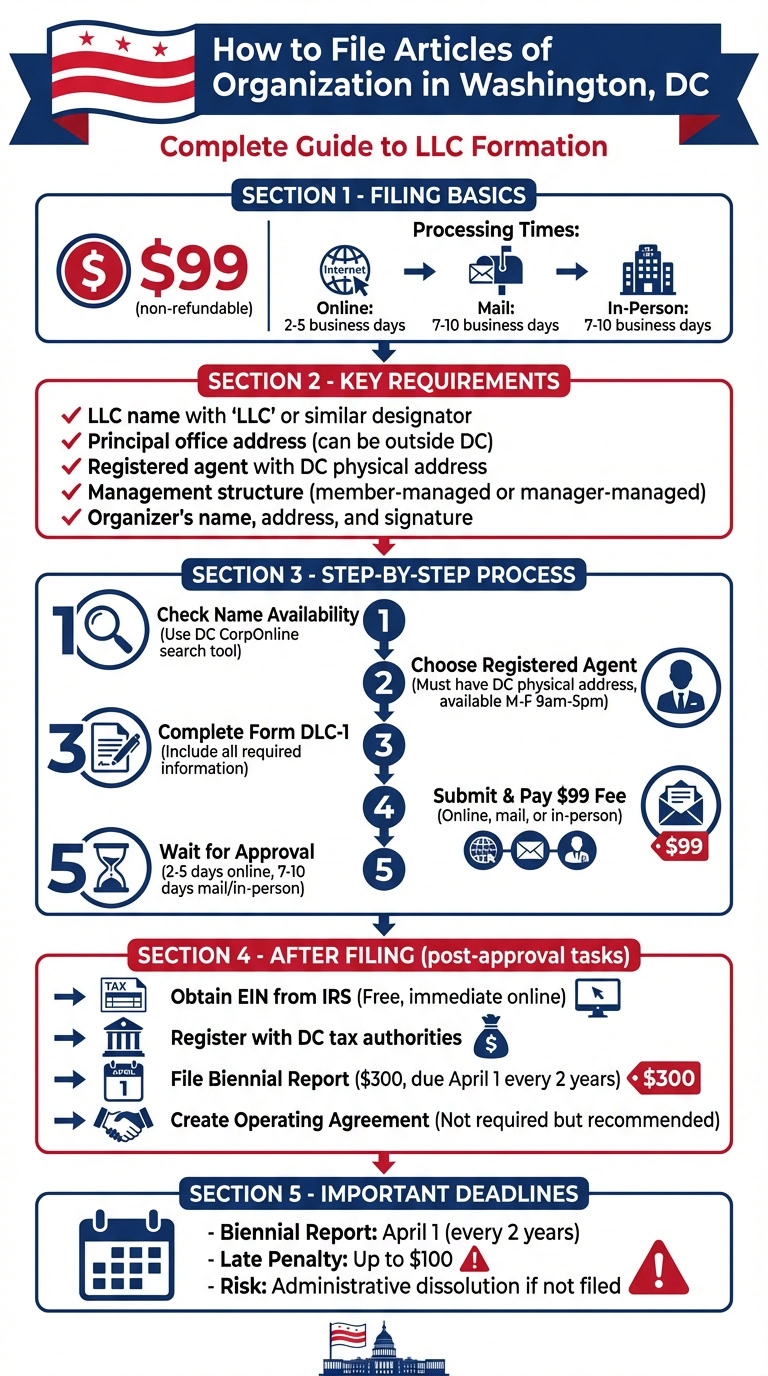
Filing the Articles of Organization is the first step to officially forming your LLC in Washington, DC. This process creates your business as a legal entity, separates your personal assets from business liabilities, and places your LLC on public record. Here’s a quick summary of what you need to know:
- Filing Fee: $99 (non-refundable).
- Filing Methods: Online (2–5 business days), by mail (7–10 business days), or in person.
- Key Requirements:
- LLC name with "LLC" or similar designator.
- Principal office address (can be outside DC).
- Registered agent with a DC physical address.
- Management structure (member-managed or manager-managed).
- Organizer’s name, address, and signature.
- Next Steps After Filing: Obtain an EIN, register with DC tax authorities, and file a $300 biennial report.
While filing is straightforward, accuracy is critical to avoid delays or rejections. Double-check your LLC name for availability using DC’s CorpOnline search tool and ensure all details are complete. Once approved, focus on compliance tasks like biennial reports and maintaining a registered agent to keep your LLC in good standing.
Articles of Organization Requirements in Washington, DC
Eligibility and Required Information
Forming an LLC in Washington, DC is open to anyone, regardless of citizenship or residency, as long as you appoint a registered agent with a physical DC address. Whether you’re a U.S. citizen, a foreign national, or even another business entity, you’re eligible to file the Articles of Organization if you’re legally authorized to operate.
When filing your Articles of Organization (Form DLC-1), you’ll need to include the following details:
- Your LLC’s legal name, complete with an appropriate designator such as "LLC" or "L.L.C."
- Principal office address, which can be located inside or outside of DC.
- Registered agent’s name and DC street address.
- Management structure, specifying whether the LLC is member-managed or manager-managed.
- Organizer’s name, address, and signature.
Many filers also choose to list the names and addresses of members or managers, particularly those holding more than 10% ownership. This information becomes part of the public record and helps establish the ownership structure from the beginning.
Before submitting your filing, double-check that your chosen LLC name meets DC’s naming standards to avoid unnecessary delays.
Washington, DC LLC Naming Rules
Your LLC name must include one of the following designators: "Limited Liability Company", "Limited Company", or an abbreviation like "L.L.C.", "LLC", "L.C.", or "LC." Additionally, the name must be distinct from all other business entities already registered in DC. It’s important to note that differences in spelling – not just pronunciation – are what make a name unique. Even if two names sound different, your filing will be rejected if the spelling is too similar to an existing entity.
To avoid issues, use DC’s CorpOnline business search tool to confirm name availability. Check for variations involving punctuation, plurals, and abbreviations to rule out potential conflicts. Also, steer clear of names that could misrepresent your LLC as a different type of entity (e.g., using "corporation" or "incorporated") or that include regulated terms like "bank" or "insurance" without the required licenses. A rejected filing not only costs you the non-refundable $99 fee but also delays your plans, so verifying your name upfront is crucial.
Once you secure a compliant name, the next step is to establish clear operational guidelines for your LLC.
Operating Agreement Considerations
An operating agreement is an internal document that outlines how your LLC will function. It covers key aspects such as ownership percentages, management authority, voting rights, profit distribution, procedures for adding or removing members, and steps to take if the LLC dissolves. While Washington, DC does not require you to file or adopt an operating agreement to form your LLC, creating one is highly recommended by legal professionals.
Having a written operating agreement provides clarity on everyone’s roles and responsibilities, reduces the likelihood of disputes, and demonstrates to banks and courts that your LLC is a separate entity from you personally – bolstering your liability protection. Even for single-member LLCs, an operating agreement is valuable. It documents things like management authority, banking permissions, and succession plans, making it easier to interact with financial institutions and potential investors. Drafting this agreement either before or shortly after filing your Articles of Organization ensures your business starts on solid footing.
Selecting a Registered Agent for Your Washington, DC LLC
What a Registered Agent Does
A registered agent acts as your LLC’s official point of contact for legal and government documents in Washington, DC. This includes receiving lawsuits, subpoenas, tax notices, reminders for biennial reports, and other compliance-related paperwork. Their role is to forward these documents to you and keep track of deadlines to help you avoid penalties or missed filings.
If your registered agent doesn’t meet compliance standards, your LLC’s filings could be rejected. Worse, failing to maintain an agent could lead to your LLC being administratively dissolved. Let’s take a closer look at the specific requirements in Washington, DC.
Washington, DC Registered Agent Requirements
In Washington, DC, your registered agent must meet a few key criteria. They can either be an individual who resides in DC or a business entity authorized to operate in the District and registered as a commercial registered agent. The agent must have a physical address in DC – P.O. boxes are not allowed – and be available during standard business hours (Monday through Friday, 9:00 a.m. to 5:00 p.m.) to accept legal documents in person. Additionally, the agent must consent to take on this role. If you’re filing Form DLC-1 by mail, you’ll also need to include Form RA-1, which is the agent’s written consent.
Since the agent’s name and address are part of the public record, many business owners choose to use a professional registered agent service to maintain their privacy. Now, let’s see how BusinessAnywhere fits into this picture.
BusinessAnywhere Registered Agent Service

BusinessAnywhere offers a reliable registered agent service in Washington, DC, complete with a physical address, weekday availability, and digital document management. If you form your LLC through BusinessAnywhere, they include one year of registered agent service at no additional cost as part of the formation package. After the first year, the service continues for $147 annually.
Their platform simplifies document handling by scanning and uploading all legal and government correspondence to your secure online dashboard. You’ll receive instant notifications when new documents arrive and reminders about compliance deadlines, such as biennial reports.
This service not only keeps your personal address off the public business database but also ensures you won’t miss critical notices, even if you’re traveling or moving. Plus, it combines LLC formation, registered agent services, and compliance tracking into one user-friendly platform.
How to Complete Form DLC-1
Where to Get Form DLC-1
You can find Form DLC-1 on the DC Department of Licensing and Consumer Protection (DLCP) website. Depending on how you plan to file, there are two ways to access it:
- Online Filing: Log into the CorpOnline portal on the DLCP website and select the option to file your Articles of Organization for a domestic LLC. The system will guide you through the process step by step.
- Mail or In-Person Filing: Download the PDF version of Form DLC-1 from the business filings section of the DLCP website. Print the form, fill it out either by hand or digitally, and send it along with your payment and Form RA-1.
If you file online, your submission is typically processed within 2–5 business days. Paper filings, on the other hand, take about 7–10 business days. Filing online also has the added benefit of capturing registered agent consent electronically, so you won’t need to include a separate consent form.
Now, let’s go over how to fill out each section of Form DLC-1 for your DC LLC.
Completing Each Section of the Form
When filling out Form DLC-1, it’s important to follow the instructions carefully to avoid delays.
Start with your LLC’s name. Enter the full legal name of your LLC, making sure to include the required suffix, such as "LLC", "L.L.C.", or "Limited Liability Company." Double-check the spelling and punctuation – DC will reject your Articles of Organization if the name is incorrect or missing the proper designator.
Next, provide the principal office address. This must be a complete street address, including the city, state, and ZIP code. The address can be located anywhere in the U.S. or even abroad, but it does not need to be in DC.
For the registered agent section, list the agent’s full legal name and a physical DC street address where they can be reached during business hours (Monday through Friday). Note that P.O. boxes are not allowed. If you’re filing by mail, make sure the agent has completed and signed Form RA-1, which must be submitted along with your DLC-1 form.
Decide on your management structure – either member-managed (where the owners handle operations) or manager-managed (where designated managers oversee the business). This should align with your operating agreement. You’ll also need to list the names and addresses of members or managers with significant ownership or control, usually those holding more than a 10% interest.
In the organizer section, include the name and address of the person or entity submitting the form. This could be an owner, attorney, or formation service. The organizer must sign and date the form – any missing signatures will result in the form being rejected. If you want your LLC to become effective on a specific future date, you can enter a date up to 90 days from the filing date.
Reviewing Your Form Before Filing
Before submitting your form, take a moment to review everything carefully. Ensure that your LLC name matches exactly what you reserved or searched for, including the correct suffix and punctuation. Any discrepancies could lead to your filing being rejected, and you won’t get back the $99 filing fee.
Verify that all fields are complete, including the office address, registered agent details, management type, member or manager information, and the organizer’s signature. Make sure the $99 fee is processed correctly. Finally, keep copies of your completed DLC-1 form, Form RA-1 (if applicable), and your payment confirmation for your records.
Up next, we’ll explore filing options and fees in more detail.
sbb-itb-ba0a4be
Filing Options and Fees
Online Filing vs. Mail Filing
In Washington, DC, you can file your Articles of Organization in three ways: online, by mail, or in person at the Department of Licensing and Consumer Protection (DLCP). Most business owners prefer the online route because it’s faster and more convenient.
To file online, start by creating an Access DC account, then log into the CorpOnline portal to complete Form DLC-1. The system walks you through each step, making it straightforward to fill out. Once submitted, you’ll receive immediate confirmation, and filings are typically processed within 2–5 business days. The online portal also handles registered agent consent electronically, saving you extra steps.
If you prefer mail, download and complete Form DLC-1 along with Form RA-1. Mail these forms, along with a check payable to "DC Treasurer", to P.O. Box 9238, Washington, DC 20090-9238. Processing by mail usually takes 7–10 days, though delays can happen. For peace of mind, consider using certified mail to track your submission and obtain proof of delivery.
In-person filing is another option. Bring your completed forms and payment directly to the DLCP office. Processing times for in-person submissions are similar to those for mail filings, so plan accordingly.
Washington, DC Filing Fees
The filing fee for Articles of Organization is $99, regardless of how you submit your forms. If filing online, you can pay via credit or debit card through the CorpOnline portal. For mail or in-person submissions, include a check made out to "DC Treasurer."
Keep in mind, there are no expedited processing options for these filings. If your submission is rejected – perhaps due to an error like a missing LLC designator or an invalid name – the $99 fee is non-refundable. You’ll need to correct the issue and resubmit with a new payment. To avoid this, double-check all details, especially your LLC name and registered agent information, before filing.
What to Do After Filing
Getting an EIN from the IRS
Once your Articles of Organization are approved, the next step is to get an Employer Identification Number (EIN) from the IRS. Think of the EIN as your LLC’s version of a Social Security number. It’s essential for opening a business bank account, hiring employees, and filing federal taxes. Plus, it adds a layer of privacy by keeping your personal information off business documents.
Applying for an EIN is straightforward. The fastest way is through the IRS website, where you can apply online and get your EIN immediately. Make sure you have your LLC’s legal name and formation date handy. Alternatively, you can apply by mail using Form SS-4, but this method takes about 4–5 weeks. Either way, the IRS doesn’t charge a fee for the application.
If handling the paperwork yourself sounds like a hassle, BusinessAnywhere offers a service to take care of it for you. For $97, they’ll complete Form SS-4 and manage the filing process. This is especially useful for non-U.S. residents, who may face additional documentation steps.
Once you’ve got your EIN, the next priority is ensuring your LLC stays compliant with local regulations.
Washington, DC Biennial Report Requirements
To remain in good standing, Washington, DC requires all LLCs to file a biennial report every two years. This report updates key details like your registered agent information, principal office address, and any members or managers who hold more than a 10% interest in the LLC. The filing fee is $300, and the deadline is April 1 of your filing year. Whether you file in an even or odd year depends on when your LLC was formed.
You can file online through the DLCP CorpOnline portal using your Access DC account. If you’d rather file by mail, complete Form B-1 and send it to the DLCP along with a check made out to "DC Treasurer." Missing the April 1 deadline can result in penalties of up to $100, and your LLC could face administrative dissolution. This means losing liability protection and being unable to conduct official business until you reinstate.
To avoid last-minute stress, set a reminder a couple of months before the deadline. Keeping your registered agent and member details updated throughout the year will also make the filing process smoother and faster.
Using BusinessAnywhere’s Virtual Mailbox
If you want to protect your privacy and ensure you never miss important mail, a virtual mailbox is worth considering. With a virtual mailbox, your LLC gets a real street address where mail is received, scanned, and made accessible online. This is especially handy if your LLC doesn’t have a physical office in Washington, DC, or if you travel frequently.
BusinessAnywhere offers a virtual mailbox service tailored to DC LLCs. Their service provides a compliant DC address and scans all incoming mail into a secure online portal. You’ll get instant notifications for new mail, including crucial documents like biennial report reminders, tax forms, and IRS correspondence. They also offer additional features like forwarding physical mail, depositing checks, and shredding unnecessary documents.
Plans start at $20/month for two recipients, $30/month for five, and $65/month for 20 (billed annually). Beyond convenience, a virtual mailbox keeps your home address off public records, which helps protect your privacy and keeps your address out of marketing databases. Plus, if you ever move, your business address stays consistent, ensuring you never miss important compliance notices or client communications.
Conclusion
Starting and maintaining a Washington, DC LLC involves several important steps, all of which contribute to the success and protection of your business. From selecting a compliant name and appointing a registered agent eligible in DC, to accurately completing Form DLC-1 and paying the required filing fee, every detail matters. Once your LLC is officially formed, the focus shifts to ongoing compliance. This includes obtaining an EIN from the IRS, registering with DC tax authorities, and keeping track of the biennial report deadlines. Staying on top of these requirements ensures your LLC retains its limited liability protection.
While forming and managing your LLC on your own is possible, it can be time-consuming and prone to errors. Missing a biennial report deadline or failing to maintain a registered agent can lead to penalties or even administrative dissolution, which jeopardizes your liability protection. For many business owners, these tasks can take valuable time away from running and growing their business.
That’s where BusinessAnywhere steps in. They simplify the entire process by preparing and filing Form DLC-1 online for quicker processing, providing a compliant DC registered agent address, and organizing all your documents and compliance reminders in one easy-to-use dashboard. Their virtual mailbox service also offers your LLC a professional DC address and digitizes mail, ensuring you never miss critical notices. This comprehensive support allows you to focus on what matters most – your business.
Whether you choose to handle the filings yourself or use a service like BusinessAnywhere, creating a solid operating agreement is essential. While DC doesn’t require you to file one, having clear guidelines for ownership, management, and profit distribution is crucial for working with banks, investors, and co-owners. With BusinessAnywhere managing the administrative side, you’ll have more time to focus on customizing your agreement and scaling your business.
Now, you’re equipped with a clear plan to launch your Washington, DC LLC. Whether you take the DIY route or rely on BusinessAnywhere, you’re ready to start your journey with confidence and focus on growing your business from day one.
FAQs
What happens if my LLC in Washington, DC doesn’t have a registered agent?
If your LLC in Washington, DC doesn’t have a registered agent, the consequences can be serious. Your business could lose its good standing with the state, face penalties, or even be dissolved. On top of that, without a registered agent, your LLC won’t be able to receive critical legal documents – like lawsuits or state notifications. Missing these could result in overlooked deadlines and expensive legal problems. To steer clear of these issues, it’s crucial to keep your registered agent information current.
How do I make sure my LLC name is unique and meets Washington, DC requirements?
To make sure your LLC name stands out and meets Washington, DC’s rules, start by checking the DC Department of Consumer and Regulatory Affairs (DCRA) business name database. This step ensures your chosen name isn’t already taken or too similar to an existing one.
Your LLC name needs to include "Limited Liability Company" or an abbreviation like "LLC" or "L.L.C.". Additionally, it cannot use restricted terms or suggest a connection to the government unless you’ve secured prior approval. Taking the time to review DC’s naming guidelines can save you from unnecessary delays during the filing process.
Why should I create an operating agreement for my LLC in Washington, DC, even though it’s not required?
Creating an operating agreement for your LLC in Washington, DC is a wise move. This document lays out clear guidelines for ownership, management, and daily operations, helping avoid misunderstandings or disputes among members. By defining roles, responsibilities, and decision-making processes, everyone knows exactly where they stand.
While it’s not legally required, having an operating agreement can also offer legal protection. It provides a written record of how your LLC operates, which can be invaluable in resolving conflicts or during legal challenges. Taking this step helps keep your business organized and running smoothly.