

If you use a business name that does not match your legal name or your company’s legal name, you usually need to file an assumed name in New York. The big question is simple: where do you file? That depends on your business type.
Here’s the short answer:
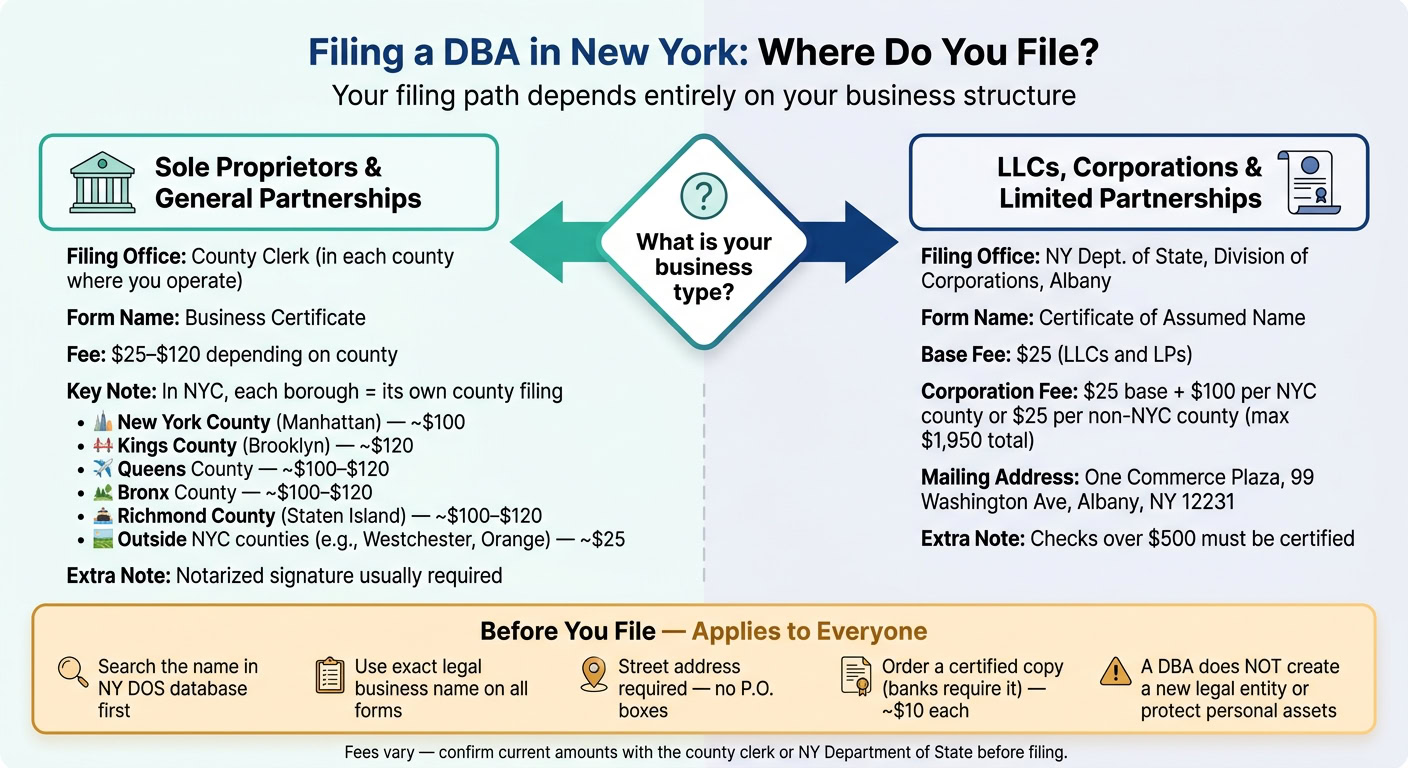
- Sole proprietors and general partnerships file with the county clerk
- LLCs, corporations, and limited partnerships file with the New York Department of State
- In New York City, each borough is its own county for county-clerk filings
- A DBA does not form a new business or protect personal assets
- Fees can range from about $25 in some counties to $100+ in NYC, and state corporate filings can cost more if county fees apply
I’d break it down like this: if I were a sole proprietor working in Manhattan and Brooklyn, I may need filings in 2 counties. But if I owned an LLC using a different brand name, I’d file one assumed name form at the state level instead.
Before I file, I’d make sure to:
- search the name
- match the legal business name exactly
- list the right addresses and counties
- check signer and notarization rules
- order a certified copy, since banks often ask for one
A few details matter more than people expect. For example, state forms often require a street address, not a P.O. box, and corporation filings may include county-based fees of $100 per NYC county or $25 per county outside NYC on top of the $25 base fee.
Quick Comparison
| Business type | Where I file | Main form | Typical fee |
|---|---|---|---|
| Sole proprietor | County clerk | Business Certificate | About $25 to $120 |
| General partnership | County clerk | Business Certificate | About $25 to $120 |
| LLC | NY Department of State | Certificate of Assumed Name | $25 |
| Corporation | NY Department of State | Certificate of Assumed Name | $25 + county fees |
| Limited partnership | NY Department of State | Certificate of Assumed Name | $25 |
So the path is simple once I know my business type: pick the right filing office, give exact business details, pay the fee, and keep proof of filing in my records.
What a DBA is in New York and who needs to file one
In New York, a DBA is called an assumed name. It’s the name your business uses in public when that name is different from its legal name. So if the name customers see doesn’t match the name on your formation papers, you need to file.
That filing ties your public-facing name to the actual owner of the business on contracts, invoices, bank records, and marketing materials. Banks also often ask for proof that the assumed name was filed before they’ll open an account or let you take payments under that name. And here’s where people get tripped up: the place you file depends on your business structure.
Sole proprietors and general partnerships file with the county clerk
If you’re a sole proprietor or part of a general partnership, you file with the county clerk, not the New York Department of State. You need to file in each county where you operate.
For example, if Maria Lopez runs her business as "Lopez Home Cleaning", she would file in every county where she does business.
In New York City, this gets a little more specific. Each borough counts as its own county for filing:
- New York County (Manhattan)
- Kings County (Brooklyn)
- Queens County
- Bronx County
- Richmond County (Staten Island)
So if a business serves customers in more than one borough, it may need more than one county filing.
LLCs, corporations, and LPs file with the New York Department of State
LLCs, corporations, and limited partnerships don’t file with a county clerk. They file a Certificate of Assumed Name with the New York Department of State, Division of Corporations, when they do business under a name other than their legal entity name.
Say an LLC is legally named "Bright Path Media LLC" but sends invoices as "Bright Path Studios". In that case, it needs to file at the state level, not with a county clerk.
One legal entity can also use more than one DBA, as long as each assumed name is filed the right way.
A DBA does not create a separate business entity
A DBA doesn’t create a new business or a separate legal entity. It’s just another name for the same business.
Once you know which filing path fits your business, the next step is to check whether the name is available and gather the exact details required for the form.
What to do before you file: name search, required details, and signer rules
Check name availability and avoid restricted or misleading names
Start with the New York Department of State Division of Corporations database. Look for exact matches and similar names, and don’t skip inactive records. If your name uses special characters like &, search the words separately too. It sounds small, but that’s the kind of detail that can save you from a rejected filing.
Your assumed name also can’t send the wrong message. It can’t suggest the wrong entity type, hint at a regulated service you’re not allowed to offer, or mislead the public about what the business does. For professional entities, New York education rules add another layer: the name cannot be false, fraudulent, deceptive, or misleading about the profession or services offered. If the name breaks these rules, the filing can be rejected.
Once the name looks clear, get your filing details lined up exactly as the form asks for them.
Gather the exact details required on New York forms
For LLCs, corporations, and LPs filing with the Department of State, you’ll need:
- The exact legal entity name as it appears in Department of State records or formation documents
- Your New York DOS ID number
- The assumed name you’re registering
- The principal business address; a P.O. box is not acceptable
- Every New York county where you’ll operate under the assumed name, plus a specific street address for each county location
- A mailing address for DOS correspondence and filing receipts, which can differ from your principal office
For sole proprietors and general partners filing at the county level, the form usually asks for the exact legal name of each owner, the assumed business name, the principal place of business, and the counties where the business will operate. Many counties also ask for each owner’s home address, the date the business started or will start using the name, and sometimes a short description of the business activity.
Confirm notarization, ID, and recordkeeping requirements
County clerk filings for sole proprietors and partnerships usually need a notarized signature. That means you’ll sign in front of a notary public, who will check government-issued ID. If there’s more than one owner, check your county’s rule on signatures. Some counties may want all partners to sign, while others may allow one authorized partner to handle it.
State-level filings for LLCs and corporations work a bit differently. They follow the Department of State’s own form instructions, so you don’t get the same county-by-county notarization issues. Still, the signer must be authorized: a member or manager for an LLC, an officer for a corporation, or a general partner for an LP. Keep written proof of that authority in your records.
Also, hold on to the certified copy and filing receipt. Banks often ask for a certified copy before they’ll open a business account under a DBA name.
After that, you can move to the county clerk or Department of State filing step.
sbb-itb-ba0a4be
How sole proprietors and partnerships file a DBA in New York City and other counties
Get the right county form and fill it out correctly
The form you need is usually called a Business Certificate. In some counties, you may see Business Under an Assumed Name or Certificate of Assumed Name instead. You get the form from the county clerk’s office in the county where you’ll do business.
In New York City, you file with the county clerk for the borough where you operate.
Manhattan works a bit differently. The New York County Clerk at 60 Centre Street, Room 161, New York, NY 10007 handles Business Certificates for New York County. The forms used there – often listed as X-74 for individuals and X-201 for partnerships – are often sold at the courthouse or through a legal stationery store, and they aren’t always posted as free downloads.
Most county forms ask for:
- Each owner’s legal name and address
- The assumed name
- The business address
- A short description of the business
That business description should be specific. Skip broad wording and say what the business actually does.
Once the form is filled out, file it with the county clerk and keep the certified copy.
File with the county clerk, pay the fee, and get certified copies
In most NYC counties, you should expect to file in person. Bring the completed form, sign it in front of the clerk or have it notarized ahead of time, show a government-issued photo ID, and pay the fee. Some counties also take mailed filings if the form is notarized.
Fees can vary a lot by county. New York City is usually much more expensive than counties elsewhere in the state.
| County | Filing Office | Typical Form Name | Approx. Filing Fee | Notarization Required? |
|---|---|---|---|---|
| New York (Manhattan) | New York County Clerk | Business Certificate (X-74 / X-201) | $100 | Sign before clerk; check current rules |
| Kings (Brooklyn) | Kings County Clerk | Business Certificate | $120 | Check county rules |
| Bronx, Queens, Richmond | Respective County Clerks | Business Certificate | $100–$120 | Check county rules |
| Westchester | Westchester County Clerk | Business Certificate | $25 | Yes |
| Orange | Orange County Clerk | Business Certificate | $25 | Yes |
| Tompkins | Tompkins County Clerk | Business Certificate | $25 | Yes |
Confirm current fees with the county clerk.
For payment, New York County accepts cash, major credit cards, and U.S. Postal money orders. It does not accept personal or business checks. Other counties may follow different payment rules, so it’s smart to check before you show up.
Order at least one certified copy when you file. In NYC counties, certified copies usually cost about $10 each.
New York City county filing details and local checks
Each NYC borough runs its clerk’s office on its own. So before you file, check four things with that county clerk:
- The current form name and version
- The exact filing fee and certified copy fee
- Whether you must file in person or can file by mail
- The office hours
The NYC Business portal and NYC 311 are the best official places to start if you need current fee details and office locations for all five boroughs.
If you’re filing as an LLC, corporation, or limited partnership, this county clerk process does not apply. In that case, you file through the New York Department of State.
How LLCs, corporations, and LPs file a DBA with New York State
For LLCs, corporations, and LPs, the filing process moves away from county clerks and goes straight to the Division of Corporations in Albany. You must file the Certificate of Assumed Name with the New York State Department of State in Albany.
Complete the Certificate of Assumed Name with the correct entity details
This form looks simple, but small mistakes can slow things down. Use the entity details exactly as they appear in state records.
You’ll need to include:
- Exact legal entity name, exactly as shown in DOS records or formation documents
- Entity type – for example, domestic LLC, foreign corporation, or limited partnership
- DOS ID number
- Assumed name, without LLC, Inc., Corp., or LP
- Principal business address – full street address, not a P.O. box
- Counties where the DBA will be used – list each county where the name will be used
- Address of each business location – every location where business will operate under the assumed name
- Contact name and mailing address for the filing receipt
- Authorized signer: an officer, LLC member/manager, or LP general partner
Most rejections happen for a pretty simple reason: the legal name doesn’t match state records, or the counties and addresses don’t line up with the form. It’s worth checking every line before you send it in.
Calculate New York filing fees by entity type and county
Once the form is done, count the counties before you figure out the fee. The base filing fee is $25. Corporations also pay county fees: $100 per county in New York City and $25 per county outside NYC, with a maximum total fee of $1,950.
| Entity type | Base filing fee | County fee treatment | Filing office | Typical payment methods |
|---|---|---|---|---|
| LLC (domestic/foreign) | $25 | No additional county fees | NY Dept. of State, Division of Corporations, Albany | Check, money order, credit card; certified check required over $500 |
| Corporation (domestic/foreign) | $25 + county fees | $100 per NYC county; $25 per county outside NYC; maximum total fee of $1,950 | NY Dept. of State, Division of Corporations, Albany | Check, money order, credit card; certified check required over $500 |
| Limited Partnership (LP) | $25 | No additional county fees | NY Dept. of State, Division of Corporations, Albany | Check, money order, credit card; certified check required over $500 |
All fees are paid to DOS in Albany, and any check over $500 must be certified.
Submit the filing and handle amendments or discontinuances later
After that, it’s all about sending the filing to the right place and keeping your records straight. Mail or deliver the completed Certificate of Assumed Name and payment to:
New York Department of State, Division of Corporations
One Commerce Plaza, 99 Washington Avenue
Albany, NY 12231
Once the filing is accepted, keep the receipt and order at least one certified copy, which is usually $10 each. New York also requires a certified copy of the certificate to be displayed at each place where the business is conducted under the assumed name.
If a material detail changes, you’ll need to file a Certificate of Amendment of Assumed Name. That includes changes to the assumed name, principal business address, business location addresses, or the counties where the DBA is used. If you stop using the DBA completely, file a Certificate of Discontinuance of Assumed Name. Both filings go to the Division of Corporations in Albany with the right fee.
Conclusion: File in the right place and keep your DBA records in order
The main thing to get right is where your business files. That depends on choosing the right business structure.
- Sole proprietors and general partnerships file with the county clerk where the business is located. In New York City, that means the clerk for the right borough county.
- LLCs, corporations, and limited partnerships file a Certificate of Assumed Name with the New York Department of State in Albany.
A DBA is only a name filing. It does not create a separate legal entity, and it does not protect personal assets.
Once you file, keep your records where you can grab them fast. Put the filing receipt, a certified copy, and any amendment or discontinuance records in one business records file.
Before you submit anything, confirm that the name is available. Also check the current fee schedule with the county clerk or the Department of State. If your business is in a regulated industry, you may need specific business licenses and permits, or if you plan to use more than one DBA, check the filing rules with the clerk or the Department of State before you file.
FAQs
Do I need a DBA in every NYC borough where I operate?
If you’re a sole proprietor or part of a partnership, you’ll usually register your DBA with the county where you do business. If you work across multiple boroughs, check the rules for each county. A filing in one place may not cover another.
For LLCs and corporations, DBA filings are often handled at the state level. Rules can differ, so it’s smart to contact the county clerk’s office where you plan to operate and confirm you’re in line with local requirements.
Can I use more than one DBA for the same business?
Yes. One business entity can register and use more than one DBA.
That gives a sole proprietor, LLC, or corporation room to run different brands, product lines, or services under the same legal business structure. It’s a simple way to keep one legal entity in place while presenting different names to customers.
There’s one catch: you usually need to file a separate registration for each DBA in every county, city, or state where you plan to use that name. You’ll also want to check name availability in each location so you don’t run into conflicts with another business using the same or a similar name.
What happens if my DBA details change later?
If your DBA details change, like your business address or ownership, you need to update your registration with the right filing office.
A DBA is part of the public record, so keeping it up to date can help you avoid banking problems and legal compliance issues. In most cases, you’ll file the update with your local county clerk’s office or the state agency where you first filed your assumed name certificate.