

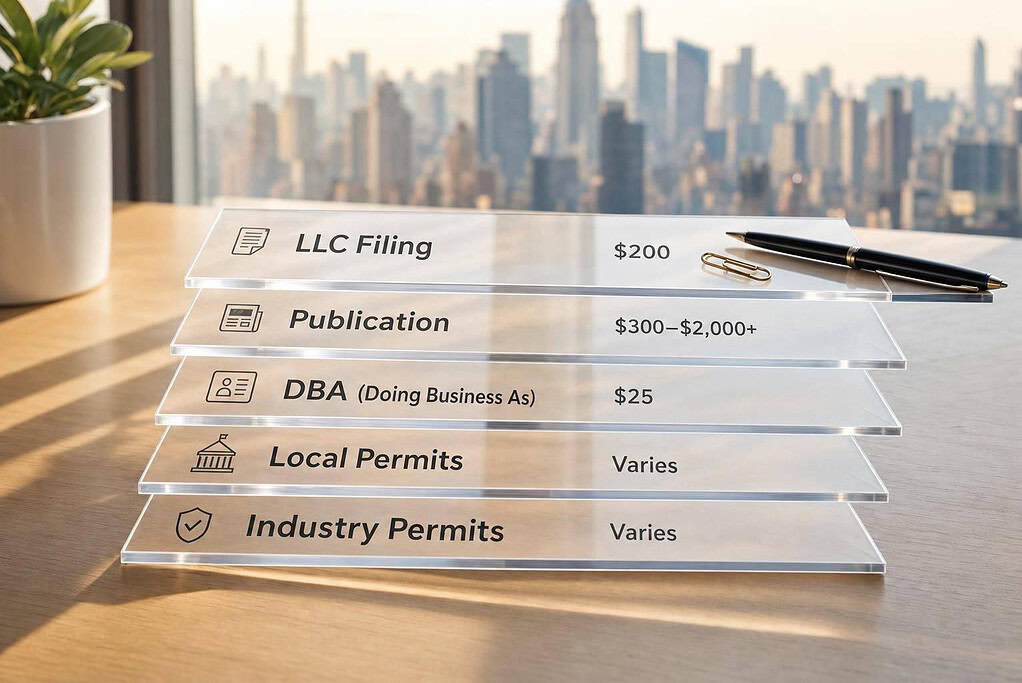
In Short: How Much Is a Business License in New York?
New York has no general statewide business license. Your fixed state costs come from forming and keeping the company, and your city, county and industry add any permits. The biggest variable is the LLC publication requirement.
- LLC formation: $200 for the articles of organization with the New York Department of State.
- Publication: notices in two newspapers within 120 days, priced by your county, plus $50 to file the certificate of publication.
- Biennial statement: $9 every two years.
- Assumed name (DBA): $25 with the state for an LLC. Sole proprietors file with the county clerk for $25, or $100 in each New York City county. See how to file a DBA in New York.
- Sales tax certificate of authority: free.
Forming the company first? Read how to start an LLC in New York, or compare business license costs by state.
Quick Comparison
| Business Type | Common Startup Costs | First-Year Range |
|---|---|---|
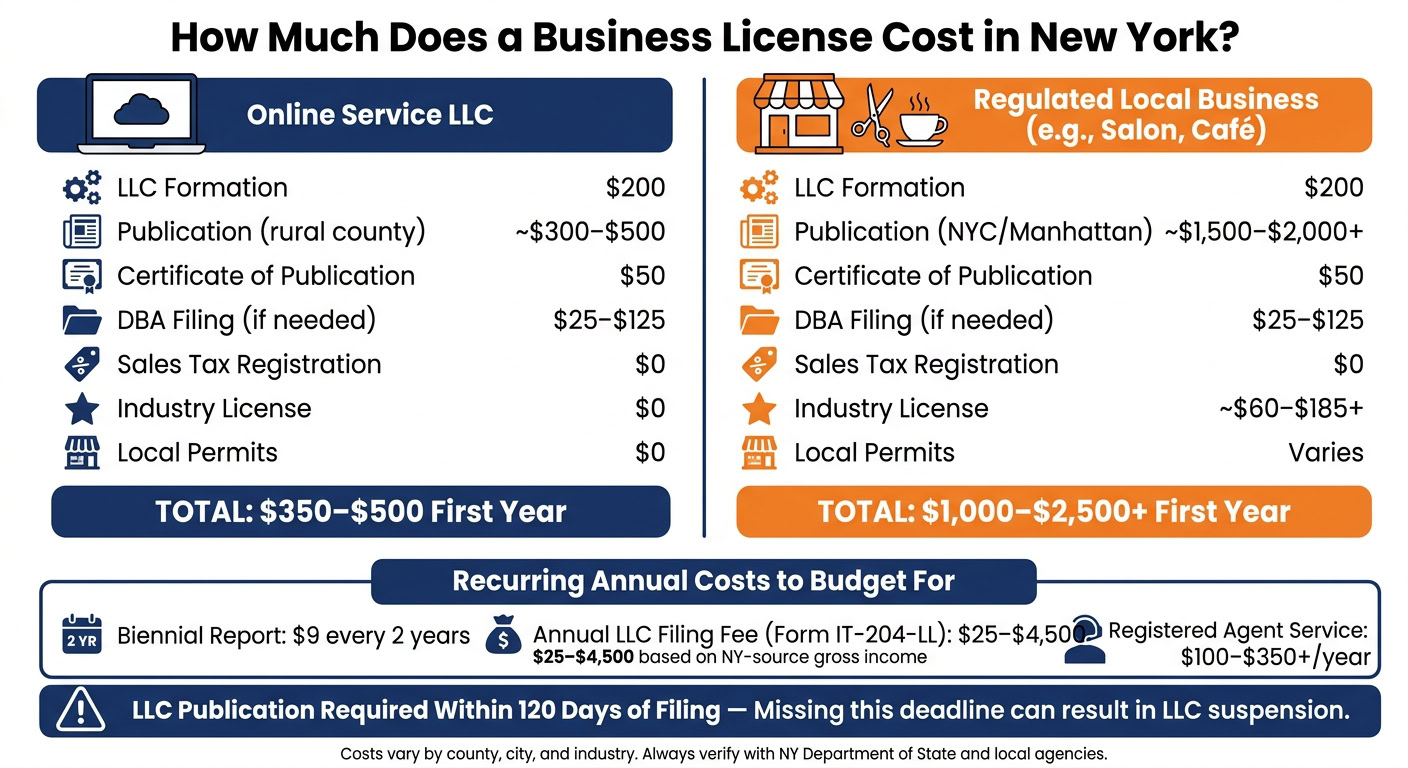
| Online service LLC | LLC filing, publication, maybe DBA | $350 to $500 |
| Regulated local business | LLC filing, publication, local permits, industry license | $1,000 to $2,500+ |
So if you’re asking, “How much is a business license in New York?” the plain answer is: it depends on the filings tied to your business, not one generic license fee.
sbb-itb-ba0a4be
What New York Businesses Commonly Pay
Core Filing and Permit Costs Most Small Businesses Face First
Most New York businesses don’t pay one flat business license fee. Instead, they usually pay a mix of filing fees, permits, and license costs.
For an LLC, formation starts at $200. Then there’s the publication rule, which can add $300 to $2,000 based on the county, plus a $50 Certificate of Publication fee. If your LLC needs a DBA, that adds $25 at the state level, with no county fee. A sole proprietor pays $25 at the county clerk, or $100 in each New York City county.
Sales tax registration through the NYS Department of Taxation and Finance is free if you plan to sell taxable goods or services. In New York City, many licenses fall in the $100 to $200 range, while a small retail food business license costs about $660 every two years.
That gives you the starting point. If your business is in a regulated field, the total can go up from there.
Professional and Industry-Specific Approvals Can Add to the Total
Some industries need more than the basic setup. Cosmetology, real estate broker, home improvement contractor, and liquor licenses all come with their own fees and renewal schedules, on top of formation and publication costs.
And this is where costs can stack up fast. A business that needs a state license, local health permits, and zoning approval will usually spend much more than a basic online business.
Comparison Table: Simple Online Business vs. Regulated Local Business
Here’s a side-by-side look at how a simple online business compares with a regulated local business.
| Cost Category | Simple Online Service (LLC) | Regulated Local Business (e.g., Salon or Café) |
|---|---|---|
| Formation | $200 | $200 |
| Publication | ~$300–$500 (rural county) | ~$1,500–$2,000+ (NYC/Manhattan) |
| Industry License | $0 | ~$60–$185+ |
| Local Permits | $0 | Varies by city, county, and industry |
| Sales Tax Registration | $0 | $0 |
| Annual LLC Filing Fee | $25–$4,500, if gross income exceeds $25,000 | $25–$4,500, if gross income exceeds $25,000 |
| Estimated First-Year Total | $350–$500 | $1,000–$2,500+ |
These numbers reflect New York state filing fees, LLC publication costs, the DBA filing fee when needed, free sales tax registration, and common New York City license ranges.
The basic formation steps are the same in both cases. The main cost differences usually come down to your industry license, local approvals, and the county where publication happens. So instead of budgeting for some generic "business license", budget for the filings your business actually needs.
Cost Breakdown by License, Permit, and Registration Type
Here’s what sits behind the broad price ranges above. The main goal is simple: separate one-time startup costs from recurring fees so you can map out a budget that fits your business.
State Formation Fees, DBA Filings, and Sales Tax Registration
The easiest startup costs to plan for in New York are the state filing fees.
- $200 for LLC formation through the Articles of Organization
- Optional name reservation: $20
- Expedited filing: $25 for 24-hour service, $75 for same-day service, or $150 for 2-hour processing
The Certificate of Publication costs $50, and the newspaper publication piece usually adds about $300 to $2,000, depending on the county.
If you plan to operate under a name other than your legal business name, you’ll also need a DBA. An LLC pays $25 to the Department of State with no county fee. A sole proprietor pays $25 at the county clerk, or $100 in each New York City county.
Sales tax registration with the NYS Department of Taxation and Finance has no application fee, which is one less line item to worry about. LLCs also have a $9 biennial report fee.
Local Permits in New York City and Other Counties
Once the state filings are out of the way, location starts to matter a lot.
New York does not have a statewide general business license, so local permit costs depend on the city or county where you operate. In New York City, licensing runs through the Department of Consumer and Worker Protection (DCWP), and the fee depends on the type of business activity.
Outside NYC, the process is more local. Municipalities and county clerks handle licensing, and a general local business license in New York often falls between $100 and $200, based on the county and the scope of the business.
Professional Licenses and Renewal Costs
If your business is in a regulated field, there’s another layer of cost on top of local permits.
Professional licenses may come with application fees, exam fees, inspection fees, and renewal fees. For fields like cosmetology or real estate, it makes sense to check the New York State Department of State Division of Licensing Services and the related state board so you can confirm the exact rules and charges.
The table below shows the recurring license and permit costs many New York businesses should build into their yearly budget:
| Fee Type | Frequency | Cost |
|---|---|---|
| Biennial Report | Every 2 years | $9 |
| Annual LLC Filing Fee (Form IT-204-LL) | Annual | $25–$4,500 |
The Annual LLC Filing Fee can range from $25 to $4,500, based on prior-year New York source gross income.
How to Find the Exact Fees for Your New York Business
Start With Your Business Activity, Entity Type, and Location
Start with three inputs: business activity, entity type, and location. That’s the only solid way to pin down your exact fee.
A remote consultant working as a sole proprietor in Albany will run into a very different set of rules than a retail food business in New York City. And even a home-based business may still need zoning approval or a professional license if the work is regulated.
Check State, City, County, and Profession-Specific Fee Schedules
Check each layer in this order:
| Jurisdiction Level | Agency | What to Check |
|---|---|---|
| State (Entity) | NY Department of State | Formation fee, DBA, biennial report |
| State (Tax) | NYS Department of Taxation and Finance | Sales tax registration, annual LLC filing fee |
| State (Professional) | NY Division of Licensing Services | Real estate, cosmetology, barbering, notary public fees |
| City (NYC) | NYC Dept. of Consumer and Worker Protection (DCWP) | 55+ license types including home improvement and general vendor |
| County | Local County Clerk | Sole proprietor DBAs, publication requirements |
| Industry-Specific | State Liquor Authority, Office of Cannabis Management | Retail liquor licenses, dispensary permits |
Start with New York Business Express for state requirements. It gives you a business-specific checklist. If your business is in New York City, check the DCWP portal for city permits.
Build a One-Time and Annual Cost Worksheet
Once you’ve gathered the filings, split them into one-time and recurring costs.
This step matters more than people think. If you lump everything together, it gets harder to see what you’ll pay now versus what will keep showing up each year.
Your one-time column should include formation fees, initial license applications, DBA filings, publication costs, and any local permit fees. Your recurring column should include biennial reports, license renewals, the Annual LLC Filing Fee (Form IT-204-LL), and registered agent service ($100 to $350+ per year).
For a comparison with another large state, see our breakdown of the business license cost in Texas.
Conclusion: Budget for the Right New York License, Not a Generic One
Once you know which filings your business needs, the next move is pretty straightforward: add up the one-time fees and the recurring ones.
That matters in New York because fees can change based on the state, county, city, and your profession. So there isn’t one flat business license cost that works for everyone.
One expense people often miss is LLC publication. In New York, it’s required within 120 days of filing. If you miss that deadline, your LLC could face suspension. That’s exactly why doing the filing research first matters before you set your budget.
Key Takeaways for New and Remote Founders
Start by figuring out your exact filings. Then total the cost based on what applies to your business.
Focus your budget on:
- formation fees
- publication costs
- local permits
- renewal fees
- industry-specific approvals
Your actual cost comes from the filings your business actually needs, not from a generic license estimate. Start with your business type, location, and entity, then budget for the fees that apply.
FAQs
Do sole proprietors need a business license in New York?
Yes, sole proprietors often need business licenses in New York, but there isn’t one statewide license that covers everyone. What you need depends on your industry, where you do business, and the kind of work you do.
Unlike an LLC, a sole proprietorship doesn’t file formation documents with the state. But in most cases, you still need to file a business certificate – also called a DBA or assumed name – with the county clerk in each county where you operate. You should also check for any local permits or professional licenses that may apply.
What happens if I skip the LLC publication requirement?
In New York, publishing a notice of formation in two newspapers is a required part of LLC compliance. Skip that step, and your business won’t comply with New York law.
That can lead to legal trouble, day-to-day disruptions, and issues keeping your business in good standing with the state. It also makes sense to check any local rules so your LLC stays fully compliant.
Which New York businesses need local or professional permits?
New York doesn’t issue one statewide business license for every company. What you need depends on what your business does and where it’s based.
At the state level, many professions need a license. That includes real estate brokers, healthcare providers, and contractors.
Local rules matter too. Cities and counties can ask for their own permits or approvals. The safest move is to check with your local city or county clerk’s office to see what applies to your business.