
Yes – in most U.S. states, an assumed name and a DBA mean the same thing. They both refer to a business name you use in public instead of your legal name. The catch is that the term, the filing office, and the rules can change by state.
Here’s the short version:
- DBA means “doing business as”
- Assumed name is often the legal term used by states
- Some states use trade name, fictitious name, or fictitious business name
- None of these filings create an LLC or corporation
- None of them give liability protection or automatic name ownership
- Banks often ask for a DBA certificate before they open an account under a different business name
- Renewal periods often run from 1 to 10 years
If I were putting it simply, I’d separate business names into 3 buckets:
- Legal name: the name of the person or entity on record
- DBA / assumed name: the filed alternate name
- Brand name: the name customers see
That difference matters more than the label itself. For example, a sole proprietor using a name like Sunset Bookkeeping instead of their own name usually needs a filing. An LLC using a customer-facing name that does not match its formation name often does too.
A few points stand out:
- In some states, filing happens with the Secretary of State
- In others, it happens at the county level
- Some states require newspaper publication
- In many places, a business may have trouble enforcing a contract or filing suit under an unregistered alternate name
Quick comparison
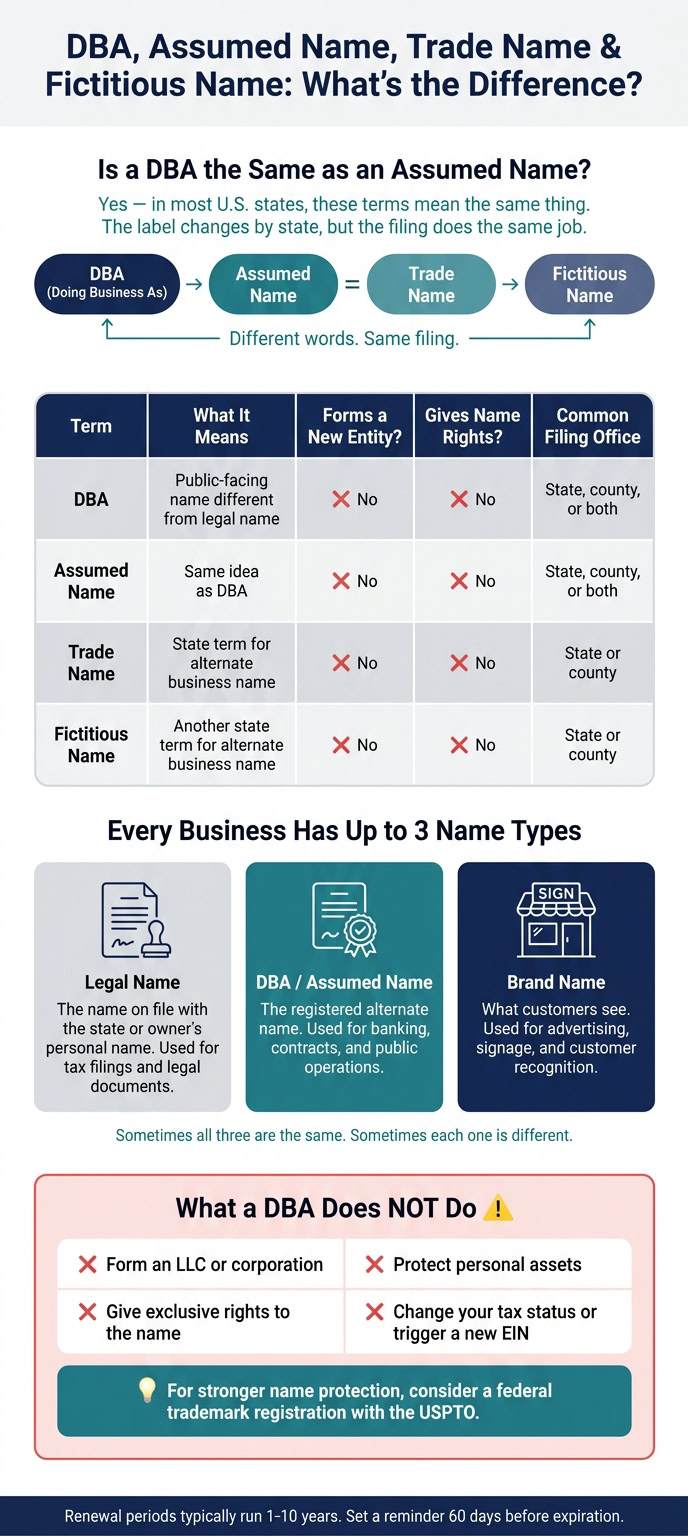
| Term | What it usually means | Forms a new entity? | Gives name rights? | Common filing office |
|---|---|---|---|---|
| DBA | Public-facing name different from legal name | No | No | State, county, or both |
| Assumed name | Same idea as DBA | No | No | State, county, or both |
| Trade name | State term for alternate business name | No | No | State or county |
| Fictitious name | Another state term for alternate business name | No | No | State or county |
So if you’re asking, “Are they the same?” the answer is usually yes. What I’d check next is not the wording – it’s where to file, whether publication is required, how long the filing lasts, and whether the name has trademark issues.
sbb-itb-ba0a4be
What Assumed Name and DBA Actually Mean
DBA stands for "doing business as." It’s the common shorthand for a business name that’s different from the legal name on file. Assumed name is the term many states use for that same filing. In plain English, both point to the same idea: a public business name tied to an existing legal business.
Neither one creates a new business entity. They simply describe a name the business uses in public.
Why These Terms Are Usually Interchangeable
The label changes from state to state, but the filing does the same job. In some places, you may also see terms like fictitious business name, trade name, or fictitious name. Different wording, same basic filing.
What an Assumed Name or DBA Filing Does and Does Not Do
An assumed name or DBA filing helps the public connect a brand name to its actual legal owner, whether that’s one person or a registered business entity. It lets a business market itself, sign contracts, and operate under a different name. And in many cases, banks want a certified DBA or assumed name certificate before opening a business checking account when the business name doesn’t match the owner’s legal name.
Just as important is what a DBA doesn’t do. It doesn’t form an LLC or corporation. It doesn’t protect personal assets. It doesn’t give the business sole rights to the name. In many states, another business may still be able to file the same DBA in that jurisdiction. It also doesn’t change tax treatment or trigger a new EIN on its own.
A DBA is a disclosure tool. It identifies who owns the business name, but it does not create liability protection or trademark rights.
The next issue is when the legal name, filed name, and public brand name match, and when they don’t.
When Business Names Match and When They Do Not
Legal Name, Assumed Name/DBA, and Brand Name: What Each One Means
A business can have more than one name, and each one serves a different job.
The legal name is the name on file with the state. For a sole proprietor, that means the owner’s full personal name. For an LLC or corporation, it’s the exact name listed on the essential formation documents.
The assumed name or DBA is a registered alternate name the business uses instead of its legal name. The brand name is the name customers see.
Sometimes all three names are the same. Sometimes only two line up. And sometimes each one is different.
| Name Type | What It Is | Used For |
|---|---|---|
| Legal Name | Name on formation docs or owner’s personal name | Tax filings, government records, legal documents |
| DBA | Registered alternate name | Banking, contracts, show who owns the business |
| Brand Name | What customers see | Advertising, signage, customer recognition |
Once those name types are clear, it gets much easier to see how they show up in actual filings.
Example: A Sole Proprietor Using a Trade Name
Take Jane Miller, a freelance bookkeeper. Her legal name – "Jane Miller" – is also her business’s legal name by default, since sole proprietors do not file formation documents. If she markets her services as "Sunset Bookkeeping," she would need to register a DBA to use that name publicly.
Without that filing, "Sunset Bookkeeping" is just a trade name. It is not Jane Miller’s registered alternate business name. After she files, her legal name still stays "Jane Miller", while both her DBA and brand name can be "Sunset Bookkeeping."
Example: An LLC Using a Different Customer-Facing Name
The same kind of split happens with LLCs. If Fitness Enterprises LLC wants to operate as "Anytime Fitness" in its local jurisdiction, it must register a DBA to legally conduct business under that name. Using the name without "LLC" can also trigger a filing requirement.
That leads to the next step: figuring out where the name has to be filed, since the rules change from state to state.
How Filing Rules Differ Across the United States
Once you know the legal name, DBA, and brand name aren’t the same thing, the next step is figuring out where the filing goes. That’s where state rules start to split.
The main differences usually come down to:
- where you file
- whether you have to publish a notice
- whether you need to renew the filing
In most cases, the point of the filing is simple: it links the public-facing name to the legal owner.
State Filing, County Filing, or Both
Some states handle these filings at the state level. Florida and Virginia are common examples. Other states push the filing down to the county level, as California and New York do. And some states divide the office by business type. In Texas, for example, sole proprietors file at the county level, while LLCs and corporations file at the state level.
That means the term alone isn’t enough. You need to check the rule for your business structure before you file.
Some states also require publication, which can add both time and cost.
Who Needs to Register an Alternate Business Name
If a business uses a public name that’s different from its legal name, it will usually need to register that name.
That has a pretty practical effect. In many states, a business can’t file a lawsuit or enforce a contract under an assumed name until that name has been properly registered. In plain English: if you use the name in public, the state often wants that name on record first.
Comparison Table: Terms and Filing Effects
The main variables are the filing office, the label the state uses, and what the filing actually does.
| Term | State Label | Filing Office | Filing Effect |
|---|---|---|---|
| Assumed Name | TX, IL, PA | Secretary of State or County Clerk | Registers alias for legal owner |
| DBA (Doing Business As) | Common across states | Secretary of State or County Clerk | Registers alias for legal owner |
| Trade Name | MD, VA, CO | Secretary of State or County Clerk | Registers alias for legal owner |
| Fictitious Name | CA, FL, PA | Secretary of State or County Clerk | Registers alias for legal owner |
An assumed name usually does not give you exclusive rights to that name. It puts the name on file, but it doesn’t give the kind of legal control many owners think it does. If you want stronger name protection, a federal trademark registration is the more reliable path.
With the filing office clear, the next step is choosing the right term and filing it correctly. For a deeper look at the process, see our business formation guide.
How to Choose the Right Term and Take the Next Step
What to Ask When Registering a Business Name
Once you know which office handles the filing, use the exact term that office uses on the form. If Virginia calls it a Trade Name, use that phrase. Matching the office’s wording can speed up the filing.
Before you file, check that the name is available and find out whether there’s a publication deadline. Ask the filing office if the registration goes through the Secretary of State, the county clerk, or both. If publication is required, ask for the deadline up front. Then search the state or county business name database to make sure the name isn’t already taken. A name might be open for state registration and still run into a federal trademark issue, so it’s smart to also check the USPTO trademark database.
How to Avoid Common Naming Mistakes
A DBA or assumed name is just a filing notice, not a new business entity. It doesn’t give you liability protection, it doesn’t change your tax status or business structure, and it doesn’t give you exclusive rights to the name.
One mistake trips people up all the time: adding entity words where they don’t belong. Don’t put "LLC", "Inc.", or "Corp." in a DBA name unless your legal entity is actually formed that way.
When you sign contracts under a DBA, show the legal owner clearly. Use this format: "[Legal Entity Name], doing business as [Brand Name]". That makes it plain who owns the brand name on the agreement.
You’ll also want to give the certificate to your bank. Many banks ask for it before they’ll open or update an account under the DBA.
DBA registrations often expire, and renewal terms often run from 1 to 10 years. Set a reminder 60 days early so the registration doesn’t lapse.
FAQs
Do I need a DBA if I use my own name?
Usually, no. If you run a sole proprietorship under your full legal name, you typically don’t need a DBA.
But if you use any other name – like a brand name or a shorter business name – most states require a DBA, which is also called an assumed or fictitious name. That lets you legally operate under that trade name without changing your business structure.
Can two businesses have the same DBA?
Yes. Two businesses can use the same DBA because a DBA filing is mostly about public notice, not exclusive name ownership.
That said, you should still check whether someone else is already using the name. Even if the law allows it, using the same DBA can lead to mix-ups with customers, vendors, or local agencies.
In many cases, a DBA filed in one county or state doesn’t block another business from using that same name in a different place. If you want exclusive rights to the name, you’d need a federal trademark.
How do I know where to file my DBA?
Where you file a DBA depends on your state’s rules. Check with your state’s business registration office or Secretary of State to confirm what’s required.
Some states handle DBA filings at the state level. Others route them through the county clerk. And in some cases, you may need to file in both places.
The right filing office can also depend on your principal place of business or the area where you do business. That’s why it’s smart to verify the details before you file.