

Yes – but usually only for mail. If you want to open or update a bank account in the U.S., I’d treat a virtual mailbox as a mailing address only, not as your physical address.
Here’s the short version:
-
Banks usually allow a virtual mailbox for statements and other mail
-
Banks usually do not allow it as your main physical or residential address
-
U.S. rules require a street address banks can verify for identity checks
-
CMRA and PO box addresses often get flagged by bank systems
-
The fix is simple: use a street address for compliance and your virtual mailbox for correspondence
That split matters because banks don’t review every address field the same way. In most cases, the problem is not the mailbox itself. The problem starts when you put it in the wrong field.
A few points I’d keep in mind:
-
For personal accounts, banks usually want a residential street address
-
For business accounts, banks usually want a real business location or other street address tied to the business
-
A registered agent address is usually for legal notices, not day-to-day banking
-
If your address is marked as a CMRA, your application may go to manual review
Under bank ID rules in the U.S., the address on file must connect to a place the bank can check with records like an ID, lease, or utility bill. So if you want privacy and smooth account setup, the cleanest setup is simple: street address for verification, virtual mailbox for mail.
If a bank says no, I’d first check for one of three issues:
-
CMRA flag
-
PO box used as the main address
-
Address mismatch across your documents
That’s the whole idea of this article in plain English: virtual mailboxes can work with banks, but not as a stand-in for a physical address.
What Banks Accept, Allow Only for Mail, or Reject
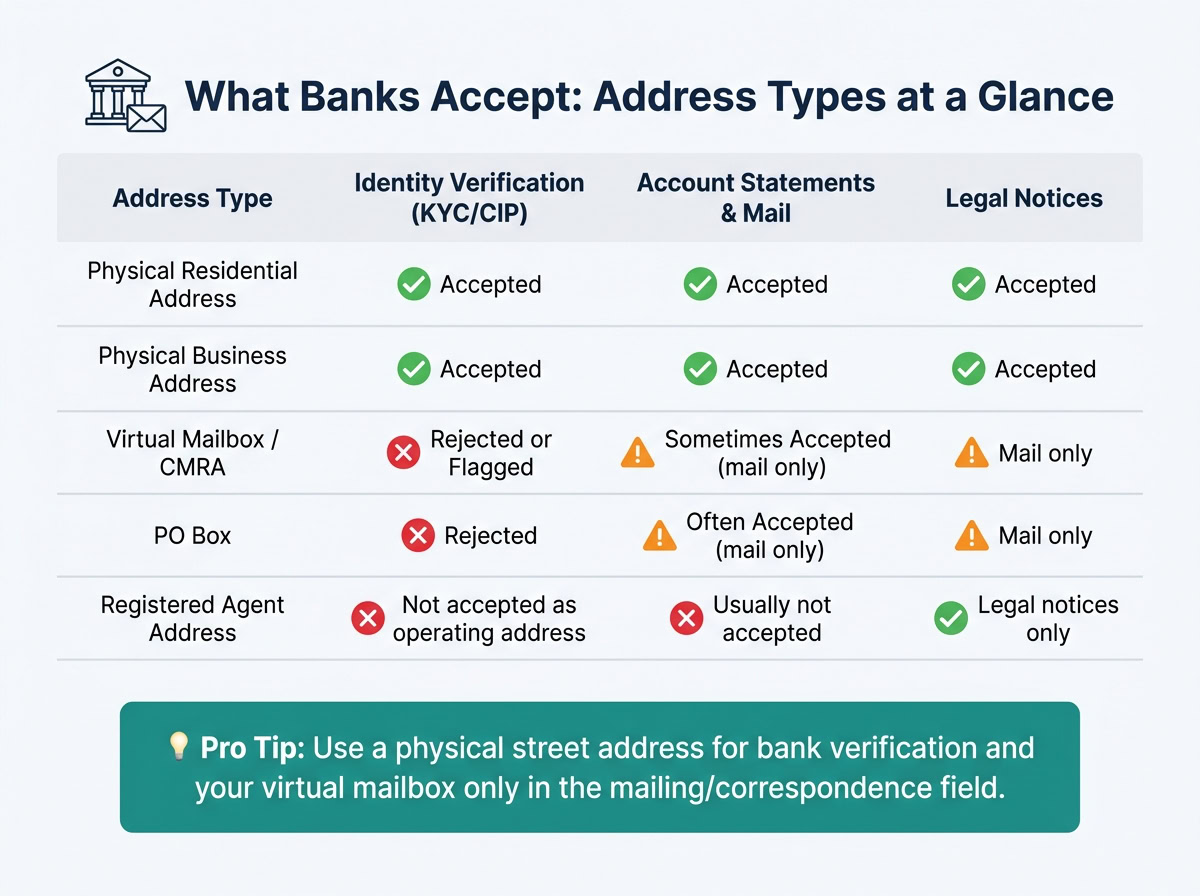
Virtual Mailbox vs. Physical Address: What Banks Accept
Banks don’t treat every address the same way. A virtual mailbox might work for getting mail, but that doesn’t mean it’ll pass identity checks. In practice, banks tend to sort address types into different buckets.
Mailing Address vs. Physical Address vs. Residential Address
A mailing address is where the bank sends statements and notices. A physical address – or residential address for personal accounts – is the address the bank uses for identity checks and compliance.
Federal CIP rules require a residential street address for individuals and a physical business address for entities.[1] The mailing address field is usually more flexible. Banks will often allow a virtual mailbox or CMRA address there, but ONLY if they also have a compliant physical address on file.
For personal accounts, your home address will usually meet the physical address rule. For business accounts, the bank wants the place where the business actually operates. A home office can work if it’s a real operating location and you can back it up with documents like a lease or utility bill.
|
Address Type |
Identity Verification (KYC/CIP) |
Account Statements & Mail |
Legal Notices |
|---|---|---|---|
|
Physical Residential |
Accepted |
Accepted |
Accepted |
|
Physical Business |
Accepted |
Accepted |
Accepted |
|
Virtual Mailbox / CMRA |
Rejected or flagged |
Sometimes accepted (mail only) |
Mail only |
|
PO Box |
Rejected |
Often accepted (mail only) |
Mail only |
|
Registered Agent |
Not accepted as operating address |
Usually not accepted |
Legal notices only |
That explains why a virtual mailbox can help with correspondence but still fail a compliance review.
Why CMRA and Mailbox Addresses Get Flagged
Banks often use automated screening tools to cross-check application addresses against USPS CMRA databases and similar datasets.[1] If an address matches a registered CMRA location, the system treats it as a mail-receiving point, not a physical location.
That kind of flag can lead to a rejection or a manual review, especially if the CMRA address is the only address listed on the application.
Why Banks Reject Virtual Mailbox Addresses
KYC, CIP, and Address Verification Requirements
Banks reject virtual mailbox addresses when they can’t verify a real street address under CIP rules. The problem isn’t the mailbox on its own. The problem starts when that mailbox is entered in the address field the bank is required to verify.
Under 31 CFR § 1020.220, U.S. banks must collect identity details when an account is opened, including an address.[4][7] For individuals, that usually means a residential street address. For businesses, it means a principal place of business, local office, or other physical location – not a mailing address.[4][7][8]
Banks use that address to tie together identity, business activity, and fraud checks. They often cross-check it against records like a utility bill, lease agreement, government-issued ID, or formation documents. A virtual mailbox doesn’t show physical presence. That’s why the address on file needs to match a physical location, not just a mail-handling service.
Common Rejection Triggers During Review
Most rejections come from a small set of common issues:
-
PO box listed as the primary address. Federal CIP rules do not allow a PO box to stand in for a street address.[8]
-
CMRA address flagged in automated screening. Banks compare addresses against CMRA databases, and a match can lead to a rejection or a manual compliance review.
-
Registered agent address used as the operating address. A registered agent address is meant for legal notices and service of process, not day-to-day business activity.
-
Missing proof of address documents. Even a valid physical address can create trouble if the applicant can’t provide recent supporting records.
In each case, the bank is looking for a street address it can verify and connect to the applicant. The usual fix is simple: give the bank a separate physical address, and use the virtual mailbox only for mail.
How to Meet Bank Requirements While Protecting Your Privacy
Once a bank asks for a street address it can verify, the move is pretty simple: separate compliance from mail handling. Use a physical address for the bank check, and use a virtual mailbox for your mail.
Address Options That Work for Different Business Setups
The best option comes down to how your business is set up:
-
Freelancer or sole proprietor: use your home address for bank verification
-
LLC owner: use a leased office or coworking space with a dedicated street address
-
Remote founder: use a verifiable U.S. residential address for banking
|
Address Type |
Privacy |
Compliance for Banking |
Cost |
Practicality |
|---|---|---|---|---|
|
Home address |
Low |
High |
Low |
High for freelancers and solo owners |
|
Leased office |
Medium–High |
High |
High |
Strong for businesses that need a separate physical office address |
|
Coworking office with dedicated street address |
Medium |
High |
Medium |
Good fit for remote teams |
|
Physical business location |
Medium |
Highest |
High |
Best if you already run the business from a real location |
|
Medium–High |
Low for banking |
Low–Medium |
Useful for legal notices, not bank accounts |
|
|
CMRA virtual mailbox |
High |
Low as physical; Medium–High as mailing |
Low–Medium |
Best as a mail solution, not a physical address replacement |
How to Use a Virtual Mailbox Without Causing Problems
When you fill out the bank application, keep the two address fields separate. Put your physical address in the bank’s physical/residential field, and put your virtual mailbox in the mailing/correspondence field. Never use a virtual mailbox address in the physical address field.[1]
That setup gives you the best of both sides. The bank gets the address it needs for verification, and your mailbox handles scanning and forwarding without being treated as your bank address. BusinessAnywhere is built for that mail-handling side, so your virtual mailbox stays where it should be – in the correspondence field, not the compliance field.
How to Apply Without Delays and What to Do If the Bank Says No
Documents to Prepare Before Opening or Updating an Account
Once you separate your mailing address from your physical address, the next move is simple: get your paperwork lined up so it matches the street address on file.
For a personal account, bring a government-issued photo ID and one recent proof-of-address document, like a utility bill, lease, mortgage statement, or property tax bill. That setup lets you keep the virtual mailbox for mail while using a street address the bank can verify. For a business account, have your EIN letter, formation documents, and operating agreement ready, if it applies.[2][6][3]
The big thing here is consistency. Your ID, records, and application should all show the same address. If they don’t, the bank may send your application to manual review.
If the bank still puts the application on hold, start with the most common problem: an address mismatch. Send recent proof of the address you entered as soon as you can. It also helps to ask which field failed – CMRA, PO box, or address mismatch. In many cases, the problem is the address field itself, not the mailbox service.[2][5][9]
Conclusion: Use a Virtual Mailbox for Mail Only
A virtual mailbox is for mail. A physical street address is for bank verification.
Use the mailbox for correspondence, use a real street address for bank compliance, and keep those two separate on every application.
FAQs
Can I open a bank account with only a virtual mailbox?
It depends on the bank.
Many banks will accept a virtual mailbox as your mailing address. But they may still ask for a physical address to verify your identity and meet compliance rules.
Before you apply, check the bank’s policy first. Also make sure your business documents use the same address details across the board. And if the bank asks, be ready to show proof of a physical business location.
What address should I use if I run my business from home?
If you run your business from home, be ready to show documents that confirm your physical location for banking compliance. You can use your home address for your business, but that may put your personal address on the public record.
If privacy matters to you, it’s smart to keep each address role separate. Use a registered agent for legal compliance, a virtual mailbox for mail, and your home address as your physical location. Your bank may also ask for proof, like a utility bill or lease.
What documents can a bank ask for to verify my address?
Banks often ask for proof that your business operates at the address you listed. In most cases, that means documents like a utility bill, a signed lease agreement, or business documents filed with the state.
If the bank needs more detail, it may also ask for a notarized affidavit or a letter of support from the person or company providing your address. To help avoid delays, make sure the address matches across your Articles of Organization, IRS EIN records, and bank application.