

Expanding your business into multiple states? Here’s the big question: is it worth paying for foreign qualification, or should you risk the penalties of non-compliance? Let’s break it down:
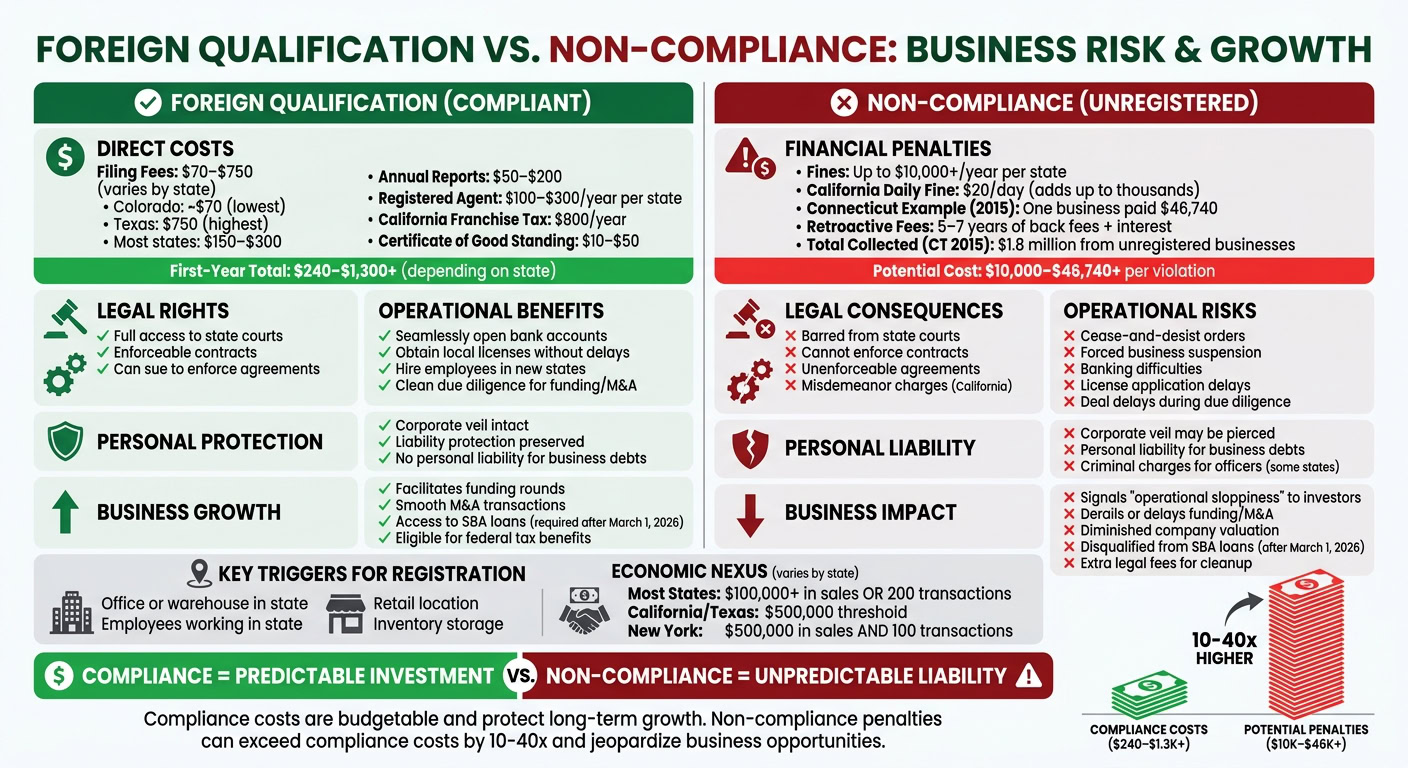
- Foreign Qualification Costs: Filing fees range from $50 (Michigan, Missouri) to $750+ (Texas, South Dakota). Add annual expenses like registered agent fees (registered agent fees ($100–$300)00–$300) and report fees ($50–$200). Some states, like California, also require additional taxes (e.g., $800 annual franchise tax).
- Non-Compliance Risks: Operating without registration is illegal. You could face fines, unenforceable contracts, delayed deals, and even personal liability in some cases. Penalties can snowball into tens of thousands of dollars, and compliance gaps may scare off investors or buyers.
- Key Factors: Physical presence (e.g., office, employees) or economic thresholds (e.g., $100K+ in sales) often trigger registration requirements. Rules vary by state, so staying informed is critical.
Bottom Line: While compliance costs are predictable, non-compliance can lead to unexpected financial and legal troubles. Staying registered ensures smoother operations and better growth opportunities. Tools like BusinessAnywhere can help simplify compliance management.
Quick Comparison:
| Category | Foreign Qualification (Compliant) | Non-Compliance (Unregistered) |
|---|---|---|
| Costs | Filing fees ($70–$750); Annual fees ($50–$300) | Fines, back fees, interest (up to $10,000+/year) |
| Legal Rights | Enforceable contracts | Contracts may be unenforceable |
| Business Impact | Easy access to licenses, funding | Delays in deals, potential liabilities |
| Personal Risk | Liability protection intact | Risk of personal liability |
Choose wisely – compliance is an upfront investment that protects your business long-term.
Foreign Qualification and Non-Compliance Explained
What is Foreign Qualification?
Foreign qualification is the process of registering your business to legally operate in a state other than the one where it was originally formed. For example, if your business is incorporated in Delaware but you decide to open an office in California, you’ll need to file for foreign qualification in California. This process notifies the state that your business is operating there, making it subject to the state’s laws and regulations.
This step becomes necessary when your business establishes a physical presence, hires employees, or meets economic nexus thresholds in a state other than its formation state. The most common trigger is a physical presence – like opening an office, warehouse, or retail location in another state. However, economic nexus has gained prominence since the Supreme Court’s South Dakota v. Wayfair decision. For example, surpassing $100,000 in sales or completing 200 transactions within a 12-month period in a particular state could require registration.
What is Non-Compliance?
Non-compliance arises when a business fails to meet these registration requirements. This is more common than you might think, especially for companies that don’t realize they’ve crossed a threshold. For instance, remote businesses often unknowingly trigger compliance issues when hiring employees in other states or when online sales exceed economic nexus thresholds.
Some typical scenarios include e-commerce businesses surpassing sales thresholds without tracking them, companies with employees working remotely in different states, or businesses storing inventory in warehouses scattered across multiple states. Even without a deliberate plan to expand into a new state, these activities can create obligations to register.
How Requirements Vary by State
The rules and costs for foreign qualification vary significantly depending on the state. Filing fees, for instance, range from around $70 in Colorado to more than $750 in Texas. Additionally, states differ in how quickly they require businesses to register after establishing a nexus. Some demand immediate registration, while others allow for a grace period.
Economic nexus thresholds also vary. States like Florida, Massachusetts, and Illinois stick to the $100,000 sales threshold, while California and Texas set a much higher bar at $500,000 in sales. New York adds another layer of complexity by requiring both $500,000 in sales and 100 transactions to trigger registration. These differences in filing fees and thresholds significantly impact the cost and compliance strategies for businesses operating across multiple states.
sbb-itb-ba0a4be
What Foreign Qualification Costs
Filing Fees and Annual Costs
The cost to register your business in a new state can vary widely depending on the state you’re entering. Filing fees range from $50 to over $750, with the majority of states falling between $150–$300.
Once you’ve filed, you’ll need to account for ongoing annual expenses. Every state requires you to designate a registered agent – someone or a service with a physical address in the state to handle legal and tax documents on your behalf. Registered agent services typically cost between $100 and $165 per year. Additionally, many states charge annual or biennial report fees, which range from $50 to $200. Some states also impose franchise or privilege taxes, regardless of profitability. For example, California enforces an $800 annual franchise tax for all registered entities.
You’ll also need a Certificate of Good Standing from your home state, which costs $10–$50 and is valid for 60 days (or 30 days in Florida). Certain states like Arizona, Nebraska, and New York require you to publish notice of your qualification in local newspapers, adding another layer of expense. These additional requirements can quickly increase the total cost of foreign qualification.
Administrative Costs for Multi-State Operations
Managing compliance across multiple states involves more than just filing fees – it requires time and resources to keep up with deadlines, monitor economic nexus triggers, and ensure your business remains in good standing. This administrative workload can become overwhelming, especially if you’re managing compliance manually. For example, you’ll need to conduct quarterly nexus reviews by comparing sales-by-state reports from platforms like Stripe or QuickBooks against economic nexus thresholds by state. Missing a registration deadline or failing to file in a state where you’ve triggered nexus can lead to penalties that far outweigh the cost of staying compliant.
To streamline these tasks, many businesses use platforms like BusinessAnywhere. These tools centralize compliance management, offering services like registered agent support, automated reminders for annual reports, and dashboards to track entity numbers, due dates, and fees across all registered states. By shifting from unpredictable penalties to predictable operational costs, businesses can free up internal resources to focus on growth rather than paperwork.
State-by-State Cost Comparison
The costs of foreign qualification can vary drastically by state, as shown in the table below. For example, filing in Texas costs $750, while Colorado charges just $70. These differences can add up quickly if you’re expanding into multiple states.
| State Foreign LLC Filing Fee Foreign Corp Filing Fee Annual Report/Tax Fee | |||
|---|---|---|---|
| California | $70–$85 | $135 | $800 (Annual Tax) |
| Colorado | ~$70 | ~$70 | Varies |
| Delaware | $200 | $245 | $400 (LLC Tax) |
| Florida | $125 | $70 | $138.75 (LLC) |
| Massachusetts | $500 | $400 | $500 |
| New York | $250 | $225 | $9 (Biennial) |
| Tennessee | $300 (min) | $600 | $300 (min) |
| Texas | $750 | $750 | $0 (if revenue <$2.65M) |
When planning your budget, remember that first-year costs include the initial filing fee, registered agent costs, and annual report fees. Depending on the state and your entity type, these first-year expenses can range from $240 to over $1,300. This highlights why it’s crucial to evaluate both upfront and ongoing compliance costs when expanding your business.
Penalties and Risks of Non-Compliance
Financial Penalties
operating without proper foreign qualification and tax compliance can lead to steep fines, with penalties differing based on the state and the duration of non-compliance. For instance, back in 2015, Connecticut collected $1.8 million in fines from unregistered companies, with one business facing a staggering $46,740 penalty. Nevada, on the other hand, limits its annual fines to $10,000. Since penalties can be enforced by multiple jurisdictions, the costs can snowball quickly.
Legal and Operational Consequences
The fallout from non-compliance goes beyond just monetary fines. In California, conducting intrastate business without the necessary qualifications is considered a misdemeanor. Meanwhile, New York can impose significant administrative hurdles, such as requiring corporations to wait up to six months for tax commission consent before they can register if they’ve been operating improperly.
Hidden Costs of Non-Compliance
The true cost of non-compliance often becomes painfully clear during pivotal business moments. Whether it’s securing venture capital, negotiating a merger, or applying for a major loan, compliance issues uncovered during due diligence can bring everything to a screeching halt. As the Glencoyne Editorial Team explains:
“Discovering that you have nexus in multiple states but have failed to register creates a real problem… It signals operational sloppiness and requires rushed rectification, delaying the deal”.
These delays can lead to missed opportunities, diminished company valuations, and unexpected legal expenses to fix compliance issues retroactively. When you add it all up, the risks and hidden costs of non-compliance often far outweigh the predictable expenses of staying fully compliant.
Compliance Costs vs. Non-Compliance Penalties
Cost Comparison Table
When you break it down, compliance costs are predictable and manageable, while non-compliance penalties can quickly spiral out of control.
| Category | Foreign Qualification (Compliant) | Non-Compliance (Unregistered) |
|---|---|---|
| Direct Costs | Filing fees ($70–$750) plus annual reports ($50–$200) | Retroactive back fees, interest, and civil penalties (up to $10,000+/year per state) |
| Legal Rights | Full access to state courts to enforce contracts | Barred from initiating lawsuits; contracts may be unenforceable |
| Operational Impact | Seamlessly open bank accounts and obtain local licenses | Risk of cease-and-desist orders and forced business suspension |
| Personal Risk | Preserves corporate veil and liability protection | Potential for personal liability for business debts; misdemeanor charges for officers in some states |
| Business Growth | Facilitates clean due diligence for funding and M&A | Signals “operational sloppiness” and can derail or delay transactions |
For example, filing fees range from about $70 in Colorado to over $750 in Texas. On top of that, businesses typically spend $100–$300 per year on registered agent services in each state. Meanwhile, penalties for non-compliance can rack up fast. In California, a $20 daily fine can snowball into thousands of dollars in just a few months. And don’t forget retroactive back fees and interest, which can stretch back 5–7 years of operations.
Business Impact Analysis
The numbers only tell part of the story – compliance (or lack of it) has a massive ripple effect on how your business operates. When you’re properly registered, you gain access to state courts to enforce contracts, open bank accounts without hassle, secure required licenses, and hire employees in new states without setting off regulatory alarms.
But if you skip registration, things get messy. You might lose the ability to enforce contracts, leaving you vulnerable if a partner or client doesn’t hold up their end of the deal. Worse, your corporate veil could be pierced, exposing you to personal liability for business debts. In some states, like California, operating without proper registration is even classified as a misdemeanor.
On top of that, non-compliance can scare off investors and acquirers. Due diligence is a critical part of funding rounds or mergers, and any sign of improper registration can be a red flag. As the Glencoyne Editorial Team puts it:
“Discovering that you have nexus in multiple states but have failed to register… signals operational sloppiness and forces a scramble to fix the issue, delaying the deal and incurring extra legal fees for cleanup”.
These delays don’t just cost money – they can cost you opportunities and even lower your company’s valuation.
The bottom line? Staying compliant isn’t just about avoiding penalties – it’s about setting your business up for smooth growth. Tools like BusinessAnywhere make it easier by centralizing registered agent services, tracking annual reports, and sending compliance alerts through a single platform. This kind of streamlined approach helps businesses stay on top of multi-state requirements, which is critical when scaling or preparing for investment rounds.
How to Decide What’s Right for Your Business
Assess Your Business Nexus
The first step in navigating compliance is figuring out whether your business has established a nexus in another state. Physical nexus is straightforward – having an office, employees, or inventory in a state usually establishes it. Economic nexus, on the other hand, comes into play when your sales or transaction volumes meet specific thresholds set by each state, even if you don’t have a physical presence there. Since these thresholds vary, it’s important to verify the specific requirements for each state where you operate.
To stay ahead of potential compliance issues, consider running quarterly nexus reviews. Tools like QuickBooks or Stripe can generate sales-by-state reports, helping you track when your business approaches these thresholds. Identifying your nexus early allows you to create a compliance strategy that’s both efficient and cost-effective.
Plan for Compliance Costs
Once you’ve identified your nexus, it’s time to budget for compliance-related expenses. These costs often include initial filing fees, annual reports, and registered agent services for multi-state operations. To keep everything on track, set up a compliance calendar to monitor important deadlines for annual reports and franchise taxes. Staying in Good Standing is critical, especially if you’re planning to expand, secure financing, or sell your business down the line.
For businesses operating across multiple states, platforms like BusinessAnywhere can simplify the process. They centralize services like registered agent management, monitor compliance deadlines, and send automated reminders – all from a single dashboard. This level of organization can save both time and stress.
Long-Term Benefits of Staying Compliant
Beyond the immediate logistics, staying compliant offers significant long-term advantages. It’s not just about avoiding penalties – compliance is a strategic move that supports your business’s growth and stability. Proper registration allows you to enforce contracts in state courts, open bank accounts without hurdles, secure necessary licenses, and maintain the corporate veil that protects your personal assets.
Upcoming regulatory changes make compliance even more critical. Starting March 1, 2026, new SBA loan policies will require 100% U.S. citizen or national ownership and proof of Good Standing in all states where your business operates. Non-compliance could disqualify you from SBA-backed financing, and potential investors or buyers may see compliance gaps as red flags, possibly jeopardizing important deals.
Compliance also opens the door to federal tax benefits. Under the One Big Beautiful Act, signed on July 4, 2025, businesses can claim 100% bonus depreciation on equipment purchased in 2026 – provided they’re properly registered. Additionally, for multi-state operators, the SALT deduction cap will increase to $40,000 for married couples filing jointly in 2026, offering further tax relief. These upcoming changes highlight how compliance can directly impact your bottom line.
Conclusion
Foreign qualification is an investment you can plan for, with clear costs and predictable processes. Filing fees range from $70 in Colorado to $750 in Texas, annual report fees fall between $50 and $200, and registered agent services typically cost registered agent services typically cost $100 to $300 per state, per year00 to $300 per state, per year. These expenses allow businesses to budget effectively and stay organized.
On the flip side, non-compliance can bring about serious financial and operational setbacks. For instance, Connecticut collected $1.8 million in penalties from unregistered businesses in 2015, with one company paying as much as $46,740. Beyond the fines, non-compliant businesses risk losing the ability to enforce contracts in state courts, facing time-consuming audits, and tarnishing their reputation with investors or lenders.
As the Glencoyne Editorial Team wisely notes:
“This isn’t about legal trouble, it’s about building a durable, compliant foundation for growth.”
Staying compliant doesn’t just protect your business from penalties – it also paves the way for smoother fundraising, mergers, acquisitions, and other major transactions. These benefits highlight the value of proactive compliance.
To stay ahead, conduct quarterly nexus reviews, maintain a compliance calendar, and use tools like BusinessAnywhere to streamline filings, automate deadlines, and manage registered agent services. The relatively small cost of compliance ensures smoother operations, stronger legal footing, and better growth opportunities.
FAQs
When does a business have to foreign qualify in another state?
When a business starts conducting notable activities in another state – like setting up offices, hiring staff, or signing contracts – it’s required to foreign qualify in that state. This step ensures the business complies with local laws and avoids potential penalties or legal issues.
What’s the fastest way to fix past non-compliance in a state?
The fastest way to address past non-compliance is by completing the foreign qualification process. This means registering your business with the relevant state authority. Usually, this involves submitting forms such as an Application for Authority or a Certificate of Registration, along with paying the necessary fees. Taking the time to review the specific requirements and processing timelines for the state in question – or working with professional compliance services – can help speed things up and minimize potential risks.
Does foreign qualification change my taxes or create new filings?
Foreign qualification doesn’t directly impact your taxes or create additional filing requirements. However, skipping the process can lead to penalties or legal complications that might interfere with your business operations. Staying compliant helps you avoid these avoidable risks.