
If you’re running a business under a name that’s different from your legal one, filing a DBA (Doing Business As) is often required. A DBA, also known as a fictitious or trade name, helps businesses operate under a chosen name without changing their legal structure. Rules for filing vary widely by state, including where to file, fees, renewal schedules, and publication requirements. Here’s a quick breakdown:
- Where to File: State-level (e.g., Oregon), county-level (e.g., California), or both (e.g., Texas).
- Fees: Range from $5 (Washington) to $175 (Georgia).
- Renewals: Every 2–10 years, depending on the state. Some states (e.g., New York) don’t require renewals.
- Publication: Required in some states (e.g., California, Florida) for a set number of weeks.
Failing to file a DBA can lead to issues like fines, problems with bank accounts, or unenforceable contracts. Platforms like BusinessAnywhere can simplify multi-state compliance by managing filings, renewals, and choosing the best registered agent service to handle compliance in one place.
Quick Tip: Always check your state’s specific rules, as requirements can change frequently. For example, Delaware recently centralized all DBA filings into a single online portal as of 2026.
DBA Filing Basics
How to File a DBA: 5-Step Process Guide
When Do You Need a DBA?
You’ll need to file a DBA (Doing Business As) if the name you’re using publicly doesn’t match your legal name. For instance, if you’re a sole proprietor operating as "Rivera Consulting" instead of your legal name, "Maria Rivera", filing a DBA is necessary. Similarly, LLCs and corporations must register a DBA when using a name different from their registered one to maintain consistency in branding.
A DBA is also helpful if a single legal entity manages multiple brands. For example, an LLC registered as "Greenfield Ventures LLC" can file DBAs like "Greenfield Catering" and "Greenfield Events." This allows for unique branding without the hassle of creating separate companies.
| Situation | DBA Required? |
|---|---|
| Sole proprietor using their full legal name | No |
| Sole proprietor using a name like "Smith Consulting" | Yes |
| LLC operating under its exact registered name | No |
| LLC dropping the "LLC" suffix in public use | Yes |
| LLC launching a second brand within the same entity | Yes |
| Franchisee operating under a franchisor’s brand name | Yes |
General Steps to File a DBA
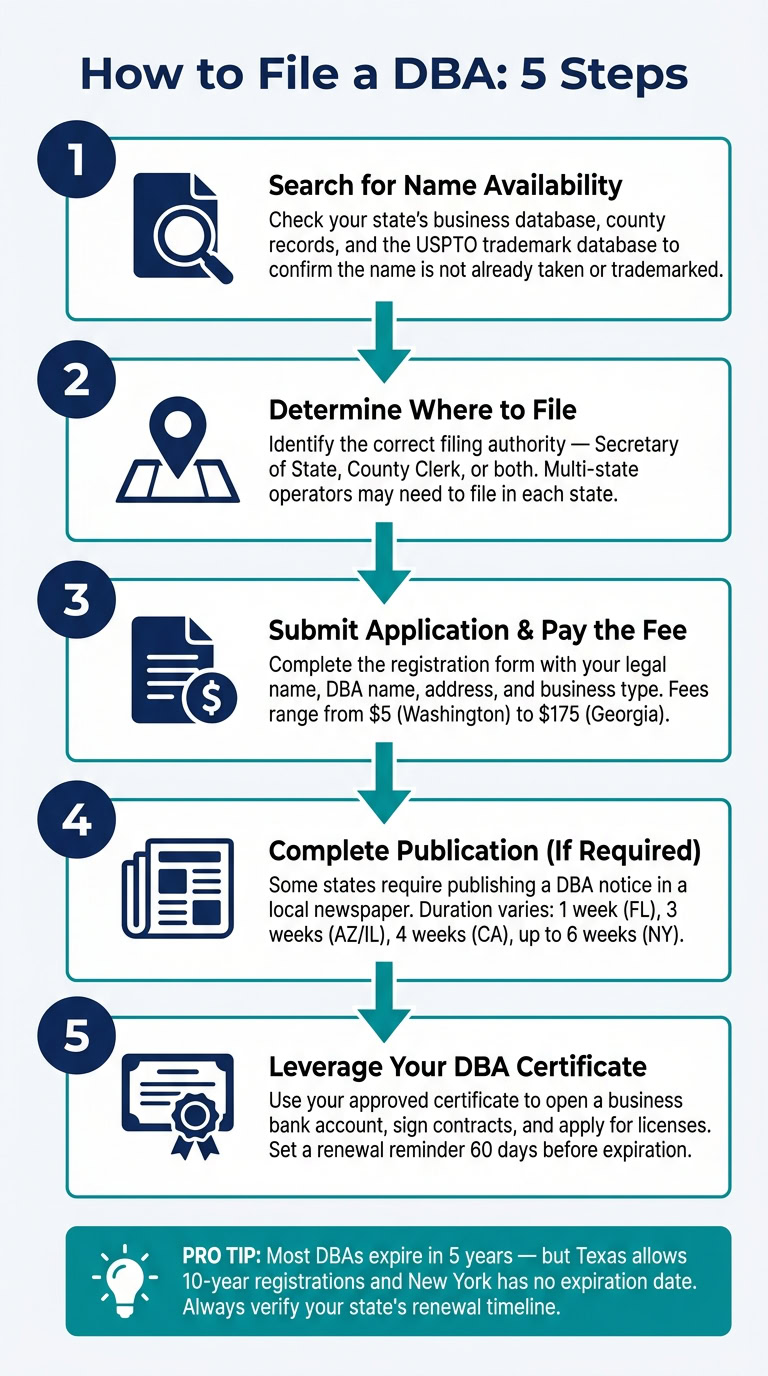
Filing a DBA is a straightforward process, often involving these steps:
- Search for Name Availability
Check your state’s business database, county records, and the USPTO trademark database to ensure the name you want isn’t already taken or trademarked. - Determine Where to File
Confirm the appropriate filing authority – this could be the Secretary of State, County Clerk, or both. If you’re operating in multiple states, you may need to file in each one. - Submit Your Application and Pay the Fee
Fill out the registration form, including details like your legal name, DBA, address, and business type. Filing fees vary widely, ranging from $10 to $175 depending on your state and county. - Complete Publication, If Required
Some states require you to publish a DBA notice in a local newspaper and submit proof of publication. Costs for this step depend on your location, so check local rules for specifics. - Leverage Your DBA Certificate
Once approved, your DBA certificate allows you to open a business bank account, sign contracts, and apply for licenses under your trade name. Keep in mind that most DBAs expire after five years, though some states, like Texas, offer ten-year registrations, while others, like New York, have no expiration date. To avoid disruptions, set a reminder to renew at least 60 days before your DBA expires.
While understanding the filing process is crucial, it’s just as important to know what a DBA doesn’t do.
What a DBA Does Not Do
A DBA has its limitations. Here’s what it won’t do:
- Create a separate legal entity. A DBA is tied to your existing business, meaning any debts or liabilities under the trade name remain your responsibility.
- Provide liability protection. Unlike an LLC, a DBA doesn’t shield your personal assets.
- Grant exclusive name rights. Another business in your area could register the same DBA name. If exclusive rights are important, consider applying for a federal trademark, which starts at around $350 per class.
- Replace other legal requirements. Filing a DBA doesn’t exempt you from needing an Employer Identification Number (EIN) or other required licenses.
If protecting your personal assets is a priority, forming an LLC might be a better option than relying solely on a DBA. Understanding these basics will help you navigate filing requirements, which can vary by state and jurisdiction.
DBA Filing Rules by State
How to Use This Section
This section provides a quick overview of DBA filing details for various states, including where to file, associated fees, publication requirements, and renewal timelines. Use it as a handy reference before starting your filing process.
Keep in mind that DBA rules vary depending on your state, county, and business type. Some states centralize filings through the Secretary of State, while others delegate them to county or city clerks. Your business structure also plays a role. For instance, in states like Texas and New York, LLCs file at the state level, but sole proprietors handle filings at the county level. Filing with the wrong office could invalidate your registration.
Fees can range significantly, from as little as $5 in Washington to as much as $175 in Georgia, not including publication costs. In New York City, for example, publication requirements – posting in two newspapers for six consecutive weeks – can add $200 or more. Meanwhile, states like Kansas, Mississippi, and New Mexico don’t require formal DBA filings for domestic businesses.
"A DBA filing is one of the cheapest things you can do for your business… but skipping the filing risks fines, contract enforceability problems, and the inability to open a business bank account." – Eliot Reynolds, Senior Legal Researcher
The table below highlights filing details for a selection of states, giving you a clear starting point. Notably, Delaware revamped its system on February 2, 2026, consolidating all DBA filings into a centralized online portal called Delaware One Stop. This new process replaced the previous county-level filings with a flat $25 fee.
| State | Filing Office | Approx. Fee | Publication Requirement | Renewal Period |
|---|---|---|---|---|
| Alabama | Secretary of State | $30 | No | 5 Years |
| Alaska | Dept. of Commerce | $25 | No | 5 Years |
| Arizona | Secretary of State | $10 | Yes (3 weeks) | 5 Years |
| California | County Clerk | $26–$100 | Yes (4 weeks) | 5 Years |
| Colorado | Secretary of State | $20 | No | Annual |
| Delaware | Div. of Revenue | $25 | No | No Expiration |
| Florida | Dept. of State | $50 | Yes (1 week) | 5 Years |
| Georgia | Superior Court Clerk | $150–$175 | Yes (2 weeks) | No Expiration |
| Illinois | County Clerk / SOS | $10–$150 | Yes (3 weeks) | 5 Years |
| Massachusetts | City / Town Clerk | Varies | No | Every 4 Years |
| Michigan | County Clerk / LARA | $10–$25 | No | 5 Years |
| Minnesota | Secretary of State | $50 | Yes (2 weeks) | Annual |
| Nebraska | Secretary of State | $100 | Yes (2 weeks) | 10 Years |
| New York | Dept. of State / County | $25–$100+ | Yes (6 weeks) | No Expiration |
| Oregon | Secretary of State | $50 | No | 2 Years |
| Pennsylvania | Dept. of State | $70 | Yes (1 week) | No Expiration |
| Texas | SOS / County Clerk | $15–$25 | No | 10 Years |
| Virginia | State Corp. Commission | $10 | No | No Expiration |
| Washington | Dept. of Revenue | $5 | No | Annual |
| Wyoming | Secretary of State | $100 | No | 10 Years |
Some notable details include California, which requires the longest publication period – four consecutive weeks – and mandates filing an affidavit of publication with the county clerk within 30 days of the final notice. Florida stands out for requiring the newspaper notice to run before submitting your registration to the state. Meanwhile, states like Oregon have shorter renewal cycles, with filings required every two years, making it easy to miss if not closely monitored.
If your state isn’t listed here, check with your Secretary of State’s website or your local county clerk’s office. Rules can change quickly, as shown by Delaware’s 2026 overhaul of its filing system.
Key Differences in DBA Rules Across States
State-Level vs. County-Level Filing
When it comes to filing a DBA (Doing Business As), the rules vary greatly depending on your state and business structure. States generally fall into one of four filing categories: state-level, county-level, hybrid (both), or city/town-level.
| Filing Level | Example States | Typical Authority |
|---|---|---|
| State Level | FL, OH, OR, CO, VA | Secretary of State / Dept. of State |
| County Level | CA, NV, GA, IA | County Clerk / Recorder of Deeds |
| Both (Hybrid) | TX, NY, IL, NC | Secretary of State AND County Clerk |
| City/Town | MA, ME, RI, VT | City or Town Clerk |
Choosing between an LLC, S-Corp, or C-Corp plays a crucial role in determining where to file. For instance, in Illinois, LLCs must file with the Secretary of State, while sole proprietors file with the County Clerk. Filing in the wrong jurisdiction can lead to delays or even invalidate your registration.
State-level filings provide protection across the entire state, while county-level filings are geographically limited. For example, if you’re operating in multiple counties in California (a county-filing state), you’ll need to file separately – and pay separate fees – for each county.
Knowing where to file is just the beginning. Publication and renewal requirements add another layer of complexity.
Publication and Renewal Rules
In about seven to nine states, you’re required to publish a notice of your DBA in a local newspaper. Each state has its own rules for publication timelines and costs, so it’s important to refer to specific guidelines.
"A DBA is permission to use a name – not ownership of it." – StartCosts
Renewal requirements also differ. For example, Oregon mandates renewal every two years, while Massachusetts requires it every four. Most states follow a five- or ten-year renewal cycle, but states like Virginia and New York don’t require renewal at all.
On top of filing and publication, fees can vary widely, making it essential to budget for all related costs.
Filing Fees and Related Costs
Filing fees can range dramatically – from $5 in Washington to $175 in Georgia. However, the base fee is often just the tip of the iceberg. Additional costs like publication, notarization, and county-specific fees can significantly increase the total expense.
New York’s dual filing system is a good example of how costs can stack up. Sole proprietors file at the county level, with fees typically ranging from $25 to $100. LLCs, on the other hand, file with the state for $25 and also pay county-specific fees of $25–$100 per county. To avoid unnecessary expenses, it’s wise to search both state and county databases before paying any non-refundable filing fees. A name that’s available at the state level might already be taken in a specific county.
These variations highlight the importance of staying organized and understanding the rules across different jurisdictions to manage your DBA effectively.
sbb-itb-ba0a4be
Tips for Managing DBAs Across Multiple States
Handling DBAs across multiple states can feel daunting, but staying on top of compliance is absolutely critical. Here’s how to keep things organized and avoid the common pitfalls.
Aligning DBAs with Licenses and Tax Registrations
Before registering a DBA in a new state, check if your business activities trigger the need for foreign qualification. Some common triggers include hiring remote W-2 employees, leasing office space, or storing inventory in a fulfillment center. Most states require foreign qualification to be completed before you can file for a DBA. Plus, the address on your DBA filing needs to match your foreign qualification documents and IRS records. If it doesn’t, you could face account holds during bank CIP reviews.
Keep in mind that managing compliance across states comes with extra costs. For example, foreign qualification fees range from $70 in California to a whopping $750 in Texas. And that’s just the start – you’ll also need to budget for DBA fees, annual reports, and state franchise taxes.
Tracking Renewal Deadlines
Trying to manually track renewal deadlines is a recipe for disaster. Instead, create a centralized digital compliance calendar with automated alerts set at least 30 days before each deadline. This gives you enough time to gather any required paperwork, such as [obtaining a Certificate of Good Standing].
It’s also a good idea to review your compliance requirements every year. Things like fees, agency names, and filing URLs can change, so staying updated is essential.
"Failure to acquire proper licensing could jeopardize your business, resulting in expensive penalties or leaving you without legal protection." – Wolters Kluwer
To avoid missed deadlines, assign a single person to oversee all compliance tasks – foreign qualification, registered agent services, and DBA registrations. When responsibilities are spread across multiple people, it’s much easier for something to slip through the cracks.
If all of this feels overwhelming, consider using tools designed to simplify multi-state compliance.
Using BusinessAnywhere to Manage Multi-State Compliance
BusinessAnywhere is a great tool for streamlining the management of DBAs across multiple states. It combines registered agent services, virtual mailbox options, compliance alerts, and annual filings into one easy-to-use dashboard.
Its registered agent service provides a staffed physical address in your registration state to handle service of process. Meanwhile, the virtual mailbox gives you a professional U.S. street address that meets local DBA filing requirements and keeps your personal address off public records.
For business owners juggling operations in several states, this kind of integrated solution can save time, reduce stress, and help prevent costly mistakes like lapsed registrations.
Staying Compliant with DBA Rules
Once you’ve filed your DBA and taken care of renewals, keeping everything compliant is crucial to safeguarding your business.
Compliance with DBA rules isn’t a one-and-done task – it’s an ongoing responsibility. Renewal timelines differ by state: Massachusetts requires renewals every four years, California and Florida every five years, Texas every ten years, while New York and Delaware offer perpetual registrations. Missing these deadlines can lead to fines or even loss of legal standing, which could prevent you from enforcing contracts or pursuing unpaid invoices until your filings are updated.
No matter where you’re located, there are some basic practices to follow. Make sure your DBA name and address are consistent across all records, like bank accounts, EIN documentation, and licenses. If you stop using a DBA name, you’ll need to file a formal statement of abandonment. This clears the public record and removes any renewal obligations, tying back to the renewal reminders mentioned earlier.
Certain states, like California, add extra steps for renewals, such as re-publication requirements. This process can take four to six weeks and cost anywhere from $25 to $200. Setting reminders at least 60 days before renewal deadlines can help you navigate these requirements without unnecessary stress.
Delaware recently centralized its DBA filings through the "One Stop" portal as of February 2, 2026. While existing registrations remain valid, re-registering quickly is a smart move to secure your business name.
Platforms like BusinessAnywhere simplify compliance by offering services such as registered agent support, a virtual mailbox with a professional U.S. street address, compliance alerts, and help with annual report filing requirements. This all-in-one solution is especially handy for business owners managing DBAs in multiple states, making it easier to meet deadlines and avoid costly lapses that could disrupt banking or legal activities.
FAQs
Do I need a DBA if I’m already an LLC or corporation?
If your LLC or corporation operates under a name different from its exact registered legal name, you’ll need a DBA. This applies in scenarios like dropping the entity designation (e.g., using "Bright Ideas" instead of "Bright Ideas LLC"), managing franchises, or running multiple brands. However, if you stick to your registered legal name, a DBA isn’t required. Services like BusinessAnywhere can assist with registration and compliance as your business expands.
If my state files DBAs by county, do I need one in every county I operate in?
In the United States, the rules for DBA (Doing Business As) filings vary depending on your state. For example, in states like California, where DBA filings are handled at the county level, you’ll need to file in every county where your business operates. On the other hand, some states streamline the process, allowing a single registration to cover the entire state. To ensure compliance, check your state’s specific jurisdictional rules to determine if you need separate filings for each location or if one filing will suffice.
Does a DBA impact my taxes or protect me from personal liability?
A DBA, or "Doing Business As", doesn’t change how your taxes are handled or provide any personal liability protection. It’s simply a way to register an alternate name for your business or yourself. Because it doesn’t establish a separate legal entity, your personal assets could still be at risk if your business faces legal action. If protecting your personal assets is a priority, you might want to explore forming an LLC or corporation instead. Services like BusinessAnywhere can help simplify the process of registering and staying compliant with their easy-to-use platform.