
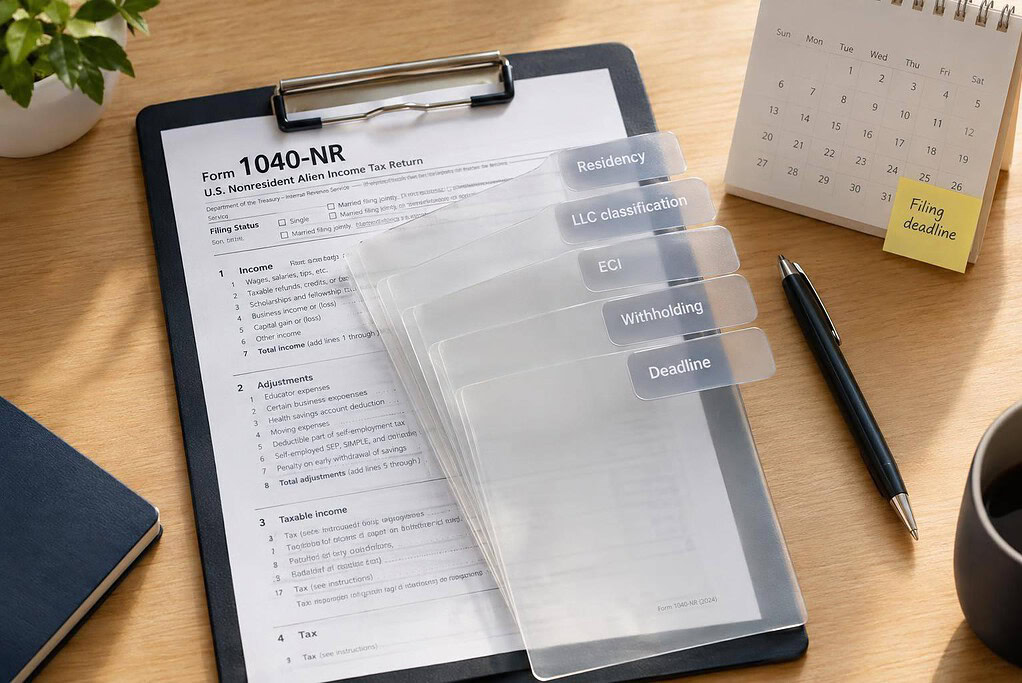
Owning a U.S. LLC does not automatically mean you need Form 1040-NR. I start with three checks: your U.S. tax residency, how your LLC is taxed, and where you work or earn income.
Here’s the short version:
- Your activity matters. A nonresident conducting a U.S. trade or business generally must file – even with a loss or no tax due. Serving U.S. customers entirely from abroad usually does not trigger filing by itself.
- Your LLC’s tax setup matters. A disregarded LLC, partnership, and C corporation each have different reporting rules. Forms 5472, 1065, or 1120 do not replace your personal return.
- Your deadline matters. Calendar-year Form 1040-NR returns are generally due April 15 if you have wages subject to U.S. withholding, or June 15 if you don’t. A filing extension does <u>not extend your payment deadline</u>.
I’ll walk through these checks so you can separate your personal filing duties from your LLC’s – and gather the records for each.
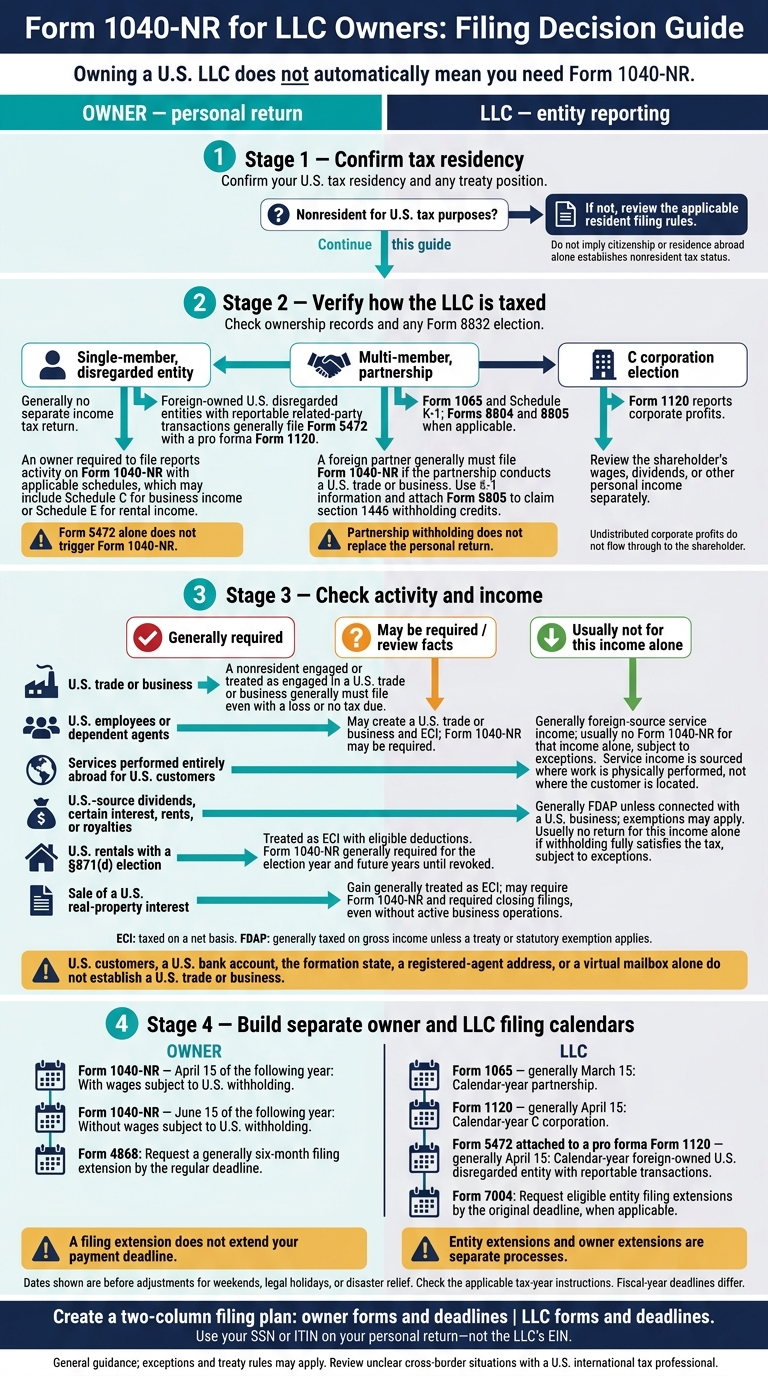
Form 1040-NR for LLC Owners: Filing Decision Guide
How LLC Tax Classification Affects Your Return
Once you’ve confirmed residency, the LLC’s tax classification determines where its income is reported: on your return, through a partnership, or at the corporate level. Check ownership records and any Form 8832 election before choosing a reporting path. Then check which income items require a personal return.
| LLC tax classification | LLC-level return or report | Owner-level filing | What triggers Form 1040-NR |
|---|---|---|---|
| Single-member, disregarded entity | Generally no separate income tax return; Form 5472 with a pro forma Form 1120 may apply | Form 1040-NR with applicable schedules | The owner’s U.S. trade or business, ECI, or another filing trigger |
| Multi-member, partnership | Form 1065 and Schedule K-1; Forms 8804 and 8805 when applicable | Form 1040-NR using K-1 information | The partnership conducts a U.S. trade or business, or the partner has other reportable U.S. income |
| C corporation election | Form 1120 | Form 1040-NR if personal income or activity requires filing | The shareholder’s wages, dividends, or other personal income – not undistributed corporate profits |
Single-Member LLCs: Disregarded Entities
If you’re a nonresident owner who must file, report the LLC’s activity on the applicable Form 1040-NR schedules. These may include Schedule C for business income or Schedule E for rental income.
Foreign-owned U.S. disregarded entities with reportable related-party transactions generally file Form 5472 with a pro forma Form 1120. Track contributions, distributions, loans, and owner-paid formation costs. Filing Form 5472 does not, by itself, require you to file Form 1040-NR.
Multi-Member LLCs: Partnership Taxation
If a partnership conducts a U.S. trade or business, its foreign partner generally does too – even while living abroad. Use Schedule K-1 to prepare Form 1040-NR, and attach Form 8805 to claim section 1446 withholding credits. Section 1446 withholding is a prepayment of tax, not a replacement for filing the return.
LLCs That Elect Corporate Taxation
An LLC that elects C corporation treatment reports its profits on Form 1120. Those profits stay at the corporate level rather than flowing through to the shareholder.
Your own U.S. income or activities may still require Form 1040-NR. Review wages, dividends, and other personal income separately from the corporation’s profits.
sbb-itb-ba0a4be
Which Activities and Income Require Filing?
Once you’ve determined residency and LLC classification, check which income items trigger a personal return.
The income’s source and its connection to a U.S. trade or business determine whether you need Form 1040-NR. Effectively connected income (ECI) is taxed on a net basis. Most U.S.-source fixed, determinable, annual, or periodic (FDAP) income is taxed on gross income unless a treaty or statutory exemption reduces or eliminates the tax. Foreign-source income generally falls outside U.S. federal income tax for nonresident aliens, though special rules apply.
The table below separates filing triggers from income that may be taxed only through withholding.
| Activity or income | Likely treatment | Filing result |
|---|---|---|
| Services performed in the United States | U.S.-source service income; generally ECI | Form 1040-NR generally required when the owner is engaged or treated as engaged in a U.S. trade or business |
| Services performed entirely abroad for U.S. customers | Generally foreign-source service income | Usually no Form 1040-NR for that income alone, subject to exceptions |
| Business through U.S. employees or dependent agents | May create a U.S. trade or business and ECI | Form 1040-NR may be required |
| U.S.-source dividends, certain interest, rents, or royalties | Generally FDAP unless connected with a U.S. business; exemptions may apply | Usually no return for this income alone if withholding fully satisfies the tax, subject to exceptions |
| U.S. rental income under a §871(d) election | Treated as ECI, allowing eligible deductions | Form 1040-NR generally required for the election year and future years until revoked |
| Sale of a U.S. real-property interest | Gain generally treated as ECI | May require Form 1040-NR and any required closing filings, even without active business operations |
Start with a common trigger: work performed in the United States.
U.S. Services, Employees, and Business Activity
Physically working in the United States is a key filing trigger. Check where the work took place, who performed it, and whether U.S. employees or agents were involved. Also review whether the business had an office, inventory, or recurring business activity.
Even with the same LLC classification, doing the work yourself in the United States rather than abroad can change your filing obligation. A nonresident engaged or treated as engaged in a U.S. trade or business generally must file even with a loss or no tax due.
U.S. customers, a U.S. bank account, the formation state, a registered-agent address, or a virtual mailbox alone do not establish a U.S. trade or business. Keep a work-location log, and review employee duties and agent agreements.
For passive or cross-border income, you also need to check the income’s source and whether withholding covers the tax.
Passive Income, Services Abroad, and U.S. Real Estate
For dividends, certain interest, rents, and royalties, compare Form 1042-S with the tax actually required. Treaty benefits depend on eligibility and documentation. Qualifying portfolio interest has a statutory exemption.
Service income is sourced where the services were physically performed – not where the customer is located. If you work in multiple countries, track U.S. workdays separately.
For U.S. rentals, compare tax on gross rent with a §871(d) election. This election allows qualifying income to be treated as ECI, with eligible expenses deducted. It generally requires a statement attached to Form 1040-NR and stays in effect until revoked, which can mean filing returns in future years.
Handle a U.S. property sale separately. Review the gain, basis, FIRPTA withholding, and closing records.
Personal and LLC Tax Filing Deadlines
Tax filing deadlines depend on who is filing and which form is required, not just who owns the LLC. Filing your personal return does not meet the LLC’s separate reporting duty.
The table below shows calendar-year deadlines before adjustments for weekends, holidays, or disaster relief.
| Taxpayer or entity | Form | Filing trigger | Regular calendar-year deadline | Extension form | Payment considerations |
|---|---|---|---|---|---|
| Nonresident individual with U.S.-withholding wages | Form 1040-NR | U.S. wages subject to withholding or another filing requirement | April 15 of the following year | Form 4868 | An extension gives you more time to file, not pay. Pay the estimated balance by the original deadline. |
| Nonresident individual without U.S.-withholding wages | Form 1040-NR | Effectively connected income, self-employment income, or another filing trigger without qualifying wages | June 15 of the following year | Form 4868 | Estimate and pay tax by the original deadline. |
| LLC taxed as a partnership | Form 1065 | LLC taxed as a partnership | Generally March 15 for a calendar-year partnership | Form 7004 | The partnership generally passes income through to members, who handle their own tax separately. |
| LLC taxed as a C corporation | Form 1120 | Corporate tax classification | Generally April 15 for a calendar-year corporation | Form 7004 | Corporate tax generally must be paid by the original deadline. |
| Foreign-owned U.S. disregarded entity | Form 5472 attached to a pro forma Form 1120 | Reportable transactions with a foreign owner or related foreign party | Generally April 15 for a calendar-year entity | Form 7004, when applicable | The entity’s filing does not replace the owner’s Form 1040-NR. |
Does April 15 or June 15 Apply?
Check the Form 1040-NR instructions for the tax year you’re filing. For calendar-year filers, April 15 generally applies if you have U.S.-withholding wages. June 15 applies if you do not.
Fiscal-year filers use the applicable fourth- or sixth-month deadline after their tax year ends. If a deadline falls on a Saturday, Sunday, or legal holiday, it generally moves to the next business day. Also check IRS disaster-relief notices for any postponed filing and payment dates.
Request a Filing Extension and Pay Tax
Submit Form 4868 by your regular deadline to request a generally six-month filing extension – not extra time to pay.
Estimate your tax, subtract withholding and estimated payments, and pay the balance by the original deadline. Keep proof of payment. Unpaid tax can lead to interest and late-payment penalties, and an extension does not remove estimated-tax obligations. Track filing-extension and payment deadlines for both your personal return and any related entity filing.
Track Forms 1065, 1120, and 5472 Separately
Submit Form 7004 by the entity’s original deadline to request an eligible business-return extension. Entity extensions and owner extensions are separate processes.
For foreign-owned U.S. disregarded entities, owner contributions, distributions, and loans are reportable transactions even if the entity has no sales. Attach Form 5472 to a pro forma Form 1120. That filing does not include the owner’s Form 1040-NR.
Conclusion: Confirm Your Filing Requirements
Now that you’ve reviewed the deadlines, confirm whether you need to file Form 1040-NR. LLC ownership alone does not determine your filing requirement. Your residency, LLC classification, activity, and income do. Review your personal and LLC reporting duties separately.
Follow the Filing Checklist
- Confirm your U.S. tax residency and any treaty position.
- Verify the LLC’s classification using its formation documents, any tax election, or a prior return.
- Identify where services are performed and whether there are U.S. employees, agents, offices, or inventory.
- Separate effectively connected income from other U.S.-source income.
- Check withholding against your filing requirement.
- Create a two-column filing plan: one column for owner forms and deadlines, the other for LLC forms and deadlines.
Gather Records and Review Cross-Border Filing Issues
Gather the records you need to check your residency, classification, and income: formation documents, tax elections, accounting and withholding records, relevant tax forms, owner contribution and loan records, and travel or work-location records. Use them to assess your personal return and LLC return separately.
Use your SSN or ITIN on your personal return – not the LLC’s EIN.
Work with a U.S. international tax professional if you have a foreign-owned disregarded entity, treaty claims, partnership withholding, related-party transactions, or unclear facts about a U.S. trade or business. Match allocations and withholding credits before filing.
FAQs
How do I determine my U.S. tax residency?
The IRS uses two tests to determine residency: the Green Card Test and the Substantial Presence Test. If you hold a U.S. green card, you’re a resident alien, regardless of how much time you spend in the country.
Without a green card, you must spend at least 31 days in the United States this year and reach 183 weighted days. That total counts all your U.S. days this year, one-third of last year’s, and one-sixth of the year before that.
If you meet neither test, you’re a nonresident alien.
Can a short U.S. business trip trigger Form 1040-NR filing?
A short U.S. business trip doesn’t automatically mean you must file Form 1040-NR. The filing requirement depends on whether your activities produce effectively connected income (ECI) through substantial, continuous, and regular U.S. business activities.
If your visit is brief and your activities don’t amount to a U.S. trade or business, your income may remain foreign-sourced and exempt from federal income tax.
What if I missed filing Form 1040-NR but owe no tax?
Owing $0 in federal tax doesn’t mean you can skip filing. Your filing requirements depend on your LLC’s tax classification and U.S. business activity. If your LLC generates effectively connected income, you must still file Form 1040-NR.
Foreign-owned single-member LLCs also must report transactions on Form 5472 with a pro forma Form 1120. Failing to do so can lead to penalties of $25,000 or more per form. Check which reporting requirements apply to your LLC.